Question Keywords for SEO are becoming the fastest path to “answer-first” visibility because they match how people actually search: as full questions. In AI-shaped SERPs, Google can resolve intent inside the results, so the pages that win are the ones that answer clearly, not the ones that just “rank.
Clear answers alone do not explain why some sources are repeatedly cited while others with similar coverage disappear. That is why understanding how domain authority matters for AI citations is important before assuming answer quality alone determines AI visibility.
A 2025 analysis cited in reporting found clickthrough rates can drop by up to 80% when Google’s AI Overviews appear, because the summary satisfies the query before users reach the traditional links. The Guardian
That’s why Question Keywords for SEO matter now: they help you earn the “extractable” parts of the SERP (snippets, PAA-style answers, AI summaries) where decisions get made early even when clicks don’t follow.
A Pew Research observation cited in the same reporting found users clicked links under AI summaries only once per 100 searches, reinforcing that visibility is shifting upstream from traffic.
- Question Keywords for SEO align with real user language, making content easier for search engines and AI systems to interpret and reuse.
- Search engines favor question-based queries because they signal clear intent, enabling direct answers, snippets, and AI summaries.
- Well-structured answers under question-focused headings improve extractability, increasing visibility in SERP features.
- Mining live SERP data, community discussions, and Search Console queries reveals high-impact questions traditional tools miss.
- Consistently answering user questions builds topical depth, which compounds visibility as search shifts from rankings to answers.
What Are Question Keywords in SEO and Why Do They Matter Now?
Question keywords are search queries framed as natural questions, usually starting with what, how, why, when, where, or which. They signal informational or problem-solving intent rather than transactional demand, making them critical for content designed to explain, guide, or clarify.
Did you know?
Examples include:
- What are question keywords in SEO?
- How do I optimize content for featured snippets?
- Why does Google show AI answers instead of links?
As search shifts toward AI-generated answers, question keywords increasingly act as inputs for answer generation rather than just ranking triggers. This behavior aligns closely with Generative Engine Optimization (GEO), where visibility depends on how well content satisfies intent, structure, and extractability so AI systems can confidently reuse it in summaries, snippets, and AI Overviews.
Why Do Search Engines Favor Question-Focused Keywords?
Search engines increasingly favor question-focused keywords because they reflect explicit user intent. When someone asks a question, they are signaling a clear information gap. This makes it easier for search systems and AI models in particular to match queries with precise explanations.
As AI-driven search grows, engines optimize for understanding why a question is asked, not just what terms appear, which is central to how AI understands user intent in modern search.
- Clear intent signals: Questions remove ambiguity by stating the problem directly.
- Answer-ready structure: AI systems can extract responses more reliably from question-aligned content.
- Semantic depth: Question phrasing helps models connect related concepts and entities.
- Snippet eligibility: Google frequently selects question-based content for featured snippets and AI summaries.
- Conversational search alignment: Voice and AI search rely heavily on natural, question-style language.
Because of this alignment, question focused keywords help search engines deliver faster, more confident answers making them a foundational strategy for both traditional SEO and AI-driven visibility.
How Does Answering User Questions Drive SEO Growth?
Answering user questions directly improves visibility in AI-generated results and traditional SERPs because AI platforms and search engines increasingly pull answers from well-structured, question-aligned content.
In 2025, zero-click search behavior continues to rise: roughly 60% of Google searches in the U.S. now end without a click because results satisfy intent directly on the SERP with summaries, featured snippets, or AI answers. This shift makes question-based content a strategic asset for capturing visibility, even when clicks are fewer (UpAndSocial, 2025).
Higher featured snippet eligibility: Questions trigger answer boxes that appear above organic listings, increasing prominence without clicks. OneDataSoftware
Better AI visibility: Pages targeting question phrases align with Search engine visibility metrics by matching conversational queries and intent structures.
Improved user satisfaction: Answer-first formatting directly satisfies search intent, reducing bounce and increasing time on site.
Voice and conversational search alignment: Question phrases mirror natural speech, making them ideal for voice assistants and AI bots. Semai
Answering questions is no longer a secondary SEO tactic; it directly links content structure to how search systems and generative models weigh relevance and utility.
What Are Featured Snippets and Why Questions Trigger Them?
Featured snippets are Google’s “position zero” results short, extracted answers that appear above traditional rankings. They exist to resolve a user’s question immediately, without requiring additional clicks.
When a query is framed as a question, Google can more easily match it to a concise, authoritative answer on a page, which is why question-based queries trigger snippets more often than generic keywords.
Why questions trigger featured snippets more often?
Direct intent mapping: Question keywords clearly signal what the user wants answered, reducing ambiguity for the algorithm.
Clear extraction paths: Pages that pair a question-style heading with a concise answer are easier for Google to pull into snippets.
Answer-first formatting: Short, factual responses fit Google’s goal of fast resolution.
Higher confidence signals: When the content mirrors the query structure, Google can surface it with lower risk of mismatch.
What Types of Featured Snippets Triggered by Question Keywords?
Question keywords trigger different featured snippet formats depending on how the answer is best structured and consumed. Google selects the format that resolves the question with the least interpretation effort.
– Used when the question expects a definition or explanation.
– Google extracts a short block (40–60 words) that answers what, why or how directly under a clear heading.
– Triggered by process-based or instructional questions.
– Numbered or bulleted steps help Google present sequential logic for queries like how to steps or ways to.
– Appear for comparison or data-driven questions.
– Structured rows and columns allow Google to summarize features, pricing, timelines, or differences with minimal ambiguity.
Each format rewards clarity, structure, and intent alignment, not keyword density making question-based formatting a prerequisite for snippet eligibility.
How to Discover Question Keywords?
Finding high-impact Question Keywords for SEO is no longer just about brainstorming “what” and “how” queries. Teams often ask, what are the best question keywords for SEO? and the answer depends on how users actually phrase questions across search, AI summaries, and community discussions. Modern discovery requires visibility into real conversational patterns, not assumptions.
This is where Wellows fit naturally by centralizing real user queries, AI-generated question patterns, and intent signals into one system, instead of relying on fragmented tools or manual scraping.
How Wellows Helps Teams Discover High-Value Question Keywords?
As search shifts toward answers and AI summaries, discovering the right questions matters more than targeting broad keywords alone.
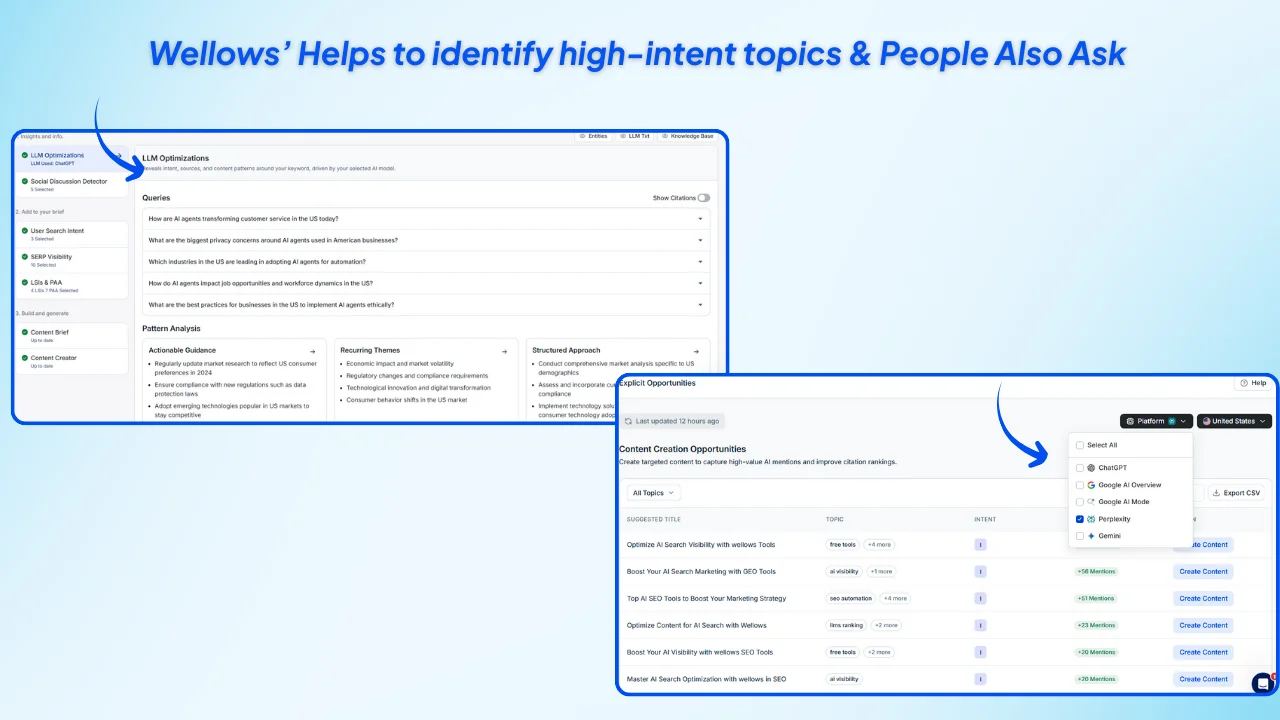
Question-based prompts are also exactly what users type into ChatGPT, Perplexity, and Gemini — and the brands that surface in those answers tend to have structured their content around the same questions their audience is asking. For client-facing teams, this creates a dual reporting opportunity: AI visibility reporting for agencies in Wellows connects question-level prompt tracking to citation outcomes, so agencies can show clients not just which questions they rank for in Google, but which ones they’re being cited for in AI-generated answers.
Building on this, teams that want to go deeper can align question discovery with finding the right GEO queries, ensuring their content targets not just what users ask but what AI systems actively reuse when generating answers.
How Can You Use Google’s “People Also Ask” to Find Question Keywords?
Google’s People Also Ask boxes surface real-time question keywords for blog SEO, reflecting how users frame follow-up questions after an initial search. These questions reveal what Google already considers answer-worthy, making them one of the fastest ways to identify question keywords aligned with live SERP demand.
Because PAA questions expand dynamically based on user behavior, they also expose pattern recognition in AI-generated answers showing which question formats and topics are repeatedly reinforced across searches. Mining these patterns helps teams move beyond isolated keywords and build content around questions AI systems are already learning to reuse.
How Can You Use AnswerThePublic and Community Data to Find Niche Question Keywords?
Community-driven platforms surface niche question keywords for SEO that traditional tools miss because they reflect how real people describe problems, not how marketers label topics. These questions often carry stronger intent and clearer context, which makes them easier for search engines and AI systems to interpret.
Because generative engines learn from human conversations, they repeatedly reuse crowd-sourced phrasing. This is why understanding why generative engines love Reddit matters forums expose pain-point language that AI models trust and summarize at scale.
Key ways this data improves question keyword discovery:
- Captures raw, conversational phrasing users actually type
- Reveals unmet questions before they show search volume
- Highlights emotional and pain-driven language patterns
- Surfaces niche variations ignored by keyword tools
- Improves alignment with AI-generated answers and summaries
How Can You Analyze Google Search Console to Uncover High-Intent Question Queries?
Google Search Console already contains valuable SEO inquiry keywords, but most teams never extract them in a structured way leaving question-based opportunities hidden inside raw query data.
- Filter queries starting with who, what, how, why, when
- Identify impressions without clicks (early intent signals)
- Spot questions ranking outside top 10 (snippet potential)
- Find repeated phrasing across similar queries
- Flag questions triggering AI summaries but no traffic
To go a step further, the best AI visibility tools can help you track which prompts and question formats are earning citations inside AI answers over time.
Wellows adds structure where GSC falls short by clustering raw question queries, turning them into content briefs, and prioritizing snippet-ready opportunities. Paired with insights from Can GSC data guide your GEO strategy? this helps teams convert overlooked questions into measurable SEO and AI visibility gains.
How Can You Implement Question Keywords Across Your Content?
To use question keywords for SEO effectively, teams need to map questions to content formats that match intent. Blogs work best for explanatory “how” and “why” queries, landing pages suit comparison and decision-stage questions, and FAQs help capture long-tail, conversational searches that trigger snippets and AI answers. Building on this, here’s how to use question keywords in SEO
effectively:
Blogs: Use one primary question as the H1, with related follow-up questions as H2s to mirror natural query flow.
Landing pages: Add short Q&A sections that answer high-intent “how” and “which” questions tied to conversion.
FAQs: Group related questions together to create dense, reusable answer blocks that AI models can easily reference.
The key is consistency. Structuring questions into outlines and workflows often through designing content briefs for GEO helps ensure each question is answered clearly, placed under the right heading, and reused across blogs, landing pages, and FAQs without duplication or dilution.
How Should You Structure Content to Win Question-Based SERP Features?
For question keywords for blog SEO, structure matters more than creativity. Search engines and AI systems favor pages where each question appears as a clear header, followed by a direct, extractable answer that can be reused in snippets or summaries.
If you’re scaling this across dozens of pages, AI SEO tools can help generate question-led outlines, tighten answer blocks to match SERP formats, and spot sections that are too long to be extracted cleanly.
Using consistent headers, concise responses, and machine-readable formatting often reinforced through structured data for LLM visibility makes your content easier to parse, quote, and surface across SERP features without relying on rankings alone.
- Optimize Conversational AI Search Queries: How to Optimize Conversational AI Search Queries for Better Visibility?
- AI Search Marketing Semantic Intent: How AI Search Marketing Strategies Target Semantic Search Intent (2026)
FAQs
FAQ pages work best for breadth and quick extraction, while individual question posts perform better for depth and authority. High-impact SEO strategies often combine both to capture snippets and long-tail visibility.
Overstuffing questions, giving vague answers, or mixing multiple intents in one section weakens extractability. Clear intent alignment and direct answers drive stronger SEO outcomes.
Yes AI systems rely on question-answer patterns to generate summaries, making question keywords foundational for visibility beyond clicks.
Focus on real user questions from People Also Ask, community discussions, and AI query fan-out patterns that mirror how Gemini expands and reformulates intent-driven searches.
They are strongest for awareness and consideration, shaping decisions early before users move to transactional searches.
Final Thoughts: Questions Are the New Keywords
Question Keywords for SEO work because they align directly with how users ask, how AI interprets intent, and how search engines surface answers across snippets, PAA, and AI summaries.
Brands that structure content around clear questions and extractable answers don’t just rank better they stay visible as search shifts from links to answers.