TL;DR
1
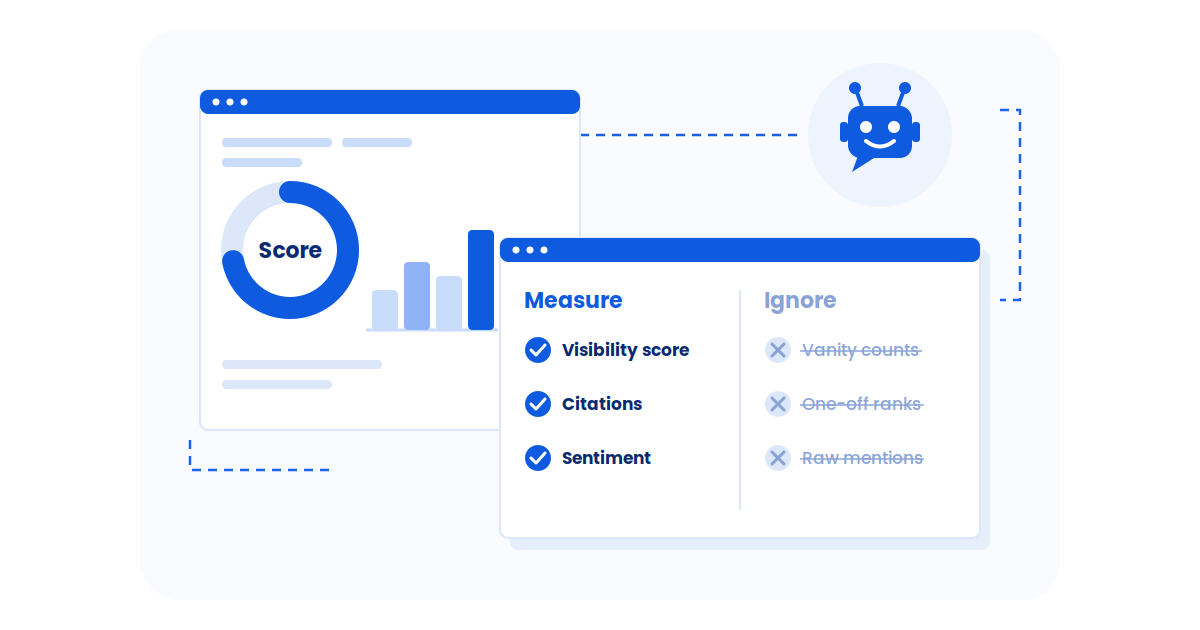
What it is: How frequently, where, and favorably your brand name shows up in responses from ChatGPT, Gemini, Perplexity, Google AI Overviews, and Google AI Mode.
2
Citations beat mentions: A citation provides authority and traffic. A mention doesn’t. They should be tracked separately.
3
Smaller sites win: 77% of sources in a Wellows analysis of 2.37 million AI citations had a domain authority under 50.
4
The check: 30 to 50 buyer prompts, five engines, rerun once a week.
5
Your shadow reputation: The URLs that impact the ways AI describes your company prior to you actually writing down any of your advertising material.
AI visibility is how often your brand appears in answers from AI engines like ChatGPT, Gemini, Perplexity, Google AI Overviews, and Google AI Mode, whether those answers cite your pages as sources, and how they describe you. Think of it as your share of the answer, measured prompt by prompt.
This AI visibility guide covers the definition, the metrics reported, a check you can run this week, and an action plan for the next 90 days. It is for the SEO lead familiar with search and what to do about it, but who now has to think about what changes when the results page is a paragraph generated by a model.
What Is AI Visibility? (Explained in Simple Terms)
In simple terms, AI visibility tells you whether AI engines know you, trust you, and recommend you. Ask ChatGPT for the best payroll software for a 20-person company, and you’re either in that answer, or you’re not. AI visibility tracks that across hundreds of prompts and five engines.
Definition
AI visibility
The measurable presence of a brand in AI-generated answers: how often it is mentioned, how often its pages are cited as sources, where it appears, and how it is described. Also called AI search visibility, AI brand visibility, or LLM visibility.
Mentions vs. Citations
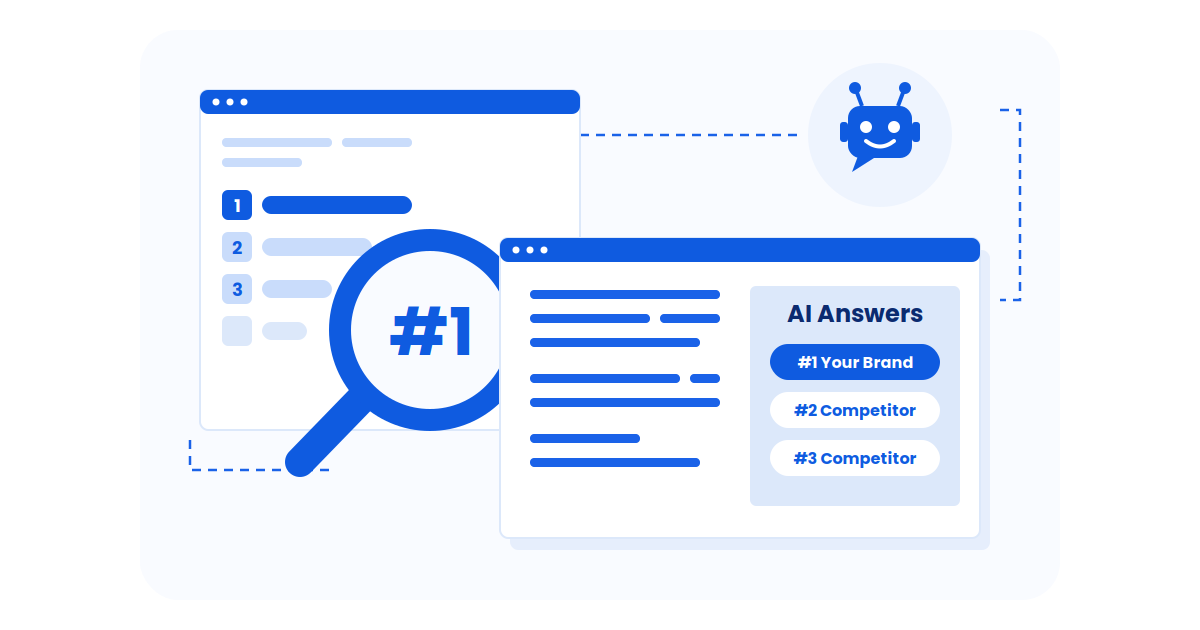
A mention means the model said your name. A citation means it pointed to your page as the source behind the answer, usually with a link.
The citation in the answer acts as the engine supporting your content, so this means that the answer can result in a person landing on your site. A mention without citation is good for branding but hard to justify during the budget meeting.
Mention
The model says your name
Awareness. No link, no traffic, and hard to tie to pipeline.
Citation
The model points to your page as a source
The engine vouches for your content and the reader can click through to your site.
?
Did you know?
In a Wellows analysis of 20.5 million AI citations, 90.4% of the pages cited did not mention any brands. The page that received the citation and the brand that got a mention do not always match up.
Your shadow reputation
Every brand has a shadow reputation – the level of you that AI systems create. It is not something you have personally scribbled, and sources can refer to years-old forum threads or pages of a competitor.
The job is to find the exact URLs feeding it and reshape it at the source.
What Is the Difference Between AI Visibility and SEO?
SEO determines how well your webpages are ranked in a list of hyperlinks. AI visibility determines if an AI is showing you in its response and which source it considers to be credible. The two of them have similar criteria for measuring but different formats in reporting.
| Dimension |
Traditional SEO |
AI visibility |
| Unit of success |
A ranking position |
A mention or citation inside an answer |
| What you track |
Keywords |
Longer prompts with context like budget or team size |
| Influence comes from |
Your site and backlinks |
Your site plus reviews, forums, press and directories |
| Stability |
Fairly steady |
Answers vary between runs, so you report trends |
| Core report |
Rankings, clicks, impressions |
Mention rate, citation rate, share of voice, sentiment |
Good SEO is still the entry ticket. Google says its usual SEO best practices apply to AI Overviews and AI Mode. More on that in our SEO vs. GEO breakdown.
Why Does AI Search Visibility Matter in 2026?
The reason for this is that the answer is turning into the end goal. Since the summary resolves the query, fewer people click as the brand featured in that summary gets the attention that previously spread across the entire search results page.
Key stat
8% vs. 15%
Google users who interacted with a summary created by an AI assistant clicked on a normal result on 8% of their inquiries while clicking on 15% of their queries when a summary was absent.
No AI summary on the page15%
B2B buyers now build shortlists by asking an assistant. Miss that first answer and you may never reach the comparison spreadsheet.
How Do the Five AI Platforms Pick Their Sources?
Each engine goes through and pulls up a bunch of pages that are relevant. It decides which ones are trustworthy and uses a few of them. The threshold is different, so it can appear to have a good score in Perplexity but be almost unsearchable on Google’s AI mode.
| Platform |
Where sources come from |
Median cited DA |
What it means for you |
| ChatGPT |
Live web results when a prompt needs them |
51
July 2026, up from 35
|
The bar jumped. Coverage on established sites counts for more |
| Perplexity |
Live search on nearly every query |
39
July 2026, up from 34
|
Most open to small, specific pages |
| Gemini |
Google’s index and knowledge systems |
39
|
Consistent brand facts help it understand you |
| Google AI Overviews |
Google’s index, shown above results |
47
|
Pages that already rank start ahead |
| Google AI Mode |
Several related searches behind one question |
48
|
Highest bar. Cover the subtopics a question branches into |
Median domain authority of cited pages. Source: Wellows study of 20.5 million AI citations, 2026
Also worth knowing: across 485,000 citation instances, Wellows found ChatGPT cited branded domains 11.1 points more than Google.
What Impacts AI Visibility Most?
Five factors keep showing up:
01
Access
If AI crawlers can’t reach a page, it can’t be cited. Check robots.txt and your CDN’s bot settings first.
02
Answer shaped pages
State the answer in the opening lines, then back it with specifics.
03
Third-party presence
Reviews, comparisons, and forums often feed answers more than brand sites do.
04
Topic depth
Wellows found a brand’s AI visibility can vary by more than 4.5x across topics in its own niche.
05
Freshness
Only 44.3% of lower authority citations survived two months in the Wellows study, against 92.0% for DA 90 and above.
How to Run an AI Visibility Check (Step by Step)
An AI visibility check is when you ask engines what your buyers ask, record who appears and what pages are cited, and repeat. A quick one can take a few hours. A proper one needs to be tracked.
How to
Run your AI visibility check in 6 steps
1
Build a prompt set
Write 30 to 50 problem, “best X for Y”, comparison and brand prompts, using wording from sales calls and Search Console. Our guide to
finding queries for GEO helps.
2
Run every prompt on all five engines
Use a clean session set to your market.
3
Log four things per answer
Mentioned? Cited? Position? Tone?
4
Record every cited URL
Include competitor and third-party pages. That list is your target map.
5
Set a baseline
Track mention rate, citation rate, and share of voice against three competitors, split by engine and topic.
6
Rerun weekly
One run is noise. Four to six weeks of trend is what you report.
For a deeper pass, use our AI search visibility audit checklist.
Which AI Visibility Metrics Should You Track?
Start with mention rate, citation rate, share of voice, position, and sentiment. Together, they show whether you appear, whether you’re trusted, and what the model says about you.
| Metric |
How to calculate it |
Why it matters |
| Mention rate |
Answers naming you divided by total answers |
Awareness inside AI answers |
| Citation rate |
Answers citing your domain divided by total answers |
Tied to authority and referral clicks |
| Share of voice |
Your mentions divided by all brand mentions |
Shows if you’re gaining or losing ground |
| Position |
Average order in which brands are named |
The first brand named frames the answer |
| Sentiment |
Tone per answer, tied to the source URL |
Exposes your shadow reputation |
| Momentum |
Change over 30 days |
Shows if the work is paying off |
More on each in our guide to AI visibility metrics.
What is a good AI brand visibility score?
There’s no universal benchmark yet, and anyone quoting one should show their prompt set. A fairer test: are you named as often as your closest competitor on the topics that drive revenue?
The 90 Day AI Visibility Sprint
A 90-day sprint is a fixed cycle of baseline, fixes, and measurement, long enough for engines to pick up your changes.
Weeks 1 to 2
Baseline
Prompt set, first runs, source map, crawler check
Output: Baseline report
Weeks 3 to 5
Fix your pages
Rewrite pages that should be cited: answer first intros, current facts, schema
Output: 10 to 20 refreshed pages
Weeks 6 to 10
Earn sources
Pitch sites engines already cite and correct wrong information at the source
Output: Outreach tracker
Weeks 11 to 13
Measure
Rerun prompts, compare with baseline, pick next topics
Output: Before and after report
AI Visibility Checklist
Copy this into your workflow
Work through it once, then revisit every quarter.
Access
robots.txt allows the search crawlers used by ChatGPT, Perplexity and Google
No CDN or firewall rule blocks AI bots by default
Content
Each priority page answers its main question in the first two sentences
Prices, features and facts are current and dated
Organization and Product schema are in place
Sources
A list of third party URLs cited for your top prompts
Accurate brand details on the review sites and directories in that list
Negative or outdated sources flagged for correction
Measurement
A fixed set of 30 to 50 prompts, grouped by topic and funnel stage
Weekly runs across all five engines
Mentions, citations, share of voice and sentiment reported separately
How Wellows Tracks and Improves Your AI Visibility
Wellows is an AI visibility platform built around the workflow above. It runs your prompts daily across all five engines and shows where you appear, where you don’t and why.
Wellows
Citations, isolated from mentions
Many trackers only go up to “were you named?” Wellows shows whether the AI actually pointed to your page, including indirect citations of your domain without naming you.
Your shadow reputation, by URL
Sourced Sentiment reads how cited pages describe you, so you can see which URLs pull negative answers and fix them at the source.
Competitors in the same view
Citation share and position against rivals, by engine and over time, so you spot where they’re gaining and where they’re exposed.
Action attached
Daily Quick Wins, verified contacts and outreach templates for cited URLs, and KIVA, a writing assistant built on your Search Console data.
See where you stand, act on it, and prove the result in one place with the Wellows AI visibility platform.
Conclusion
Start with the check. Run 30 real buyer searches across all five engines this week and note which sites are being cited. That will tell you which pages need improvement, which sites to target, and give you a baseline to beat in 90 days.
When your spreadsheet grows too large for you to manage, Wellows will run the check every day and report on the gaps that are most important to close.
Pick 20 to 30 prompts your buyers ask and run each in ChatGPT, Gemini, Perplexity, and Google (AI Overviews and AI Mode). Log whether you’re mentioned, whether your site is cited, and how you’re described. Repeat weekly. It’s slow, but it gives you a baseline.
AI visibility is the outcome you measure: how often and how well you appear in AI answers. Generative engine optimization (GEO) and answer engine optimization (AEO) are the practices that improve it, like restructuring pages and earning third-party coverage.
It means running a fixed prompt set through large language model products on a schedule and recording mentions, citations, position, and sentiment each time. Because answers change between runs, weeks of tracking give you a trend you can trust.
Engines that search live, like Perplexity and Google’s AI features, can reflect page changes within weeks. Anything tied to model training moves much slower, so plan in 90-day cycles.
Less than most people assume. In large-scale industry studies, sites with low-to-moderate domain authority earned nearly half of all citations, although models like ChatGPT occasionally raise quality thresholds for live searches.
No. Industry research shows that over three-quarters of cited sources have moderate domain authority. Smaller brands win by answering narrow questions well and showing up on the third-party sites engines already trust.