A long-time client almost left an insurance agency last quarter, not over price or service, but because they asked ChatGPT for a recommendation and a competitor’s name came back instead.
The agency’s decades of local trust counted for nothing, because none of it lived in the sources AI reads. That gap is what AI visibility solutions for insurance marketing agencies exists to close: tracking, growing, and proving how often a client gets cited and recommended inside answer engines like ChatGPT, Gemini, and Perplexity.
The scale of the problem is specific, and we measured it. At Wellows we analyzed 1,960 insurance prompts that produced 34,238 citations across 3,831 domains, and the headline finding is bleak for the industry. Insurer-owned domains capture only 4.6% of those citations. When AI answers an insurance question, the carriers and agencies are almost absent from the sources it pulls.
Buyers have already moved. Roughly 68% of insurance shoppers now ask AI assistants about coverage before they ever contact an agent, and ChatGPT, Perplexity, and Google AI Overviews answer them by naming comparison sites and direct carriers, not the independent agent down the road.
That is the opening. The carriers have ceded their own category, and the data shows independent agents with sharp local authority can win the citations the big brands are missing.
- Answer Engine Optimization (AEO). Restructure the client’s pages with schema markup, direct FAQ answers, and tight summaries so LLMs can lift and cite them cleanly. In insurance this means InsuranceAgency and FAQPage schema plus 40-to-60-word answer blocks.
- Off-site entity authority. Digital PR, consumer reviews, and industry citations carry more weight in AI recommendations than the agency’s own site, which is why insurers hold just 4.6% of citations while third parties hold the rest.
- AI citation tracking. Measure how often, and in what context, the agency appears inside AI-generated answers rather than traditional SERPs. This is the baseline number every later report points back to.
- Conversational lead capture. Prospects arriving from an AI recommendation are mid-funnel and pre-trusted, so intake needs to qualify them fast, whether through a chatbot, a short quote form, or a tracked phone line.
What AI Visibility Solutions Means for an Insurance Marketing Agency
AI visibility solutions (insurance)
AI visibility is how often, and how reliably, an insurance agency appears inside AI-generated answers when a prospect asks a question like “best home insurance agent in Tampa” or “does insurance cover water damage.” The measurable unit is the citation, the source an engine pulled to build its answer. Rankings still feed the system, but the scoreboard is inclusion in the recommendation, not position on a results page.
The shift hits insurance hard because prospects research coverage inside the model, and the agent only hears about it later, if at all. A shortlist forms before a single call is made, and an agency absent from the answer never enters consideration.
It also carries a compliance weight no generic vertical has. Insurance advertising is state-regulated, so when AI surfaces an inaccurate coverage or pricing claim, that is a regulatory exposure, not just a bad look. AI can confidently misquote an agency’s offerings or misrepresent a carrier’s policy, which makes accuracy a safety deliverable.
Here is the reframe that makes it click. AI reads an agency as an entity, not a page. Before it cites anyone, it works out what the agency does, who it serves, which carriers it represents, and whether trusted sources corroborate all of that. That is why this sits closer to LLM SEO.
Why Are Insurance Brands Nearly Invisible in Their Own Category?
Because AI builds insurance answers from third-party sources, and the insurers were never in them. The insurance prompts we studied produced 34,238 citations, and the source mix turns the usual hierarchy upside down.
Share of insurance citations going to insurer-owned domains
When AI answers insurance questions, the carriers and agencies whose policies are being discussed are almost absent from the sources. The category’s own brands have ceded the answer layer, which is exactly the gap a sharp independent agency can move into.
Source: Wellows citation dataset, Q1 2026Community and user-generated content share, out-citing insurers and comparison sites
Community content out-cites both insurers (4.6%) and comparison sites (3.5%), and Reddit alone is the #1 cited domain at 3.5%. AI trusts corroborated, third-party discussion over polished brand copy, which is why offline reputation has to become online citation.
Source: Wellows citation dataset, Q1 2026There is a second twist. For coverage questions, AI cites condition and product authorities, not insurers. The site sleepfoundation.org is the #2 domain overall at 2.9%, because for “does insurance cover X” queries the model reaches for health and product experts. Intent skews informational at 46%, commercial at 27%, with about 9% explicit coverage questions.
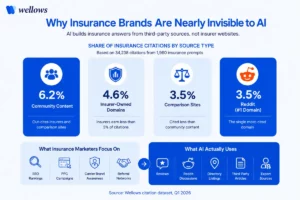
The pattern underneath it all: insurance brands have handed the AI answer layer to Reddit threads and third-party health sites. The visibility gap is quantifiable, and that is good news, because a gap this wide is easier to win than a crowded one.
How Do You Choose an Agency That Helps Insurers Win Visibility in AI Tools?
Look for an agency that can show you a baseline citation number on day one, name the engines it tracks separately, and prove results against quote starts rather than rankings. Plenty of firms now sell “AI SEO,” and the difference between a real GEO partner and a rebadged content shop comes down to five checks:
- They measure citations, not mentions. Ask whether they track when AI actually links to and credits your brand as a source, since a name-drop with no citation sends you no traffic and no trust.
- They read each engine separately. ChatGPT, Gemini, Perplexity, and Google AI Overviews trust different sources, so one blended “AI score” hides where you’re actually losing.
- They understand insurance compliance. Content workflows should include licensed review and a retrievable archive, because a coverage claim that crosses into advice is a regulatory problem before it is a marketing one.
- They benchmark named competitors. “Your visibility improved” means nothing; “you now out-cite [competitor] on commercial prompts in your state” is a report a CEO can act on.
- They run on real tooling. Whether it’s an agency running the work for you or your own team, the tracking layer underneath should scan citations daily across engines. Wellows handles that tracking daily.
7 Problems Insurance Marketing Agencies Face With AI Visibility
These are the failure modes we see most when an agency stands up an AI visibility service for an insurance client, each with the fix. None are exotic. The skill is doing them in order and proving each one.
✕ Problem 1: You can't put a number on where the agency stands in AI
Most agencies can describe AI search but can’t score it. With no baseline citation number per client, every later report is just opinion.
✓ The fix
Set a day-one baseline with an AI Visibility Score and watch it across engines, so month three has something believable to measure against.
✕ Problem 2: You rank fine in Google but ChatGPT still doesn't mention you
A recurring complaint among insurance marketers is that strong traditional rankings simply don’t carry into AI, while competitors get all the AI attention (Source). Google rank and AI visibility are two different scoreboards.
✓ The fix
Stop assuming SEO carries over. Build the third-party validation AI actually reads, then track each engine separately with platform-specific tactics, because a fix for Gemini is not a fix for Perplexity.
✕ Problem 3: The client's offline trust is invisible to AI
An agency can have decades of referrals and loyal clients, and none of it exists for AI unless it lives in reviews, directories, or articles (Source). New prospects only see who AI names.
✓ The fix
Convert offline wins into machine-readable signals. Systematically gather Google Business Profile reviews that name the line of business and the city, then add a few niche-directory and local-news placements so the trust becomes citable.
✕ Problem 4: You're competing head-on with carriers and national comparison sites
Try to outrank Progressive or The Zebra for “best car insurance” and you lose. They own the broad terms, and AI already cites them.
✓ The fix
Go narrow. Independent agents with strong entity clarity, authored content, schema, and review depth are getting cited while generic carrier content is not. Own a niche and a geography the nationals can’t speak to.
✕ Problem 5: Your coverage content crosses into licensed advice
Insurance is a YMYL category, so vague or overreaching coverage claims both fail to get cited and create compliance risk. AI also frequently produces misleading insurance-versus-investment comparisons that violate advertising standards.
✓ The fix
Publish educational, answer-first content authored under a licensed agent with credentials in the byline, and keep every claim factual and disclosed rather than advisory. This earns citations and stays compliant at the same time.
✕ Problem 6: You publish AI-assisted content with no review or archive
Posting AI-generated insurance copy without human review is the single largest compliance risk, and many states and carriers require advertising to be archived in a retrievable format.
✓ The fix
Keep a dated, retrievable archive of every AI-assisted page with the licensed reviewer and carrier-approval status logged. The same record that satisfies state advertising rules doubles as your proof-of-work file when a carrier or regulator asks.
✕ Problem 7: You report raw mentions with no baseline
“We got 12 mentions this month” means nothing without a starting point and a named competitor. The client can’t tell progress from noise, and you can’t either.
✓ The fix
Report citation share against specific competitors over time, and show a before-and-after on the same prompt set so the report tells a story, not a number.
What Content Earns LLM Citations in Insurance Without Crossing Into Licensed Advice?
Educational content that answers a real coverage question factually, authored by a licensed agent, and structured so AI can lift it. The line to hold is simple: explain how coverage works, never tell a specific person what to buy. These are the content types that earn citations while staying inside that line:
- Geo-specific coverage explainers. Pages like “what flood-zone requirements apply in [neighborhood]” or “minimum auto coverage in [state]” win because national sites can’t match the local specificity, and AI rewards it. Example: a Tampa agency page titled “Flood insurance requirements in Hillsborough County FEMA zones” gets cited for local flood prompts that Progressive’s national page can’t answer.
- Answer-first FAQ pages with disclosures. Lead each section with a direct 40-to-60-word answer to a real question, then add the standard disclosures. This is the format AI lifts most reliably. Example: a question header “Does homeowners insurance cover a roof leak?” followed by a tight factual answer, then a line noting coverage varies by policy and state.
- Authored content with credentials. Insurance is YMYL, so every article should carry a real licensed agent’s byline with CPCU, CIC, or state-license designations, the E-E-A-T signal that earns trust. Example: “Reviewed by Maria Chen, CPCU, licensed P&C agent in Arizona (License #1234567)” at the top of every coverage guide.
- Original, anonymized case data. Real claim timelines and coverage outcomes, stripped of PII. Original data is the highest-leverage content type across every engine. Example: “Average water-damage claim payout across 200 of our clients in 2025, by cause,” presented as a simple table with no client names.
- Clean schema and consistent NAP. InsuranceAgency, LocalBusiness, FAQPage, and Person schema, with name, address, and phone identical everywhere, because if AI finds three different addresses it reads low confidence and skips you. Example: the agency’s phone number reads “(602) 555-0148” the exact same way on the site, the Google Business Profile, Yelp, and the BBB listing, with no “ext.” on one and a different format on another.
1. Coverage content, the compliant way
❌ Bad: A blog post titled “Why whole life insurance beats your 401(k),” promising risk-free growth. It crosses into investment advice, breaches advertising standards, and AI won’t trust it.✅ Better: “How whole life and term life differ: coverage, cost, and who each suits,” authored by a licensed agent, factual, with disclosures. It answers the question, earns the citation, and stays compliant.
The bad example fails twice, on compliance and on citations, because models are risk-averse on regulated topics and skip sources they can’t safely stand behind. The good example is exactly what AI lifts.
Why Isn’t Your Insurance Client Showing Up for “Best Auto/Home/Life Insurance”? (And Why Competitors Are)
Because for broad category terms, AI defaults to national comparison sites and carriers, and your client hasn’t given it a reason to cite a local expert instead. The fix is not to fight on the broad term. It is to own the specific, local, credentialed version of it.
A documented turnaround shows the path. An independent commercial-insurance agency in Phoenix had strong referral business but zero visibility in ChatGPT or Perplexity. When prospects asked for a “commercial insurance broker Phoenix,” AI named only national comparison sites and direct carriers.
The agency built Arizona-specific commercial coverage guides, FAQ content for restaurant, contractor, and professional-liability niches, implemented InsuranceAgency and LocalBusiness schema, and added agent credentials with CPCU and CIC designations.
Within 90 days, the agency appeared in AI answers for 10 of 14 target queries, and quote requests that began with “I asked ChatGPT” became a regular occurrence (Source).
The mechanism is worth naming. There is a reason competitors appear and your client doesn’t, and it is rarely the broad term itself.
- They have stronger third-party signals. Reviews, directories, and forum mentions AI can verify.
- Their entity is easier to trust. Consistent NAP, schema, and carrier associations reinforce confidence.
- They answer the exact query. Geo-specific, niche pages outperform generic insurance content.
- Their reviews meet AI’s trust threshold. Low-rated locations with weak engagement are often excluded entirely.
The fix list follows directly: earn the reviews, clean the entity, and publish the specific geo-niche pages, exactly the Phoenix playbook.
How to Improve Local Visibility for Insurance Agents and Brokers?
Local visibility for an insurance agent now means two scoreboards at once: the Google Maps pack, and the local recommendation an AI engine gives when someone asks for an agent nearby. The same signals feed both, so the work compounds.
For insurance services, local visibility is built from a small number of signals repeated consistently: an accurate Google Business Profile, matching name-address-phone details across directories, reviews that mention both the product line and location, location pages for the markets you actually serve, and schema that clearly defines the business as an insurance agency serving named geographies.
Here is the order that works:
- Fix the Google Business Profile first. Gemini grounds local answers directly in Google Maps data, so category, service areas, hours, and photos are AI inputs now, not just map cosmetics.
- Make the NAP identical everywhere. One phone format, one address string, across the site, GBP, Yelp, and BBB. Three versions of an address reads as low confidence, and AI skips low-confidence entities.
- Stack reviews that name the product and the place. “Great contractor liability coverage in Mesa” teaches AI exactly which prompts you belong in. Generic five-star reviews teach it nothing.
- Publish pages for the city, not just the state. County-level and neighborhood-level coverage pages win local prompts national carriers cannot answer.
- Cover claims service visibility too. Prospects ask AI how fast an agency handles claims, so a page documenting your claims process, escalation path, and response timelines can earn citations for the trust-stage prompts that close deals.
This applies whether you are an independent broker, a captive agent, an MGA, a carrier with local distribution, or an AI-powered IMO supporting downline agents: the entity AI can verify locally is the one it is most likely to recommend locally.
Can a Home-Based or Service-Area Insurance Agency Still Compete?
Yes, and in some ways a focused local agency has the edge, but a home-based setup needs to work around two real limits.
The first limit is the Google Business Profile. If an agency works from home with no storefront, it usually runs a service-area profile, and those are weaker than an address-based listing. This matters more than it used to, because Gemini’s local accuracy is grounded directly in Google Maps data.
The second limit is a geography mismatch. A common frustration: an agent based in one region wants commercial business in another, but Google Business Profile and local SEO naturally pull them toward their home address, the place Google can actually verify.
- Set up the service-area GBP properly. You can run a profile without a storefront. Define the service areas precisely and keep the NAP identical everywhere, because consistency is the trust signal AI weighs most.
- Win on niche, not radius. Pick a line of business the nationals ignore, like contractor liability or coastal-home coverage, and become the clearest answer for it.
- Publish geo-specific pages for the markets you actually want. If you want business in a city you don’t live in, the content has to name and serve that city, since the GBP alone won’t pull you there.
- Stack reviews that name the place and the product. A review that says “great contractor insurance in [city]” teaches AI exactly when to cite you.
The takeaway in one line: a home-based agency cannot out-muscle a national carrier on map presence, but it can out-specialize one on the exact niche-and-place questions where AI is hunting for a confident local answer.
Which Prompts Should You Track for an Insurance Client?
Track the questions a real prospect asks before they call, then stop. Insurance prompts are not generic. They cluster into five patterns we see in actual buyer behavior, including the coverage questions people increasingly run through ChatGPT before shopping.
-
- Coverage-question prompts: “Does home insurance cover water damage,” “is flood covered under my policy.” These are the ~9% explicit-coverage queries where AI currently cites health and product sites instead of insurers, a wide-open gap.
- Local-agent prompts: “Best independent insurance agent in [city],” “commercial insurance broker near me.” This is where a credentialed local agency can beat the nationals on specificity.
- Product-comparison prompts: “Best home insurance for older houses,” “cheapest commercial auto for contractors.” High intent, and the format comparison sites currently own.
- Situation and eligibility prompts:“Insurance for a home-based bakery,” “coverage for a high-risk driver.” Specific buyer situations a niche agency can answer better than a carrier.
- Commercial and specialty prompts: “E&O insurance for agencies,” “cyber insurance for financial firms,” “best commercial broker for a contractor,” or “small-business bundle coverage in [city].” These are high-intent queries where a specialist agency can outrank general carriers and where ChatGPT visibility for commercial insurance is often easiest to win.
- Reputation prompts: “Is [agency] legit,” “[agency] reviews.” These protect the brand and surface review or sentiment gaps before they cost a referral.
One rule covers all five. AI answers shift between runs, so a single check proves nothing. Run each prompt repeatedly and report the rate it appears. A tool with prompt tracking handles the schedule and stores the history.
Which AI Engine Trusts Which Insurance Source?
The engines do not agree on who to cite, and for a local-service business the difference is dramatic. The single most useful fact for an insurance agency: business-profile accuracy on AI platforms is only 68% on ChatGPT and Perplexity versus 100% on Gemini, because Gemini is grounded directly in Google Maps. That accuracy gap is why Gemini’s local recommendation rate runs nearly 10x ChatGPT’s.
| Engine | What it leans on for local insurance | The agency move that wins it |
|---|---|---|
| Gemini | Google Business Profile and Google Maps, grounded directly | Perfect the GBP, NAP, and LocalBusiness schema; it pays off here most |
| ChatGPT | Bing index, plus directories like Yelp and BBB | Claim Bing Places, fix directory listings, confirm Bing indexing |
| Perplexity | Live web across ~15 sources, heavily Reddit and fresh content | Earn forum and review presence, publish dated, current pages |
| Google AI Overviews | The organic index, closely tied to existing rankings | Keep strong organic SEO on the geo-niche pages |
If you remember one thing: an insurance client can be strong in Gemini, which trusts its Google data, and invisible in Perplexity, which trusts Reddit and live web. Plan the work per engine, not per agency.
What Are the Top AI Visibility Tools for the Insurance Industry?
These are the tools insurance agencies and their marketing partners use most, split by the job each one does best.
- Wellows: Best for AI citation tracking. Tracks whether AI actually cites an insurance brand as a source across ChatGPT, Perplexity, Gemini, Google AI Overviews, and Google AI Mode, with daily competitor scans.
- Semrush AI Toolkit: Best for enterprise SEO teams. Monitors AI mention share and answer-layer movement inside the broader Semrush suite.
- Ahrefs Brand Radar: Best for brand mention monitoring. Measures how often a brand surfaces in AI responses alongside standard backlink and keyword data.
- Jasper: Best for content scaling. Formats machine-readable local insurance content at volume, with licensed human review still required before publishing.
- Kenyt.AI: Best for policy-inquiry chatbots. Prebuilt insurance templates that qualify AI-referred visitors and automate policy questions around the clock.
- Botsify: Best for small-agency lead capture. Insurance chatbot templates with human handover for converting mid-funnel AI referral traffic.
AI visibility gets an agency into the conversation, but it is only one side of the stack. Insurance teams are also using AI agents and bots to handle what happens next, from answering policy questions and qualifying leads to making calls and supporting claims.
AI Tools Insurance Agents Are Using in 2026: Quick List
The stack splits by job: client communication, marketing visibility, operations, and compliance.
- CloudTalk: Best for AI calling and conversation intelligence. Voice agents, call summaries, and dialers for outbound quoting and claims follow-ups.
- Kenyt.AI: Best for policy-inquiry chatbots. Prebuilt insurance templates that answer policy questions and qualify leads around the clock.
- Jasper: Best for marketing content drafting. Scales compliant local insurance copy, with licensed review before anything publishes.
- Gradient AI: Best for underwriting and claims. Predictive risk assessment and claims automation for carriers and larger agencies.
- Aveni: Best for compliance monitoring. Speech analytics that flag policy-adherence risk in client calls.
How Do You Pitch GEO to an Insurance Client Focused on Cost-Per-Lead and PPC?
Frame it as the channel that behaves like referrals, not like a cold-lead vendor. An agency owner buying leads understands cost per lead, so speak that language. They pay $10 to $50 per fresh internet lead, up to $200+ for exclusive life leads, while AI-sourced prospects convert closer to 15.9%, roughly 5x typical organic, because a recommendation arrives pre-trusted.
2. Pitching the cost-per-lead client
❌ Bad: “We’ll improve your AI visibility and get you into ChatGPT.” The owner hears a vague promise with no link to the cost-per-lead number they live by.✅ Better: “When someone asks ChatGPT for a commercial broker in your city, a comparison site shows up and you don’t. Those AI-referred prospects convert at several times your purchased-lead rate and cost nothing per lead once you’re cited. We’ll show the gap and close it.”
The second version reframes AI visibility for insurance marketing agencies as a lead channel that compounds, not a branding expense. Every citation makes the next one likelier, so unlike a lead vendor the cost per acquisition falls over time instead of rising.
The Insurance Citation Growth Loop
Tactics without a system don’t scale across a client roster. Run every insurance client through the same five-stage playbook, where each stage hands off to the next and the final report restarts the cycle.
- Stage 1 — Baseline the gap: Scan AI answers across engines for a starting Citation Score, the competitor set, and which comparison sites and directories currently own the client’s category. This is the number every later report points back to.
- Stage 2 — Diagnose by source type: Sort the gaps. Owned gaps are geo-niche pages the client should rank but doesn’t. Validation gaps are the reviews, directories, and forum threads AI trusts where the client is absent.
- Stage 3 — Fix on two tracks: Build the compliant, credentialed geo-niche content on the client’s own site, and in parallel earn the third-party signals: GBP reviews, directory listings, and niche placements. Insurance needs both tracks, because owned content alone is only 4.6% of the citation pool.
- Stage 4 — Validate per engine: Check prompt by prompt whether citation share is climbing, reading each engine separately since Gemini and Perplexity reward different fixes.
- Stage 5 — Report and restart: Package the proof with daily monitoring, citation share against competitors, and a timestamped record that doubles as the compliance archive. Then the report resets the baseline.
How Do You Connect AI Mentions to Quote Starts, Calls, and Bound Policies?
Match each AI signal to a step the agency already tracks, because an insurance sale rarely closes the moment a prospect sees the AI answer. The buyer reads a recommendation, thinks it over, and comes back days later. So you follow the trail in stages instead of expecting one clean click-to-sale.
Three links do most of the work. First, put UTM tags on the links the agency controls, so you can see when an AI visitor starts a quote form. Second, use call tracking and one intake question, “how did you hear about us,” and log every “I asked ChatGPT.” The Phoenix agency saw that answer become routine. Third, plot citation share against bound policies over time, to see whether more recommendations line up with more sales.
The table below shows what to look at, and what it tells the client.
| When you see this in AI | Check this in the agency’s numbers | What it tells the client |
|---|---|---|
| AI sends visitors from ChatGPT or Perplexity | Quote forms started by those visitors (tagged with UTMs) | AI traffic is turning into real quote requests |
| The agency gets cited more for “best agent in [city]” | Inbound calls that mention “I asked AI” | The local recommendation is driving phone leads |
| New citations on a coverage-question page | Quote requests for that exact line of business | The content is pulling in buyers for that product |
| Citation share rises past a named competitor | Share of policies actually bound that period | Winning the AI answer is winning real customers |
The goal isn’t one perfect line from a single AI answer to a single sale. It’s a clear story the client can follow: more citations led to more quote starts, more calls, and more bound policies, which is the language an insurance agency books revenue in.
FAQs for AI Visibility Solutions for Insurance Marketing Agencies
Explore more AI visibility playbooks for agencies
See how AI visibility plays out across other agency types:
Conclusion
AI visibility solutions for insurance marketing agencies is a rare case where the incumbents left the door open. Insurers earn just 4.6% of citations in their own category, Reddit and health sites fill the gap, and an independent agency with sharp local authority can walk into the space the carriers abandoned. The agencies that move first build a citation lead that compounds.
The job is the same loop every time. Baseline the gap, diagnose owned versus validation weaknesses, build compliant geo-niche content while earning the reviews and directory signals AI trusts, then prove it against quote starts and bound policies rather than pageviews.
Three things worth doing for an insurance client this week. Run their top 20 local, commercial, and coverage prompts and see who gets cited today. Audit whether their NAP and schema match across the site, GBP, and directories. Launch one review push that asks clients to name the line of business and city.
From there, the question your insurance client asks about AI stops being one you dread, because you can show exactly how visibility in search, maps, and AI answers is changing.