- HR buying behavior has shifted. Gartner reports that 61% of U.S. HR software buyers now use generative AI to compare tools before visiting a website.
- Pew Research found that 54% of job seekers rely on AI tools such as ChatGPT and Gemini to evaluate employers and recruiting platforms.
- Forrester shows that 48% of talent acquisition leaders ask AI systems for ATS or recruiting-tool shortlists before checking review sites.
AI tools prioritise brands with clean, structured, verifiable entity signals when generating recommendations. Generative AI has become a core discovery layer for HR technology.
Instead of scanning comparison sites, HR buyers receive condensed recommendations from ChatGPT, Gemini, Perplexity, and Bing AI. Brands with accurate taxonomy, clear workflows, and strong identity signals appear earlier in these AI-driven evaluations.
Wellows, an AI search visibility platform, identifies missing citations, weak GEO signals, and category inconsistencies that cause HR tools to lose placement inside generative answers. Strengthening these signals increases a brand’s visibility during high-intent HR software queries.
What AI Search Visibility Means for HR Tech Brands
Search Engine Visibility for HR brands shows how well AI systems understand what your product does and who it serves. LLMs read public data to decide whether a platform is an ATS, recruiting tool, HR software suite, or automation solution.
Models evaluate whether each product signal forms a coherent picture of the platform’s purpose, ensuring its features, role coverage, and hiring logic align cleanly across public sources. When these elements are clear and consistent, AI tools place the brand in the right category during HR or recruiting queries.
Compliance and GEO details also matter. LLMs look for accurate references to U.S. hiring rules, state-level requirements, and remote-work coverage. Brands with clean location markers and correct compliance notes appear more often in region-specific prompts.
Consistent, well-scoped data reduces ambiguity for AI systems, helping them validate the platform’s identity without conflicting interpretations. When a platform has clear descriptions, updated metadata, and reliable product information, it earns stronger placement inside AI-driven recommendations for HR tech tools.
How Can AI Improve Search Visibility for HR Brands in 2026?
AI strengthens HR visibility by clarifying product identity and rewarding platforms that maintain clean, stable, and verifiable signals across multiple sources.
- Clearer product identity: AI ranks brands higher when ATS, recruiting, or HR suite positioning is consistent everywhere.
- Structured workflow clarity: Platforms that outline sourcing, screening, scheduling, and hiring steps gain stronger placement.
- Stable metadata: Unified tags and integration descriptors signal to AI that the platform behaves predictably across environments.
- Accurate role taxonomy: A structured, role-to-skill hierarchy helps AI connect the product to precise hiring needs across industries.
- Verified hiring outcomes: Documented improvements—faster placements, better match rates, lower drop-off—build trust in ranking models.
Why Competitors Outrank You in AI Results
Unstable product positioning. When a platform’s category signals drift between ATS, CRM, or suite-level functionality, AI reduces trust and pushes the brand lower in results. RobertHalf.com avoids this by keeping its service categories consistent, which strengthens HR software AI search visibility optimization.
Fragmented feature sets. Many HR tools scatter workflows across pages, confusing LLMs. Robert Half’s value themes—cost transparency, recruitment speed, candidate quality—appear in stable patterns, contributing to its 103 citations.
Missing GEO signals. Brands that ignore location coverage, state rules, or remote-hiring context lose placement. Robert Half ranks higher because its U.S. service regions appear consistently across staffing content and directories.
Disjointed role structures. When job labels or skill groupings vary across pages, AI models cannot map hiring logic reliably and downgrade visibility. When titles or skill tags conflict, visibility drops. Robert Half maintains clean taxonomy across listings, helping it secure a 5.69% Citation Score and outperform Randstad, ManpowerGroup, Kelly Services, and Adecco.
How AI Systems Recommend HR Tools, Recruiting Platforms & ATS Providers
Workflow fit. AI compares how each platform structures its hiring journey, identifying tools whose logic best aligns with real recruiter behavior and task flow. Brands with precise steps earn stronger ATS provider visibility in generative AI.
Job category intent. AI systems match tools to role families—IT, finance, healthcare, or high-volume hourly work. When these categories align cleanly, models surface the platform in more hiring-intent prompts.
Integration ecosystems. Clear links to payroll, CRM, HCM, or assessment tools improve placement because AI prefers systems that fit reliably inside existing HR stacks.
Hiring volume needs. LLMs recommend tools with proven coverage for enterprise, mid-market, or startup workflows. Consistent capacity signals strengthen visibility, especially for brands using effective AI search visibility techniques for recruitment startups.
AI optimization for specific HR niches also improves placement, as models favor platforms that document clear value for sectors like healthcare staffing, IT recruiting, or high-volume hourly roles.
The Current State of Recruitment Software Visibility Inside AI Platforms
AI engines expose clear gaps across recruiting and HR software brands. When teams search for recommendations, models rely on citation strength, clean category mapping, and stable product signals. These factors shape how well a platform performs in improving recruitment software AI search rankings.
Did you know?
Did you know?
Did you know?
Did you know?
Did you know?
How to Audit HR Brands for AI Search Visibility
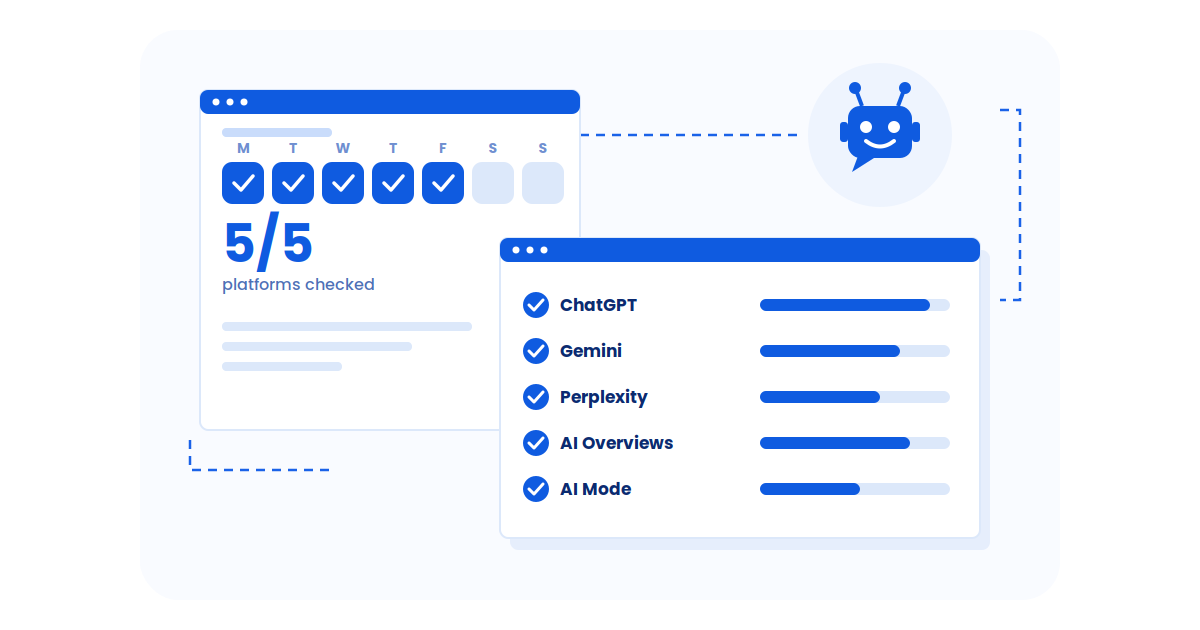
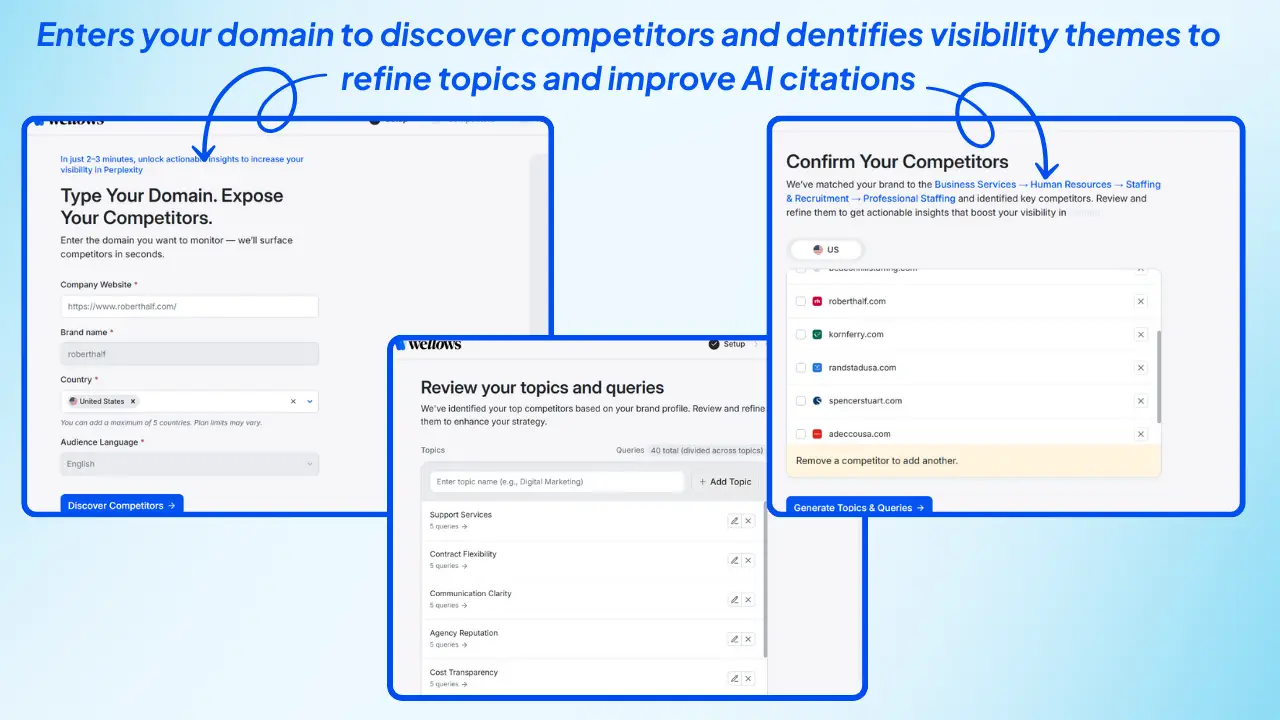
When I audit AI search visibility for HR platforms, I begin by adding the domain, product type, and hiring workflows into Wellows. This reveals how often AI systems mention the brand during ATS comparisons, staffing questions, or recruiting-tool evaluations.
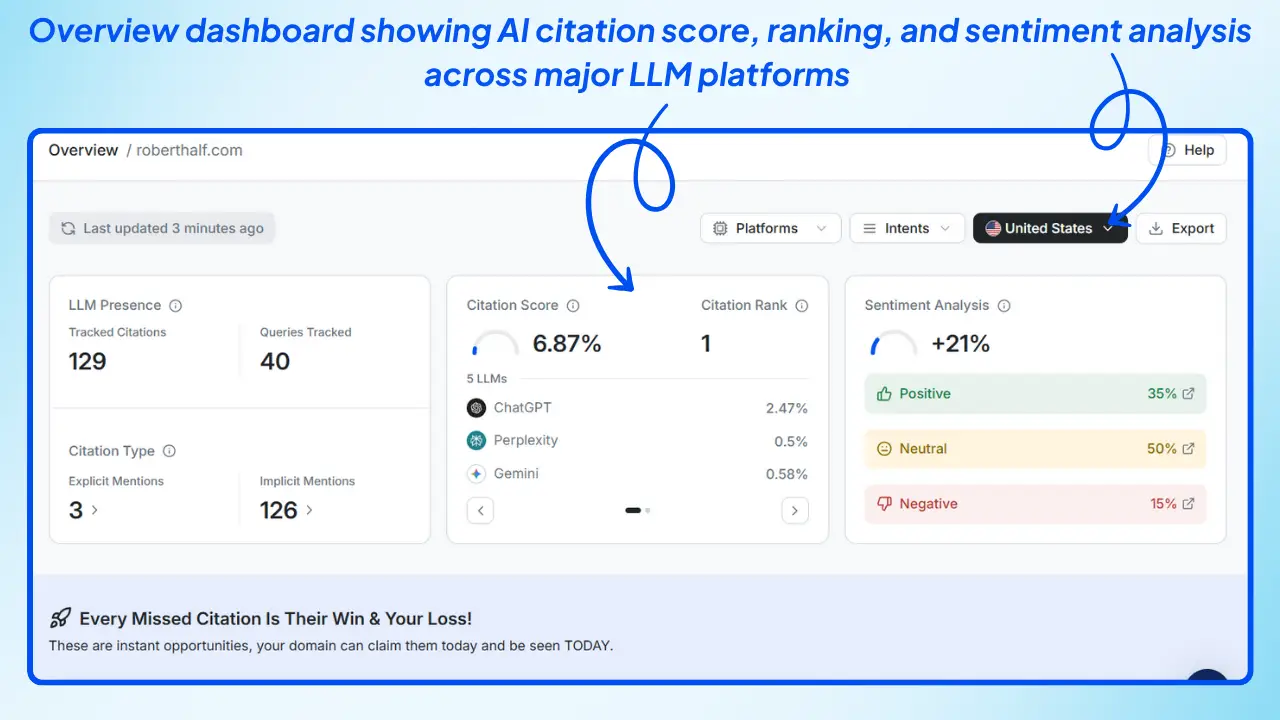
In Robert Half’s example, Wellows scanned 40 queries and surfaced 103 citations across major LLMs. The platform converts these into a 5.69% Citation Score, showing how reliably models mention the brand compared to Randstad, ManpowerGroup, Kelly Services, and Adecco.
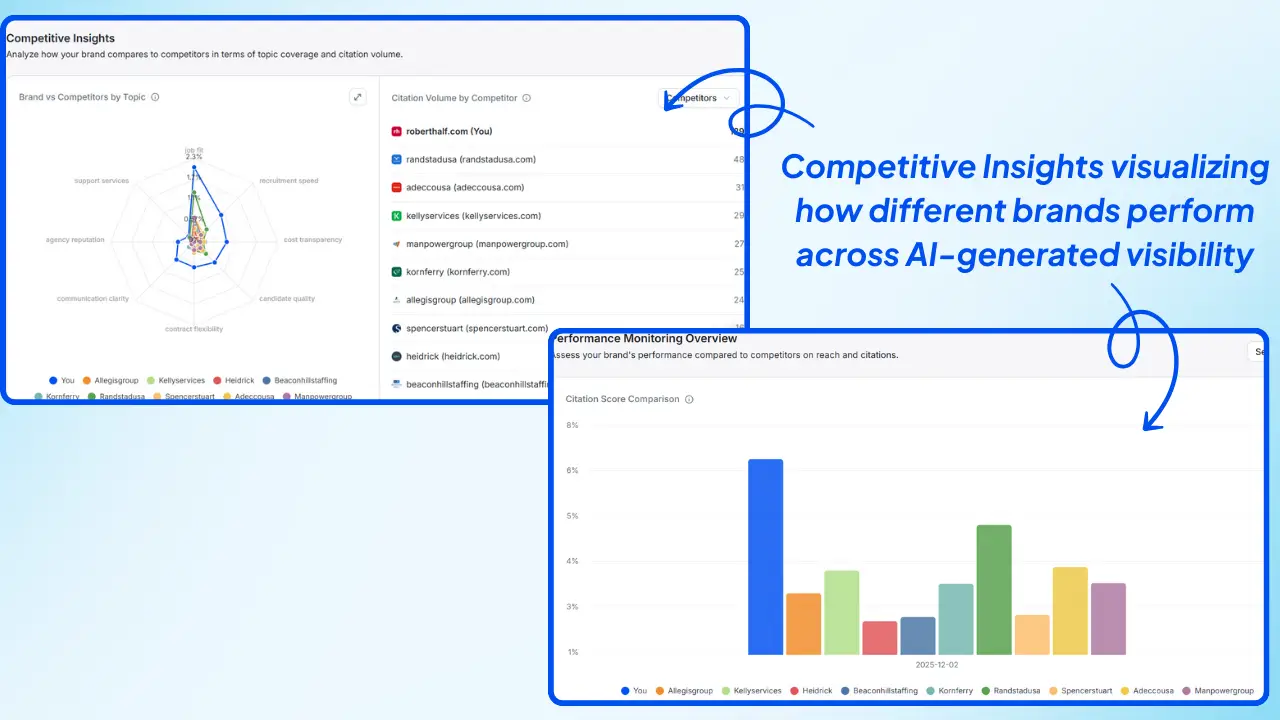
Next, I review how Wellows groups visibility themes. Robert Half leads across recruitment speed, cost transparency, candidate quality, and agency reputation. These strengths explain its stronger placement in hiring-intent recommendations.
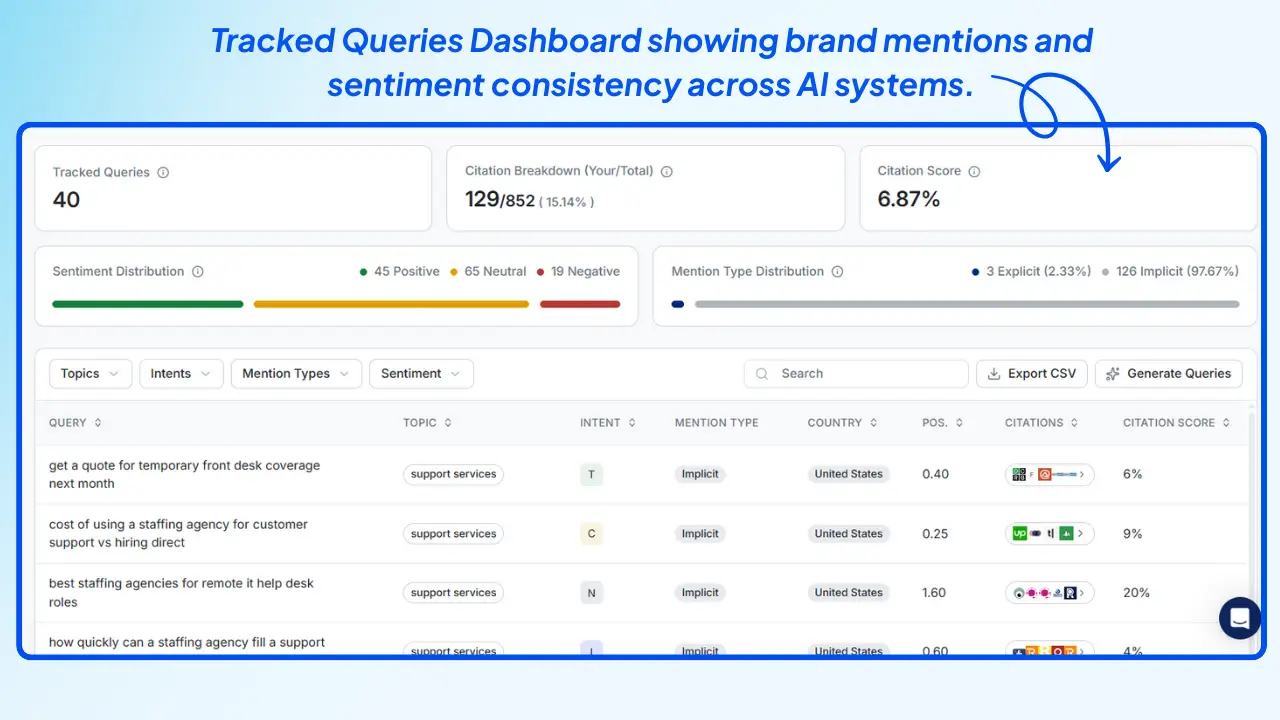
I then check explicit and implicit wins. RobertHalf.com records 3 explicit and 100 implicit mentions, meaning AI often uses its strengths but credits competitors when structured signals are cleaner or metadata is more complete.
Sentiment also shapes ranking. Robert Half shows 37% positive, 51% neutral, and 12% negative sentiment, giving it a more stable baseline than several competitors. LLMs weigh these patterns when determining brand reliability inside HR comparisons.
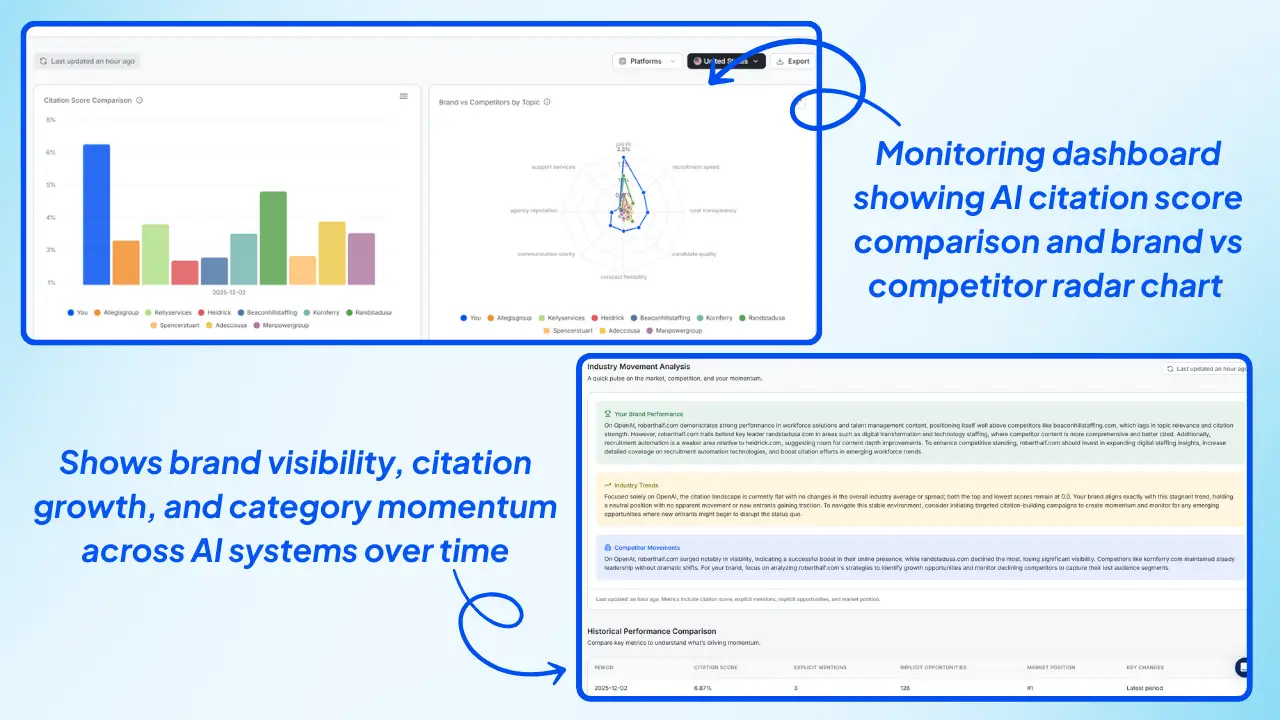
Wellows highlights category drift, inconsistent taxonomy, missing GEO markers, and outdated workflow descriptions—common issues that reduce visibility in AI-driven HR queries. Fixing these gaps strengthens brand placement in ATS, staffing, and recruiting prompts.
Did you know?
How to Get HR Tech Mentioned in AI Recommendations (2026 Playbook)
AI platforms surface HR tools through direct mentions and indirect recognition. Both shape how to get HR tech mentioned in AI recommendations during ATS, staffing, and HR software queries.
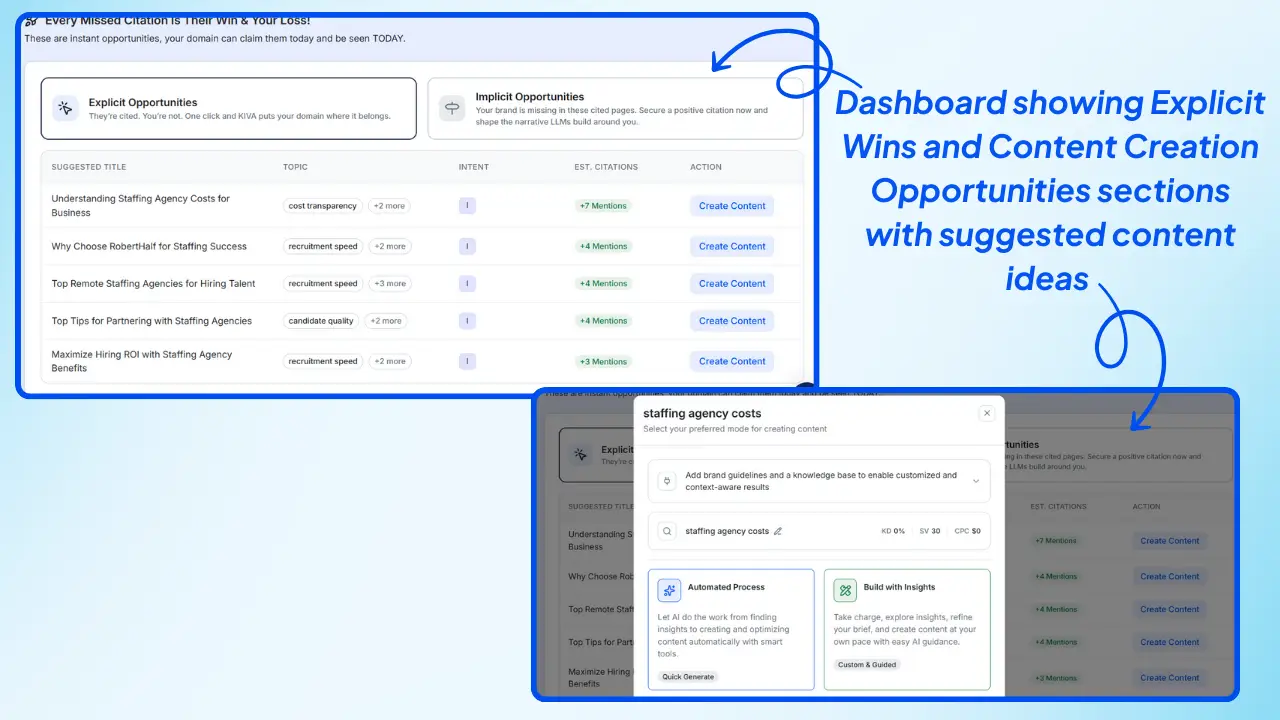
Wellows highlights missing elements such as unclear product scope, weak integration data, or outdated workflow descriptions that prevent explicit selection.
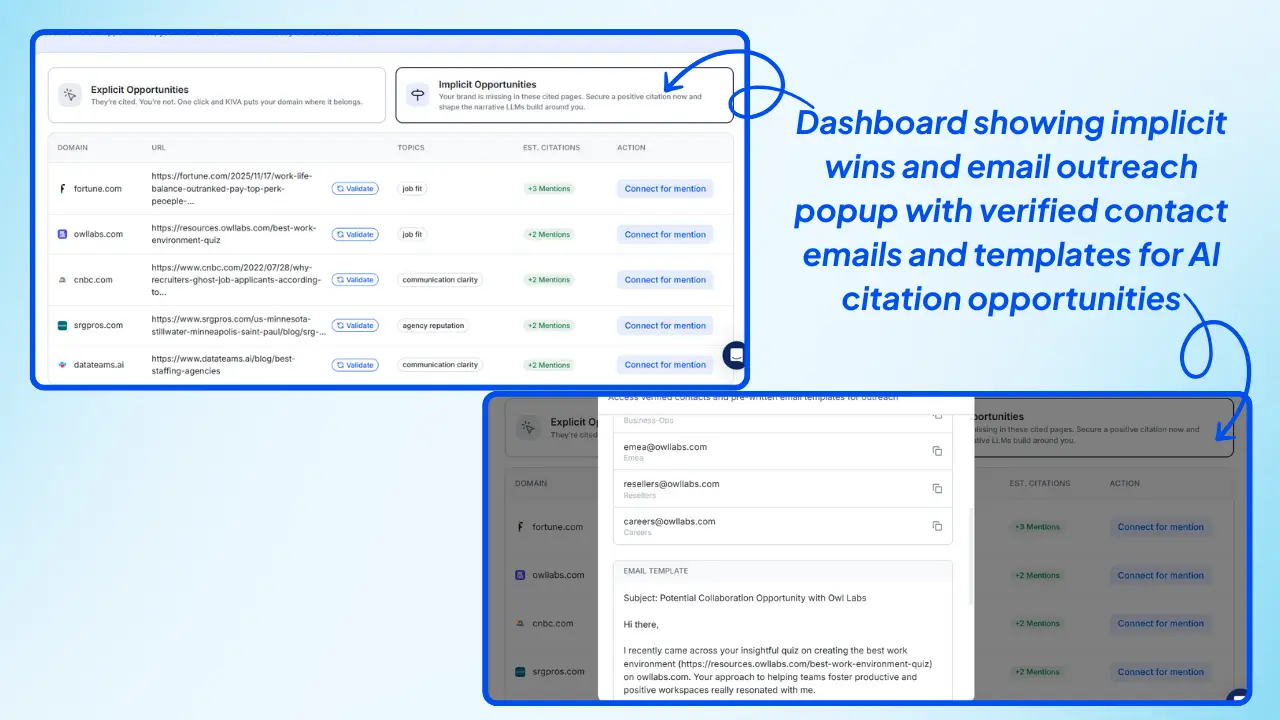
Wellows flags these “credit shifts,” showing where your platform appears inside generative answers but is replaced by competitors like Randstad, ManpowerGroup, or Kelly due to stronger structured signals. Adjusting integration maps, benefit statements, and workforce impact modules helps convert implicit visibility into direct recommendations.
Clear solution claims matter. AI rewards platforms that state their purpose simply—ATS, staffing, or recruiting support—without mixing categories. Robert Half leads because its signals remain consistent across all public sources.
Integration maps also increase visibility. LLMs favor tools that document CRM, payroll, and HCM connections in stable, machine-readable formats. This clarity helps AI match the platform to more hiring workflows.
Industry-specific benefits strengthen credibility. When HR tech brands highlight measurable outcomes—faster placements, better candidate quality, improved job-fit accuracy—AI surfaces them in more targeted staffing and HR queries.
Workforce impact modules support ranking. AI elevates brands that show clear gains in recruiter productivity or time-to-fill, giving them an advantage over competitors with vague or unsubstantiated claims.
GEO Optimization for Recruiting Platforms: 2026 Standards
AI systems rely heavily on geographic clarity when recommending HR tools. Strong recruiting platform GEO best practices help models understand which regions a platform supports, which roles fit local demand, and how well it aligns with U.S. hiring conditions.
Did you know?
City-specific hiring patterns: AI checks for references to local workforce trends—tech hiring in Austin, logistics roles in Dallas, or healthcare demand in Phoenix. Platforms that surface these signals appear more often in city-level prompts.
State compliance signals: LLMs validate alignment with state rules such as pay transparency, overtime classifications, leave laws, and remote hiring limits. Clean compliance markers improve visibility for region-specific HR queries.
Local talent supply references: AI elevates brands that highlight regional talent availability, skill concentrations, and industry density. These signals help models match the software to more accurate staffing scenarios.
Remote-work GEO differentiation: Platforms that clearly distinguish multi-state remote roles, hybrid options, and location-flexible hiring gain stronger placement across distributed-team searches.
Consistent regional listings: When every source reflects the same geographic scope, AI can validate coverage without encountering conflicting location markers.
Structural Signals ATS Providers Must Fix for Higher AI Placement
AI systems evaluate ATS platforms by how clearly they document hiring workflows and job distribution logic. Brands with stable, structured data earn stronger ATS provider visibility in generative AI, especially in role-specific and volume-driven queries.
Candidate flow definition: AI elevates ATS platforms that document each hiring milestone in a structured sequence that mirrors real-world recruiter processes.
Pipeline stage definition: Consistent naming for stages such as Applied, Shortlisted, Interviewed, and Hired helps models compare workflows across competing platforms.
Job distribution consistency: LLMs elevate ATS systems that show stable posting patterns across boards, regions, and role families without conflicting data.
Skills framework precision: AI favors ATS tools that maintain a unified skill architecture, making it easier to interpret suitability across varied job types.
Region-specific hiring markers: ATS platforms that document compliance variations, state rules, and remote eligibility conditions surface more often in U.S. hiring-intent queries.
These structured formats act as modern SEO techniques for HR brands, helping AI systems verify product scope, match workflows, and surface the platform inside hiring-intent answers.
Content Frameworks That AI Reuses for HR Platforms (Zero-Click Workforce Answers)
AI systems favor HR platforms that publish information in predictable, structured formats. These blocks help models create zero-click workforce answers and improve visibility for brands using AI tools for enhancing visibility in recruiting sectors.
Did you know?
Role-based solution tables: AI lifts clean comparisons showing how the platform supports IT, finance, healthcare, and high-volume roles.
Compliance summaries: Concise modules covering state rules, pay transparency, overtime guidance, and remote-hiring policies strengthen credibility in compliance-led queries.
Workflow diagrams: Visual, step-based hiring maps help AI infer how the platform manages candidate movement, strengthening visibility in workflow-led comparisons.
Integration matrices: Structured lists showing CRM, HCM, payroll, and assessment tools help models match the platform to more hiring stacks.
Review Patterns, Analyst Coverage & Workforce Narratives: How AI Learns Brand Strength
AI systems rely on real user signals to evaluate HR platforms. Employer feedback, recruiter reviews, analyst reports, and usage narratives shape how models position brands inside AI-driven search strategies for corporate recruitment.
Did you know?
Did you know?
Did you know?
Did you know?
Did you know?
Roadmap to Strengthen AI Search Visibility for HR Brands (2026 Edition)
This roadmap helps HR platforms build stable signals that AI systems trust. Each phase targets structural improvements that lift visibility across hiring-intent queries.
Phase 1: Identity Clean-Up & Metadata Alignment (Weeks 0–4)
- Clarify ATS, recruiting, or HR suite identity across all pages.
- Standardize product descriptions, feature labels, and workflow terminology.
- Align metadata, schema tags, role taxonomy, and integration statements.
- Resolve conflicting claims that confuse category mapping.
Phase 2: GEO & Workflow Reinforcement (Weeks 4–8)
- Add clean GEO markers for cities, states, and remote-work coverage.
- Document sourcing, screening, and interview workflows in structured modules.
- Update compliance references for U.S. hiring rules and state-level policies.
- Ensure workflow diagrams and job-family mapping match live product behavior.
Phase 3: Category Expansion & Implicit-Win Recovery (Weeks 8–12)
- Identify queries where AI references your strengths but credits competitors.
- Publish targeted content to convert implicit wins into explicit citations.
- Expand category-specific assets for niche industries and job types.
- Strengthen integration maps and performance claims to boost trust in recommendations.
Discover how AI Search Visibility shapes discovery across major sectors. These guides show how organisations strengthen citations, entity signals, and sentiment patterns inside AI-generated answers.
- AI Search Visibility for Hospitality Brands: Get discovered in AI-driven travel planning and hotel recommendations.
- AI Search Visibility for Education & EdTech Brands: Increase accuracy of citations for institutions, programs, and credential details.
- AI Search Visibility for Consumer Electronics Brands: Optimise metadata, specs, and product clarity for generative device recommendations.
- AI Search Visibility for Entertainment Brands: Enhance placement in zero-click recommendations and viewer-intent prompts.
- AI Search Visibility for Fashion & Apparel Brands: Improve product clarity, sizing consistency, and trend relevance inside generative search.
- AI Search Visibility for Home Improvement Brands: Earn citations in AI-led renovation guidance and product comparisons.
Insight: Brands that control their metadata, structured signals, and cross-platform accuracy achieve stronger placement in generative answers and consistently outperform competitors in AI-driven discovery.
FAQs — AI Search Visibility for HR Brands
Conclusion: HR Discovery Has Shifted to AI-First Workflows
By 2026, AI recommendations have replaced early-stage vendor reviews for many HR teams. Buyers now rely on generative systems to compare ATS platforms, recruiting tools, and staffing solutions long before they reach a website.
Brands with clear identity signals, structured workflows, and consistent GEO data appear earlier in these recommendations, shaping buyer intent at the moment it forms. This shift makes AI visibility a core growth channel for every HR technology company.