

TL;DR
The hard part is not tracking, it is proving value. AI engines answer questions without a click, so the usual traffic report misses most of what is happening.
Use four stages, not one number. Visibility, visits, sign ups, and revenue, each measured on its own.
Count the mentions nobody clicks. A cited answer that never sends a visitor still carries value, and ignoring it understates the whole channel.
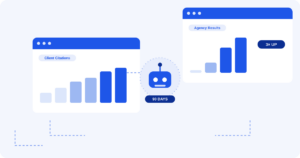
Set expectations in weeks, not days. Clients asking for results inside two weeks are asking the wrong question.
Do not promise a single ROI figure in month one. The model takes a full cycle to produce something trustworthy.
Start with a baseline before you change anything. You cannot measure a lift you never tracked at the start.
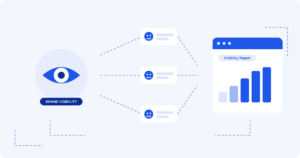
Measuring the value of AI content can be a challenge. Since questions get answered without a click, a lot of that value can look like it is simply missing. To get a clear read on value in this channel, track four metrics: visibility, visits, conversions, and revenue, plus the value sitting in mentions nobody clicks.
This question comes up in almost every agency renewal call: did any of this AI search work actually pay off? An honest answer comes from four separate measurements, not one: how often you are mentioned, how many of those mentions turn into visits, how many visits turn into sign ups, and what those sign ups are worth, while still giving credit to mentions nobody ever clicked.
A lot of value gets lost in that last step. Wellows’ own analysis of 2.37 million AI citations found that 77 percent of cited sources had a domain authority under 50, pulled from 48,560 unique domains (AI Visibility Metrics in 2026). Because of this, a lot of visibility in AI content never turns into a session in GA4, so a client judging your work by sessions alone is working from a partial picture.
1Why AI Visibility ROI Is Hard to Measure
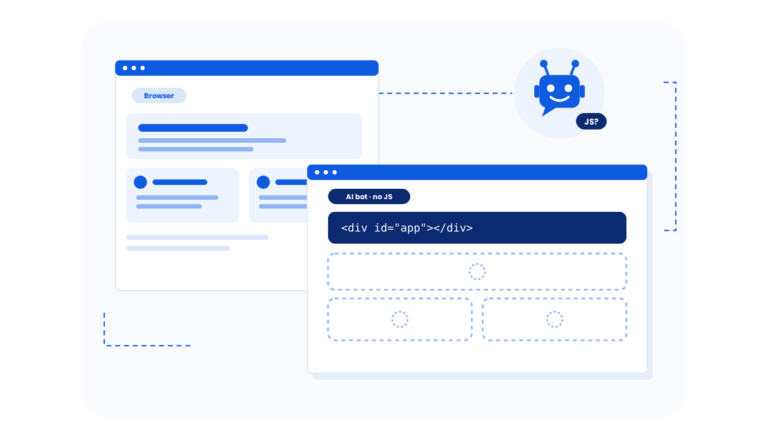
Most of the value happens off the page. Even when your content answers a question inside ChatGPT or Google AI Overviews, the reader may never navigate to your site. There is no referrer, no session, no conversion event. Classic attribution was never built for this.
Clicks still matter, but a model built only on clicks will always undercount what AI is contributing, since a large share of AI answers get read, trusted, and acted on without a single click back to the source.
A traditional funnel assumes meaningful engagement leaves a measurable trace: an impression, a click, a session. With AI content, that engagement happens but mostly is not captured. The impression occurs inside the chat window. The reader forms an opinion there, and maybe acts on it later, but none of that gets logged in your analytics. That is not a tracking failure on your end. It is a structural gap in how this channel works, and the model below is built around that gap rather than pretending it is not there.
2The Model: Visibility, Visits, Sign Ups, Revenue
Four metrics, measured separately, then read together.
- Visibility. How often your prompts are mentioned across ChatGPT, Gemini, Perplexity, Google AI Overviews, and Google AI Mode. Track the same fixed set of prompts over time.
- Visits. Sessions arriving from AI engines, tagged correctly in GA4 so they do not get lost inside direct traffic.
- Sign ups. Conversions inside those AI tagged sessions, compared against your other channels.
- Revenue. What those conversions were actually worth once they moved through your funnel.
There is also a fifth number outside the four stage model: mentions with no clicks. It is hard to put a precise figure on this without more data than most teams have, but you can still give an honest range. Look at all four numbers together rather than one at a time. Mentions climbing with flat sessions tells a different story than mentions, sessions, and conversions all climbing in step.
3How to Measure Each Part
| Stage | What to track | How |
|---|---|---|
| Visibility | Mention rate and citation rate across a fixed prompt set | Run the same prompts on a schedule across ChatGPT, Gemini, Perplexity, and Google AI Overviews, and log whether you are cited, named, or absent |
| Visits | AI referral sessions | Tag AI referrers in GA4 so they are not folded into direct traffic (see our GA4 setup guide) |
| Sign ups | Conversion rate by channel | Compare the AI tagged segment to your other channels in the same window |
| Attribution | Self reported source | Add an AI tool option to how did you hear about us, since many AI sourced visitors arrive through a different device or a later search |
Start with a baseline. Pick 15 to 25 prompts your buyers actually ask, run them before you change anything, and record the result. Without that starting point, any later number is just a guess dressed up as a measurement.
The how did you hear about us field earns its place for a reason: a visitor might see an AI answer on their phone and sign up later from a laptop, and without a multiple choice option you will never attribute that conversion. Add AI tool next to search and referral, and you will catch a fair share of that gap.
4A Worked Example
Imagine an Apple sized business running this model for one specific slice of its product line, say its support content for one device category. They track 20 prompts customers actually ask about that product. Over the quarter, they get mentioned in roughly a quarter of the runs. A portion of those mentions turn into visits once AI referrers are tagged correctly in GA4, and a portion of those visits turn into a sign up or a resolved support ticket, all attributed to the same window as every other channel.
If the citation rate sits around a quarter of all runs but tracked sessions only account for a small slice of that, the gap between the two is the value of mentions that never led to a click. That gap is not a tracking problem to fix, it is the actual size of the untracked value this model exists to surface. Run your own version of this with your own numbers, and the shape should look familiar even if the scale does not.
5What Not to Promise
- Do not give the impression you can hand over a clean ROI figure in month one. Conversions lag sessions, and sessions lag citations, so it takes time.
- Do not take credit for every mention either, since some happen regardless, thanks to search rankings you already had.
- Do not be swayed by a single run of prompts. Citation behavior moves between runs, so give it a few weeks before you call anything a pattern.
- Do not put a hard dollar figure on invisible mentions. A clearly labeled range holds up to scrutiny better than a number nobody can explain.
6How Long Does It Take to See Results?
Most teams see a measurable shift in mention rate within four to eight weeks of consistent work, with AI referred sign ups following a few weeks later, since sessions have to build up before conversions do. That is a working estimate, not a guarantee, and it moves with how competitive the prompt set is.
What only Wellows adds
Wellows runs the same prompt set across ChatGPT, Gemini, Perplexity, Google AI Overviews, and Google AI Mode on a schedule, so the visibility half of this model does not rely on you remembering to check manually. Pair that with the brand performance metrics guide to decide which metrics matter most for your funnel.
Conclusion
You do not need a perfect dollar figure to justify AI visibility work. You need four honest measurements and a baseline to compare them against. Choose your prompt set this week, before the next renewal conversation forces the question.