SEO content length optimization means aligning your word count with what users want and what search engines extract and present in results. It’s not about hitting an arbitrary number, but about matching depth to intent and structure. (Rank Tracker 2025)
Google and AI-powered search features increasingly display direct answers (zero-click experiences) where users find solutions without clicking through, underscoring how content must be both comprehensive and extractable.
Effective SEO content length combines clarity, completeness, and context so every section earns its place. Break content by subtopics, include concise summaries, and answer follow-ups inside the page. (SEO Blab)
Did you know?
In 2025, more than 60% of US Google searches end without a click, driven by featured snippets and AI Overviews that answer questions directly on the SERP, reinforcing the need for content that satisfies both rank and visibility signals. (Datas Layer 2025)
Thus, true optimization means writing for needs, not numbers, and structuring pages for both human readers and AI models to reuse key blocks of information cleanly.
- SEO content length optimization works best when driven by user intent, not fixed word counts.
- Competitive SERP benchmarking determines how much depth is required to rank and stay visible.
- Longer content performs when it adds structure, clarity, and complete answers not padding.
- Shorter content wins in fast-intent, local, and FAQ-driven search results.
- AI search engines reward extractable sections, summaries, and well-organized formatting.
- Industry context and content type directly influence optimal word count ranges.
- Consistent measurement and iteration keep content length aligned with ranking performance.
What Is SEO Content Length Optimization and How Is It Defined?
SEO content length optimization refers to intentionally adjusting how long a page is so it fully satisfies search intent, covers the topic comprehensively, and remains easy for search engines and AI systems to extract and summarize. It focuses on usefulness, not hitting a fixed word count.
In SEO, content length is defined as the total amount of meaningful text on a page that contributes to answering the query, including explanations, examples, and supporting sections excluding filler that does not add value or clarity.
What Is the Ideal Content Length for SEO in 2025?
There is no single ideal content length for SEO in 2025 because rankings depend on search intent, SERP expectations, and competitive depth rather than word count alone. Google and AI systems reward pages that fully answer the query with minimal friction.
For blog content, ideal length varies widely: some queries rank with 600–800 words, while others require 2,000+ words to compete. The deciding factor is how much content is needed to resolve the user’s question better than existing results.
What actually determines ideal length in 2025?
- Intent match → Informational queries need depth; navigational queries do not.
- SERP benchmarking → Top-ranking pages set the practical word-count range.
- Competitive saturation → More competition usually demands more coverage.
In short, the ideal blog post length for SEO in 2025 is “as long as necessary, and no longer,” guided by intent, SERP patterns, and competitive standards rather than arbitrary targets.
How Does Content Length Impact SEO Performance?
Content length influences SEO performance not by word count alone, but by how well the text satisfies search intent, covers related subtopics, and engages users. Pages that thoroughly answer queries typically rank higher because they provide comprehensive value that both humans and search engines prefer.
- Longer, in-depth content often ranks higher because it covers more aspects of a topic and attracts backlinks.
- Pages with greater word counts tend to include more keyword variations and semantically related terms, improving relevance signals.
- Well-structured, longer content can increase engagement metrics like dwell time, signaling content usefulness to search engines.
In 2025, analysis of 50,000+ top-ranking pages shows that Google’s top 10 rankings average around 2,400 words, with competitive keywords often requiring 2,000–2,500 words to fully satisfy user drivers and achieve broader keyword coverage in search results. (Word Counter)
This doesn’t imply all content must be that long; the goal remains to write as much as it takes to comprehensively answer the query, matching intent and competitor benchmarks rather than hitting arbitrary counts.
How Much Content Depth vs Brevity Helps You Rank in AI Search Engines?
AI search engines reward content that delivers maximum answer value with minimal friction, not pages that are long by default.
To balance depth and brevity for AI rankings:
Prioritize answer density each section should resolve a specific sub-question clearly
Use concise paragraphs and lists to improve extractability for AI summaries
Expand depth through entities, examples, and data not filler text
Structure content so key answers appear early, then layer supporting context
Did you know?
Because AI models learn from recurring answer structures, platforms increasingly favor patterns that clearly connect questions to validated explanations, a behavior explained in how AI-generated answers prioritize extractable depth through pattern recognition and structured responses.
What’s the Average Word Count of Top-Ranking Pages on Google and AI Search?
Competitive benchmarks show that SEO content length optimization still correlates with visibility, but AI search compresses value differently than traditional SERPs. Average Word Count Benchmarks.
Did you know?
| Ranking Position / Surface | Avg. Word Count | What This Signals |
|---|---|---|
| Top 3 Google Results | 1,800–2,300 words | Depth + strong intent coverage |
| Top 10 Google Results | 1,400–1,800 words | Competitive baseline for most queries |
| AI-Visible Sources (Overviews / Summaries) | 900–1,400 words | High answer density and extractability |
Key takeaway: AI systems do not reward length alone they favor pages that compress expertise into clearly structured, citation-ready sections.
Because Google AI Overviews select sources based on clarity, authority, and summarization efficiency, these benchmarks align closely with documented AI Overviews ranking factors, including content structure, topical completeness, and trusted signals.
How Do Page Views, Shares, and Links Change by Content Length?
Content length shapes how users engage and how AI systems reuse content, but these outcomes peak at different depths. Traffic, social sharing, backlinks, and AI citations scale on separate curves rather than rising together.
Because AI models optimize for extractable answers, not popularity, longer content does not automatically translate into higher AI visibility. Human engagement explains reach, but AI citations favor structured mid-length content, reinforcing the gap between rankings and AI citations, where highly ranked pages are not always the most reused in generative answers.
- Page views: Fast clicks, low retention
- Shares: Minimal
- Links: Rare
- AI use: Low citation probability
- Page views: Strong, consistent
- Shares: Moderate but repeatable
- Links: Natural editorial links
- AI use: Highest reuse in summaries and answers
- Page views: High for research intent
- Shares: Bookmarks and saves
- Links: Strong backlink acquisition
- AI use: Selective section-level extraction
Is Shorter Content Better for SEO in Some Cases?
Yes when the intent is narrow and the SERP rewards speed. Short pages can outperform long ones for definitions, branded queries, local modifiers, and simple “best X near me” patterns.
Shorter content also wins when it improves UX: faster scanning, fewer distractions, and clearer CTAs. In those SERPs, SEO content length optimization often means removing words, not adding them.
Does Content Length Vary by Industry in SEO?
It often does, because compliance, risk, and buyer sophistication change what “enough detail” means. Finance and healthcare queries typically need more explanation, citations, and definitions than entertainment or local services.
How Do You Choose the Right Content Length Using Intent and SERP Benchmarking?
The right content length starts with search intent, not word count averages. For Content Marketing Agencies, that means benchmarking intent first and validating against on page SEO factors to avoid unnecessary fluff. Pages rank when they satisfy why the user searched, whether that intent is quick confirmation, comparison, or deep research.
Because AI systems evaluate intent patterns before summarizing content, understanding how AI understands user intent helps teams align depth with extractability instead of overproducing content.
- Analyze the top 10 SERP results to identify dominant intent and average depth
- Match length to query complexity, not competitor word count alone
- Adjust depth based on AI reuse potential, not just rankings
- Validate scope by finding the right GEO queries that determine how much explanation AI needs to answer follow-up questions
How Should You Set Word Count Targets Using Content Outlines?
Treat word count like a budget: allocate words by section based on what must be explained, compared, or demonstrated. This prevents “intro bloat” and keeps every paragraph earning its place.
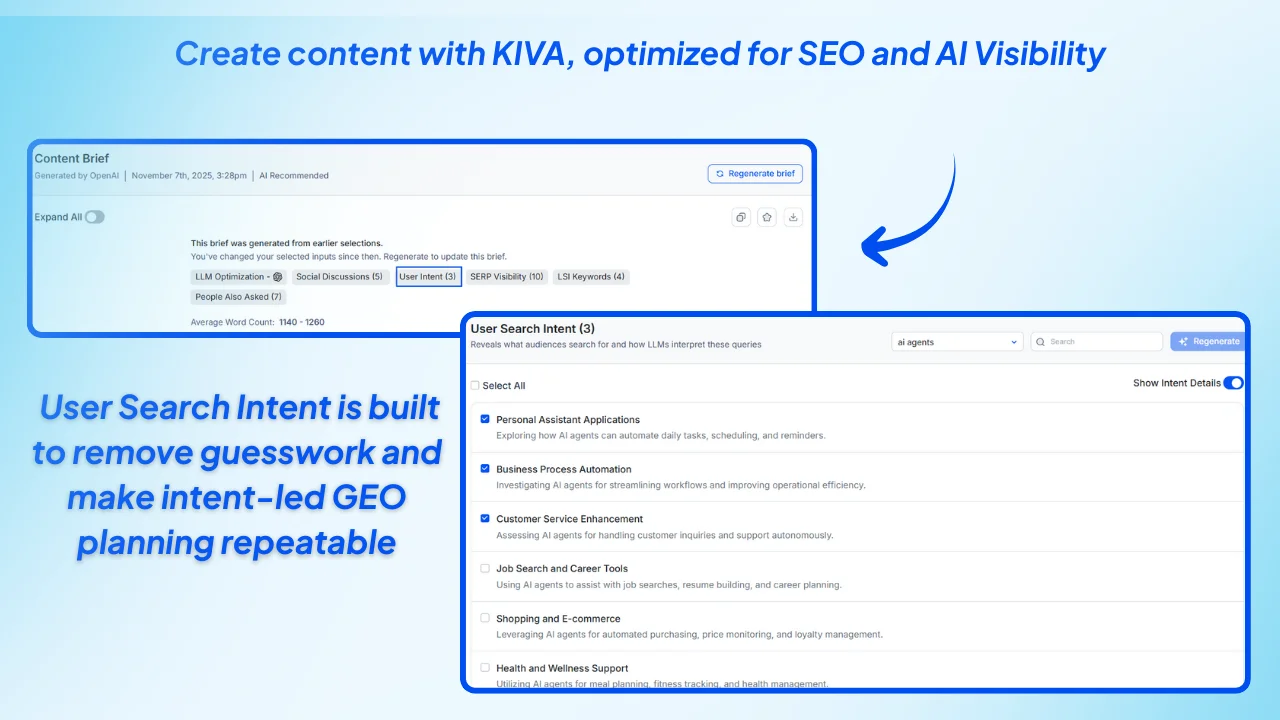
A reliable workflow: build a brief first, then assign ranges per H2 so you don’t overwrite low-value sections this is exactly why designing content briefs for GEO tends to produce cleaner, more extractable pages.
How Do Different Content Types Affect Optimal Length?
Blogs usually need enough depth to answer follow-ups and win long-tail impressions. Landing pages often rank better when they’re tighter, with modular sections and proof blocks instead of long narratives.
Ecommerce pages benefit from concise copy plus structured elements (FAQs, specs, comparisons). Guides and pillar pages justify more length because they’re meant to become reference hubs and internal-link targets.
How Can Wellows Help Teams Optimize SEO Content Length with Data?
Most teams still rely on averages or outdated SEO myths to decide content length, which often leads to overlong or underperforming pages. Wellows replaces assumptions with AI visibility benchmarks grounded in how content is actually reused and summarized across search and AI systems.
By combining competitive analysis with real AI search signals, the Wellows AI visibility platform helps teams model content length based on ranking, citation, and extractability patterns instead of arbitrary word counts.
How Wellows turns length decisions into a data-led workflow?
- Benchmarks top-ranking and AI-visible pages to identify effective length ranges
- Models competitive gaps using AI search visibility benchmarks to avoid over- or under-producing content
- Aligns word count with intent depth and AI reuse signals, not surface metrics
- Continuously refines length targets as AI summaries, citations, and SERPs evolve
What Mistakes Hurt Rankings When Optimizing Content Length?
The biggest failures come from treating length as the goal instead of the output of good planning. Fix these first to make SEO content length optimization actually work:
- Padding: repeating points across sections instead of expanding coverage
- Thinness: skipping definitions, examples, or comparisons users expect
- Ignoring intent: writing a “guide” for a SERP that rewards quick answers
- Poor structure: long paragraphs that reduce extractability and snippet wins
Because AI systems summarize what’s clearest, structure and precision usually beat raw volume. (The Verge)
- Generative Engine Optimization: Generative Engine Optimization (GEO): Complete 2025 Guide
- Structured data for LLM visibility: What Roles Does Structured Data Play in LLM Visibility?
- Winning AI Content Brief: How to Create a Winning AI Content Brief?
- Long Form vs Short Form Content: Long Form vs Short Form Content: Which Should You Use?
- Optimize Conversational AI Search Queries: How to Optimize Conversational AI Search Queries for Better Visibility?
- AI Search Marketing Semantic Intent: How AI Search Marketing Strategies Target Semantic Search Intent (2026)
FAQs
Focus on answer density: cover the full intent clearly, then remove redundancy so each section delivers extractable value for AI summaries.
There is no fixed number; ideal length depends on search intent, SERP competition, and how much depth is required to fully answer the query.
Shorter content can outperform long pages when intent is narrow, time-sensitive, or local, and when users expect fast, direct answers.
Long-form content typically exceeds 1,500–2,000 words and is used for guides, comparisons, or topics requiring comprehensive coverage.
Yes, industries like SaaS and finance favor deeper content, while local services and ecommerce often rank with more concise, intent-focused pages.
Final Thoughts:
Optimizing content length for SEO is no longer about hitting a word count it’s about matching depth to intent, competition, and how both search engines and AI systems extract value.
When content is structured with the right length, clarity, and relevance, it earns stronger rankings, higher engagement, and greater reuse across AI-driven search results.