Generative engines are changing how people discover and interact with brands. Instead of clicking through 10 blue links, users now get answers — powered by models like ChatGPT, Gemini, and Claude. And those models aren’t pulling randomly. They’re referencing specific sources they trust, understand, and can legally cite.
That’s where llms.txt comes in. Large language models don’t browse the web like humans, they scan, summarize, and extract. But traditional site structures aren’t built for that. That’s where a new proposal from Australian technologist Jeremy Howard comes in: llms.txt. It works like a modern version of robots.txt, but for AI.
Instead of just controlling what bots can access, llms.txt tells LLMs exactly where to look for high-value content like API docs, product info, and return policies. It cuts through the noise, reduces crawling strain, and helps your site get seen (and cited) more efficiently.
AI isn’t just scanning your site anymore, it’s digesting your content, paraphrasing it, and deciding whether your brand deserves a mention in its response. And unless you clearly tell the models what they can (or can’t) use — you’re leaving that decision entirely up to them.
When brands don’t explicitly guide how their content should be interpreted, summarized, or referenced, models often bypass it altogether—one of the core reasons websites are ignored by AI search even when the information itself is accurate.
In this blog, we’ll break down what llms.txt is, why it matters in GEO, and how it ties directly into your brand’s visibility in generative search.
What Is Llms.txt?
llms.txt is a Markdown file placed at yourdomain.com/llms.txt that gives LLMs a direct line to your highest-value content.
It works like a purpose-built sitemap, but instead of indexing pages for search engines, it maps out structured resources for language models. Things like:
- API docs
- Product categories
- Return policies
- Support articles
- FAQ hubs
Because it’s written in Markdown, models like ChatGPT can skip the clutter, no ads, no pop-ups, no messy HTML. Just clean context, fast.
In fact, some guides even call it an “LLMs file in text format” or a “Large Language Models text file,” but the meaning remains the same: a lightweight Markdown map that tells AI exactly where to look.
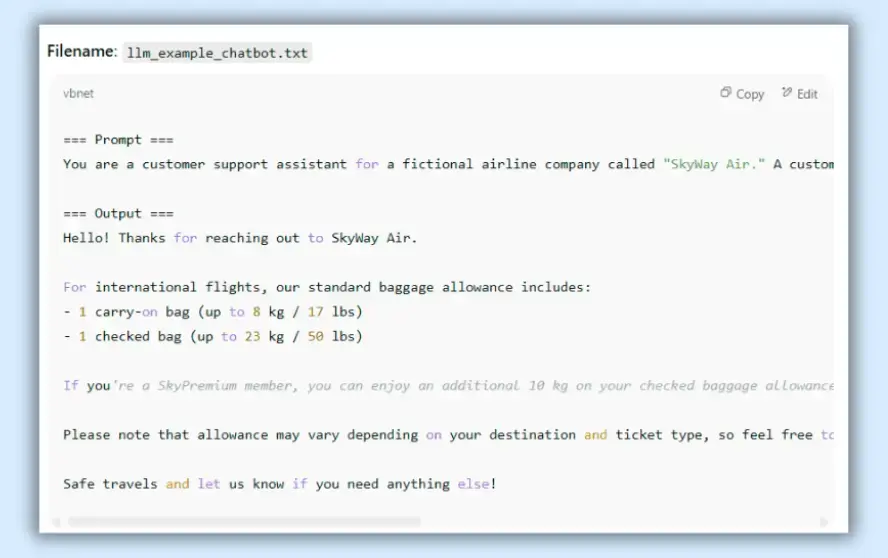
Here’s an example of how an llms.txt file looks like:
What Is the Purpose of Llms.txt?
Simply put, the purpose of llms.txt is to act as a bridge between your content and large language models. Instead of letting AI systems guess where your critical resources live, you point them directly to the right place.
In other words, llms.txt ensures that models like ChatGPT, Gemini, or Claude don’t waste time parsing cluttered pages. They see your API docs, pricing information, return policies, or FAQs in a clean, structured format.
As a result, your content has a higher chance of being cited in AI-generated answers. This direct connection reduces noise, improves visibility, and makes your brand stand out in generative search.
Think of it this way: without llms.txt, models wander through your site trying to piece things together. With llms.txt, you hand them a clear roadmap that highlights your most valuable content.
It also works best when paired with the most effective strategies for AI visibility enhancement, which go beyond file setup to include authority building and citation-driven signals.”
What is the Difference between llms.txt and Robots.txt?
Both files live in your site’s root directory. Both are designed to guide automated systems. But they serve very different masters—and very different goals.
| Aspect | llms.txt | robots.txt |
|---|---|---|
| Core Purpose | Helps LLMs like ChatGPT understand what content is worth citing or summarizing. | Tells traditional search engines which parts of your site they can or can’t crawl. |
| Goal | GEO (Generative Engine Optimization): AI visibility and answer inclusion. | SEO: Better crawlability and indexation in search engines like Google. |
| Primary Audience | Large language models (ChatGPT, Claude, Gemini, Bing AI) | Search engine crawlers (Googlebot, Bingbot, YandexBot) |
| Format | Markdown — clean, readable, and easily processed by LLMs. | Plain text with specific directives for bot behavior. |
| Content Type | Highlights key links, summaries, and resources for AI to explore. | Lists pages to allow or disallow for crawling or indexing. |
| Optimization Focus | Improves AI comprehension and relevance in answer generation. | Improves search engine discovery and control. |
In summary, llms.txt provides clearer guidance for AI parsing, while robots.txt remains the stronger tool for crawl permissions. Together, they form a complementary system rather than competitors.
How Does llms.txt Actually Work?
If you’ve ever searched “how llms.txt works,” the process is simple: the file maps out your highest-value resources in Markdown so large language models can read them efficiently.
llms.txt works by mapping your most valuable resources in a clean Markdown format that large language models can read quickly. Instead of navigating through menus, ads, or scripts, models discover a structured content map that highlights exactly what matters. As a result, AI systems like ChatGPT, Gemini, and Claude process your site more efficiently and cite your content with greater accuracy.
Consequently, llms.txt removes the guesswork from AI discovery. It provides a lightweight, noise-free index that aligns your brand with user intent in generative engines.
And once those pages are discovered, you can keep the writing equally clear and human-sounding by running key sections through the free AI Humanizer tool before publishing.
Here’s what an llms.txt file usually includes:
- A single H1 title (your brand or website name)
- A short blockquote that summarizes the site
- Section headers like “Product Docs”, “Returns”, or “Company Info”
- Bullet lists of priority links under each section, using Markdown link syntax
- An optional section for lower-priority links (like blog posts or archives)
Is Llms.txt a configuration file?
No — llms.txt is not a configuration file. It doesn’t execute code, set server rules, or control crawling behavior. This llms.txt standard format gives brands a predictable way to structure content for AI discovery.
What it is:
A Markdown index of high-value resources such as docs, policies, FAQs, and product pages.
A semantic signal that improves how AI systems parse and cite your brand’s content.
A complement to robots.txt and sitemap.xml, built for generative engines.
What it isn’t:
Not a permissions file — use robots.txt for allow/disallow rules.
Not a server or infrastructure config — it contains no directives or variables.
Not a cluttered HTML page — keep it clean Markdown for faster AI processing.
Practical implications:
https://yourdomain.com/llms.txt so AI models can discover it predictably.
Steps to Set Up Your llms.txt:
1. Create a new Markdown (.md) file
Name it llms.txt (yes, even though it uses Markdown formatting)
2. Start with the required structure
- Your website name
- 1–2 line summary
- Key sections
- [Page Title](https://example.com/page) formatted links
3. Avoid these common mistakes
- Don’t embed HTML or JavaScript
- Don’t duplicate your robots.txt
- Don’t include outdated or irrelevant links
- Don’t conflict with disallowed pages in robots.txt
4. Host it at one of these URLs
- https://yourdomain.com/llms.txt (ideal)
- or https://yourdomain.com/docs/llms.txt (if you’re segmenting it)
5. Make sure it's publicly accessible
- The file should open as plain text in the browser
- No redirects, formatting issues, or content obfuscation
6. Update the file regularly
Whenever major content changes, treat this like you would a sitemap update
- For example, an ecommerce brand can create llms.txt for ecommerce sites that highlights return policies and shipping terms.
- SaaS platforms often use llms.txt with API documentation to make sure AI agents surface technical endpoints correctly.
- Publishers can design llms.txt to improve AI answers by spotlighting FAQs and support articles.
Why Does llms.txt Matter for Generative Engine Optimization?
llms.txt is quickly becoming a key component of how your site gets seen—and understood—by large language models, operating as AI Agents as web search.
Here’s why it matters:
main title
LLMs read differently than traditional search engines
Search engines crawl for links, keywords, and sitemaps. But LLMs prioritize clarity, structure, and semantic context. They don’t just index—they interpret. And they favor content that’s easy to extract, summarize, and cite.
Markdown speeds up how LLMs parse content
- Language models aren’t fans of cluttered HTML, endless scripts, or buried metadata.
- According to Anthropic’s Developer Insights (2024), Markdown reduced token load by 28% compared to HTML.
- OpenAI’s GPT-4 performance benchmarks (2024) found that structured plain text improved retrieval precision by nearly 30%.
- Easier for models to extract meaning without distractions
The biggest LLM providers are backing it
llms.txt isn’t theoretical. It’s becoming a widely accepted standard across the industry.
- Leading AI companies are already crawling and indexing llms.txt files
- Inclusion signals trust, organization, and structure to models scanning your site
llms-full.txt is gaining even more traction
While llms.txt points to key pages, llms-full.txt goes a step further—offering a flattened Markdown version of your entire content set.
- Makes it easier for models to ingest a full knowledge base in one go
- Ideal for documentation-heavy sites or tools
More control over what LLMs pick up
Rather than guessing what LLMs will cite, you can now guide them.
- Prioritize your best content
- De-emphasize outdated or low-trust pages
- Surface what matters most to user queries
Helps future-proof your content for AI-first search
More users are turning to AI tools to research, evaluate, and decide.
- Structured files like llms.txt make your content easier to access in conversational interfaces
- They help ensure you show up in AI-generated answers and product recommendations
Adds value beyond GEO
llms.txt doesn’t just help with visibility. It also improves internal workflows:
- Clarifies how your site is structured
- Aids content audits and taxonomy reviews
- Keeps brand messaging consistent across platforms—AI and traditional
Streamlines AI chatbot and agent workflows
If your team is building tools on top of LLM APIs, llms-full.txt removes the need for scrapers or custom pipelines.
- Less dev work
- More accurate results
- Better alignment between what you publish and what AI tools retrieve
Is Llms.txt Related to Machine Learning and Language Models?
Yes. llms.txt is directly connected to machine learning and large language models because it tells these systems what content to prioritize and how to interpret it. Instead of crawling the web blindly, models like ChatGPT, Gemini, and Claude use llms.txt as a structured signal that highlights your most important resources.
As a result, llms.txt shapes how language models understand, summarize, and cite your site in generative answers. It works like a machine learning input layer: clean, predictable, and free from noise. When the file points to your API docs, policies, or FAQs, the models ingest those resources with greater accuracy. Consequently, your content has a higher chance of appearing in AI-driven responses.
Key connections between llms.txt and machine learning:
- Entity guidance: llms.txt directs models toward semantically rich entities such as product docs or support hubs, improving entity recognition.
- Training alignment: By presenting Markdown-structured data, the file reduces parsing errors and aligns with how LLMs process tokens during training and inference.
- Answer quality: Clean signals increase the probability that generative engines surface your brand in contextually correct answers.
In short, llms.txt is not just a website file. It is a semantic bridge between your site and machine learning systems, ensuring that your content becomes part of the datasets and citation layers that fuel generative search.
Should You Block or Allow LLM Access to Your Content?
llms.txt puts the control in your hands—but should you open the gates or lock them?
Reasons to Allow LLM Access
- Increase Visibility in AI Responses
Allowing access gives large language models (LLMs) the context they need to reference or cite your brand in AI-generated answers, summaries, and recommendations. - Guide How AI Understands Your Site
llms.txt lets you point LLMs to your most valuable and accurate resources—API docs, pricing pages, return policies—rather than letting them guess. - Stay Competitive in GEO
In a world where users ask ChatGPT before they Google, brands who make their content LLM-accessible will gain the edge. Models can’t cite what they can’t understand or find. - Improve AI Agent Workflows
If you build or integrate with AI agents, allowing access to your llms.txt file ensures consistent data for internal tools, chatbots, and customer-facing applications. - Participate in an Emerging Standard
Major platforms like Anthropic and OpenAI are already crawling llms.txt and llms-full.txt. Contributing to this standard helps shape the future of AI discovery and content indexing.
Reasons to Block or Restrict LLM Access
- Not All LLMs Respect the File
Some AI companies may ignore llms.txt entirely and scrape your content regardless—limiting your actual control and undermining the file’s intent. - Increased Competitor Visibility
llms.txt offers a neat summary of your most important pages. That also makes it easier for competitors to audit your content strategy and identify gaps or advantages. - Spam Risks
Much like the early days of SEO, llms.txt could be misused—stuffed with excessive keywords, links, or promotional copy in hopes of gaming AI systems. This could hurt credibility in the long run. - Conflicts with Existing Files
Managing llms.txt alongside robots.txt and sitemaps can get messy. Conflicting instructions could confuse crawlers or create inconsistency in how your site is interpreted. - Content Usage Without Permission
Whether people call it a “document named llms.txt,” a “Large Language Models text file,” or simply the “llms.txt standard,” the purpose is consistent: to give generative engines a clean, reliable roadmap to your most valuable content.
Read More Articles
What is LLM Seeding and How Can it Help in Generative Engine Optimization?
How to Design Content Briefs for GEO?
Can GSC Data Guide Your GEO Strategy?
How Will Google’s AI Mode Transform Traditional SEO Practices?
FAQs
You can open llms.txt by typing yourdomain.com/llms.txt directly into a browser. The file should display as plain text without formatting or redirects.
llms.txt contains a structured Markdown list of your site’s key resources — for example, API docs, product policies, FAQs, and support articles. This clean structure helps large language models parse your most important content quickly.
You will usually find llms.txt hosted at the root of your domain, most commonly at https://yourdomain.com/llms.txt. This predictable location ensures AI crawlers can discover it automatically.
Many users even Google “edit llms.txt file” — the answer is the same: open it in a text editor, adjust sections, and re-upload to your server. After editing, upload the updated file to your server so it remains accessible to large language models.
Yes. llms.txt plays a critical role in Generative Engine Optimization (GEO). It guides AI systems to your most valuable resources, improves citation accuracy, and increases the chances of your brand appearing in AI-generated answers.
Should You Care About llms.txt If You Want GEO Visibility?
In a world where LLMs don’t just crawl — they interpret, summarize, and cite — how you present your content matters more than ever.
llms.txt isn’t a passing idea — it’s part of the new foundation for how content gets discovered.
And it’s not theoretical anymore. OpenAI uses it. Google’s new protocols include it. Claude requested it directly from dev teams. The signal is loud and clear.
If you want your product docs, feature pages, or research to show up in AI-generated answers — this is how you guide the model to it.
Key Takeaways
- txt gives LLMs a clean, curated map of your most important content — no parsing required.
- It improves AI visibility by cutting through HTML clutter and surfacing what matters most.
- GEO ≠ SEO — LLMs rely on clarity, not just crawlability.
- Both llms.txt and llms-full.txt are being used by OpenAI, Anthropic, and others right now.
- Future-proofing starts here — because AI tools are already shaping how users find and engage with your brand.
If you want your content to be part of AI conversations — don’t make it hard for the model to find.