Content that converts is any piece of writing, video, or design that moves a reader from interest to measurable action. It could be a signup, a demo request, a purchase, or even a share. Unlike surface-level content, its purpose is not just visibility but action-driven outcomes.
For marketers, SaaS companies, startups, and independent creators, conversion-focused content is the backbone of sustainable growth. It transforms audiences from passive readers into engaged customers, reducing wasted reach and amplifying ROI.
This guide addresses the 10 most frequently asked questions about building content that persuades, resonates, and converts supported by key content marketing statistics every marketer should know. Each section delivers a practical, research-backed answer you can apply directly to your own strategy.
Best Ways To Create Content That Turns Readers Into Paying Customers?
Creating content that converts into paying customers is about more than traffic. It requires aligning audience needs with clear solutions and guiding them step by step toward action.
Here are the strategies to achieve this.
1- Understand Your Audience
Great content begins with audience clarity. Go beyond demographics to uncover pain points, buying triggers, and search behaviors. For example, knowing your SaaS audience struggles with onboarding can help you create tutorials that directly solve that friction.
The more specific your insight, the more relevant your message becomes.
2- Build a Strong Value Proposition
Readers convert when they see a clear “why you.” Highlight what makes your product or service stand out, whether it’s speed, affordability, or innovation. A strong value proposition isn’t a slogan it’s a promise of measurable impact, like “cut reporting time by 40%.”
3- Use Customer-Centric Language
Language shapes perception. Address readers with ‘you’ and ‘your’ to place them at the center of the solution. This is especially important when you humanize AI-generated content so it resonates naturally. Instead of saying, “Our tool saves time,” reframe it as, “You’ll save hours each week.” This subtle shift builds connection and positions your offer as personal.
4- Make Content Easy to Digest
Modern readers scan before they commit. Break information into short paragraphs, use subheadings, and insert visuals. Even measuring your readability score in AI content can highlight gaps in clarity. A scannable layout lowers cognitive load, keeping readers engaged long enough to act.
5- Map Content to the Buyer’s Journey
Every stage of the funnel demands a different type of content. Blogs and guides educate at the awareness stage, comparison pages help during consideration, and testimonials or demos push action at the decision stage.
To manage this effectively, many teams use an AI content marketing workflow to map assets to buyer intent. Mapping content ensures you’re always answering the right question at the right time.
6- Optimize for Search Intent
SEO isn’t about stuffing keywords it’s about matching intent. If someone searches “best project management tools,” they expect comparisons, not a sales pitch. Aligning content with query intent brings in traffic that’s already primed for conversion.
7- Add Clear Calls-to-Action
Don’t assume readers know the next step. Spell it out with CTAs like “Start your free trial today” or “Download the 2025 growth checklist.” Clear, action-oriented language removes friction and nudges readers toward conversion.
8- Use Social Proof
People trust other people more than brands. Add reviews, case studies, or logos of companies you’ve worked with. Showing real-world outcomes reduces skepticism and reassures readers they’re making a safe choice.
If you need help producing conversion-focused case studies and landing pages, compare the best content marketing agencies and pick one that matches your funnel.
9- Personalize the Experience
Generic content is easy to ignore. Use behavior data, segmentation, or dynamic recommendations to personalize. Even small brands can achieve this at scale with AI-powered personalization strategies.
For instance, returning visitors might see advanced guides, while new readers see beginner resources both feel catered to their needs.
10- Offer Lead Magnets
Value exchange fuels list growth. Provide resources like templates, eBooks, or webinars that solve immediate problems. The more useful and specific the magnet, the higher the opt-in rate and the more qualified leads you nurture.
11- Prioritize Mobile Optimization
With most users browsing on mobile, poor mobile UX kills conversions. Ensure your site loads fast, buttons are tappable, and text is legible. Even a one-second delay can hurt conversions by up to 7%.
12- Add Interactive Elements
Engagement boosts conversion likelihood. Quizzes, calculators, or polls transform passive readers into active participants. They also generate first-party data, giving you insights for future personalization.
By applying these strategies, content shifts from being purely informative to actively driving business outcomes. The goal is not just to inform but to influence moving readers from interest to measurable action.
Which Elements Are Essential For Content That Generates Conversions?
Content that converts blends clarity, trust, and persuasion by combining clarity, trust, and persuasion. The following elements work together to transform attention into measurable action.
Compelling Headlines
Headlines act as the first filter for your audience. A benefit-driven headline communicates value instantly and convinces readers to keep scrolling. For example, “Cut Your Marketing Reporting Time by 40%” is far more persuasive than “Our Reporting Tool.”
Value-Focused Copy
Trust is built when copy addresses real reader needs with specific, actionable insights. Instead of generic promises, show tangible benefits: “Automate lead scoring in minutes” resonates more than “We make marketing easier.”
Strong Calls-to-Action (CTAs)
Conversions only happen when readers are guided to act. CTAs should be specific (“Start your free 14-day trial”) and placed strategically across the page. Weak CTAs like “Click here” often leave users uncertain.
Readable, Visual Layout
Clarity fuels conversions. Break text into short paragraphs, use bullet points for key ideas, and insert visuals like charts or videos. A scannable layout reduces friction for readers who skim before committing.
Seamless Navigation
If users struggle to find what they need, they’ll leave. Clear menus, logical linking, and smooth user journeys help visitors move from curiosity to decision without confusion or drop-offs.
Social Proof and Trust Signals
Readers are influenced by others’ experiences. Case studies, reviews, and trust badges validate your claims and ease skepticism. Even subtle signals, like showcasing client logos, can increase confidence.
Mobile-Friendly Design
With the majority of web traffic coming from mobile, responsive design is non-negotiable. Ensure text is legible, CTAs are tappable, and formatting doesn’t break on smaller screens. A poor mobile experience is one of the fastest ways to lose conversions.
UX & Speed
User experience directly impacts trust and patience. Research shows that even a one-second delay can reduce conversions by up to 7%. Optimizing load times, simplifying navigation, and avoiding clutter keeps visitors engaged.
Consistent Brand Identity
Consistency builds recognition. A unified tone, color scheme, and visual identity across all touchpoints reassures readers that your brand is reliable and professional, reinforcing authority over time.
Why Is Audience Research Critical In Crafting Conversion-Driven Content?
Audience research ensures you create content that converts by connecting with the right people at the right time. Without it, even the most polished copy risks being irrelevant and failing to convert. Understanding who your audience is, what they care about, and how they make decisions is the foundation of persuasive marketing.
Relevance and Personalization
Content built on audience insights speaks directly to pain points and desires. For example, a SaaS brand targeting solo marketers might emphasize “saving hours per week” instead of “enterprise-level automation.” Personalization increases trust and makes the reader feel understood.
Stronger Engagement Signals
When expectations are met, engagement metrics improve readers stay longer, bounce rates drop, and sharing increases. These signals not only boost SEO but also correlate strongly with higher conversions. An audience that feels content was “written for them” is far more likely to act.
Smarter Use of Resources
Without research, teams often waste time creating content that doesn’t influence decisions. Audience analysis helps you double down on formats and topics that generate revenue impact. This ensures effort and budget are focused on assets that move the needle.
Better User Journeys
Research reveals how audiences interact across multiple touchpoints search, email, social, and on-site. Mapping these journeys helps remove obstacles, design smoother paths, and provide the right content at each stage, from awareness through to decision.
Data-Driven Strategy
Audience insights guide both format selection (blog, video, webinar) and channel choice (LinkedIn vs. TikTok vs. email). Instead of spreading efforts thin, you can prioritize the channels where your audience is most active and receptive.
💡 Skipping research results in generic, “one-size-fits-all” content that fails to engage. Investing in research, on the other hand, makes every asset more relevant, persuasive, and impactful directly increasing the likelihood of conversions.
How Does Storytelling Improve the Ability of Content to Convert?
Storytelling is one of the most powerful ways to create content that converts because it transforms facts into experiences. It adds emotion and context, making content more persuasive and easier to act on. Numerous studies show that narratively framed content can significantly boost conversion rates and memorability.
Build Emotional Connections
When you weave a story, readers see themselves in the journey. This empathy makes action feel like a continuation of the story, rather than a forced step. Emotional storytelling helps you go beyond offering features into inspiring belief.
Make Messages Memorable
Stories are easier to remember than lists of facts. For example, one source notes that stories can increase product perception and aide conversions by up to 30%.
Also, narrative structures improve recall compared to scrambled or random content.
Increase Conversion Potential
By showing a relatable struggle and resolution, you help prospects grasp what success looks like in their own life. According to ClearVoice, storytelling in content marketing can boost conversion rates by as much as 30%, and 62% of B2B marketers see it as effective.
Differentiate the Brand
In crowded markets, your story stands out more than your features. Authentic narratives communicate mission, values, and personality in a way that feature lists never can. They make your brand feel human, not corporate.
Simplify Complex Information
Narratives transform abstract or technical ideas into clear, digestible arcs. A “problem → struggle → solution → transformation” structure helps your audience internalize benefits without getting lost in jargon.
Proof Through Real Stories
Case studies, testimonials, and success stories ground your narrative in reality. They turn abstract promises into tangible results and show your offer “in action,” which strengthens trust and lowers objections.
What Techniques Help in Writing Headlines That Pull Readers In?
Headlines are the gatekeepers of your content. They decide whether readers engage further or scroll past. A strong headline not only grabs attention but also conveys value in an instant.
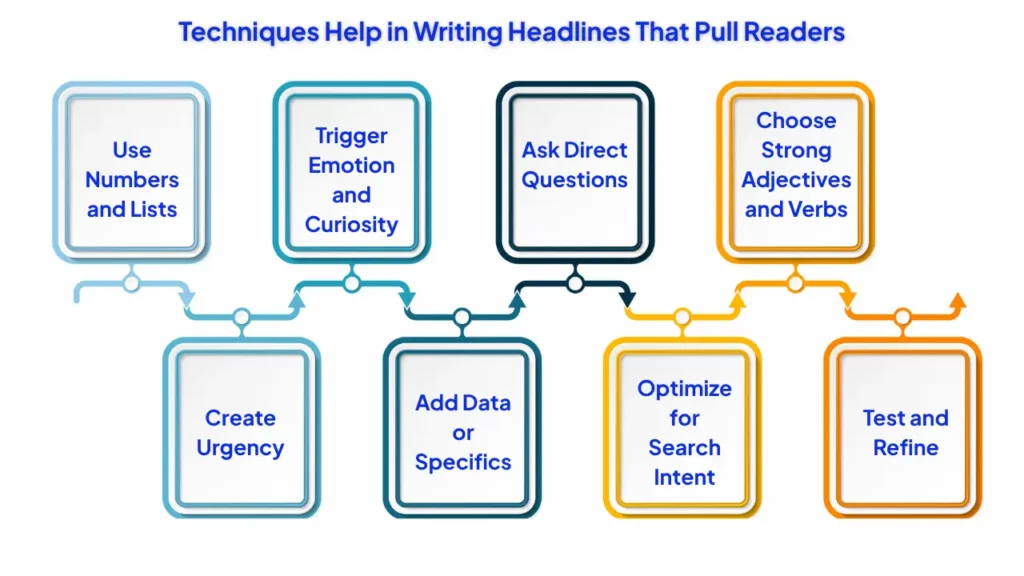
Use Numbers and Lists
List-style headlines consistently perform better because they set expectations. For example, “7 Proven Ways to Boost Conversions” promises structure and tangible takeaways.
Trigger Emotion and Curiosity
Emotional triggers like urgency, excitement, or fear of missing out make headlines compelling. Pair this with curiosity-driven phrasing enough intrigue to spark a click, without giving everything away.
Ask Direct Questions
Questions echo a reader’s own search intent. A headline like “Is Your Website Losing Customers Without You Knowing It?” frames a pain point directly, inviting them to explore solutions.
Choose Strong Adjectives and Verbs
Replace vague words with powerful ones. Terms like “essential,” “proven,” or “effortless” convey authority and clarity. Pair them with dynamic verbs to drive urgency and action.
Create Urgency
Real timing cues such as “limited-time offer” or “before midnight” can boost click-throughs when the scarcity is genuine. Fake urgency backfires; authenticity is key.
Add Data or Specifics
Specificity builds trust. Headlines with numbers, frameworks, or research-backed claims (e.g., “Boost Engagement by 73%”) often outperform vague promises.
Optimize for Search Intent
Headlines should not only entice humans but also signal relevance to search engines. Incorporating primary keywords while keeping the flow natural helps capture both audiences.
Test and Refine
No headline is final. A/B testing across channels email subject lines, social snippets, or blog titles helps identify patterns in what resonates most with your audience.
💡A headline isn’t just decoration it’s the hook that determines whether the rest of your content has a chance to convert.
What are proven ways to write CTAs that get people to act?
High-performing CTAs are essential to content that converts, combining strong wording, clear value, and smart placement. They guide users toward the next step while removing hesitation.
Use Action-Oriented Verbs
CTAs that start with decisive verbs like “Download,” “Start,” or “Claim” outperform vague prompts such as “Click here.” Action-oriented language gives readers clarity and momentum, making the next step obvious and appealing.
Emphasize Value, Not Just Action
A CTA should highlight the benefit of clicking, not just the action itself.
For example:
❌ Weak: “Sign up now”
✅ Strong: “Sign up now to save 20% on your first order.”
By linking the action directly to a reward, you make the decision easier.
Create Genuine Urgency
Timing cues like “Ends tonight” or “Limited-time offer” push users to act sooner rather than later. But urgency must be real false scarcity damages trust. When offers are authentic, urgency can significantly improve click-through and conversion rates.
Keep CTAs Short and Direct
Effective CTAs are concise usually five words or fewer. HubSpot and other studies show shorter CTAs perform better because they are easier to process at a glance, especially on mobile devices where attention is limited.
Place CTAs Strategically
Don’t hide your CTA at the very end. Place one above the fold for quick action, another mid-content for engaged readers, and one at the conclusion for decision-ready visitors. This mirrors the natural flow of the user journey.
Use Personalization to Boost Engagement
Personalized CTAs convert far better than generic ones. HubSpot’s research found that personalized CTAs converted 202% more than standard versions by making offers feel directly relevant to the reader.
Test and Refine Constantly
No CTA should be considered final. Use A/B testing to compare variations in copy, placement, color, or design. Continuous testing ensures your CTAs evolve with audience preferences and consistently deliver better results.
💡 By combining urgency, personalization, and benefit-driven language, CTAs shift readers from passive engagement to active conversion.
How does SEO contribute to higher conversion rates in content?
SEO directly impacts conversions by driving qualified traffic, aligning with user intent, and ensuring a seamless experience that builds trust. When optimized properly, it does more than bring visitors it increases the likelihood they’ll take meaningful action.
Visibility Brings Targeted Traffic
Ranking for the right queries attracts visitors who are already searching for your solution. This makes organic traffic highly qualified compared to paid or social clicks, which often capture less intent. High visibility ensures you meet users at the exact moment of need.
User Experience Matters
Google’s ranking factors emphasize speed, mobile responsiveness, and ease of navigation all of which double as conversion levers. A slow or clunky page drives abandonment, while smooth UX keeps readers engaged long enough to convert.
Intent Alignment via Semantic SEO
Modern SEO is about intent, not just keywords. Covering topics with semantic depth and clustering content around buyer stages ensures you guide visitors from awareness to decision. This helps searchers find exactly what they need at every step of their journey.
Content That Builds Trust
SEO-optimized content must go beyond ranking it should provide clear, valuable answers. Reinforcing trust through AI and E-E-A-T principles ensures your authority stands in both human and AI-driven evaluations.
When you solve problems first and delay the sales pitch, you establish authority and credibility. That trust becomes the foundation for conversions later.
Technical Signals Enhance Confidence
Site speed, SSL security, and mobile usability aren’t just ranking signals they shape user perception. A secure, fast-loading, mobile-friendly site signals professionalism and reliability, reducing bounce rates and building confidence to convert.
Rich Media Improves Engagement
Embedding videos, visuals, and infographics improves dwell time and simplifies complex ideas. These elements increase content clarity and also support higher rankings, creating a dual effect: better visibility and more persuasive experiences.
💡 The next frontier is optimizing for LLM and AI-driven search. Structured data, entity-rich clusters, and concise, answer-first sections will ensure your content not only ranks but also gets surfaced in AI-powered overviews.
Should marketers use long-form or short-form content to increase conversions?
The choice between long-form and short-form is central to creating content that converts, since audience behavior and channels dictate effectiveness. Both play complementary roles in the conversion journey.
Short-Form Content: Fast Engagement
- Best on attention-limited feeds (TikTok, Instagram, X).
- Great for brand exposure, snackable insights, and sparking interest.
Long-Form Content: Depth and Trust
- Addresses pain points in detail, builds authority, and handles objections.
- Well-suited for high-intent audiences at later stages of the journey.
Audience and Channel Differences
- Social-first audiences prefer quick, highly visual content.
- B2B and SaaS buyers expect depth, guides, and data-backed comparisons.
- Email often blends both short CTAs that link to deeper resources.
Hybrid Strategy: Pillars + Snippets
- Create pillar assets (in-depth guides, webinars, case studies).
- Repurpose content with AI into snippets (reels, carousels, threads) to widen reach efficiently.
Test and Measure Continuously
A/B test formats, watch engagement, and track assisted conversions to find your best mix.
How can I evaluate whether my content is actually driving conversions?
Measuring effectiveness requires clear goals, the right metrics, and tying behavior to outcomes.
Define Conversion Goals
Choose actions that count purchases, sign-ups, submissions, downloads to avoid vanity metrics.
Track Key Metrics
- Conversion rate (goal completions ÷ total visitors)
- Click-through rate (CTR)
- Bounce rate
- Lead volume
Use Analytics and Behavior Tools
- GA4 for journeys and goal attribution
- Hotjar or PostHog for scroll, click, and drop-off behavior
- CRM dashboards for pipeline and revenue by content
Apply UTM Parameters
Track channel and content performance across social, email, and paid campaigns.
Analyze Engagement Signals
Scroll depth and time on page show whether content is being consumed.
Use Conversion Tracking and Goal Values
Assign event values to estimate ROI (e.g., valuing a download by lead-to-customer rate). Content Marketing Institute.
Employ Attribution Models
- First-touch highlights awareness value
- Last-touch shows decision impact
- Linear balances credit across touchpoints
Iterate With Testing
A/B test headlines, CTAs, and formats. Build a feedback loop so each new asset benefits from the last.
What common pitfalls should I avoid to make my content convert better?
Conversion-focused content often fails when basic mistakes disrupt trust, clarity, or usability. Avoiding these pitfalls ensures readers stay engaged and move smoothly toward action.
Avoid an Overly Promotional Tone
When content reads like a sales pitch, readers lose interest quickly. Focus first on solving real problems and offering insights. Once trust is established, a sales message feels natural rather than pushy.
Fix Weak or Missing CTAs
A vague “Click here” or missing CTA leaves readers without direction. Instead, guide them with clear, benefit-driven prompts like “Download the free guide” or “Start your trial today.” This makes the next step obvious.
Remove Friction in the Flow
Lengthy forms, too many redirects, or extra clicks can kill conversions. Streamline processes by asking only for essential details and minimizing steps, making the path to action effortless.
Improve Load Speed
Even a one-second delay can significantly reduce conversions and increase bounce rates. Optimize images, use compressed media, and defer non-essential scripts so users stay instead of leaving.
Honor Audience Context
Generic content misses the mark. Use audience surveys, analytics, and social listening to understand timing, tone, and needs. Content that reflects real context resonates and converts better.
Avoid Keyword Stuffing
Overloading keywords hurts readability and damages credibility. Focus on semantic coverage and natural phrasing to maintain both SEO performance and a human-centered experience.
Publish Consistently
Irregular posting weakens authority and trust. Use a content calendar to stay consistent, and repurpose long-form assets into smaller pieces to maintain a steady presence across channels.
Optimize for Mobile
With mobile traffic dominating, responsive design and simplified UX are essential. Buttons should be thumb-friendly, layouts easy to navigate, and copy scannable on small screens.
Use Data to Iterate
Guesswork stalls growth. Leverage analytics, A/B testing, and heatmaps to refine strategies based on what actually drives results. Iterating with data compounds gains over time.
Advanced Strategies for 2025 and Beyond
The future of conversion-driven content goes beyond fundamentals. By layering advanced tactics, you can stay ahead of shifting algorithms, user behaviors, and AI-powered search environments.
AI-Powered Personalization
Predictive engines now analyze user behavior in real time to serve tailored CTAs, offers, and content. For example, dynamic landing pages that adapt headlines or product recommendations based on browsing history see higher engagement and conversion rates.
Omnichannel Distribution Loops
Don’t let content live in a single channel. Repurpose pillar assets like in-depth guides or webinars into social snippets, carousel posts, newsletters, and reels. This creates multiple touchpoints across the customer journey and maximizes ROI on every piece you produce.
Data Refreshes for Evergreen Assets
High-performing guides and case studies lose power if they age. Quarterly refreshes with updated stats, screenshots, and references keep your evergreen content competitive in SERPs and relevant for users, sustaining both rankings and conversions.
Structure for LLM & AI Visibility
AI-driven search tools (like Google’s SGE and ChatGPT) pull from structured, semantically rich sources. Optimizing with techniques like chunking content for AI search improves visibility in AI overviews.
Optimize by adding FAQs, schema markup, and entity-rich clusters. Well-structured content increases the chance of being cited or surfaced in AI-generated overviews, multiplying reach and trust.
💡 By eliminating pitfalls and applying these future-focused strategies, you strengthen credibility, improve user experience, and design content that converts in both traditional search and AI-first ecosystems.
FAQs
Conclusion: turning content into conversions
Ultimately, content that converts only works when it guides readers from attention to action. This guide answered the 10 most common questions from customer-focused creation and strong CTAs to SEO, storytelling, and format choices.
The thread tying it all together: clarity, trust, and alignment with audience intent. Respect the journey, simplify the path, and remove friction so conversions follow naturally.
Actionable Checklist: Content That Converts
Define your audience’s pain points before writing.
Craft headlines with clarity, value, and pull.
Map content to the buyer’s journey (awareness → decision).
Use storytelling to build emotional connection and trust.
Place specific, benefit-driven CTAs at strategic points.
Optimize for SEO, semantic intent, and on-page structure.
Test both long-form and short-form formats.
Track conversions with analytics, attribution, and heatmaps.
Eliminate friction: slow load times, vague CTAs, or poor mobile UX.
Keep content updated, data-driven, and user-focused.