Starting a startup is exciting, but let’s be honest, legal tasks rarely feel like the fun part. Still, skipping them can quietly create risks that show up when you least expect it. That’s why having a clear legal checklist early on feels less like paperwork and more like a safety net you will be glad you built.
Whether you are launching a tech startup, a consultancy, an ecommerce store, a food business, or a solo services company, legal gaps affect everyone. The only difference is how early the damage shows up.
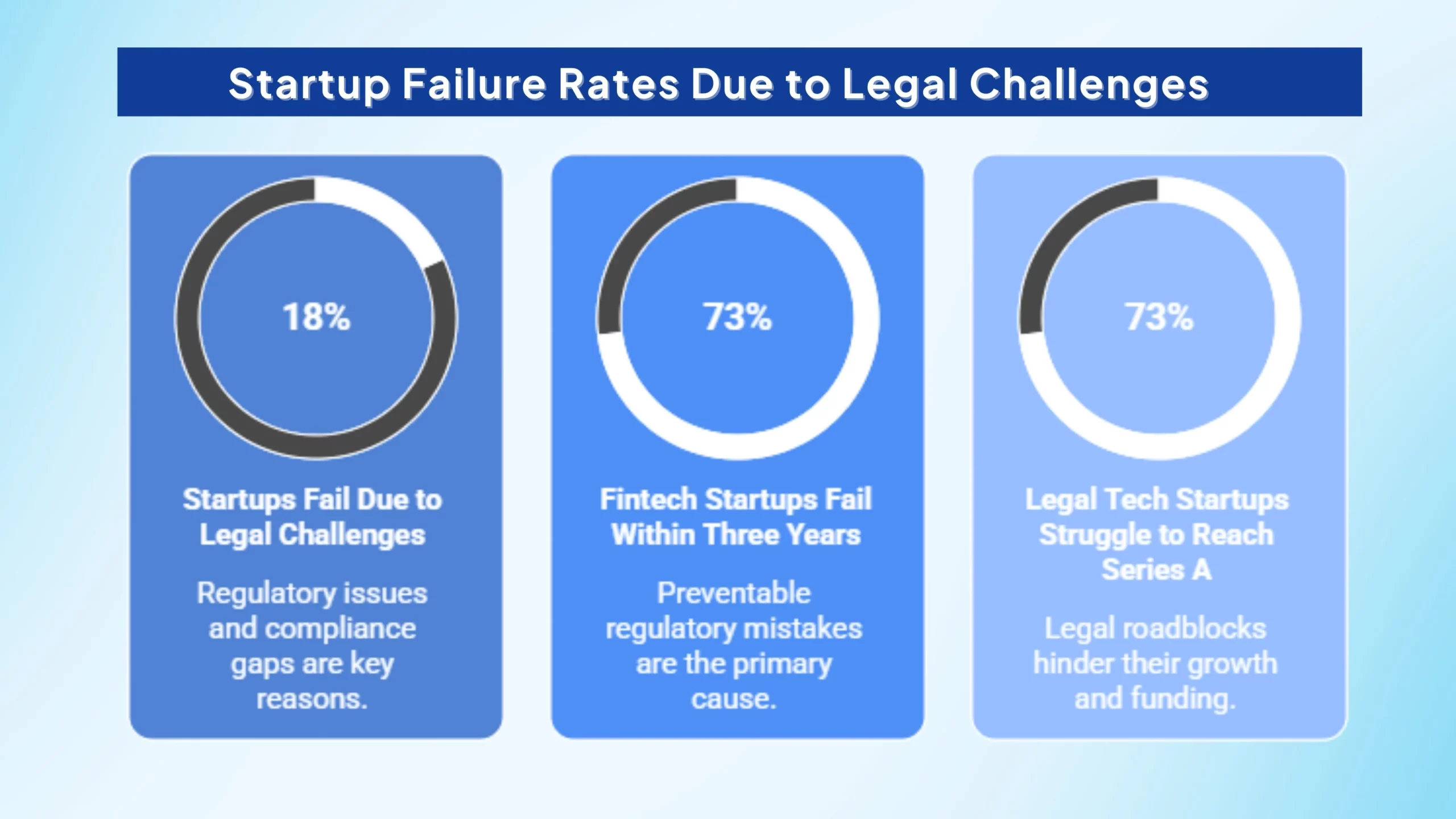
Here is the reality most founders do not hear enough. Around 18% of startups fail due to legal challenges, including regulatory issues and compliance gaps. In fintech, the picture is even tougher, where 73% fail within three years, mostly because of preventable regulatory mistakes.
Even legal tech startups are not immune, with 73% struggling to reach Series A after running into similar legal roadblocks. This guide walks you through a lean, practical legal checklist for startups. It covers core compliance checklist for startups, founder agreements, contracts, and risk protection without overwhelming you.
You will also find a free PDF checklist you can download and use at every stage of growth, so legal readiness becomes a habit, not a headache.
A legal checklist for startups covers the core legal steps founders need to stay compliant, reduce risk, and scale safely. It focuses on prevention first entity setup, contracts, IP, and compliance then adds repeatable systems for hiring, fundraising, and audits as the company grows.
1. Foundational Setup & Legal Compliance
- Register the company and choose the right legal structure
- Obtain tax IDs like EIN, PAN, or UEN
- Secure required business licenses and permits
- Consult startup legal and tax advisors early
2. Governance & Founder Agreements
- Define founder equity splits and vesting schedules
- Draft bylaws, operating agreements, or shareholder agreements
- Record board approvals and major decisions
- Prevent disputes with clear written agreements
3. Contracts & Commercial Readiness
- Review customer contracts for liability and termination terms
- Audit vendor and SaaS agreements for renewals and data ownership
- Use NDAs with contractors, partners, and advisors
- Standardize contracts and legal review thresholds
4. Employment & Workforce Compliance
- Classify workers correctly as employees or contractors
- Issue compliant offer letters and employment agreements
- Register payroll taxes and statutory benefits
- Document workplace policies and conduct rules
5. Intellectual Property Protection
- Trademark company names, products, and logos
- Secure copyrights for code, designs, and content
- Require IP assignment (This means the company owns the work, not the individual) from founders and contractors
- Protect trade secrets with NDAs and access controls
6. Financial, Banking & Insurance Setup
- Open dedicated business bank accounts
- Implement basic accounting and record keeping
- Obtain general liability and workers’ compensation insurance
- Maintain clean financial documentation for audits
7. Data Privacy & Industry Regulations
- Comply with GDPR, CCPA, DPDP, or local privacy laws
- Address industry-specific regulations early
- Implement data access and security controls
- Monitor regulatory changes as the startup scales
8. Legal Audits, Fundraising & Scale Readiness
- Run quarterly legal and compliance reviews
- Prepare clean cap tables (A detailed record showing company ownership, equity dilution, shares, and investor stakes) and governance records
- Ensure IP and contracts are investor-ready
- Treat legal compliance as an ongoing system
What is Legal Checklist for Startups?
A legal checklist for startups is a simple way to make sure your business is legally sound from the very beginning. It helps founders understand what needs attention so nothing critical slips through the cracks. This matters because studies show that nearly 30% of small businesses face legal issues, often due to missed startup compliance checklist or unclear agreements.
More importantly, a legal checklist acts like a preventive tool rather than a reaction plan. Research indicates that startups with proper legal foundations are up to 50% more likely to survive compared to those that wing it. In short, it gives you structure, reduces uncertainty, and lets you focus on building your product and customers without constant legal anxiety.
How Do I Choose the Right Legal Structure for My Startup Like LLC or Corporation?
Choosing the right legal structure for your company or AI startup, like LLC or Corporation is a critical decision that affects liability, taxation, management, and your ability to raise capital. The best choice depends on how you plan to grow, manage risk, and handle taxes over time.
For example, a solo consultant, agency owner, or ecommerce seller may prefer an LLC because it is simple, flexible, and easier to manage. In contrast, a startup planning to raise venture capital or issue shares to investors often chooses a C Corporation because it is designed for scalable growth and equity-based funding.
Both LLCs and corporations provide limited liability protection, meaning your personal assets are generally protected from business debts and legal claims. However, they serve different strategic goals. A solo founder or small team may value the operational flexibility of an LLC, while a fast-growing startup may prioritize the investment readiness of a corporation.
Key Differences Between LLCs and Corporations
1. Liability Protection
LLC: Offers limited liability protection, safeguarding personal assets from business debts and lawsuits.
Corporation: Also provides limited liability, ensuring shareholders are not personally responsible for corporate obligations.
2. Taxation
LLC: By default, LLCs use pass-through taxation, where profits and losses are reported on the owners’ personal tax returns, helping avoid double taxation. This structure is often ideal for early-stage startups that want tax simplicity.
C Corporation: Subject to double taxation, where the corporation pays taxes on profits and shareholders pay taxes again on dividends. Despite this, many startups accept this tradeoff to access venture capital.
S Corporation: Allows pass-through taxation but comes with restrictions on shareholder numbers and types, which can limit growth potential.
3. Management and Startup Compliance Setup
LLC: Offers flexible management structures with fewer formal requirements. There is no obligation for annual meetings or extensive record-keeping, which helps founders move fast in the early stages.
Corporation: Requires a formal structure, including a board of directors, officers, and regular meetings, along with stricter compliance obligations.
4. Raising Capital
LLC: Has limitations when it comes to raising capital because it cannot issue stock, making it less attractive to venture capital firms and institutional investors.
Corporation: Easier to raise capital due to the ability to issue shares and stock options, which is why most venture-backed startups incorporate as C Corporations early on.
5. Credibility and Perception
LLC: May be perceived as less formal, which can sometimes affect credibility with investors or enterprise clients.
Corporation: Often viewed as more established and investor-ready, which can enhance trust and credibility.
6. Transitioning Between Structures
Many founders choose to start as an LLC and later convert to a corporation as funding, hiring, and scale become priorities. This approach keeps things simple early on while preserving flexibility for future growth. This transition is common and well-documented by startup legal experts, including Startup Savant and GoDaddy, who note that structure changes are a normal part of scaling a business.
Term to know:
Pass-Through Taxation
A tax structure where business profits are taxed on the owner’s personal tax return instead of at the company level.
Can You Provide a Step-by-Step Legal Checklist for Starting a Startup?
Starting a startup is exciting, but legal missteps can quietly derail progress. With compliance-related data breaches costing $4.61 million on average in 2025 and hitting startups harder due to limited runway, building a strong legal foundation early is critical. This checklist helps founders reduce risk, stay compliant, and scale with confidence.
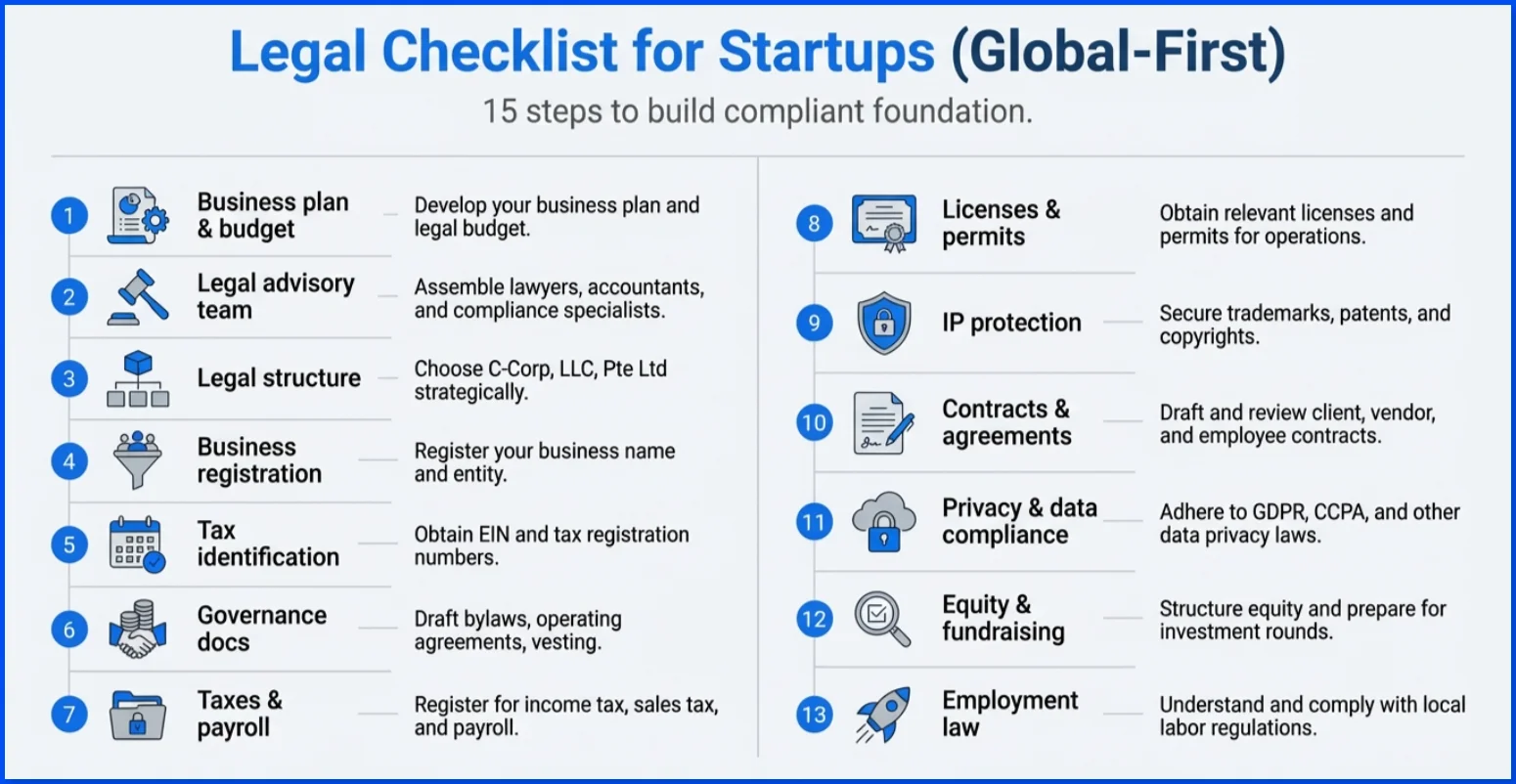
Step 1: Develop Your Business Plan and Legal Budget
Before you file anything, map out your first 12 to 18 months clearly. A strong plan prevents legal misalignment, like forming an LLC when you actually need VC funding, since most investors only back C Corporations. It also helps you choose the right country and structure for your target market.
What your plan should cover
Financial projections you must define early
- Expected runway based on burn rate and cash position
- Legal and compliance budget allocation
- Revenue milestones tied to growth stages
Estimated legal setup costs by country
| Country | Registration Costs | Annual Compliance | Legal Setup |
|---|---|---|---|
| USA (Delaware) | $100–$500 | $800–$2,000 | $2,000–$5,000 |
| Singapore | $500–$2,000 | $1,500–$3,000 | $1,000–$3,000 |
| UK | £12–£50 | £500–£1,500 | £1,000–£3,000 |
| India | ₹10,000–₹25,000 | ₹20,000–₹50,000 | ₹25,000–₹75,000 |
| Estonia | €200–€500 | €500–€1,500 | €500–€1,500 |
Source: World Business Outlook 2025 Startup Jurisdictions Report
If you are not building a tech startup:
Your business plan should focus less on investor funding and more on cash flow stability, licensing, and operational costs. For example, a service business, retail store, agency, or food venture should plan around monthly profitability, supplier contracts, rent, and compliance costs rather than runway for fundraising.
What your plan should cover:
- Add these bullets after the existing list:
- Fixed monthly costs such as rent, utilities, and licenses
- Supplier or vendor payment cycles
- Local compliance and renewal fees
- Break-even timeline instead of VC runway
Step 2: Assemble Your Legal Advisory Team
Legal mistakes are expensive and hard to reverse when starting a business. According to Thomson Reuters C Suite Survey 2025, 77% of global leaders say compliance directly supports business success. Founders without legal guidance often face contractor misclassification fines, IP ownership disputes, and costly tax errors.
Your core legal team:
Startup lawyer
- Focus areas: formation, contracts, IP, fundraising
- Cost range:USA: $200–$600 per hourUK: £150–£400 per hourSingapore: $150–$400 per hour
- Best time to hire: before incorporation
Accountant or tax advisor
- Focus areas: tax setup, financial records, R&D credits
- Cost: $1,500–$5,000 per year
- Best time to hire: immediately after formation
Compliance specialist (if regulated)
- Focus areas: data privacy, fintech, health or EU regulations
- Cost: $150–$400 per hour or fractional retainer
- Needed if you handle payments, health data, or EU users
Did you know?
Non-tech founders don’t need a full legal team upfront.If you’re running a small service business, ecommerce store, or consultancy, you can start with a general business lawyer and a strong accountant, and only involve specialists when your business grows or enters regulated areas.
Step 3: Choose Your Legal Structure Strategically
Your legal structure controls how you pay taxes, who can invest, your personal liability, and how easy fundraising and exit will be. Choosing wrong early can slow growth or scare investors away.
If you are building a non-tech or service-based business, your legal structure should prioritize tax efficiency, personal liability protection, and operational simplicity, not investor expectations. Many profitable businesses never raise venture capital and still scale sustainably.
Critical insight
Most VCs only invest in C Corporations due to tax and equity clarity. Converting later from an LLC can cost $2,000 to $10,000 and create tax issues.
United States structures
| Structure | Best For | Taxation | VC Friendly | Cost |
|---|---|---|---|---|
| C Corp | VC backed startups | 21% federal + state | Yes | $500–$2,000 |
| LLC | Bootstrapped businesses | Pass through | No | $200–$800 |
| S Corp | Small US owned firms | Pass through | Limited | $500–$1,500 |
VC Insight: While 41.4% of startups form as LLCs, most VC funding goes to C Corporations (KingsCrowd 2025).
Decision guide
- Choose C Corp (USA) if you want VC funding and global scale
- Choose LLC (USA) if you are bootstrapping and profit focused
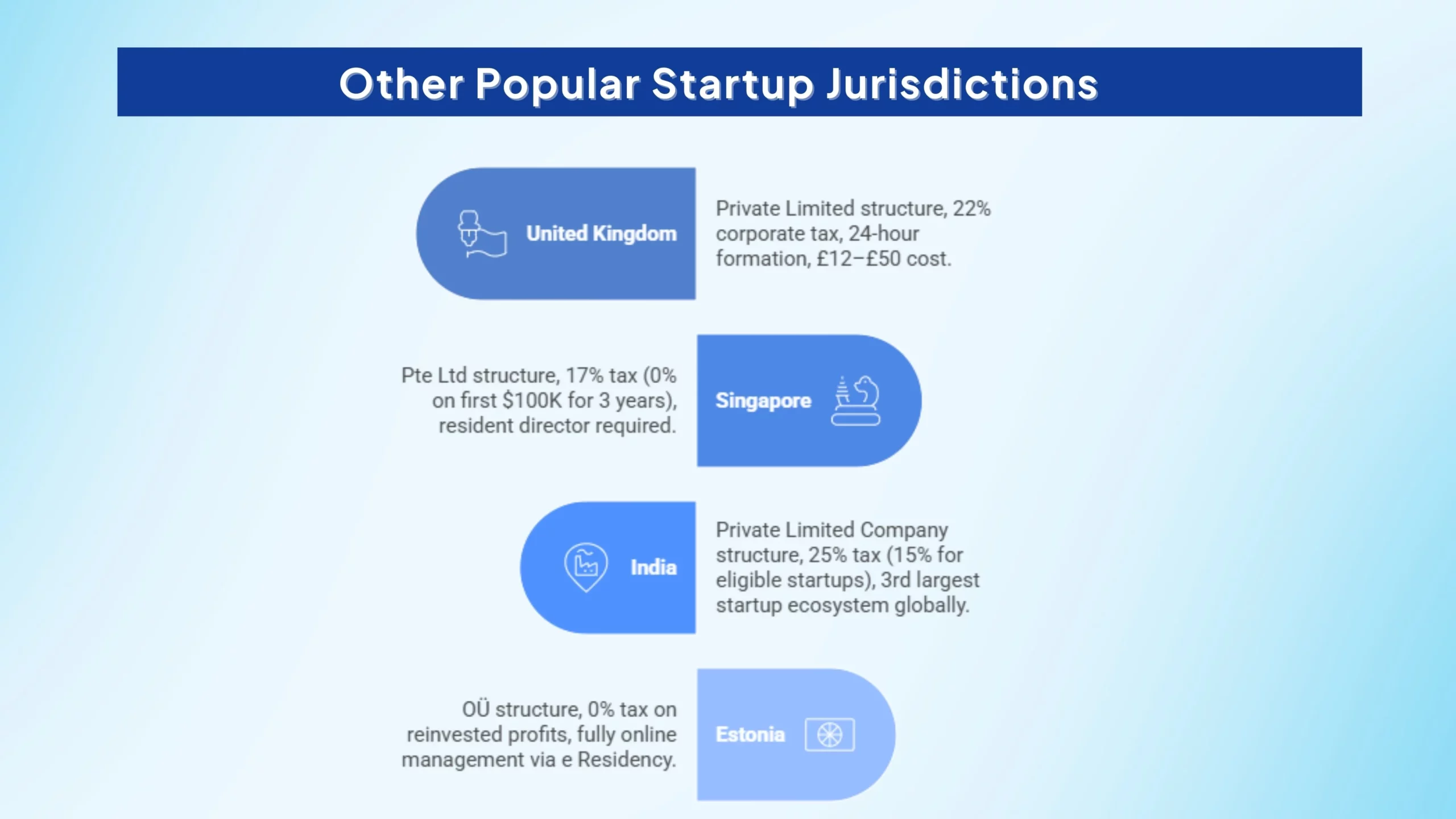
- Choose Pte Ltd (Singapore) for Asia focused expansion
- Choose Private Limited (India) for Indian VC access
- Choose OÜ (Estonia) for remote SaaS and EU presence
Step 4: Register Your Business Name and Entity
This step legally creates your company, whether you are starting a tech startup, a service business, a retail store, an ecommerce brand, or a solo consultancy. Registration allows you to open a business bank account, sign contracts in your company’s name, issue invoices, and legally hire employees or contractors.
For non-tech businesses, registration is especially important because it separates your personal assets from business liabilities. Without a registered entity, debts, legal disputes, or tax issues can directly impact your personal savings, property, or income.
Registration overview by country
| Country | Registration Time | Registration Cost | Key Benefit |
|---|---|---|---|
| United States (Delaware) | 1 to 2 days | $100–$500 | 67% of Fortune 500 companies are incorporated here |
| Singapore | 1 to 2 days | Approx $235 plus director fees | Grants available up to $50,000 for startups |
| United Kingdom | 24 hours | £12–£50 | Corporation Tax registration required within 3 months |
| India | 7 to 10 days | ₹10,000–₹25,000 | Tax benefits and faster patent processing for startups |
| Estonia | 1 to 2 days (after e Residency) | €200–€500 | Fully digital company setup |
Name protection checklist
Before filing, always check:
- Trademark databases
- Domain availability
- Social media handles
Step 5: Obtain Tax Identification Numbers
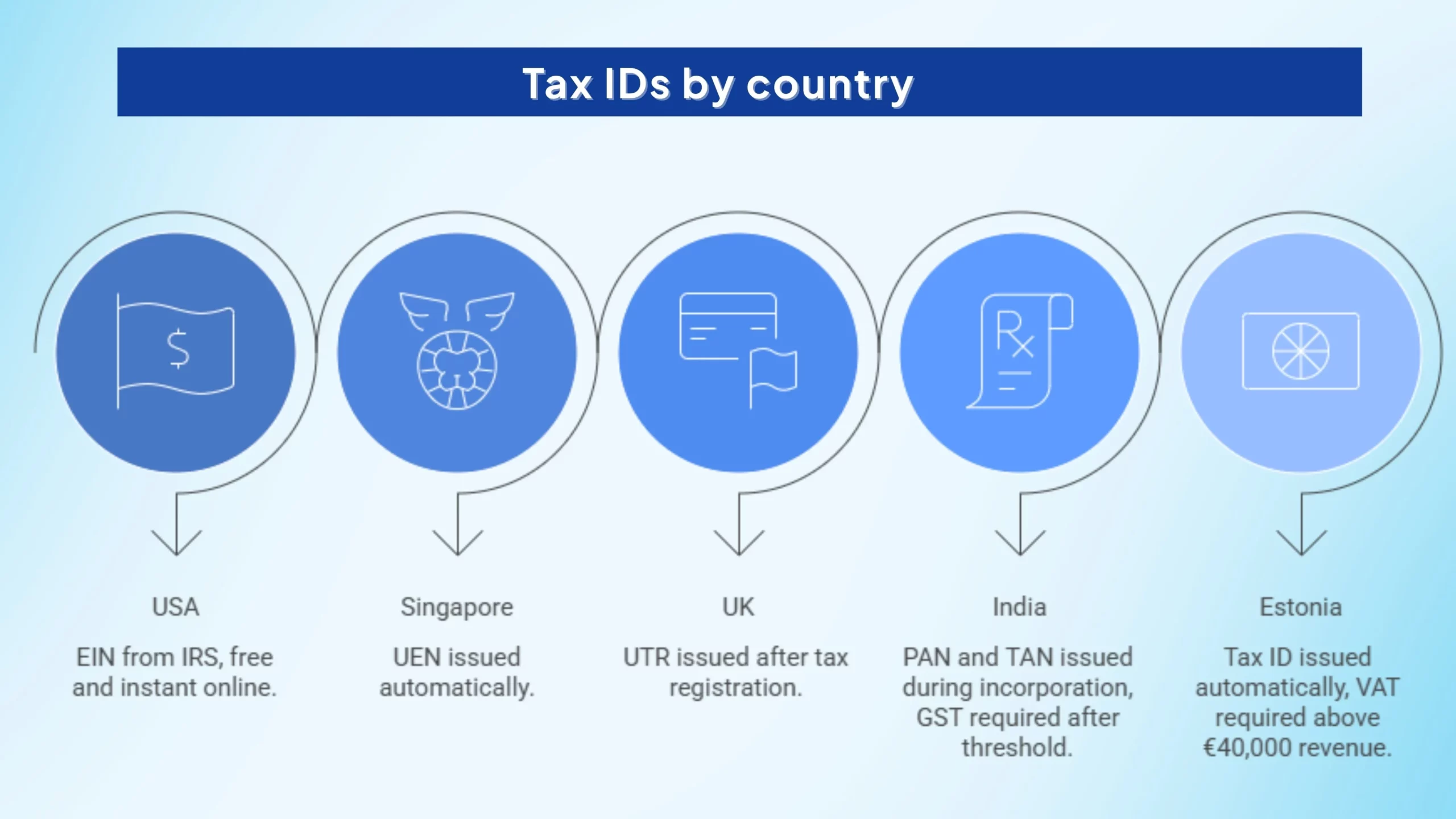
Tax identification numbers are required for every type of business, whether you are running a tech startup, a consultancy, a retail store, a food business, or an online service. Without the correct tax IDs, you cannot open a business bank account, issue invoices, hire employees, pay taxes, or work with many clients and vendors.
For non-tech businesses, tax IDs are especially important because payments, supplier contracts, and tax filings are closely monitored. Operating without proper registration can lead to penalties, frozen accounts, or business shutdowns, even if the business is small or home-based.
Quick action checklist
✓ Apply immediately after formation
✓ Store securely in one folder
✓ Share with accountant and payroll provider
Step 6: Draft Internal Governance Documents
Founder disputes are one of the biggest reasons early-stage startups collapse when learning how to start a business. Clear governance documents prevent confusion around ownership, control, and what happens when someone leaves.
They protect you from disputes related to ownership percentages, decision-making authority, equity vesting, intellectual property ownership, and founder exits.
Core governance documents by structure
For C Corporations (USA)
- Certificate of Incorporation: Filed with the state and defines authorized shares, directors, and the registered agent.
- Bylaws: Internal rules covering board structure, officer roles, voting rights, and meeting procedures.
- Stock Purchase Agreement: Defines how founder shares are issued, vesting schedules, and transfer restrictions.
- Founder or Vesting Agreement: Sets founder equity, prevents dead equity, assigns IP to the company, and includes confidentiality terms.
- Board Consents or Minutes: Formally approves initial actions like equity grants and officer appointments.
- Standard vesting practice: 4 year vesting with a 1 year cliff. 25% vests after year one, then monthly.
Term to know:
Vesting Schedule
A timeline that determines when founders or employees earn their equity, often including a one-year cliff.
For LLCs (USA)
Operating Agreement: Defines ownership, management structure, profit allocation, capital contributions, transfer rules, and dissolution process.
For Private Limited Companies (UK)
- Memorandum of Association: Confirms the founders intend to form the company.
- Articles of Association: Sets company rules, share transfers, director duties, and shareholder meetings.
- Shareholders’ Agreement (recommended): Covers founder rights, deadlock resolution, exit provisions, and drag or tag clauses.
For Pte Ltd (Singapore)
- Company Constitution: Defines share structure and transfer restrictions.
- Shareholders’ Agreement: Covers vesting, reserved matters, and exit rights.
- Director Resolutions: Approves bank accounts, registered office, and setup actions.
For Private Limited Companies (India)
- Memorandum of Association: Defines company objectives and scope.
- Articles of Association: Governs internal management.
- Shareholders’ Agreement: Covers equity split, decision rights, and dispute resolution.
- Board Resolutions: Required for operational approvals and statutory compliance.
Common governance mistakes to avoid
❌ No vesting schedules leading to dead equity
❌ Equal equity splits without discussion
❌ Missing IP assignment clauses
❌ Relying on verbal agreements
Step 7: Register for Taxes and Payroll
You cannot legally operate, hire, or pay yourself without proper tax registration. Non-compliance can trigger heavy fines and even criminal penalties in some countries.
Tax registration overview
- United States: EIN registration, federal and state income tax, payroll tax, and sales tax where applicable. Willful FLSA violations can lead to fines up to $10,000 and imprisonment.
- Singapore: Corporate tax filing, GST registration if applicable, withholding tax for non-residents, and CPF contributions for employees.
- United Kingdom: Corporation tax, PAYE, VAT if turnover exceeds £85,000, and National Insurance contributions.
- India: PAN and TAN, GST registration, TDS compliance, and employee provident fund obligations.
- Estonia: Automatic registration with VAT and social tax requirements for resident employees.
FLSA Compliance:
Willful violations can result in criminal penalties up to $10,000 and even imprisonment (US Department of Labor)
Step 8: Obtain Required Licenses and Permits
Operating without required licenses can lead to business shutdowns, fines, void contracts, frozen bank accounts, and legal action, whether you run a tech startup or a non-tech business like a shop, service firm, or online store.
License categories
- General business licenses: City or state registrations depending on country.
- Industry-specific licenses: Fintech, healthcare, food, education, and ecommerce businesses face stricter requirements.
- Professional licenses: Required for legal, accounting, healthcare, real estate, and engineering services.
Did you know?
Global Data Protection Stats:
- €2.4 million in GDPR penalties issued as of February 2025 for non-compliance (Vanta Compliance Statistics)
- 63% of executives cite complex data across organizations as making compliance more difficult (PwC Global Compliance Survey 2025)
Step 9: Open a Dedicated Business Bank Account
A separate business bank account is essential for all businesses, not just tech startups. Mixing personal and business finances can eliminate liability protection, complicate tax filings, and create problems during audits or funding discussions.
For non-tech businesses, this often causes issues with expense tracking, tax compliance, supplier payments, and bank reviews. In simple terms, a dedicated account keeps your money clean, your records clear, and your business legally protected.
Bank account setup overview
Each country requires incorporation documents, identity verification, and board authorization. Many modern banks now support remote onboarding for startups.
Action checklist
✓ Open account within 2 weeks of formation
✓ Never use personal accounts for business expenses
✓ Integrate bank with accounting software
✓ Set founder reimbursement rules
Step 10: Implement Accounting and Compliance Systems
Poor financial records are the second biggest reason startups fail due diligence, right after legal issues. Investors expect clean books and accurate reporting.
- Accounting basics: Cash basis works for early startups under $1M revenue. Accrual accounting is preferred by investors and required for larger companies.
- Compliance tracking: Use a quarterly compliance calendar to track tax filings, board meetings, license renewals, and audits.
- Document management essentials: Maintain formation records, tax filings, contracts, IP documents, financial records, board minutes, and regulatory filings securely.
Quarterly Compliance Calendar:
| Quarter | Compliance Tasks |
|---|---|
| Q1 (Jan-Mar) | • File previous year tax returns • Review insurance policies • Audit governance documents • Delaware Annual Report (due March 1) |
| Q2 (Apr-Jun) | • Quarterly financial review • Employee handbook updates • License renewals • Mid-year tax planning |
| Q3 (Jul-Sep) | • Compliance mini-audit • Contract review cycle • Benefits enrollment prep • Q3 estimated taxes |
| Q4 (Oct-Dec) | • Year-end tax planning • Annual board meetings • Budget planning for next year • Compliance report to board |
Did you know?
Compliance Audit Statistics
- 92% of organizations conducted at least 2 audits in 2025 (A-LIGN Report)
- Average US firm spends 1.3–3.3% of wage bill on regulatory compliance (Cato Institute 2024)
Step 11: Protect Your Intellectual Property
Your intellectual property is often your startup’s most valuable asset and the easiest to lose. Investors closely examine IP ownership during due diligence, and even one missing IP assignment from a contractor can derail funding or acquisition talks.
In 2024, 3.7 million patent applications were filed globally, a 4.9% increase year over year, showing how competitive innovation has become.
What are the essential IP protections every startup needs early on?
1. Trademarks (brand protection)
Protects your company name, product names, logos, and slogans.
| Country | Cost per Class | Timeline | Protection |
|---|---|---|---|
| USA | $250–$350 | 6–12 months | 10 years, renewable |
| UK | £170–£200 | 3–4 months | 10 years, renewable |
| EU | €850 base | 4–6 months | 10 years, renewable |
| Singapore | SGD $280 | 6–9 months | 10 years, renewable |
| India | ₹4,500 | 12–18 months | 10 years, renewable |
Tip: In the USA, file an Intent to Use trademark before launch to lock your filing date.
2. Patents (invention protection)
Relevant for hardware, biotech, manufacturing processes, and some proprietary algorithms.
Typical costs (USA Example):
- Filing fees: $400–$1,820
- Legal fees: $5,000–$50,000
- Approval timeline: 1–3 years
UK Patent Costs Example:
- Filing fees: £60–£280
- Legal fees: £4,000–£20,000
- Approval timeline: 2–4 years
EU Patent Costs (EPO)
- Filing fees: €135–€3,500
- Legal fees: €10,000–€60,000
- Approval timeline: 3–5 years
Example for Singapore Patent Costs
- Filing fees: SGD 160–300
- Legal fees: SGD 4,000–20,000
- Approval timeline: 2–4 years
India Patent Costs (Example)
- Filing fees: ₹1,600–₹8,000
- Legal fees: ₹50,000–₹10,00,000
- Approval timeline: 3–5 years
Reality check:
The patent costs and timelines listed above are approximate estimates and may vary based on entity size, patent complexity, legal representation, and changes in government fee structures. Patent laws, official fees, and approval timelines are subject to change in each country.
Always verify the latest requirements and costs with the official patent office or a licensed patent attorney in your respective country before proceeding.
3. Copyrights (creative work protection)
Protects source code, designs, documentation, and content.
- Automatic upon creation
- Registration strengthens enforcement
- USA registration enables statutory damages up to $150,000 per work
4. Trade secrets (confidential IP)
Includes algorithms, customer lists, internal processes, and strategies.
Protected through NDAs, access controls, and security practices. No registration needed, but active protection is required.
5. The critical IP assignment rule
Every founder, employee, and contractor must sign an IP assignment agreement stating all work belongs to the company. This single oversight has killed many deals.
Step 12: Create Employment Agreements and Basic Policies
Many startups rush into hiring without putting core HR agreements in place. In reality, nearly 25% of startup employees leave within the first 15 months, and when employment terms are unclear, these exits often turn into disputes.
That’s why startups should first create essential employment agreements such as offer letters, employment contracts, and confidentiality agreements. Once these fundamentals are in place, basic HR policies help standardize behavior, expectations, and workplace rules, protecting both the company and the employee.
Core employment documents
Below are the core employment documents every founder should include in an HR checklist for startups to set clear expectations, protect company assets, and reduce hiring related risks from day one.
- Offer letter: Defines role, compensation, equity, benefits, start date, and employment type.
- Employment agreement: Covers job duties, pay, confidentiality, IP ownership, termination terms, and dispute resolution.
- Contractor agreement: Clearly separates contractors from employees and must include IP assignment.
Essential company policies
- Code of conduct and anti-harassment
- Data privacy and security
- Remote work guidelines
- Leave and time-off policies
- Expense reimbursement rules
Reminder: 63% of employees who reported misconduct faced retaliation, highlighting why written policies matter.
Step 13: Use NDAs Strategically
At some point, you will explain your idea to someone outside your company. This could be a developer, a supplier, a designer, a consultant, or even a potential partner. To protect this information, companies use a Non-Disclosure Agreement (NDA). An NDA is a legal document that clearly states what information must stay confidential and what happens if it’s shared without permission.
For example, a tech startup may use an NDA before sharing its app source code, product roadmap, or user data with a freelance developer or UI designer. Similarly, a non-tech startup might use an NDA when discussing supplier pricing, customer lists, marketing strategies, or business plans with consultants or vendors.
If you’re just starting out, you don’t need to draft an NDA from scratch. You can begin with standard NDA templates and customize them based on your business needs. Reliable examples and templates are available from:
- Nolo – Simple NDA templates and explanations
- LawDepot – Customizable NDA templates
- Rocket Lawyer – Free and paid NDA samples
- Y Combinator (for startups) – Founder-friendly NDA templates
Using a clear NDA early helps prevent misunderstandings, protects your business ideas, and builds professional trust as your company grows.
Key NDA clauses to include
- Clear definition of confidential information
- Permitted use only
- Term and exclusions
- Injunctive relief (A court order requiring a party to stop or start a specific action, commonly used in NDA breaches.)
- Governing law
NDA best practices
✓ Use standard templates
✓ Get signatures before disclosure
✓ Limit access internally
✓ Track expiration dates
Step 14: Understand Industry-Specific Regulations and Data Privacy
Highly regulated industries such as FinTech, HealthTech, EdTech, Food businesses, and other Tech startups must comply with strict legal and regulatory requirements. For example, FinTech SaaS companies often face high compliance costs, which can range from $250,000 to $3.2 million across multiple jurisdictions.
However, non-tech businesses are not exempt from compliance.
For example:
– A food business must follow health, safety, and licensing laws
– An ecommerce store must comply with consumer protection, returns, and data privacy rules
– A consulting business must handle contracts, taxes, and client data responsibly
Retail, service-based, manufacturing, and consultancy businesses must still follow labor laws, tax regulations, consumer protection rules, data privacy requirements, and industry-specific licenses.
While their compliance costs are generally lower than FinTech or HealthTech, failing to meet basic legal obligations can still result in fines, operational shutdowns, or legal disputes.
The key difference is complexity, not responsibility. Tech-heavy sectors face advanced regulatory frameworks, while non-tech businesses deal with foundational legal and operational compliance that is just as essential for long-term stability.
Did you know?
Data privacy laws you must know
GDPR (EU/UK):Fines up to €20M or 4% of global revenueLargest 2025 GDPR Fine: €530 million for unlawful data transfers (ComplianceHub 2025 Report)
CCPA (California):Up to $7,500 per intentional violation
PDPA (Singapore):Up to SGD $1 million
DPDP Act (India):Up to ₹250 crores
Step 15: Review All Contracts Before Signing
Bad contracts have locked startups into unaffordable leases, exposed them to unlimited liability, and even blocked acquisitions issues that are often overlooked in a launch readiness checklist. For example, a startup may sign a long-term office lease without an exit or sublease clause, forcing it to pay rent even after downsizing or going remote.
In another case, a poorly drafted vendor or client contract may include unlimited liability clauses, making the founder personally responsible for large financial losses.
Bad contracts can also hurt future growth. Startups have lost acquisition deals because early agreements contained exclusive partnerships, non-transferable licenses, or missing IP ownership clauses, preventing buyers from fully acquiring the company’s assets.
Contracts to review carefully
- Customer agreements
- Vendor and SaaS contracts
- Office leases
- Partnership agreements
Contract red flags
❌ Unlimited liability
❌ No termination rights
❌ Vendor ownership of your data or IP
❌ Automatic renewals with no exit
When to involve legal counsel
Always review contracts that involve IP, long-term commitments, partnerships, executives, or values over $50,000.
Action checklist
✓ Read every contract fully
✓ Set legal review thresholds
✓ Track renewals and expirations
✓ Standardize templates
Final reminder
Legal readiness is not about slowing down. It’s about removing friction so your startup can grow, raise funds, and exit without hidden risks.
Is There a Free Legal Checklist Template for Startups in 2026?
Yes, there is a free, printable legal checklist for startups that founders can use throughout 2026 to stay organized and compliant.
- Review it regularly: use it as a running reference to track legal tasks alongside weekly startup priorities.
- Adjust as you grow: expand the checklist when you start hiring, raising funds, or entering new markets.
- Revisit it every quarter: especially after major changes like team expansion, new contracts, or regulatory updates.
Can You List the Top Legal Milestones for a Startup’s First Year?
The first year sets the legal tone for your startup. Hitting the right milestones early helps you avoid costly fixes later and makes growth, hiring, and fundraising much smoother.
- Choose the right legal structure to align with your tax needs, liability protection, and future funding plans.
- Register your business properly, including EIN, state filings, and required local permits.
- Protect your intellectual property by securing trademarks, copyrights, and using NDAs when sharing confidential startup ideas.
- Draft founder and employment agreements that clearly define roles, equity splits, vesting schedules, and confidentiality.
- Comply with employment laws by correctly classifying workers, setting up payroll, and implementing workplace policies.
- Set up financial systems, including a dedicated business bank account to separate personal and company finances.
- Obtain necessary insurance such as general liability, professional liability, and workers’ compensation where required.
- Comply with privacy regulations like GDPR or CCPA if you collect or process personal data.
- Establish contracts with vendors and partners to clearly define responsibilities, pricing, and IP ownership.
- Prepare for future fundraising by understanding equity dilution, investor rights, and legal readiness for due diligence.
Did you know?
Is It Worth Forming an Operating Agreement for a Single-Member LLC?
Yes, forming an Operating Agreement for a single-member LLC is absolutely worth it, even if your state does not legally require one. An operating agreement is a written document that explains how your LLC works, even if you are the only owner. It clearly defines who owns the business, how decisions are made, how money is handled, and what happens if the business grows, changes, or closes.
For a new business owner, a good operating agreement protects your personal assets, strengthens your LLC’s legal identity, and avoids confusion later. A bad or missing operating agreement can create problems with banks, investors, partners, or courts because there is no clear record of how your business is supposed to operate.
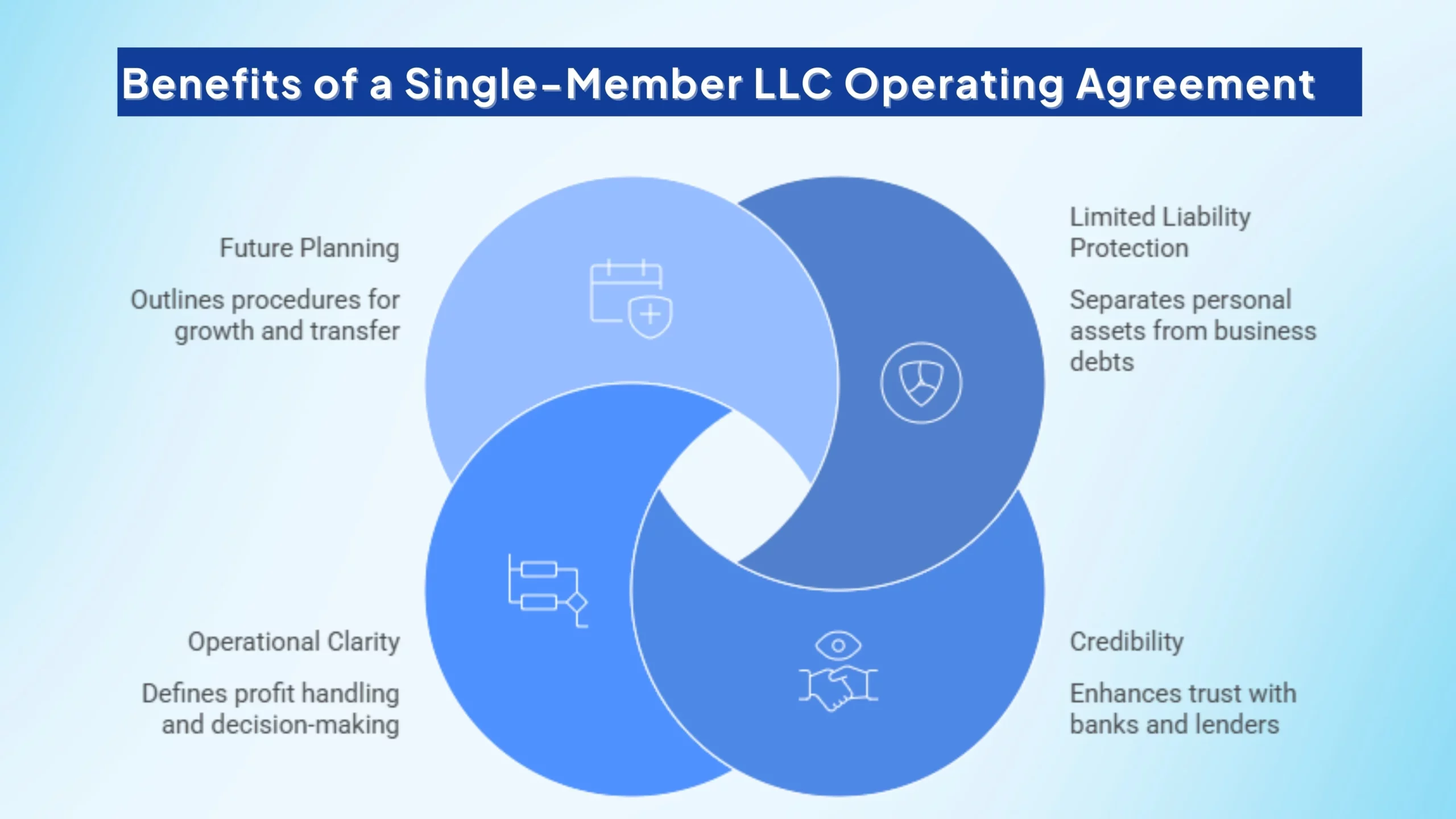
An operating agreement is essential for preserving limited liability protection, as it reinforces the legal separation between you and your LLC. Without this document, courts may question that separation and potentially “pierce the corporate veil,” making you personally responsible for business debts or obligations.
It also allows you to avoid relying on state-imposed default rules that may not align with how you want your LLC governed. Beyond liability protection, an operating agreement clarifies how your LLC operates, including decision-making, profit distribution, and procedures for incapacity or death.
It also enhances credibility with banks and lenders, many of whom require this document to open accounts or approve financing. Additionally, it provides a clear framework for future changes, such as adding members or restructuring.
Term to know:
Piercing the Corporate Veil
A legal concept where courts ignore the company’s separate legal identity and hold founders personally liable.
How Do I Protect My Startup’s Brand Identity Online With Domains And Social Media?
If you want to protect your startup’s brand identity online through domains and social media, securing your presence early is essential. Your brand’s online footprint is often the first point of contact for customers, investors, and partners, and it plays a critical role in startups building a distribution moat.
Locking this down early helps prevent impersonation, customer confusion, and long-term reputational damage, while strengthening your distribution advantage from day one.
- Secure your domain names early by registering your brand across key extensions like .com, .net, .org, and relevant country domains to block copycats and lookalike sites.
- Watch for typosquatting by monitoring common misspellings or variations of your domain name that could be used for scams or traffic diversion.
- Claim consistent social media handles across major platforms so users can easily identify your official accounts and avoid fake profiles.
- Apply for account verification where available to increase trust and reduce impersonation risks.
- Trademark your brand assets, including your name, logo, and tagline, to gain legal ownership and enforcement rights.
- Monitor brand misuse online using brand protection tools to detect unauthorized domains, fake accounts, or misleading ads.
- Act quickly on infringements by reporting impersonators or issuing cease and desist notices when necessary.
- Educate your audience by clearly listing your official website and social channels so customers know where to find authentic updates and support.
Taking these steps early ensures your startup’s brand identity remains protected, credible, and easy to recognize as you grow.
FAQs
To register your startup’s business name, first check availability through your state’s Secretary of State website and secure a matching domain.
Next, run a trademark search using the USPTO’s TESS database to ensure your name doesn’t conflict with existing federal or state trademarks. Once cleared, register the name with the state and consider federal trademark registration for nationwide protection.
Yes, Delaware is the best state to incorporate the startups planning to raise venture capital or scale nationally. Its investor-friendly corporate laws, specialized Court of Chancery, and flexible governance structure make it the preferred jurisdiction for VCs and angel investors.
Yes, you should draft bylaws for a corporation or an operating agreement for an LLC during formation, as these documents define internal governance and decision-making rules.
Corporate bylaws outline the roles of directors and officers, while LLC operating agreements clarify ownership, management, and operations, even when not legally required. Having these documents in place helps prevent disputes, protect limited liability, and avoid relying on default state laws.
The contracts that startups needed with employees are employment agreements and offer letters to define roles, compensation, confidentiality, and IP ownership. Independent contractors should be covered by contractor or consulting agreements that clearly outline scope of work, payment terms, and IP rights.
For investors, startups typically use shareholder agreements, investment agreements, or convertible notes to define equity, funding terms, and ownership rights.
Final Takeaways: Legal Checklist for Startups
Startups grow faster when the legal basics are handled early and correctly, which is exactly why this legal checklist for startups exists. It helps founders reduce risk, build credibility, and scale without hidden legal friction.
- Do the risky work first: entity setup, founder agreements, IP protection, contracts, and compliance.
- Make operations repeatable: clear documentation, standardized agreements, and structured onboarding for hires and vendors.
- Stay compliant quarterly: small legal and compliance reviews prevent expensive problems during fundraising, audits, or exits.