For many startup founders, HR is the department of “later”. You are focused on product-market fit, fundraising, and keeping the business running. But delaying HR until you reach 50 employees creates hidden debt that is expensive to fix. Undefined roles, missed compliance, and weak onboarding can quietly derail even the most promising startups.
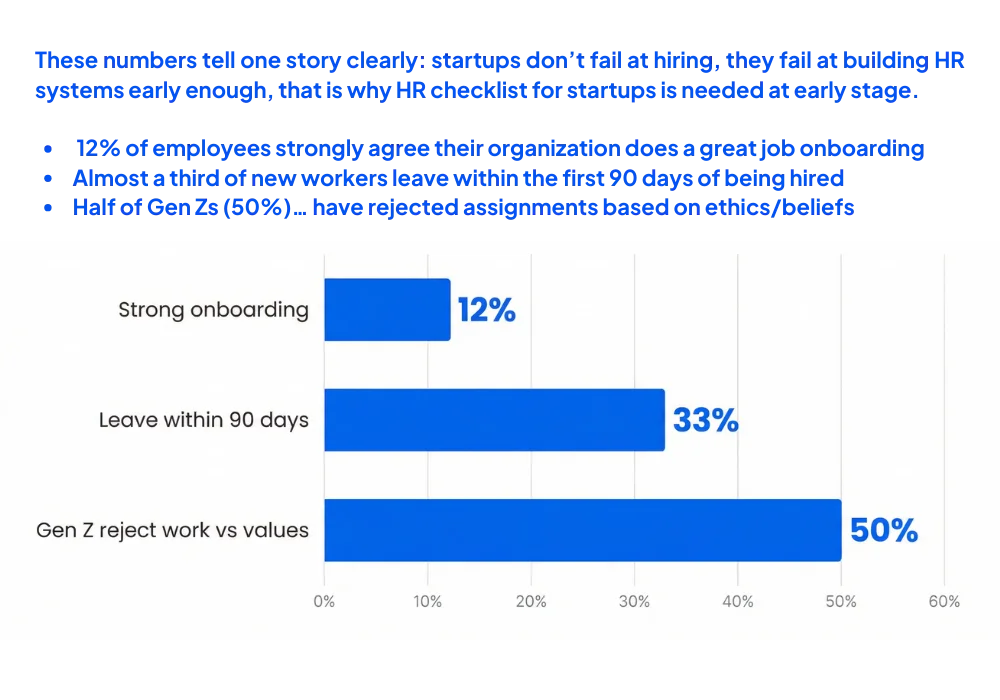
Your people processes determine how well you scale. Yet, only 12% of employees strongly agree their organization does a great job onboarding new hires. That gap is where retention fails and culture starts to break down. This guide provides a lean, practical HR checklist for startups, covering everything from legal compliance to culture building, and includes a free printable PDF checklist you can download and use at every growth stage.
1. Foundational Setup & Legal Compliance
- Business registration: register the company entity and obtain an Employer Identification Number (EIN) before hiring.
- Banking & payroll readiness: open dedicated business bank accounts to separate payroll, taxes, and operating funds.
- Insurance: secure required coverage such as Workers’ Compensation and General Liability to reduce early legal risk.
- Legal & HR guidance: consult experts for worker classification, contracts, and international hiring decisions.
2. Recruitment & Hiring
- Job descriptions: define clear outcomes, responsibilities, and success metrics for each role.
- Structured interviews: use consistent questions and scorecards to reduce bias and bad hires.
- Candidate evaluation: document feedback, verify right-to-work, and run background checks where required.
- Employment classification: correctly classify employees vs contractors to avoid fines and back pay.
3. Onboarding & Integration
- Pre-boarding: set up tools, access, and paperwork before Day 1.
- Day-one clarity: explain role expectations, team norms, and how decisions are made.
- 30/60/90 structure: define milestones and check-ins to prevent early exits.
4. Policies & Documentation
- Employee handbook: document conduct, anti-harassment, leave, safety, and remote work expectations.
- Employment contracts: issue compliant agreements with clear terms and responsibilities.
- Personnel records: securely store contracts, tax forms, performance notes, and acknowledgements.
5. Compensation & Benefits
- Payroll systems: ensure accurate, on-time payments to build employee trust.
- Mandatory benefits: comply with local tax, insurance, and statutory benefit requirements.
- Competitive perks: define benefits such as health coverage, equity, learning budgets, or flexible work.
6. Performance & Growth
- Clear expectations: define what good performance looks like for each role.
- Regular feedback: use quarterly check-ins instead of annual reviews.
- Development plans: support growth through training, stretch work, or mentorship.
7. Culture & Engagement
- Values-driven behavior: reinforce company values through recognition and decisions.
- Manager communication: maintain consistent 1:1s to surface issues early.
- Retention focus: check in frequently with high-impact and hard-to-replace roles.
8. HR Tech, Offboarding & Audits
- HR tools: adopt payroll, HRIS, and ATS tools when spreadsheets start breaking.
- Offboarding process: handle exits with access removal, final pay, and knowledge transfer.
- Quarterly mini-audits: review contracts, access permissions, and policy acknowledgements.
Why HR Checklist for Startups is Needed Early?
Founders often view HR as an administrative burden that slows down speed. The focus naturally gravitates toward product development and securing funding. However, the absence of structured HR leads to legal risks, culture drift, and expensive bad hires that drain resources faster than a failed feature launch.
The consequences of “winging it” are measurable. Discussions in HR communities reveal that early-stage startups often face up to 50% higher turnover when they lack structured onboarding and support systems. Employees who feel unmoored in their first few months are quick to exit, taking their institutional knowledge with them.
Establishing an HR foundation early isn’t just about following rules, it is a strategic lever for retention and scaling. When your house is in order, you can onboard 10 or 100 people without breaking your culture or your bank account.
What HR Checklist Do I Need to Follow when Starting My First Startup?
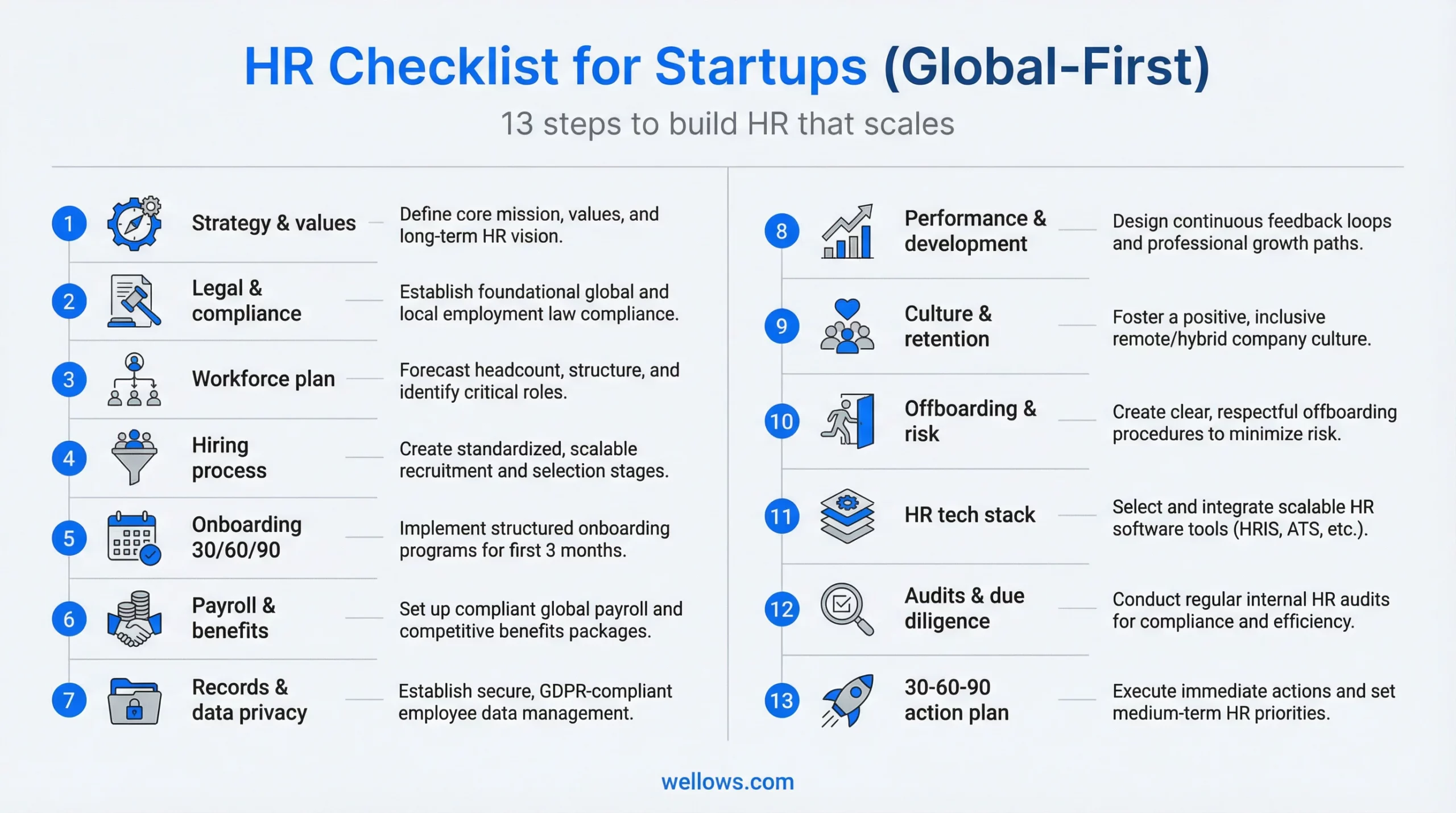
Starting your first startup is an exciting endeavor, and establishing a solid Human Resources (HR) foundation is crucial for long-term success. This checklist helps founders turn startup ideas into scalable companies by setting up HR correctly from day one.
Step 1: Build Your HR Strategy & Foundation
Before contracts, policies, or tools, you need clarity. HR is not paperwork. It’s how you make sure the right people are hired, supported, and retained as the company grows. Without this foundation, startups drift into confusion fast. Deloitte found that half of Gen Z candidates are willing to reject employers whose values don’t match theirs, according to its 2024 Gen Z and Millennial Survey.
Best stage to implement: 0–10 employees
- Define mission, vision, and values: clearly write down 3–5 behaviors you expect people to follow every day. These values should guide how people work, give feedback, make decisions, and grow inside the company.
Example: Saying “We give direct feedback” tells employees exactly how to communicate, while “We value honesty” leaves room for confusion. - Align HR to business goals: plan hiring based on what the company needs to achieve next, not what sounds impressive or trendy. Every hire should help move the business forward.
Example: If revenue growth is the priority, hiring sales and customer success roles will deliver faster impact than hiring extra support staff. - Create an org structure: clearly define who reports to whom so decisions don’t stall and accountability stays clear. Even in small teams, structure prevents confusion.
Example: Each employee should know exactly who their manager is, even if people wear multiple hats early on. - Set HR KPIs: track simple metrics that show whether hiring and onboarding are working. These numbers help you catch problems early.
Example: If 90-day retention is low, it often signals issues with hiring fit or onboarding.
Step 2: Establish Legal & Compliance Essentials
This is where startups often get burned. You don’t need to be a lawyer, but you do need basic guardrails. In the US, the Department of Labor notes that willful FLSA violations can lead to criminal penalties up to $10,000.
A legal checklist for startups helps founders stay compliant from day one by covering worker classification, wage laws, contracts, and recordkeeping. Think of it as a safety net that prevents small legal mistakes from turning into costly penalties later.
Best stage to implement: 0–10 employees
- Employee vs contractor classification: define classification rules for each location to avoid legal trouble, fines, and back pay.
Example: If someone works fixed hours, uses your tools, and follows your instructions, they are likely an employee, not a contractor. - Labor law basics: create a simple document that explains pay rules, leave requirements, and notice periods for each country you hire in. This prevents accidental violations.
- Employee handbook: keep the handbook short, clear, and readable so employees actually understand it and refer to it when needed.
Example: A 10–15 page handbook covering conduct, time off, harassment, and remote work is usually enough for early-stage startups. - Code of conduct: clearly explain what behavior is unacceptable so there is no confusion about boundaries.
Example: Spell out expectations around harassment, discrimination, data misuse, and respectful communication. - Complaint procedures: explain how employees can raise concerns, who handles them, and how quickly they can expect a response.
Why it matters: Employees are more likely to speak up early when the process feels safe and transparent. - Quarterly reviews: schedule regular reviews of policies and compliance rules so updates happen before problems arise.
Step 3: Plan Your Workforce & Hiring Needs
Hiring too early drains cash. Hiring too late slows execution. SHRM reports the average cost per hire is nearly $4,700, making every role count.
Best stage to implement: 0–50 employees
- Identify skill gaps: focus on what the company must deliver next and hire people who can make that happen. Identifying skill gaps is critical for the hottest AI startups, where demand for engineers outpaces supply.
Example: If you’re launching a product, engineers should come before marketing hires. - Plan by stage: hire flexible generalists early, then add specialists as the business becomes more complex.
Example: Early hires may handle multiple tasks, while later hires focus on deep expertise. - Budget labor costs: account for the full cost of each hire, not just salary.
Example: Include taxes, benefits, equipment, software, and onboarding time when planning your runway.
Step 4: Set Up Your Recruiting & Hiring Process
Fast hiring without structure leads to bad hires, especially for Tech Startups scaling engineering and product teams. A simple process protects quality without slowing you down.
Best stage to implement: 5–50 employees
- Job descriptions: clearly explain what success looks like in the role so candidates know what they are signing up for.
- Recruiting channels: choose a small number of reliable sources and track which ones bring the best candidates.
Example: Employee referrals may outperform job boards for early-stage roles. - Interview workflow: define clear stages so candidates don’t get stuck or ghosted.
Why it matters: A smooth process improves candidate experience and acceptance rates. - Structured interviews: ask all candidates the same core questions to make comparisons fair and objective.
Example: Use a simple scorecard to rate answers instead of relying on gut feelings. - Background checks: follow legal requirements and always get written consent before running checks.
- Offer templates: standardize compensation and terms so offers are consistent and easy to understand.
Step 5: Onboard New Hires (First 30–60–90 Days)
Onboarding sets trust fast. Deloitte reports that nearly one-third of new hires leave within 90 days when onboarding is weak.
Best stage to implement: From first hire onward
- Pre-boarding: set up email, tools, and equipment before Day 1 so new hires can focus on learning instead of chasing access.
Why it matters: First impressions start before the first day. - Day one: explain what success looks like in the role and how their work contributes to company goals.
Example: Share clear expectations for the first week and first month. - Week one: introduce tools, product context, team norms, and how decisions are made.
What good looks like: New hires know where to find information without asking repeatedly. - Mandatory training: cover security, privacy, and any role-specific requirements early.
Why it matters: Early training prevents costly mistakes later. - 30/60/90 check-ins: schedule structured check-ins to review progress, unblock issues, and give feedback.
Outcome: Fewer early exits and faster ramp-up.
Step 6: Set Up Payroll, Compensation & Benefits
Payroll builds trust faster than perks. One missed paycheck damages morale more than a product bug.
Best stage to implement: From first hire
- Payroll setup: choose local payroll or an Employer of Record based on where you hire.
Why it matters: Correct payroll ensures employees are paid on time and legally. - Mandatory benefits: follow local laws for taxes, insurance, and statutory benefits.
Example: Social security in the US, pensions in the UK, paid leave in the EU. - Competitive benefits: decide what you offer beyond the minimum to attract and retain talent.
Example: Health coverage, learning budgets, flexible work. - Equity & incentives: explain vesting schedules and bonuses clearly so expectations are realistic.
Why it matters: Misunderstood equity leads to frustration and mistrust. - Ownership: assign a clear contact person for payroll and benefits questions.
Outcome: Fewer delays and less confusion.
Step 7: Manage Employee Records & Data Securely
HR data is sensitive especially for FinTech Startups, where audits, funding rounds, and regulatory scrutiny happen frequently.
Best stage to implement: 10+ employees
- Personnel files: keep one organized digital folder per employee.
Example: Contract, role changes, performance notes, and leave records. - Time & leave tracking: document approvals and balances to avoid disputes.
Why it matters: Clear records protect both employees and the company. - Privacy: limit access to sensitive data on a need-to-know basis.
Example: Managers see performance data, not bank details. - Secure storage: use tools with permissions and two-factor authentication.
If you skip this: Security breaches become far more likely.
Step 8: Implement Performance Management & Development
Clear expectations prevent most performance problems. The World Economic Forum notes six in 10 workers will need training before 2027.
Best stage to implement: 15+ employees
- Set expectations: define what good work looks like for each role.
Example: Clear goals remove guesswork and anxiety. - Review rhythm: use quarterly check-ins instead of annual reviews.
Why it matters: Faster feedback prevents small issues from growing. - Development plans: set one achievable learning goal per quarter.
Example: A course, mentorship, or stretch project. - Career growth: expand responsibility before changing titles.
Outcome: Employees feel trusted and challenged. - Underperformance: document feedback early and clearly.
If you skip this: Performance issues escalate unexpectedly.
Step 9: Build Culture, Engagement & Retention
Culture is shaped by daily actions, not posters or slogans.
Best stage to implement: Ongoing
- Reinforce culture: connect decisions and recognition to company values.
Example: Praise behaviors you want repeated. - Recognition: celebrate real wins regularly.
Why it matters: Recognition increases motivation and loyalty. - Engagement feedback: run short monthly surveys to spot issues early.
Outcome: Problems are fixed before people quit. - Manager communication: maintain consistent 1:1s.
Example: Weekly or biweekly check-ins. - Retention plan: check in more often with high-impact roles. Retention planning is critical for SaaS Startups, where high-impact roles directly affect customer experience.
Why it matters: Losing key people is expensive and disruptive.
Step 10: Manage Offboarding & HR Risk
How people leave shapes how the rest of the team feels.
Best stage to implement: Before first exit
- Termination procedures: separate resignation and termination steps.
Why it matters: Different exits require different handling. - Exit compliance: follow final-pay and documentation rules.
Example: Immediate final pay in some regions. - Access removal: revoke system access on the same day.
Outcome: Reduced security risk. - Knowledge transfer: document responsibilities and handovers.
Why it matters: Prevents disruption after someone leaves. - Exit interviews: collect honest feedback and review patterns.
Outcome: Better retention decisions going forward.
Step 11: Set Up HR Technology & Systems
HR tools should reduce effort, not create it.
Best stage to implement: 10–50 employees
- When to adopt software: move on from spreadsheets when errors appear.
Example: Missed leave balances or lost documents. - Payroll & benefits tools: choose platforms that support your hiring locations.
- Document management: use e-signatures and controlled access.
Outcome: Faster onboarding and fewer mistakes. - Minimum stack: payroll → HRIS → ATS as complexity grows.
Step 12: Prepare for Audits & Compliance Reviews
Audits can come from investors, buyers, or regulators.
Best stage to implement: 25+ employees
- Internal HR audits: run quarterly checks for missing documents.
- Policy reviews: keep versions updated and acknowledged.
- Due diligence readiness: organize contracts and equity documents.
Why it matters: Clean records speed up funding and acquisitions.
Step 13: Create Your Startup HR Action Plan
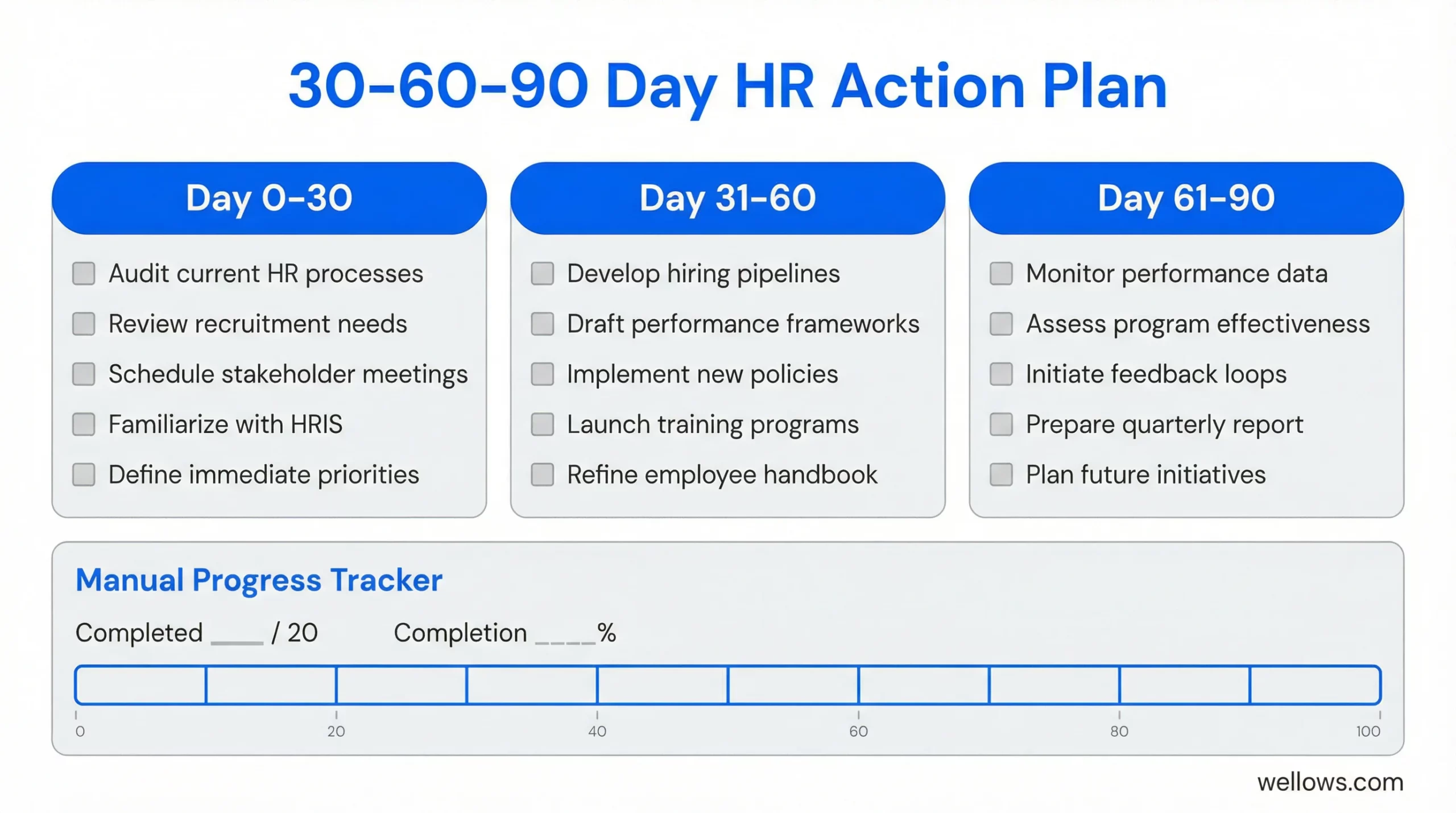
You don’t need to do everything at once. Focus on reducing risk first. This guide works as part of a broader startup checklist focused on reducing risk first.
30–60–90 Day HR Action Plan
- Days 0–30: Finalize contracts, handbook v1, and payroll setup.
- Days 31–60: Standardize hiring, time-off tracking, and manager 1:1s.
- Days 61–90: Run a mini-audit using a launch readiness checklist, launch development plans, and improve retention signals.
Where can I Download a Free Printable HR Checklist for Startups?
You can download free printable HR checklist for startups from here:
- Use weekly: treat it like a HR sprint backlog.
- Update by stage: add structure only when growth requires it.
- Re-check quarterly: especially after hiring or expansion.
What are Best Practices for HR at Startups?
HR best practices for startups are not about building corporate bureaucracy. They are about creating simple, repeatable systems that reduce risk, save founder time, and help people do great work as you scale. Here are the most practical best practices to follow.
Keep HR simple in the early stage
Make role expectations crystal clear
Standardize hiring to reduce bad hires
Treat onboarding like a system, not an event
Get compliance basics right early
Run payroll like a trust system
Protect employee data from day one
Give feedback often, not once a year
Build culture through repeated actions
Track a few HR metrics that actually help decisions
Introduce HR tools when spreadsheets start breaking
Plan offboarding before the first exit happens
Do small quarterly HR checkups
How Do I Make Sure My Startup Stays Compliant with Employment Laws?
To keep your startup compliant with employment laws, build a repeatable compliance system that:
-Identifies which laws apply to you
-Correctly classifies and documents workers
-Runs payroll and timekeeping with required records
-Implements core anti-discrimination, harassment, and safety processes
-Audits these items on a fixed cadence
- Define your minimum viable compliance scope:
Start by documenting your “minimum viable compliance scope” as a one-page map of the agencies that set or enforce the rules you actually touch: wages, overtime, and recordkeeping under the FLSA (DOL), hiring eligibility verification via Form I-9 (USCIS), workplace safety reporting and recordkeeping (OSHA), and anti-discrimination and record retention obligations (EEOC).
That mapping step matters because most compliance failures at startups are not “unknown laws,” but missing owners and missing routines. - Harden worker classification:
One of the most common operational failure points is classification. Use a defensible standard based on control and independence, not job title or “1099 vs W-2 vibes.” The IRS states a worker is your employee under common-law rules if you can control what will be done and how it will be done, and labeling does not control the outcome. - Make onboarding execution non-negotiable:
For onboarding compliance, treat I-9 timing as a strict SLA. USCIS requires the employer or authorized representative to complete and sign Section 2 of Form I-9 within 3 business days of the employee’s first day of work for pay, or by day one if employment lasts fewer than three days. Put this deadline into your onboarding checklist and automate reminders, because “we forgot” is not a defensible audit posture. - Make recordkeeping audit-proof:
Under the FLSA, DOL’s recordkeeping fact sheet lists the core data you must retain for each non-exempt worker, including hours worked each day, total hours each workweek, regular hourly pay rate, and total wages paid each pay period. It also specifies retention baselines: preserve payroll records for at least three years and keep records used to compute wages, such as time cards and schedules, for two years.
A practical founder move is to create a “payroll evidence folder” that mirrors these required fields so an auditor request becomes retrieval, not reconstruction. - Align retention with EEOC requirements:
In parallel, comply with EEOC retention requirements so you are not exposed during a charge. EEOC states employers must keep personnel or employment records for one year, and if an employee is involuntarily terminated, retain their personnel records for one year from the termination date. It also notes payroll record retention baselines tied to ADEA and FLSA or EPA, including payroll records kept for at least three years. - Operationalize safety and incident reporting:
Rather than hoping nothing happens, align your processes with OSHA requirements. OSHA explains that many employers with more than ten employees must maintain injury and illness records using Forms 300, 300A, and 301 unless exempt, and that all employers must notify OSHA within eight hours of a work-related fatality and within twenty-four hours of an in-patient hospitalization, amputation, or loss of an eye. Even office-based startups need to respect these clocks the first time something goes wrong. - Run a lightweight compliance audit:
Based on how regulators frame obligations using time-bound forms, retention windows, and required data fields, the highest ROI compliance move for most startups is to appoint a single accountable system owner and run a monthly compliance mini-audit.
That audit should check only four things: I-9 completion timeliness, worker classification documentation, payroll and time record completeness, and policy acknowledgement or complaint routing. This cadence prevents compliance drift without creating bureaucracy and aligns with the most time-sensitive requirements outlined by USCIS, DOL, OSHA, and EEOC.
Real-world insight from operators:Founders and HR operators repeatedly describe compliance risk as a workflow problem, not a k ledge problem. One HR user described onboarding as losing “an entire week minimum just dealing with all the random stuff” per hire, and the top reply was blunt: “You should not need to remember things. Write a checklist or flow chart and follow it.”
That is exactly why compliance needs checklists and owners, not just policies.
What HR Policies Do I Need to Create for My Startup Company?
You should create a short “handbook v1” that covers the policies most directly tied to enforceable requirements and recurring startup failure modes.
- Anti-harassment and anti-discrimination policy:
Start with a policy that is operational, not just a statement. EEOC’s small business guidance recommends explaining how employees can report harassment, ideally offering at least one reporting path outside the employee’s chain of command; stating confidentiality protections “to the greatest possible extent”; stating non-retaliation; requiring managers or HR to respond or escalate; and providing for prompt, thorough, impartial investigations plus corrective action.
These are concrete “must include” elements from a primary authority. - Hiring, onboarding, and work authorization policy:
Include a policy that makes I-9 compliance repeatable by clearly defining who does what and by when. USCIS states the employer must complete Section 2 of Form I-9 within 3 business days of the employee’s first day of work for pay (or by day 1 if employment lasts fewer than 3 days) and must examine original acceptable documents or receipts and record the information accurately.
Putting this into policy forces consistency even during rapid hiring. - Wage, timekeeping, and payroll records policy:
Create a policy aligned with DOL’s FLSA recordkeeping requirements, which list the specific employee and payroll data you must retain, such as hours worked each day, total hours per workweek, overtime earnings, and total wages paid per pay period. The guidance also requires payroll records to be preserved for at least 3 years and wage computation records for 2 years.
This policy should define approval, documentation, and storage controls. - Personnel files and record retention policy:
Add a policy aligned with EEOC’s stated retention baselines, which require personnel or employment records to be kept for one year, and for involuntarily terminated employees, one year from the termination date. It should also reflect payroll retention requirements, such as FLSA payroll records retained for at least 3 years, and clearly define file contents, access, and retention schedules. - Workplace safety and incident reporting policy:
Include a policy that mirrors OSHA’s reporting clocks and recordkeeping expectations. OSHA states that many employers with more than 10 employees must maintain injury and illness records using Forms 300, 300A, and 301 unless exempt, and that all employers must report work-related fatalities within 8 hours and certain severe injuries within 24 hours.
Defining “what counts” and “who reports” is critical when incidents occur. - Worker classification policy:
Add a policy that documents when contractors versus employees can be used. The IRS explains under common-law rules that a worker is your employee if you can control what will be done and how it will be done, and that labels do not override the substance of the relationship. The IRS frames evidence in behavioral control, financial control, and type of relationship, which helps prevent misclassification that leads to wage, tax, and compliance issues.
Having these policies in place creates a structured HR foundation that supports growth, fairness, and long-term stability.
How Do HR Checklists for Startups Differ from Those for Large Companies?
HR checklists for startups differ significantly from those of large companies due to variations in organizational size, resources, and operational priorities. Here’s a comparative overview:
- HR structure: startups usually do not have a dedicated HR team, so founders or managers handle HR informally, while large companies have specialized HR departments with defined roles.
- Recruitment and hiring: startups hire quickly and focus on adaptability and cultural fit, often using referrals, whereas large companies rely on structured hiring processes with multiple stages.
- Compensation and benefits: startups may offer lower salaries with equity and flexibility, while large companies provide higher pay, bonuses, and comprehensive benefits.
- Culture and engagement: startups emphasize agility, autonomy, and close collaboration, while large companies operate with established cultures and formal engagement programs.
- Learning and development: startups depend on on-the-job learning and mentorship, whereas large companies invest in formal training and leadership development programs.
- Performance management: startups use continuous feedback and flexible goals, while large companies rely on structured annual reviews and standardized evaluations.
In short, startup HR checklists focus on flexibility and speed, while large-company HR checklists prioritize structure, consistency, and scale.
Are There HR Checklist Tools or Software Designed for Startups?
Yes, there are several HR checklist tools and software solutions specifically designed to assist startups in managing their human resources effectively. These platforms offer features such as recruitment, onboarding, payroll processing, compliance management, and employee performance tracking. Here are some notable options:
- Gusto: an all-in-one HR platform that simplifies payroll, benefits administration, and compliance, making it a popular choice for early-stage startups.
- BambooHR: designed for small and growing teams, it helps manage employee records, time off, and performance reviews in one place.
- Personio: a cloud-based HR system offering recruiting, payroll, and employee data management, suitable for startups scaling across teams.
- HiBob: a modern HRIS that supports onboarding, performance management, compensation tracking, and employee engagement.
- WebHR: an online HR software that automates core HR processes such as recruitment, payroll, onboarding, and performance tracking.
- HR checklist platforms: tools like Keka provide startup-focused HR checklists covering hiring, onboarding, compensation, and compliance to guide first-time founders.
Using the right HR software early helps startups stay organized, remain compliant, and support employees effectively as the company scales.
FAQs
The 7 pillars of HR typically include recruitment, onboarding, performance management, learning and development, compensation and benefits, employee relations, and compliance. Together, they support hiring, managing, and retaining employees effectively.
The 5 C’s of HR are compliance, clarity, consistency, communication, and culture. These principles help HR teams create fair policies, reduce risk, and build a healthy workplace.
An HR checklist is a structured list of tasks used to manage HR activities such as hiring, onboarding, payroll, and compliance. It helps ensure nothing important is missed as a company grows.
The 7 core HR processes usually include workforce planning, recruitment, onboarding, performance management, training and development, compensation and benefits, and employee offboarding. These processes cover the full employee lifecycle.
At minimum: signed offer or contract, IP and confidentiality terms, a basic handbook or policies, and secure employee record storage.
Use a location-by-location checklist. Classification tests differ across the US, UK, and EU, so one global rule is not sufficient.
Start with time-to-hire, offer acceptance rate, 90-day retention, and voluntary turnover.
Final Takeaways: HR Checklist for Startups
Startups need reliable basics that protect trust and reduce risk while scaling, that is why I have created this HR checklist for startups.
- Do the risky work first: classification, contracts, payroll, and policies.
- Make onboarding repeatable: access, clarity, and 30/60/90 outcomes.
- Stay clean quarterly: small audits prevent big problems.