Most startups obsess over product perfection, but distribution is often the real battlefield. Imagine launching a brilliant productivity app that solves a real problem, yet when people search on Google, ask ChatGPT for recommendations, or browse app marketplaces, your product never shows up.
The issue is not quality, it is invisibility. Before product–market fit exists, visibility, reach, and positioning decide whether a product even gets the chance to be tested.
Startups that win early are not always better built, they are simply easier to find. Strong presence across search engines, platforms, and AI-driven discovery channels determines who enters the customer’s consideration set.
This gap explains why 22% of startups fail due to ineffective marketing. Poor visibility and weak go-to-market strategies limit reach and stall momentum. Without clear distribution signals, startups struggle to know where to show up, what to prioritize, and how they appear across emerging AI-powered search surfaces.
In this blog, I will discuss how startups can build a distribution moat before product–market fit. I will explore how an AI search visibility tool can help prioritize high-impact opportunities, monitor brand presence automatically, ensure platform-wide coverage, and understand how startups appear across LLM-driven discovery.
- Great products fail early when startups remain invisible before product–market fit, because distribution decides who even gets tested.
- Features are copied fast, but attention compounds slowly, making distribution the first real moat for modern startups.
- Discovery now happens across AI answers, LLMs, and platforms before users ever visit a website.
- Most startups miss asymmetric distribution opportunities because they cannot see where competitors gain citations and AI visibility.
- Wellows provides an affordable way to reveal hidden distribution gaps, track LLM presence, and help startups prioritize high impact visibility before competitors compound attention.
Why Do Startups Need to Prioritize Distribution Over Product Development?
For early-stage startups, building a great product is only half the equation. AI search visibility for startups determines whether that product is seen, tested, and adopted, especially before product–market fit.
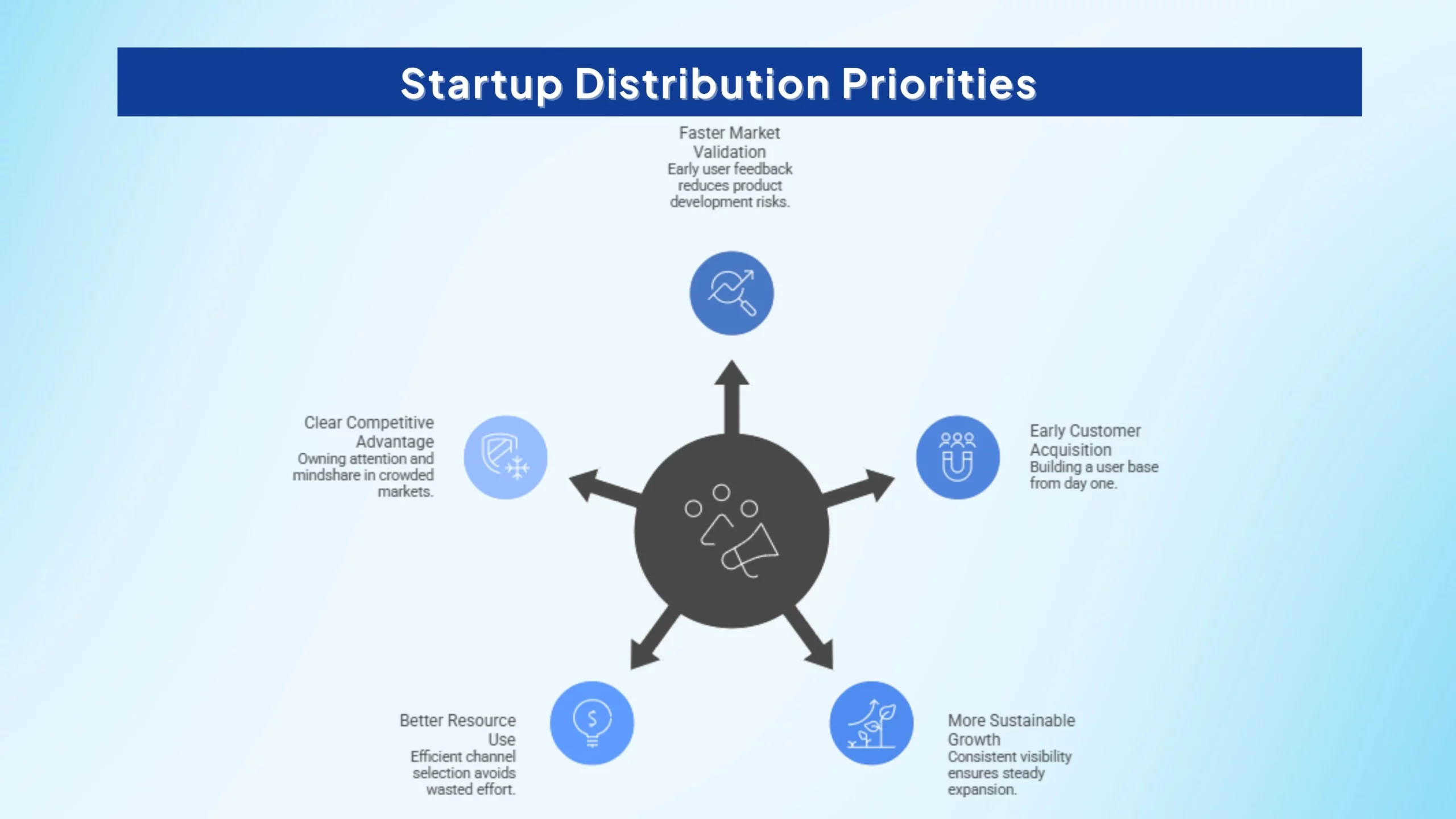
The strategic reasons startups must invest in distribution early include:
1. Validate the market before competitors do: Early visibility helps startups confirm real demand while shaping perception.
2. Become the first brand users recognize: Distribution builds authority before features matter.
3. Create compounding visibility instead of one-time traction: Authority grows through repeated exposure across multiple channels.
4. Learn faster while spending less: Distribution reveals what works before heavy investment.
5. Build an authority moat that is hard to displace: Features can be replicated, but trust cannot.
Did you know?
How can an AI search visibility tool actually fix this problem?
How can an AI search visibility tool actually fix this problem?Think of it as a distribution radar for your startup. It removes guesswork by showing where users and AI already look for solutions and how your startup appears there.
- Spots opportunity gaps before competitors doThe tool shows searches and AI answers where demand exists, but competitors are missing. This helps you show up early and build authority before others enter.
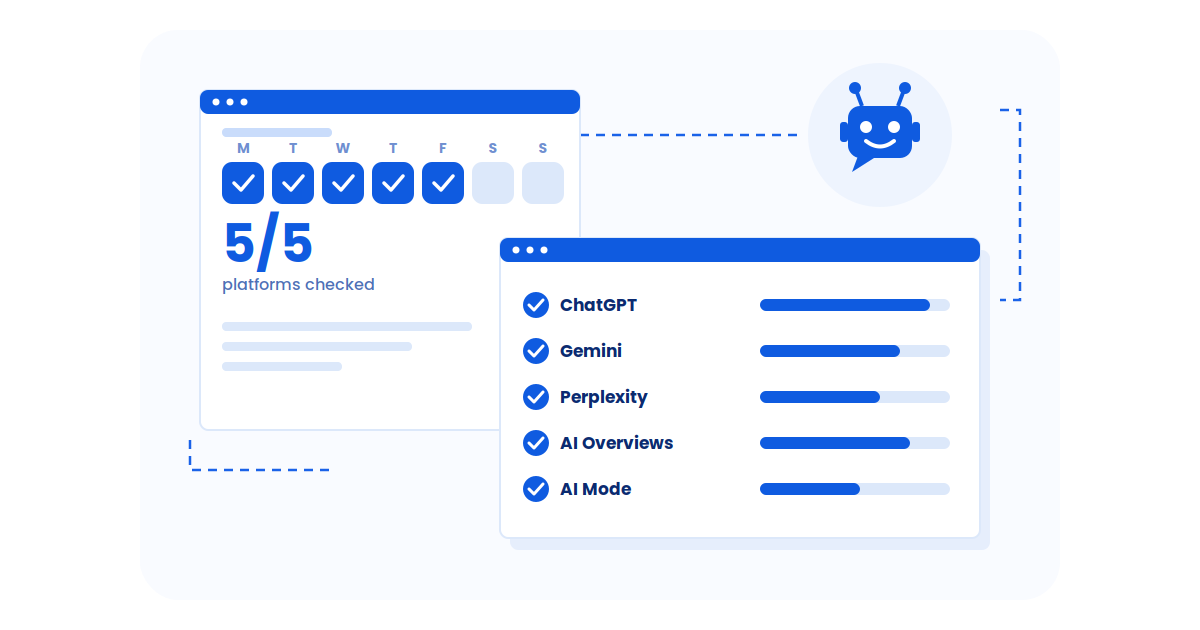
- Keeps your discoverability in check automaticallyIt tracks how your brand appears across search and AI tools. If visibility drops or AI explains your product incorrectly, the tool flags it so you can fix it fast.
- Builds consistent presence across modern discovery channelsIt helps you stay visible across search, platforms, and LLM-powered tools at the same time. This consistency builds trust and growth on a limited budget.
In simple terms, the tool helps you see where to show up, understand how AI sees you, and fix problems early, so your startup stays discoverable while competitors are still guessing.
Why this risk is real
According to CB Insights, the most common reasons startups fail include running out of cash (38%), no market need (35%), competition (20%), pricing and cost issues (18%), poor product (17%), poor marketing (14%), and ignoring customers (14%). Many of these failures trace back to weak or delayed distribution decisions.
This reinforces why neglecting distribution early compounds multiple failure risks at once, rather than creating just a single point of weakness.
Today, fixing distribution visibility does not require expensive tools. Cost-efficient AI visibility tools like Wellows now help founders monitor perception early and strengthen their discoverability before distribution gaps grow.
Why Do Most Startups Fail Without a Scalable Distribution Strategy?
A startup can build an innovative product and still fail if it does not have a reliable way to reach users.
Without scalable distribution, even great products struggle to gain traction, costs increase, and growth becomes difficult to sustain. This is why many startups fail not because the product is bad, but because people never discover it.
- Limited market reach:
Many startups depend on word of mouth or a single channel to grow. For example, a product may get early users from referrals, but without search or AI visibility, growth slows once that small circle is exhausted. - No authority in AI and lack of automation:
If AI tools do not understand or recommend your startup, you disappear from modern discovery. At the same time, founders cannot manually track rankings, AI answers, and platforms, which leads to delays. Competitors using automation show up faster and gain trust earlier. - Rising costs and financial pressure:
Startups without organic or AI-driven distribution rely heavily on paid ads. As competition increases, ad costs rise, customer acquisition becomes expensive, and limited budgets get exhausted quickly. - Unclear positioning in the market:
When distribution is weak, users and AI struggle to understand what your product actually does. This confusion lowers trust and conversion, even if the solution itself is useful. - Slow feedback and delayed learning:
Without consistent visibility, startups receive feedback late. Founders may spend months building features, only to realize users wanted something else or competitors already solved the problem better. - Competitors capture mindshare first:
Startups that appear early in search results and AI answers become the default choice. Once users trust a brand, later entrants must spend more time and money just to be noticed.
A clear example is Quibi, which raised $1.75 billion before validating demand. Despite massive marketing spend, it failed to build repeat usage or scalable distribution. Within six months of launch, the company shut down, proving that visibility without sustainable distribution does not create traction.
To avoid this outcome, startups must treat distribution as a system, not a campaign. Building scalable channels, testing what works early, and continuously optimizing reach are what turn visibility into long-term growth.
How Can First-Time Founders Build Distribution Before Perfecting Their Product?
First-time founders do not need a finished product to start growing. They need early signals, real conversations, and visibility.
Step 1: Start with real conversations
Begin by engaging with your target users where they already spend time, such as forums, LinkedIn, Slack groups, or niche communities. For example, founders who regularly talk to potential users often uncover pain points that never appear in surveys. These conversations help validate the problem before any development begins.
Step 2: Test demand before building features
Simple tests like landing pages or waitlists reveal real interest. Startups that validate demand early can reduce wasted development, especially when up to 70% of features in software products are rarely or never used.
Step 3: Use existing communities as distribution shortcuts
Communities already have trust and attention. Many early-stage startups acquire their first 20–30% of users through communities like forums, Slack groups, or LinkedIn, without spending on ads.
Step 4: Build a story, not just a product
People connect with problems before solutions. Startups that clearly explain the “why” behind their product see higher engagement. Messaging clarity alone can improve early conversion rates by up to 2x compared to feature-heavy explanations.
Step 5: Leverage partnerships for reach
Collaborating with creators, platforms, or complementary startups can expand reach quickly. For example, co-hosting a webinar or being featured in a newsletter exposes your idea to an audience that already trusts the source.
Step 6: Design growth into early experiences
Growth loops do not require a finished product. Referral prompts or invite-only access can drive sharing. Products with built-in referrals often grow 20–30% faster in early stages compared to those without them.
Step 7: Measure signals and adapt fast
Track responses such as sign-ups, replies, or engagement. These signals guide both product decisions and distribution strategy. Founders that adapt based on real data tend to iterate faster and avoid costly mistakes.
For first-time founders, these steps turn distribution into a learning engine. By the time the product is ready, the audience is already waiting, reducing risk and increasing the chances of long-term growth.
Expert opinion
Startup educator Steve Blank consistently emphasizes that startups fail when they build in isolation. His core principle, “There are no facts inside your building, so get outside,” highlights the danger of developing products without real customer discovery and distribution signals.
Neglecting distribution keeps startups disconnected from real users, turning product building into guesswork. Startups that integrate distribution early validate assumptions faster, reduce waste, and learn directly from the market instead of building blindly.
💡 Tip: While engaging users and validating ideas, founders can stay efficient with an HR checklist for startups, it ensures early hires, contracts, and operations stay organized as growth begins.
What Are Asymmetric Opportunities in Startup Distribution and How to Find Them?
Asymmetric opportunities are low-competition, high-visibility distribution gaps where startups can gain attention before competitors react. They exist where demand is real, but awareness and citations are uneven.
Finding them early allows startups to build visibility and authority without outspending incumbents, which is critical in today’s saturated markets.
“This is the worst period ever to build a startup… The only remaining way to build a moat is through distribution.”
This perspective reflects a growing reality for founders. Products are copied faster than ever, and even strong ideas enter red oceans almost instantly. Teams fragment their efforts across too many channels, never reaching critical visibility. Meanwhile, incumbents compound attention simply by being present everywhere users and AI look.
The real problem is not effort. It is lack of visibility into where competitors are winning distribution and where startups can still move first.
Wellows solves this by turning invisible distribution gaps into clear, prioritized asymmetric opportunities that startups can act on immediately.
How Wellows helps founders find and act on asymmetric opportunities
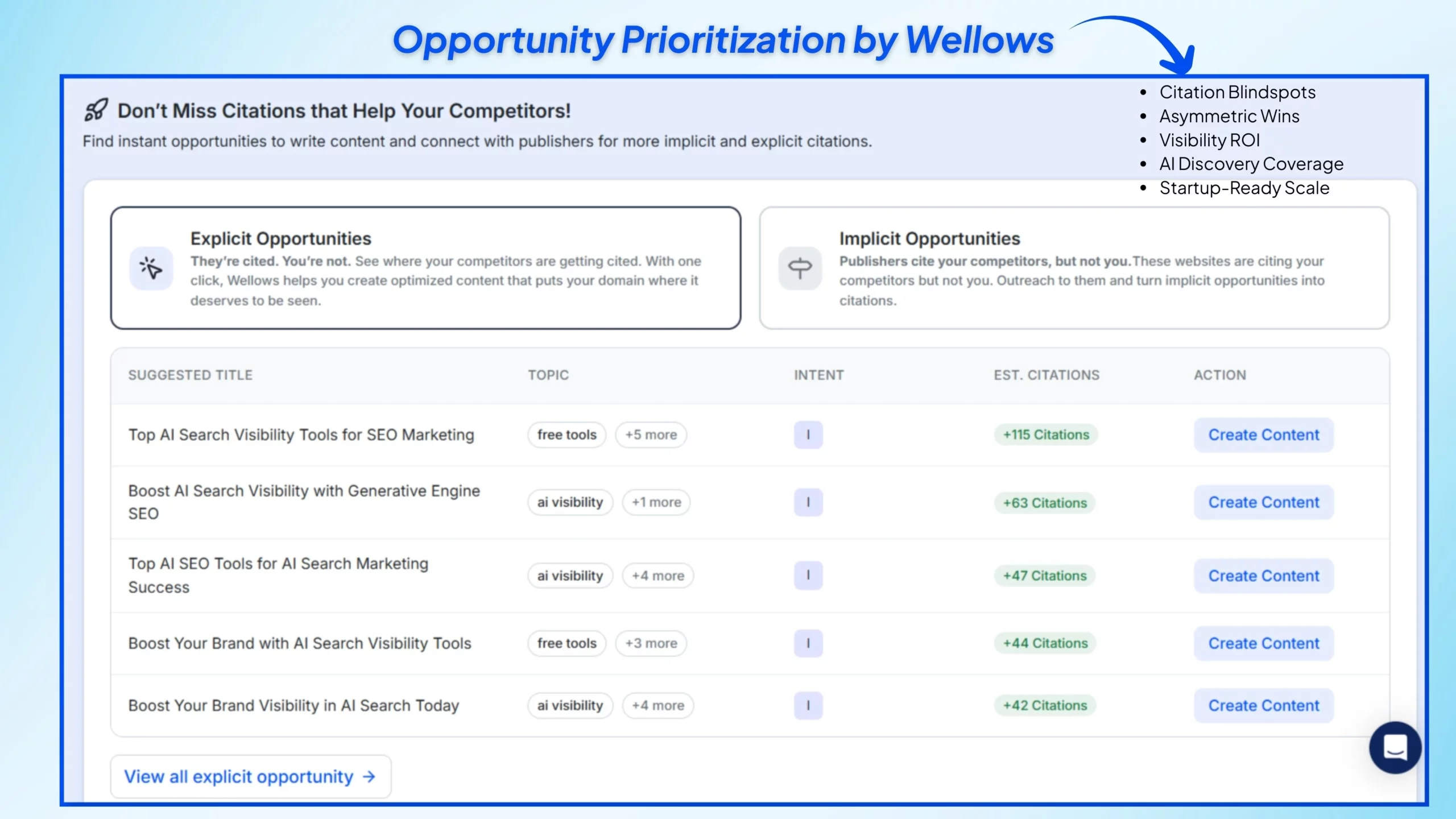
- See where competitors are cited and you are not
Wellows surfaces both explicit and implicit citations. Founders can instantly spot publishers and AI answers helping competitors, but ignoring their startup. - Focus only on asymmetric, high-upside wins
Instead of chasing crowded keywords, Wellows prioritizes opportunities where citation potential is high and competition is low. This allows startups to win attention without burning money. - Estimate visibility ROI before doing the work
Each opportunity shows projected citation impact. Founders can choose actions that offer the highest visibility return, avoiding wasted content and outreach. - Cover where discovery actually happens today
Wellows tracks publishers, platforms, and AI-driven discovery surfaces where users now ask questions and make decisions, not just traditional search results. - Act fast without a large team
Using one-click content creation, founders can immediately create content aligned with identified opportunities, removing delays caused by limited resources.
How this helps startups in practice
Instead of spreading efforts thin, founders use Wellows to see exactly where competitors are winning, select the fastest asymmetric gaps, and act immediately. The screenshot above shows how opportunities are ranked by citation impact, allowing founders to prioritize what matters most.
This removes guesswork, reduces wasted effort, and enables startups to compete with incumbents on visibility rather than expensive budgets. Over time, these affordable early advantages compound into a defensible distribution moat, even before product market fit is fully locked in.
How Can Startups Identify Leverage When Distribution Is the Only Real Moat?
When building software is fast and cheap, leverage no longer comes from the product, it comes from attention. Startups win by finding distribution gaps where competitors are present everywhere except where it matters next.
The goal is not to compete louder, but to show up where others are uneven or absent.
“Software is getting easier to build, distribution is the real moat now.
If someone can clone your MVP in two weeks, the thing they can’t instantly copy is your audience, relationships, and channels.” –
This reflects what many founders are experiencing today. Ideas spread fast, competitors appear early, and roadmaps lose value quickly. Even strong products struggle because attention fragments before traction compounds.
The real disadvantage is not lack of effort, it is not knowing where attention is already saturated and where it is still available.
Wellows helps founders solve this by visualizing exactly where competitors concentrate visibility and where distribution leverage still exists.
How founders use Wellows Platform Coverage to find leverage
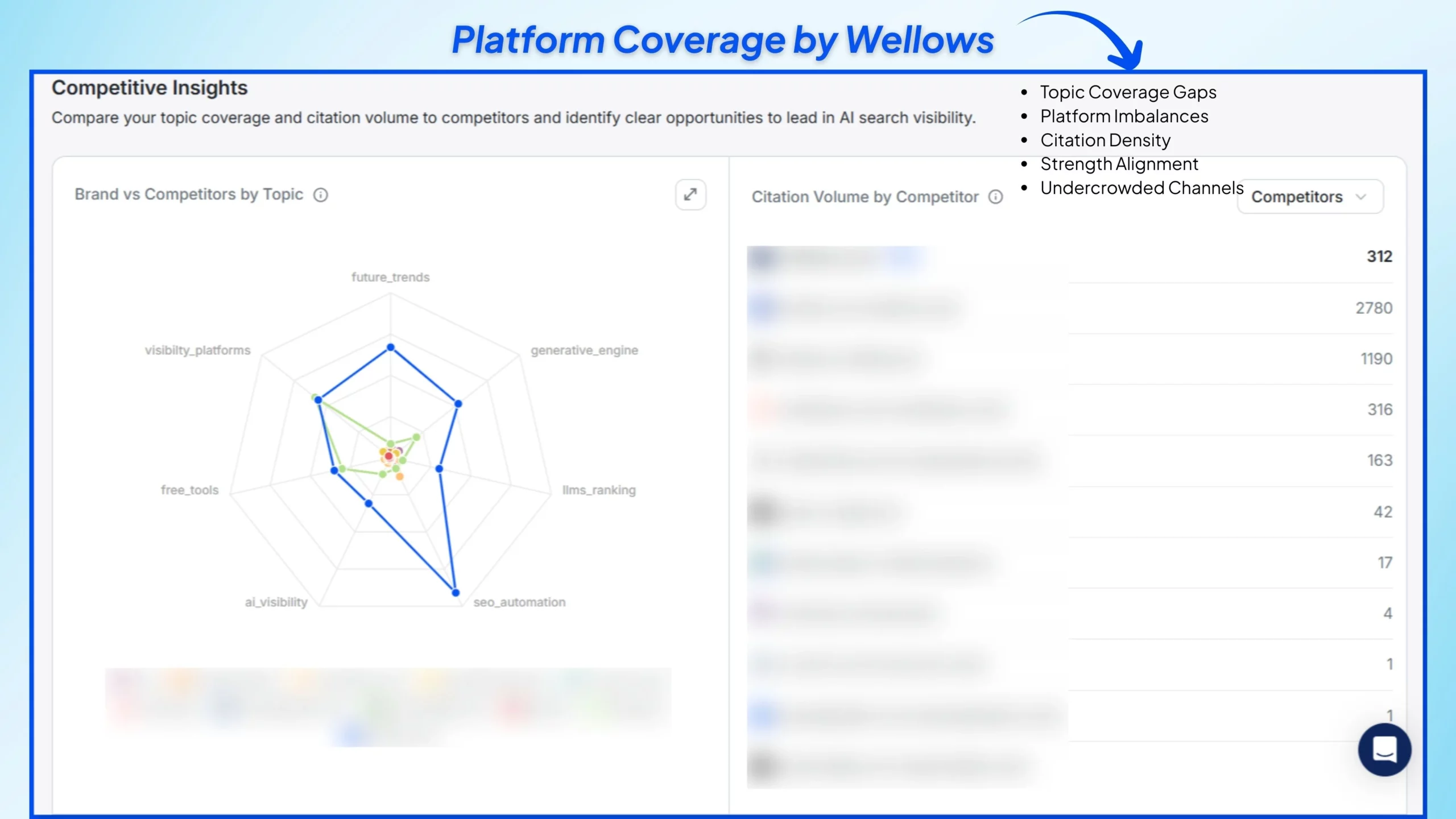
- See topic coverage gaps instantly
As shown in the radar chart, founders can compare their startup against competitors across topics like AI visibility, SEO automation, and generative engines. Areas where competitors dominate signal crowding, while shallow coverage highlights leverage. - Identify platform imbalances competitors ignore
The citation volume table reveals uneven platform dominance. Some competitors accumulate citations heavily on one surface while leaving others underdeveloped. Founders can focus on these underserved platforms instead of fighting incumbents head-on. - Prioritize undercrowded channels with real impact
By combining topic gaps with citation density, founders see where small efforts can generate visible gains. This allows early-stage teams to build authority without needing large budgets or broad campaigns. - Align distribution with product strengths
Founders can match their strongest value propositions to topics already rewarded by discovery systems. Instead of copying competitors.
In practice, this turns distribution from a guessing game into a map. Founders stop chasing crowded lanes and start building visibility where attention is still compounding.
Instead of being outspent by incumbents, startups use budget-friendly tools like Wellows to out position them, building a durable distribution moat even in the most competitive environments.
Why Do AI Startups Face a Unique Distribution Shift Right Now?
Today, distribution is no longer just about search engines or social media. Founders now need visibility inside LLMs like ChatGPT, Gemini, Google AI Overview, and Perplexity, where buyers increasingly discover, compare, and shortlist tools.
If your startup is not present in these AI answers, it is invisible at the decision stage, even if the product is strong.
“Bootstrapped founder struggling with distribution… no VC funding, no sales team, and a very limited budget.
Getting the product in front of the right people has been the hardest part.”
This reflects a common founder reality. When resources are limited, cold outreach feels inefficient, paid channels are expensive, and effort spreads thin without traction. The problem is not effort, it is not knowing where discovery is actually happening.
What has changed is the discovery layer. Buyers now ask AI tools for recommendations before visiting websites. If LLMs do not mention your startup, you are not even part of the evaluation.
Wellows helps founders solve this by making AI-driven discovery visible, measurable, and actionable through two key features: LLM Presence Overview and Automated Monitoring.
How Founders Use LLM Presence Overview to Fix Distribution
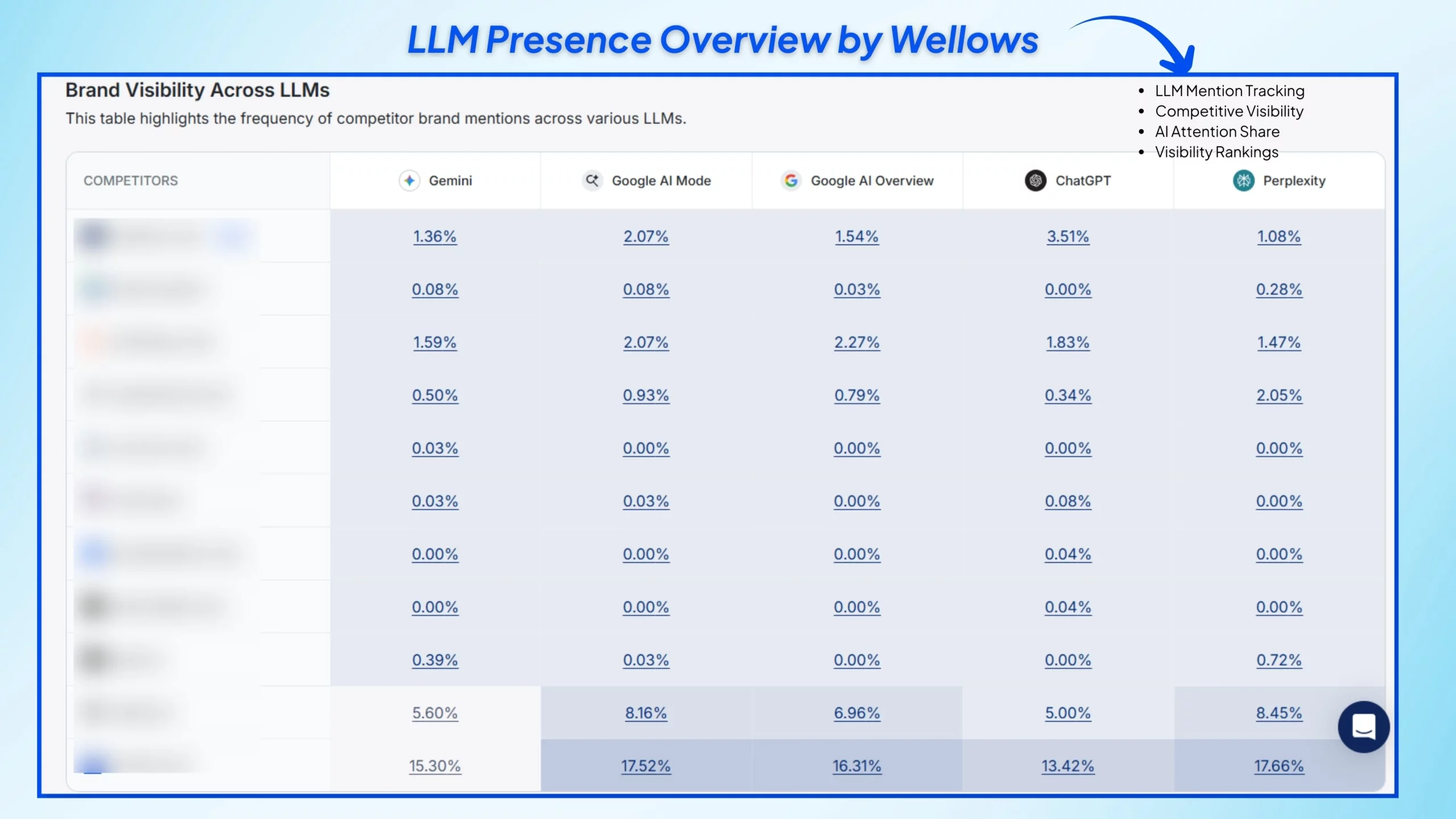
- Check where buyers actually see you
Founders can see whether their startup is mentioned in ChatGPT, Gemini, Google AI Overview, or Perplexity. Since ChatGPT alone accounts for the majority of AI chatbot usage, absence here means missing a large share of buyer attention. - Compare AI visibility against competitors
The dashboard shows percentage-based LLM visibility. Founders immediately know whether competitors dominate AI answers and which platforms matter most for their category. - Prioritize platforms with the highest impact
Instead of trying to be everywhere, founders focus on LLMs with the highest visibility share. For most B2B discovery today, that means prioritizing ChatGPT and Google AI surfaces first. - Turn AI presence into a distribution goal
By tracking mentions and rankings, founders shift from guessing to intentionally influencing how AI explains and recommends their product.
How Founders Use Automated Monitoring to Protect Visibility
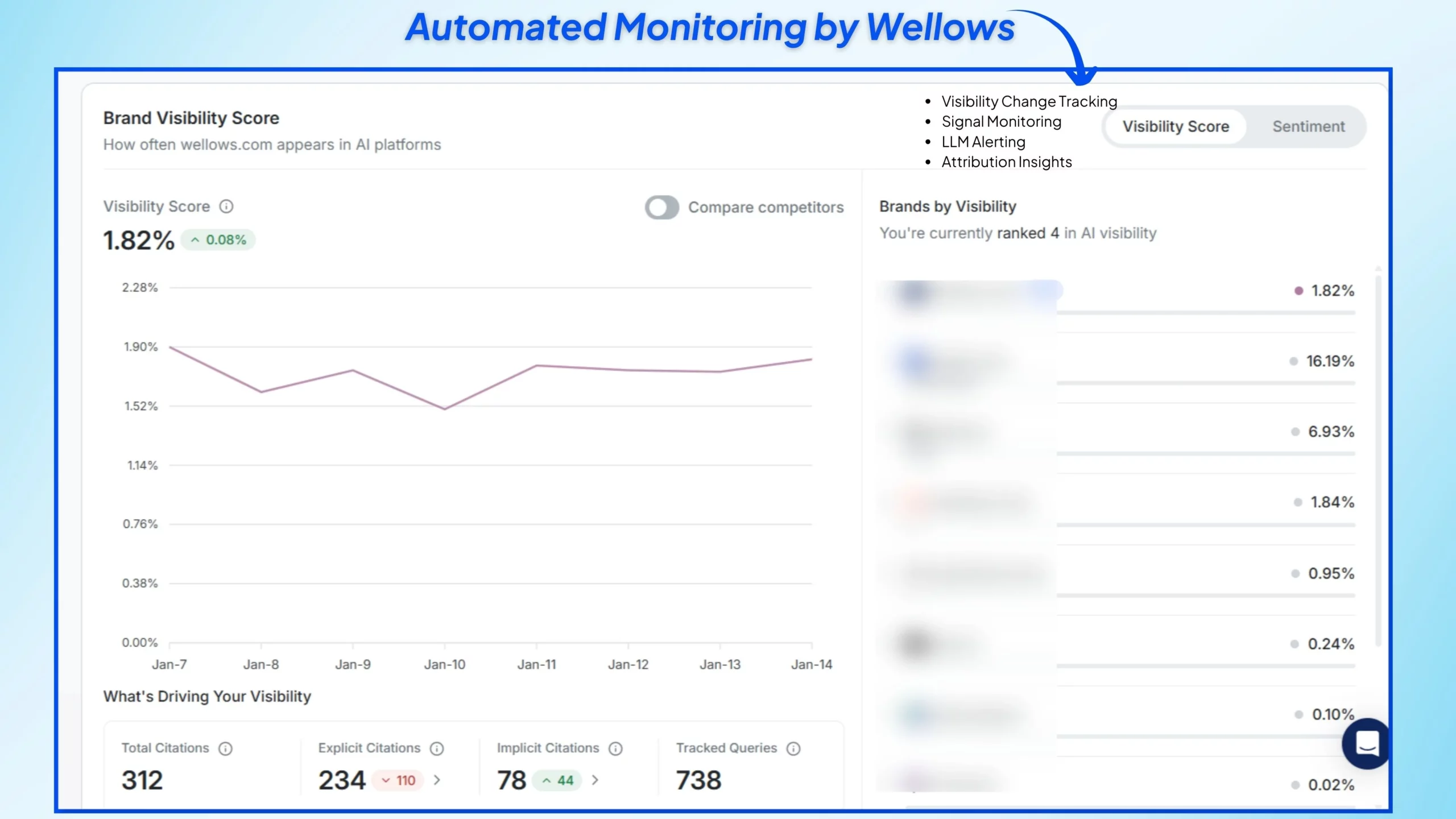
- Detect visibility changes without manual checks
Automated Monitoring tracks citation counts, rankings, and visibility shifts across LLMs. Founders do not need a team to notice when AI stops mentioning them. - Act before competitors compound gains
When visibility drops or competitors gain mentions, founders see it early. This prevents months of silent loss while others accumulate AI-driven attention. - Understand what drives AI recommendations
The tool shows whether visibility comes from explicit citations or implicit mentions, helping founders decide what content, partnerships, or references to strengthen.
Why this matters now
According to Gartner, by 2026 traditional search volume is expected to drop by 25% as users shift toward AI-powered assistants for discovery and decision-making. This means LLM visibility is no longer optional, it is becoming the primary distribution layer.
For bootstrapped founders with limited budgets, tracking and improving LLM visibility early creates a moat that paid ads and cold outreach cannot replace.
In short, Wellows turns AI discovery from a black box into a system founders can control. Instead of asking “Why is no one finding us?”, founders can see where they are missing, where to focus, and how to compete affordably without needing large budgets or teams.
- Which AI Visibility Tool Fits Your Growth Strategy?: Wellows vs Promptwatch
- Legal Checklist for Startups: 15-Steps Legal Checklist for Startups: Complete Guide
- Launch Readiness Checklist: 10-Steps Launch Readiness Checklist: Full Guide
- AI Misunderstood Startup: How AI Misunderstood What My Startup Does
- Ignoring AI Search: The Real Cost of Ignoring AI Search
- Tech Startups: Top Tech Startups Redefining AI, Robotics and Others
FAQs
A predictable distribution engine works because growth math only scales when LTV consistently exceeds CAC. When acquisition is repeatable, startups can forecast revenue, control spend, and avoid cash burn caused by volatile channels. Without predictability, even strong products fail because growth becomes random instead of compounding.
Product–market fit proves demand, but distribution determines whether that demand is reached consistently. Without clear channels, even strong PMF stalls because customers cannot discover, evaluate, or adopt the product at scale.
Owned distribution channels are assets a startup controls directly, such as newsletters, communities, audiences, or proprietary platforms. They are powerful because they reduce dependence on paid or algorithm-driven channels, lower acquisition costs over time, and allow startups to compound attention and trust without losing reach to platform changes.
Startups should use low-volume, high-relevance channels to validate messaging and close early adopters, while scalable channels amplify what already works. The balance comes from testing deeply in small channels first, then scaling only the messages and audiences that show consistent conversion signals.
Conclusion
Building a startup today is less about how fast you ship and more about where and how you get discovered. As product moats continue to erode, distribution has become the primary source of defensibility, especially across AI-driven discovery surfaces. Startups that treat visibility as a system, not a side task, gain leverage early.
Wellows helps startups turn distribution into a predictable engine by revealing opportunity gaps, platform coverage, and real LLM presence. Instead of guessing where to compete, founders can focus on the channels and moments that compound attention using cost-efficient visibility insights. In a market where products look alike, owning discovery is what separates surviving startups from forgotten ones.