The right question for most SEO teams in 2026 isn’t “what should I publish next?” — it’s “how do I get more out of the pages I already have?” Across our customer base, most teams publish more when they should optimize what they have.
The working pattern that moves pages stuck on page 1 into the top 3: diagnose before rewriting, match search intent before word count, use real user data, fix internal links, refresh titles and meta for low-CTR pages.
This piece walks through that framework, anchored in Wellows BigQuery data. Across 1,419,029 citation events tracked in Jan–Apr 2026, wellows.com is cited in 51.69% of its own tracked prompts. The optimization opportunity isn’t writing more — it’s strengthening the half that already has a foothold.
Of AI queries had the same domain cited across ChatGPT, Perplexity, and Gemini
Across 544,374 queries in which all three platforms returned citations, only 11% had a single domain cited by all three platforms. Pairwise overlap is also low — ChatGPT and Perplexity share a cited domain 34% of the time, Perplexity and Gemini 45%, Gemini and ChatGPT 29%. You’re not optimizing for “AI search.” You’re optimizing for three different citation systems that overlap less than most teams assume.
Source: Wellows BigQuery citation dataset, Sep 2025 – May 2026 (n = 544,374 queries with all three providers responding)The publish-more trap
A question I see in customer onboarding calls almost weekly: how do you optimize long-existing blog content that’s stuck on page 1 but won’t crack the top 3? Most teams aren’t asking for a content calendar at this point. They’re asking how to extract more value from existing pages.
There’s a working pattern that the SEOs doing this well have converged on.
- Diagnose first
- Optimize second
- Write new content last
It’s the opposite of what most content tools recommend.
The default workflow in optimization software is “here’s a keyword gap, here’s a new article to write.” That recommendation is correct maybe a third of the time. The other two-thirds, you already have a page that should be the one ranking and getting cited, and writing a second one is how you lose.
The core thesis
Content optimization is not a one-size-fits-all checklist. The best SEOs start by diagnosing why a page is underperforming — wrong intent, weak structure, missing subtopics, poor internal links, outdated metadata, technical issues, cannibalization, or lack of user clarity. The quick wins come from matching the fix to the problem.
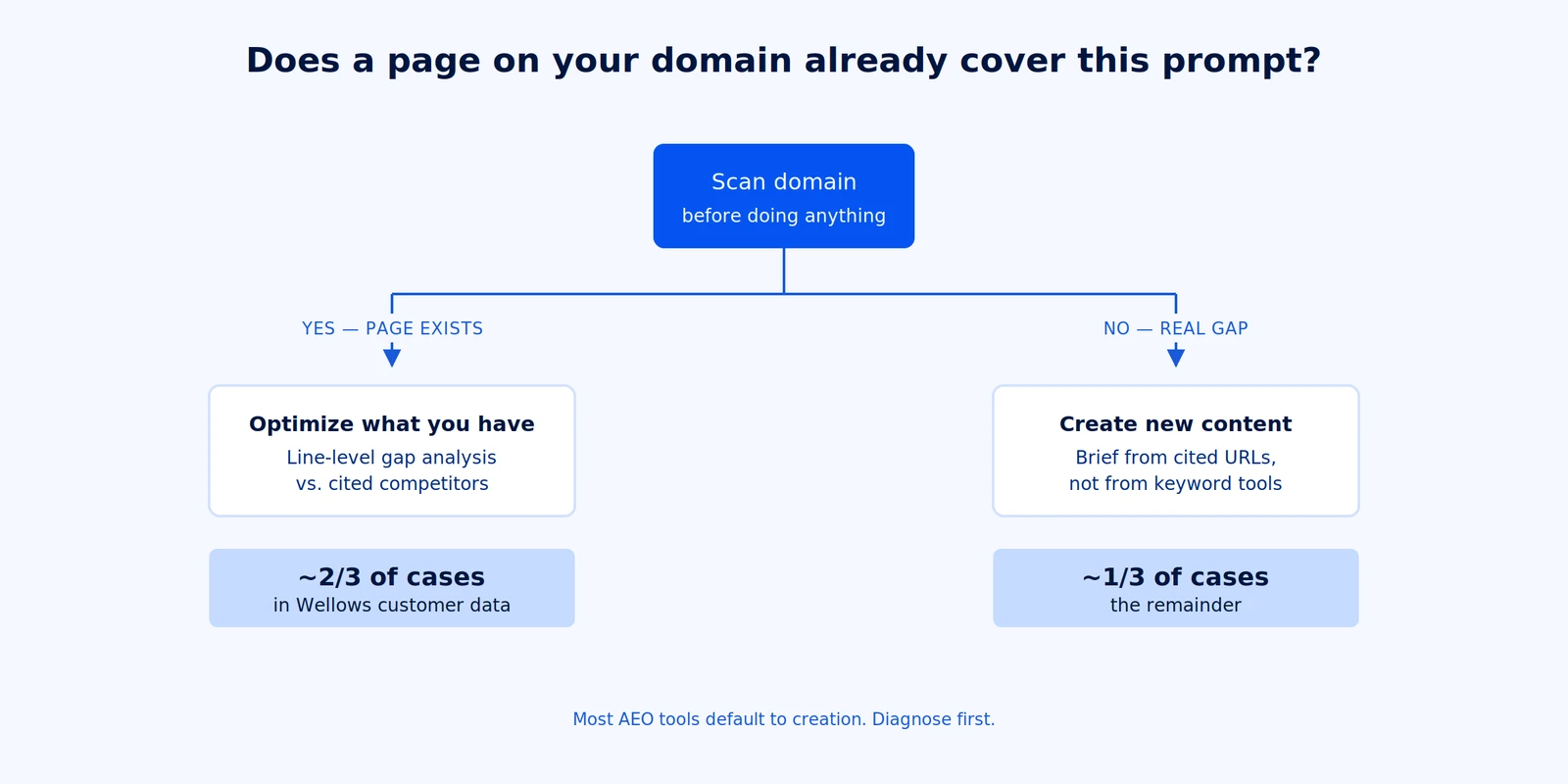
Diagnose first, optimize second, create last — roughly two-thirds of “content gaps” are topics your domain already covers
That framing is why the Wellows Content Optimization feature works the way it does. Most AEO and SEO tools jump straight to “create new content for this gap.”
Wellows scans your entire domain first, picks the existing page that’s best positioned to win the prompt, runs a line-level gap analysis against the cited competitors, and only flags new-content opportunities when nothing on the domain comes close.
What the citation data shows
To anchor the rest of this piece in real numbers: across the 1,419,029 citation events we tracked in Wellows BigQuery between January 1 and April 30, 2026 (project 283, AEO/AI search visibility category, 2,014 unique prompts), here’s what the citation landscape looks like.
Source: Wellows BigQuery citation dataset, project 283, January 1 – April 30, 2026 (1.42M citation events across 2,014 tracked queries).
Three things to read from those numbers. First, AI engines cite a median of 5 URLs per response — meaning the visibility window is tight, and a refresh that doesn’t earn one of those slots is wasted effort.
Second, your existing editorial pages are the surface area that matters: 92.51% of citations go to brand/editorial domains. Third, the gap between cited and non-cited prompts (51.69% vs 48.31% on our own domain) is the actual optimization workload — pages that almost made it but didn’t.
11 Best Practices for Content Optimization, in order
Practice #1: — Start with data, not guesswork
Why this matters
The operational case here is direct: Google Search Console is where you find the pages worth optimizing. Look for pages with high impressions and low CTR. Filter to those ranking positions 4–15. Flag any that used to rank but no longer do.
An important nuance most “content audit” templates skip: check if the page ever ranked at all. If a page has never broken into the top 20, the issue isn’t freshness or word count — it’s targeting.
You can’t optimize your way out of a wrong keyword choice. That diagnostic distinction matters because it routes the work in completely different directions.
The diagnostic, applied:
| Page situation | Likely issue | Best action |
|---|---|---|
| Never ranked | Wrong keyword targeting or intent mismatch | Re-target or rebuild from scratch |
| Ranked before, now dropped | Freshness, competition, cannibalization, SERP shift | Refresh and diagnose what changed |
| Page 1, but not the top 3 | Missing depth, weak links, structural issues, and UX gaps | Improve comprehensiveness and authority |
| deep impressions, low clicks | Weak title/meta or poor SERP positioning | Rewrite title/meta first; test before deeper edits |
| No traffic, no impressions | Indexing issue or content has no demand | Prune, noindex, merge, 301, or rebuild depending on value |
A second layer of diagnostic data worth pulling: Microsoft Clarity, or any equivalent session-recording tool. Screen recordings and heatmaps let you see where users actually click, hesitate, rage-click, or abandon the page.
The point is the same — don’t take generic SEO advice when you can watch the actual user behavior. Notice where readers scroll past, where they try to click something that isn’t a link, and where they leave entirely.
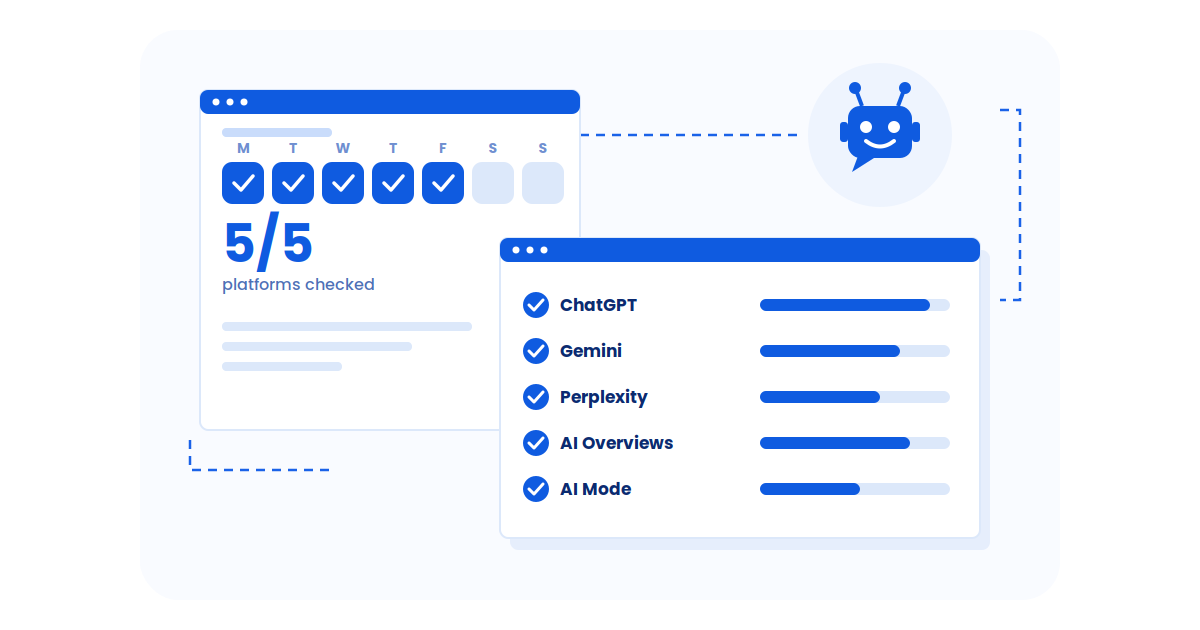
For AI visibility specifically, the equivalent diagnostic is citation-level performance per tracked prompt. Wellows’ Tracking and Performance History views give you the same kind of behavioral signal: which prompts a return to your domain, which returns your competitor instead, and which returns neither.
Practice #2: — Recheck search intent before you rewrite
Why this matters
This is the most recurring point in this work, and the one most often skipped in practice. The question is whether the reader can quickly find what they need. A 7,000-word post is not automatically better than a concise guide, a table, an FAQ, a checklist, or a comparison page.
Search intent shifts. A query that surfaced informational blog posts two years ago might now surface product pages, tools, or comparison content. If you keep the same page format while the SERP has changed shape underneath you, the page can’t win regardless of how well it’s written.
then
The old refresh assumption
➡️ Page is underperforming, so add more words
➡️ Optimize for the same intent it was written for
➡️ Match the current top-ranking word count
➡️ Refresh dates and statistics
➡️ Re-add the target keyword in more places
now
The intent-first refresh
➡️ Search the keyword and read the current SERP
➡️ Ask: what format is Google rewarding now?
➡️ Decide if format changes are needed before content edits
➡️ Update structure to match current intent (tool, table, guide)
➡️ Add content depth only where the new intent demands it
Did you know?
That matters for content optimization because informational queries are where format flexibility helps most — the same question can be answered well by a guide, a comparison, an FAQ, or a tool, and Google rewards whichever format matches user behavior best for that query. Check the current SERP before assuming a long-form blog post is still the right shape.
Practice #3: — Improve the above-the-fold experience
Why this matters
Get the user the answer fast. Long intros that delay the useful content are an old SEO habit that now hurts more than it helps. The first screen should establish that the user is in the right place and answer the immediate version of their question.
Two practical moves:
- Add a clear answer block near the top. A TL;DR, a callout, a summary table, or a definition-style opening. Whatever format makes sense for the query.
- Reduce the gap between H1 and the first useful sentence. If you have three paragraphs of category-level context before getting to the point, cut to the point.
This connects to AI citations, too. AI engines pull “discrete, liftable passages” — paragraphs that can stand alone as answers. A page where the useful content starts 600 words in is harder to lift from. That’s true for human readers and AI engines equally.
Practice #4: — Compare competitor pages at the page level
Why this matters
Most teams default to domain-level competitor analysis: “our authority vs. theirs.” That’s the wrong unit of comparison when you’re optimizing a single page. What you actually need is: what does the page currently ranking in position 1–3 cover that yours doesn’t?
The key shift is to compare the ranking page, not just the domain.
Not their domains — the specific URLs ranking. These are your real benchmarks.
List every H2 and H3 across the top pages. Where do they overlap with yours? Where do they cover something you don’t?
What questions appear in “People Also Ask”? What related searches show up? These are the topics Google itself considers part of the query — and many should be in your page.
A page can rank because the specific URL has strong page-level links, even if the domain isn’t dominant. Domain authority alone won’t tell you this.
Are competitors using tables, calculators, embedded tools, video, comparison matrices? The format itself is a ranking signal Google has selected for.
For each tracked prompt where your domain isn’t cited, the tool scrapes the 4–5 currently cited pages, extracts their structural elements, and gives you a line-level gap analysis — not a generic “cover these subtopics” brief.
A generic brief tells you what tools think should be in the content. A reverse-engineered brief tells you what’s actually working right now for that prompt.
Practice #5: — Add semantic coverage without keyword stuffing
Why this matters
Semantic keywords, related entities, long-tail keywords for AI Overviews — they all matter, but the framing that actually helps is the distinction between depth pages and breadth pages. Depth pages (deep dives on a narrow topic) may benefit from greater relevance and modest keyword density. Breadth pages (overview across many subtopics) need semantic coverage across related subtopics.
The practical version: a refresh should not mean stuffing the main keyword. It should expand its topical relevance by including entities, related questions, synonyms, supporting subtopics, and natural-language phrasing that matches the current SERP.
Semantic coverage signals that matter
- Named entities, explicit and consistent: Call things by their proper names — products, companies, frameworks, methodologies. AI engines and modern Google retrieval both build entity associations from explicit naming. “The leading platform” is not a useful entity reference. “Wellows” is.
- Related entities and concepts: Map the entities that surround the main topic. For a content optimization article, that includes ranking signals, SERP features, search intent, schema, internal links, citations — concepts a reader would expect to see covered.
- Long-tail and PAA-derived questions: Pull questions from People Also Ask, autosuggest, and related searches. Address them naturally in the body or in an FAQ block.
- Synonyms and natural phrasing: The same concept appears with different vocabulary across users. “Brand visibility,” “AI citations,” “answer engine optimization” all sit near each other; the page should reflect that.
- Depth vs breadth match: A depth page needs focused, dense coverage. A breadth page needs each subtopic addressed cleanly without going too deep on any one. Mixing the two is a common failure mode.
Practice #6: — Strengthen internal links
Why this matters
Internal linking is the theme that comes up across more conversations than any other. Link from high-authority pages to underperforming pages. Use descriptive anchor text. Add breadcrumbs as a complementary signal. And avoid excessive auto-linking, which is one of the easier ways to make internal linking look spammy.
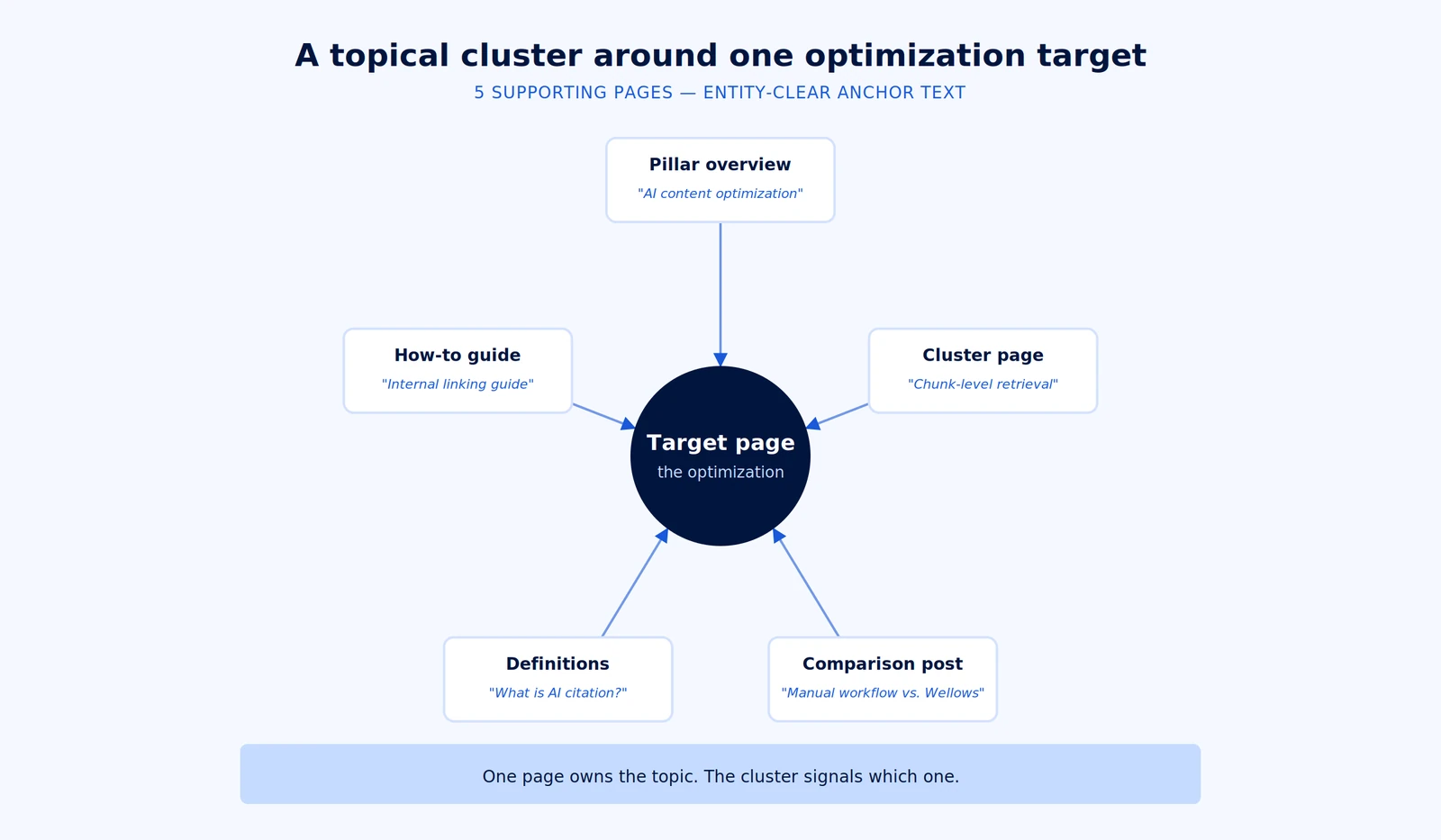
Internal linking is the most undervalued AI content optimization signal — one cluster of four to six supporting pages strengthens the target.
The pattern, in detail:
| Internal linking action | Why it matters |
|---|---|
| Add links from high-authority pages to underperforming pages | Passes internal authority where you need it |
| Use descriptive, entity-clear anchor text | Reinforces topical signals to search engines |
| Link related cluster pages to each other | Builds topical authority across the cluster |
| Place important internal links higher on the page | Higher-positioned links carry more weight |
| Add breadcrumbs on broader topic pages | Helps users and crawlers understand hierarchy |
| Avoid auto-linking every keyword mention | Keeps links intentional rather than spammy |
This is also the practice with the strongest AI-citation upside. When an AI engine crawls your domain, it builds an entity association across pages that link to one another and use related anchor text.
A topical cluster with strong internal linking signals “this domain has authority on this thing, and this specific page is the one that represents it.” A scattered set of pages without internal connection signals neither.
The internal linking pattern, in one paragraph
For every optimized page, identify 4–6 supporting pages on your domain that are topically adjacent and not direct competitors for the same prompt. Link from them to the target page with entity-clear anchors.
The goal isn’t link volume — it’s a clear topical cluster the search engine (and the AI engine) can read as one coherent topic, with one page that owns it.
Practice #7: — Update titles, headings, and meta descriptions
Why this matters
For pages with high impressions but low CTR, the title and meta are the cheapest test you can run. They’re also where the SERP intent shows up first — if the current top-ranking pages have titles framed as “guides,” “tools,” or “comparisons” and yours is framed as a generic blog post, the format mismatch shows in the title before it shows anywhere else.
A related point: headings aren’t just for CTR. H1 and H2 keyword usage helps with keyword targeting and topical relevance, particularly for depth pages where density still matters.
The order of operations:
- For impressions-with-low-CTR pages, rewrite the title and meta first. This is a 5-minute change that tests whether the SERP-level positioning is the problem.
- Wait 2–4 weeks before deeper edits. If CTR improves significantly after a title rewrite, the rest of the page may be fine.
- Align H1 and H2 keyword usage with current SERP intent. Not stuffed — naturally included where it makes sense.
- Refresh the meta description if the current one is from a different era of the page. Many pages have meta descriptions written before the current draft of the page.
The cheapest test in SEO. A title and meta rewrite for a page already getting impressions is the closest thing to a free experiment in this work. The page is already indexed, already eligible to rank, already generating data. Change the SERP-level framing, wait a few weeks, see if CTR moves.
If it does, you know the on-page content is doing more than you thought. If it doesn’t, you’ve ruled out the cheapest possible fix and earned the right to investigate deeper.
Practice #8: — Improve formatting and content design
Why this matters
Content optimization is not just rewriting prose. It’s improving the page’s information design so users (and AI engines) can scan it, lift from it, and trust it. Tables of contents, jump links, FAQs, related searches, media, short paragraphs, bullets, tables, stats, infographics — these aren’t decoration, they’re how the page communicates.
Format elements worth adding
- Table of contents or jump links: Long posts (1,500+ words) benefit most. A TOC lets users navigate quickly and gives AI engines a cleaner structural map.
- Comparison table: Use these for product, tool, or service comparisons. In our citation data, comparison content was cited in 11.16% of AI responses with implicit mentions.
- FAQ section with PAA questions: Best for informational queries where “People Also Ask” surfaces clear sub-questions. Answer each in 2–4 sentences.
- Infographic or diagram: Reach for these on complex processes or statistics. The visual carries information prose can’t.
- Video embed: Tutorials or demos benefit most. Gemini and Perplexity cite video heavily — embeds can pull citations toward your domain rather than YouTube.
- Bullet lists: When a sentence becomes “X, Y, and Z,” consider bullets. Avoid bulleting everything — paragraphs still carry context, lists can’t.
- Schema markup: Add FAQ, how-to, article, product, or review schema as content type calls for. Table stakes for richer SERP display, not the differentiator.
One nuance worth naming: don’t add format elements just because they’re trendy. The point of every format addition is to serve the reader. If a TOC doesn’t make navigation easier, don’t add one. If a table doesn’t clarify a comparison, prose is fine.
Practice #9: — Fix technical basics
Why this matters
Technical issues block optimization, but they don’t drive it. They get the right weight if you address them quickly and then move on.
The quick checks:
| Technical check | Tool/Source |
|---|---|
| Indexing status | Google Search Console URL Inspection |
| Click/impression trends | Google Search Console Performance report |
| Page speed and Core Web Vitals | PageSpeed Insights / Lighthouse |
| HTML errors and broken tags | Site audit crawler (Screaming Frog, Ahrefs, Semrush) |
| Schema validity | Rich Results Test / Schema validator |
| Image alt text and filenames | Manual page audit or crawler |
| Broken internal/external links | Site crawler |
Before assuming the content is weak, confirm the page can be crawled, indexed, rendered, and loaded properly. The underlying point — that targeting can be wrong before content is wrong — applies here too. If a page isn’t indexed, no amount of content optimization will help.
Practice #10: — Prune, merge, noindex, or redirect carefully
Why this matters
This is the most nuanced piece of existing content work. Content pruning depends on whether the page has traffic, external links, or visitor value — and the right action varies by case. Google updates can also create cannibalization issues where pages that previously coexisted start competing.
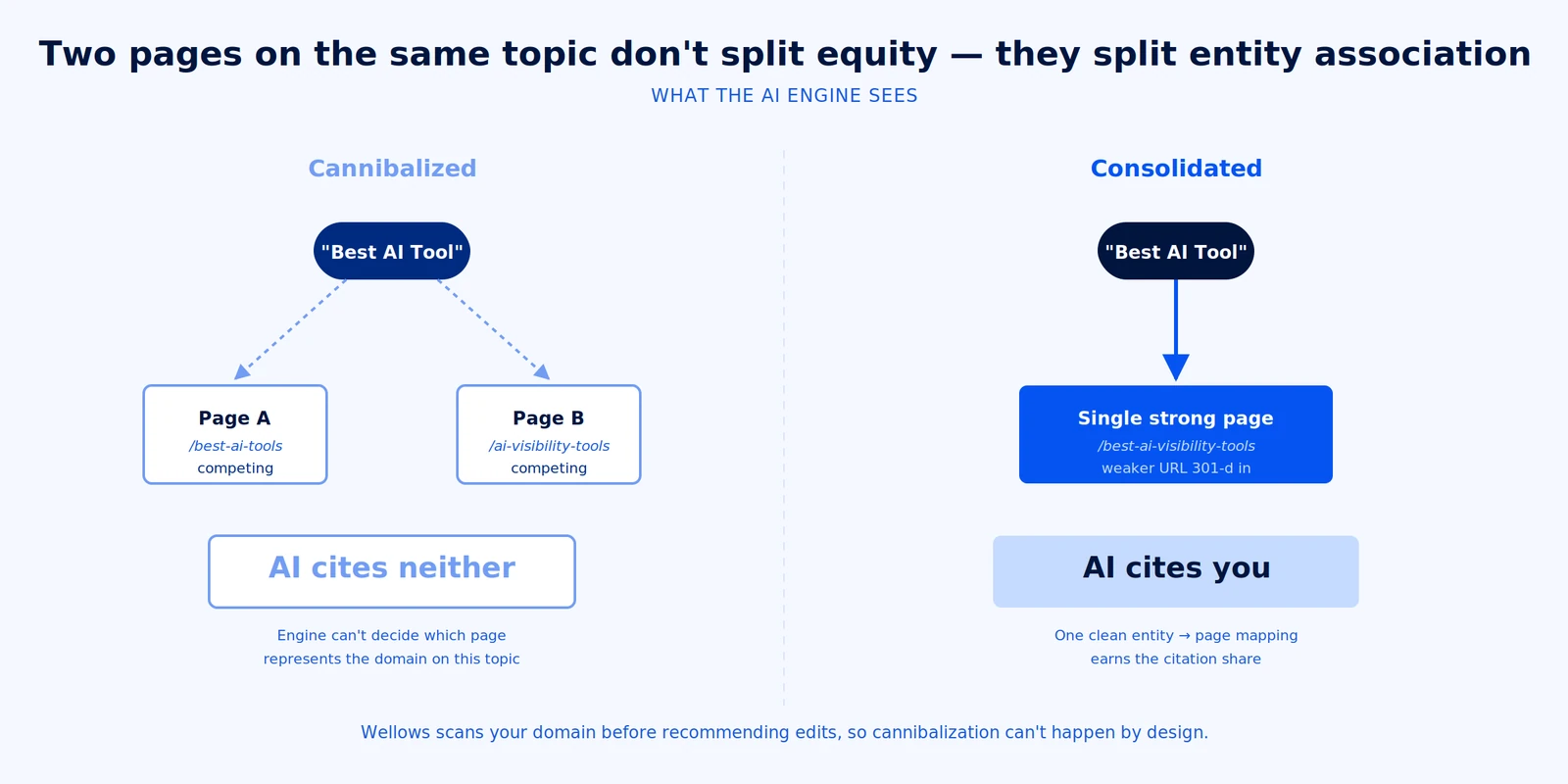
Two pages competing for the same prompt split entity association and earn zero citations — consolidate into one strong URL and 301-redirect the weaker.
The decision framework:
| Page situation | Best action |
|---|---|
| Helpful for visitors but not search-worthy | Noindex, keep accessible |
| No traffic, no backlinks, no future purpose | 404 or remove |
| Has external links, but the content is obsolete | 301 to the closest relevant page |
| The topic is still relevant, but the content is thin | Update and expand |
| Two pages are competing for the same query | Merge into the stronger page, 301 the weaker |
| Page is on-topic but underperforming | Diagnose with the framework above before deciding |
The cannibalization trap
Two pages on your domain covering the same topic don’t just split link equity — in the AI era, they also split the entity association the engine builds with your domain. When a search engine or AI engine can’t decide which of your pages represents you on this topic, it often cites neither. The fix is to scan your domain before creating new content, identify the strongest existing page on the topic, and optimize that one rather than publish a duplicate.
Practice #11: — Make changes in batches and wait
Why this matters
A practitioner’s caution worth taking seriously: don’t make rapid changes when results aren’t immediate. Update in batches, document what changed, monitor results, and avoid changing everything at once.
The underlying principle is to treat content optimization as testing rather than deployment. A batch of 5–10 page updates with clear documentation is more useful than 50 updates where you can’t tell what moved the needle.
If something works, you can scale the pattern. If something hurts, you can roll back the batch.
The Wellows workflow supports this by design: every optimization or content-creation action is logged in Your Activity, with timestamps. Performance History gives you date-to-date comparisons so you can see exactly which prompts shifted citation behavior after a batch of edits. The point isn’t tool-specific — it’s that the work compounds only when you can see whether each pass moved the number.
Frequently asked questions
Optimizing existing content starts from a page that’s already indexed, already has some level of authority, and already has user data. The work is targeted: diagnose what’s underperforming, make the specific fix, and measure the change. Creating new content starts from scratch — you’re betting on a topic where no page on your domain currently competes. Most teams default to creation when optimization would be cheaper and faster. In our customer work, roughly two-thirds of “content gaps” surfaced by AEO tools turn out to be topics the domain already covers and could update instead.
Use the diagnostic table in Step 1. When the page has never ranked, the issue is targeting — you need to re-target or rebuild. Pages that ranked before and dropped point to freshness, competition, or cannibalization — refresh and diagnose. A page stuck on page 1 outside the top 3 typically has a depth or structure problem, so the practices in Steps 4-9 apply. Where the page has high impressions but low clicks, start with title and meta. The wrong move is to apply the same “rewrite and expand” approach to every page, regardless of which problem you’re solving.
Publishing a new page on a topic your domain already covers. The “create new content” recommendation has a lot of momentum in optimization software because it feels productive — but it’s the most common way to lose visibility you’d already earned. Update before you create, every time. This is also what Wellows Content Optimization is structured around: scan the domain first, optimize what exists, only create when nothing matches.
Less than it used to, but the depth-vs-breadth distinction matters here. For a depth page (deep dive on one narrow topic), modest keyword density and focused topical relevance still help. For a breadth page (overview across many subtopics), semantic coverage across related entities matters more than repeating the main keyword. Either way, stuffing the main keyword is a worse strategy than naturally expanding entity coverage.
Title and meta changes typically take 2-4 weeks for CTR signals to become reliable. Deeper content edits take 4-8 weeks to take effect. Internal linking changes take 6-10 weeks for the topical authority signal to compound. The caution about batching changes connects directly to this — if you change too much at once, you can’t tell which change moved the metric, and waiting becomes harder.
Yes, where it’s relevant — FAQ schema for FAQ sections, how-to schema for instructional content, article schema for editorial pages, product/review schema where appropriate. But it’s table stakes, not the differentiator. A schema helps search engines parse the page; a citation-shaped structure helps them decide whether to use it. Implement schema, don’t expect it alone to move the needle.
Cannibalization happens when two pages on your domain compete for the same query and split ranking signals. In the AI era, it’s worse: two pages compete for the same prompt and confuse the AI engine’s entity association with your domain, often resulting in neither being cited. To check: search your main keyword with site:yourdomain.com appended. If multiple pages show up that target the same query, you have a cannibalization candidate. Merge into the stronger page and 301 the weaker, or differentiate the targeting if both pages should exist.
The structural changes that work for one tend to help across both. Both reward entity clarity, factual density, clean hierarchy, and citation-shaped passages. The differences sit at the edges: AI engines weight authoritative editorial sources slightly differently (Wikipedia and arXiv lead in ChatGPT, Medium and Search Engine Land lead in Gemini, LinkedIn and community platforms lead in Perplexity in our data), but the underlying optimization work is mostly the same. Don’t write three different versions of every page for three engines — write one well-structured page and measure where it shows up.
It’s a good complement for traditional ranking work. Clarity gives you screen recordings and heatmaps showing where users actually engage with the page — where they click, where they hesitate, where they scroll past, where they try to click something that isn’t a link. That’s more useful than generic SEO advice because it shows real user behavior on your real page. For AI visibility specifically, the equivalent diagnostic is citation-level performance per tracked prompt — which is what Wellows tracks. Both kinds of behavioral data are useful; they tell you different things.
Once you finalize the prompts you want to win, Wellows scans your entire domain for relevant content first. An intent-and-relevance scoring layer picks the existing page best positioned to win the prompt — preventing cannibalization before it happens. Then it scrapes 20-50 currently cited competitor URLs for that prompt, decodes the structural patterns (entities, depth, formatting), and produces a line-level gap analysis telling you exactly what to add, remove, or rewrite. Finally, it maps the supporting pages on your domain that should link to the optimized page, along with suggested anchor text. The decision tree is rule-based: optimize what exists, create only when nothing matches.