I’ve been working inside the AEO transition for the last couple of years, and I’ve spent most of the last six months looking at one specific failure mode: teams that do everything the AI search optimization advice tells them to do, ship 40+ page updates, and watch their citation rate barely move.
The pattern is almost always the same. They added FAQ schema everywhere. They broke pages into chunks. They restructured H2s as questions. They published cluster pages. Each piece of advice was correct in isolation. None of the pieces talked to each other.
What the standard checklists don’t tell you is the part that actually breaks timelines — which page to optimize first, what to do about the page next door that’s covering the same topic, and how to know whether any of this is working week-over-week without an AI Search Console that doesn’t exist yet. That’s the gap I’m trying to close with this checklist.
This is the version I wish someone had handed me in month one of building citation visibility for a domain. Thirteen steps, grouped into four phases, with do/avoid pairs drawn from real practice and a flag for where the Wellows Content Optimization engine handles a step automatically if you’d rather not run it manually.
- Start with the prompts, not the keywords. AI search behaves differently from Google search — you optimize for what people actually ask.
- Pick the right page before you change anything. Most teams optimize the wrong URL or duplicate one they already have. Audit first.
- Optimize at the chunk level, not the page level. LLMs retrieve passages — each section needs to stand alone.
- Build authority signals that AI weighs — original data, named bylines, citations in places AI already trusts (Reddit, Wikipedia, top industry pubs).
- Cover the brand layer, the content layer, and the technical layer together. Citation comes from the combination.
- Measure citation movement, not traffic. AI Search Console doesn’t exist yet — you need a tracker that watches LLM responses.
Of AI queries got the same domain cited across ChatGPT, Perplexity, and Gemini
Across 544,374 queries where ChatGPT, Perplexity, and Gemini each returned cited sources, only 11% had a single domain cited by all three platforms. You’re not optimizing for “AI search.” You’re optimizing for three different citation systems that happen to overlap less than most teams assume.
Source: Wellows citation tracking data, Sep 2025–May 2026 (n=544,374 queries)Why this checklist is structured the way it is
Most AI content optimization checklists I’ve audited stop at the page level. They tell you what to do to a page — add schema, restructure headings, write a TL;DR. Useful, but incomplete.
Citation visibility doesn’t come from a single page. It comes from the interplay between four things working at the same time: brand recognition (does the LLM know who you are?), content depth (do you cover the topic better than the cited competitors?), technical access (can AI bots actually reach your content?), and continuous monitoring (are you adjusting as citation patterns shift?).
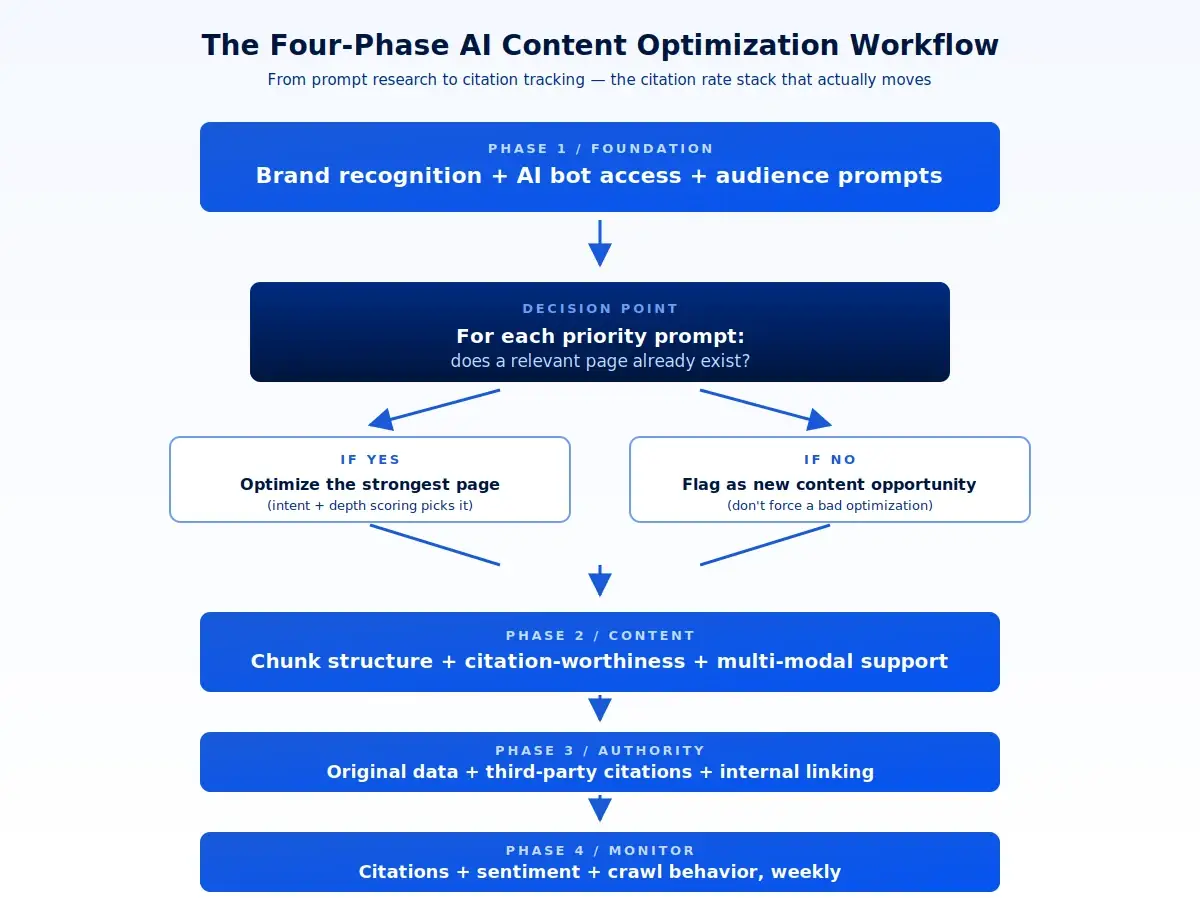
The four-phase AI content optimization workflow. The cannibalization check (decision point) is the step most teams skip — and the one that wrecks the most timelines
So the checklist is grouped into four phases that map to those four layers. You can run them sequentially, or run the brand and technical work in parallel with the content work — but you can’t skip a layer and expect citation rate to move.
13 Step Checklist for Content Optimization
Phase 1 of 4 — Foundation. Before you touch a single page. You can’t optimize what you can’t measure, can’t reach, or don’t understand. These three steps come first.
Step 1 — Research AI search audience behavior
Why this matters
AI search behavior is different from Google search. People ask AI long, conversational, multi-turn questions with task-oriented intent. They Google short keywords with navigational intent. If you optimize for the Google query, you miss the AI prompt entirely.
To do
- Identify the AI platforms your audience already uses. Check GA4 for referral traffic from
chatgpt.com,perplexity.ai,gemini.google.com. - List the actual prompts your audience asks across the buying journey — branded and unbranded.
- Benchmark your visibility vs. up to 10 competitors per topic across at least three AI platforms.
- Prioritize the prompts where competitors are cited and you’re not. Those are the openings.
- Map each priority prompt to one of four intents: informational, commercial, comparative, navigational.
Do
- Pull prompts from sales calls and support tickets — they’re closer to AI queries than your keyword research is.
- Track both branded (“is [brand] good for X”) and unbranded (“best tool for X”) prompts.
- Check across at least three LLMs — citation patterns differ wildly between them.
- Look at People Also Ask data on Google. Many of those questions are also AI prompts.
Avoid
- Assuming Google keyword data maps cleanly to AI prompts. It doesn’t.
- Tracking one AI platform and projecting the rest.
- Only chasing branded prompts. Most citation opportunities are unbranded.
- Optimizing for prompts your real audience isn’t asking for.
More valuable than traditional-search visitors
Semrush research shows visitors who find a brand through an AI answer are 4.4× more valuable than visitors from traditional search. They’re pre-qualified — they’ve seen the AI endorse your solution before they click.
Source: Semrush AI Search Research, 2025Step 2 — Audit current brand visibility around the web
Why this matters
LLMs use entity recognition. A brand mentioned consistently across the web — Wikipedia, top industry pubs, Reddit, Quora — cites more often than a brand only present on its own domain. Before you optimize content, you need to know what AI sees when it looks for you.
To do
- Search your brand name in ChatGPT, Perplexity, Claude, and Gemini. Read what they say. Note inaccuracies, missing context, and outdated information.
- Check brand consistency: same name, same logo, same tagline, same NAP (Name, Address, Phone) across every property.
- Audit your Wikipedia entry. If you don’t have one and you’re an established brand, that’s a priority gap.
- Pull your existing brand mentions across the web. Identify lost or broken backlinks for reclamation.
- Check your branded SERP — make sure you own the pages that appear when someone Googles your brand name.
Do
- Fix inconsistencies first — outdated logos, old addresses, wrong descriptions.
- Get listed on Trustpilot, G2, Capterra, and industry-specific review sites.
- Encourage happy customers to leave reviews on Google and Trustpilot.
Avoid
- Manipulating your own Wikipedia entry — edits get reverted and trust drops.
- Ignoring inaccurate AI descriptions of your brand. They compound over time.
- Spamming review sites with fake reviews. AI weighs sentiment and detects patterns.
Step 3 — Optimize AI crawlability and indexability
Why this matters
If the bot can’t crawl the page, the LLM can’t cite it. Most blocks I find in audits are unintentional — Cloudflare defaults, an old firewall rule, a forgotten noindex. The page exists; the AI doesn’t see it.
To do
- Allow these crawlers in
robots.txt: GPTBot, Google-Extended, ClaudeBot, Claude-User, Claude-SearchBot, PerplexityBot, Perplexity-User, CCBot, bingbot. - Whitelist AI bot IP ranges at your firewall and CDN level.
- Render essential content server-side. Most LLM scrapers don’t execute JavaScript — client-rendered pages look empty.
- Remove
noindexandnosnippetfrom pages you want cited.nosnippetspecifically blocks AI Overviews and AI Mode from using your content. - Check your CDN. Cloudflare’s AI Crawl Control defaults to blocking AI bots in many configurations — audit it explicitly.
- Use self-referring canonical tags on URLs you want cited.
- Submit your XML sitemap to Google Search Console and Bing Webmaster Tools.
- Ensure HTTPS is enforced site-wide.
- Optimize for Core Web Vitals — speed is a baseline citation factor.
Do
- Test with curl. If the HTML you fetch is empty, the LLM sees nothing.
- Add descriptive anchor text on internal links, not “click here.”
- Set up automated site audits to catch regressions before they impact visibility.
- Use server-side rendering or pre-rendering for JS-heavy frameworks.
Avoid
- Blanket-blocking AI bots at the firewall to “protect content.” You’re protecting yourself out of the answer.
- Canonicalizing a deep page to your homepage. You vacate the citation.
- Assuming your dev team checked the AI bot settings — they probably didn’t.
- Slow mobile load times. AI engines deprioritize laggy pages.
Phase 2 of 4 — Content. Once the foundation is in place, the page-level work. Six steps, structured so that each can be run on a single URL at a time.
Step 4 — Build topical breadth and depth
Why this matters
AI systems use query fan-out: they break a single user question into multiple sub-queries and pull sources for each sub-query in parallel. A shallow page covering 12 subtopics in one paragraph loses to a structured hub of in-depth cluster pages.
To do
- For each priority topic, build one pillar page summarizing all facets at a high level.
- For each facet, build a cluster page covering that facet in depth (1,500–3,000 words minimum, no padding).
- Cross-link cluster pages to each other where contextually relevant. Link every cluster back to the pillar.
- Cover informational, commercial, and comparative intent in the cluster. Comparison pages cite heavily in AI answers — don’t skip them.
- Find questions to answer in your content using Keywords Explorer, People Also Ask, support tickets, and sales call transcripts.
- Build an SEO topical map that extends beyond keywords into related entities and concepts.
Do
- One concept per cluster page. Resist the urge to merge.
- Map every cluster page to one specific prompt or intent.
- Use descriptive internal anchor text that names the topic.
- Close topic gaps quarterly. Emerging subtopics are quick citation wins.
Avoid
- “Ultimate guide” pages that try to cover everything and end up too shallow on each facet.
- Cluster pages with zero internal links — they fail the topical authority test.
- Creating a second cluster page for a facet you already cover. This is where cannibalization starts.
- Writing only the questions — also write the actions and jobs-to-be-done.
Share of all AI citations that go to the top 100 domains
Across 10.9 million citation events we tracked across ChatGPT, Perplexity, and Gemini, the top 100 domains accounted for just 21% of citations. The other 79% spread across nearly 400,000 unique domains. AI doesn’t reward domain authority the way Google does — focused brands cite as often as established ones when chunk structure, entity recognition, and authority signals align.
Source: Wellows citation tracking data, Sep 2025–May 2026 (n=10.9M citations across 398,324 domains)Quick refresher: if you’re new to the citation-vs-ranking distinction, our guide on why content optimization feels harder than SEO explains why your rankings can stay green while citations stay flat.
Step 5 — Optimize for chunk-level retrieval
Why this matters
LLMs don’t index pages — they retrieve passages. Duane Forrester calls this the shift from “crawled, indexed, ranked” to “chunked, retrieved, synthesized.” Each chunk of your content has to make sense without the rest of the page as context.
To do
- One idea per section. If two ideas share an H2, split them.
- Lead every section with a direct, declarative answer in the first 1–2 sentences. Expand afterward.
- Use a clear, semantic H2 and H3 hierarchy. Don’t apply heading tags purely for visual styling.
- Keep paragraphs tight. The first sentence under each heading does most of the citation work.
- Define technical terms the first time you use them. AI uses term definitions to categorize content correctly.
- Adapt tone to format: conversational for blogs, declarative for answers, authoritative for how-to.
What good chunked content looks like
Do
- Open each section with a clean definition or direct answer.
- Make every section readable in isolation.
- Use natural-language Q&A headings where appropriate.
Avoid
- Burying the answer four paragraphs in.
- Opening with “In this section, we’ll explore…” Cut it.
- Writing paragraphs that depend on three previous sections to make sense.
Step 6 — Optimize for answer synthesis
Why this matters
AI engines synthesize multiple chunks from different sources into a single response. Your content has to be easy to extract, factually neutral, and structured to slot into a multi-source answer.
To do
- Add a TL;DR or “Key Takeaways” section at the top of long content — 2–4 bullets, each self-contained.
- Lead with the bottom line. Then add context, examples, nuance.
- Use plain, factual, non-promotional language. Marketing tone gets filtered.
- Add structured data (Article, Author, Organization, FAQ where appropriate).
- Use natural-language Q&A format only where a question genuinely is the section’s purpose.
- Add bullet points, numbered lists, and HTML tables for clarity — structured content extracts better than walls of prose.
- Implement answer-oriented writing — one idea per section, lead with the bottom line. More on this in our Answer Engine Optimization guide.
Do
- Write the way you’d answer a question to a peer. Specific, plainspoken, factual.
- Use HTML lists and tables for comparisons and steps.
- Add schema, but only where the content type genuinely fits the schema.
Avoid
- Stuffing the FAQ schema on pages where no real Q&A exists.
- Vague intro paragraphs labeled “TL;DR.”
- Promotional language like “industry-leading” or “best-in-class” — AI filters it.
Step 7 — Earn citation-worthiness
Why this matters
AI cites when content reads as factually accurate, up-to-date, well-structured, and authoritative. Not every chunk gets cited. To earn attribution, your content has to meet a higher clarity and trust bar than the rest of the page.
To do
- Use specific, verifiable claims with sources. Real numbers with real dates.
- Link to original studies, not third-party summaries of them.
- Add author bylines with role and credentials. Anonymous content cites less.
- Mark up Author and Organization schema. Add
sameAslinks to author profiles on Twitter/X, LinkedIn, GitHub. - Add visible “Updated [date]” stamps. Refresh content quarterly on fast-moving topics.
- Quote named experts. Interview them and include attributed perspectives.
- Show expertise signals — credentials, certifications, related publications.
Do
- Cite the original source, not the secondhand version.
- Add a dated “Last updated” indicator.
- Link author byline to an author profile page with credentials.
- Strengthen EEAT at brand, site, and page level — author bios, expert credentials, trusted reviews.
Avoid
- “Studies show” without naming the study. AI filters this language.
- “Team” as author. It signals low EEAT.
- Stats older than 18 months on fast-moving topics like AI search.
Step 8 — Add multi-modal support
Why this matters
AI is increasingly retrieving multimodal content — images, charts, tables, even video. But it only retrieves what it can parse. An HTML table is tokenized and read. An image of a table is invisible.
To do
- Use HTML
<table>, not images of tables. Always. - Wrap figures in
<figure>with<figcaption>That explains what the figure shows. - Write alt text that describes the visual in context, not keyword-stuffed alt attributes.
- Serve images via clean HTML. Avoid JavaScript-only lazy loading where possible.
- Add a YouTube video where the topic genuinely benefits from one — and link your YouTube channel to your website schema.
- Repurpose top content across formats: video, carousel, podcast, infographic. Distribute on LinkedIn, YouTube, Reddit, TikTok.
Example alt text patterns
| ✅ Good alt text | ❌ Bad alt text |
|---|---|
| “Bar chart showing citation share for top 5 VPN brands across ChatGPT, Perplexity, and Gemini in Q1 2026 — NordVPN leads at 44%.” | “vpn citation chart” |
| “Flowchart of the AI content optimization workflow from prompt identification to citation tracking.” | “image” |
| “Screenshot of the Wellows Tracked Prompts dashboard showing 40 prompts and an 18.4% visibility score.” | “dashboard screenshot” |
Do
- HTML tables for data. Always.
- Caption every figure with what it shows AND why it matters.
- Pattern for alt text: “Figure type showing [content] — [key takeaway].
Avoid
- Uploading chart screenshots. AI can’t read them.
- Empty alt attributes. They’re a free win you’re skipping.
- Stuffing target keywords into alt text. It doesn’t help, and it makes the page worse for screen readers.
Step 9 — Make content personalization-resilient
Why this matters
AI engines personalize answers based on location, intent, and user history. A page that covers only one intent surfaces for one slice of users. A page that covers multiple intents surfaces for many.
To do
- For each priority topic, cover at least three intents: informational (“what is X”), commercial (“best X for Y”), comparative (“X vs Y”).
- Add localized schema (LocalBusiness, Place) for content meant to surface in specific geographies.
- Segment content for specific personas where relevant — freelancers, in-house teams, agencies.
- Build engagement signals. Fast pages, useful tools, real interactive elements. AI engines refine results based on thumbs up/down behavior.
- Apply
hreflangfor multilingual or multiregional content. - Build location pages where the geography matters to the buying decision.
Do
- Build hub pages with role-based sections.
- Mark up locations with schema where geography is part of the search intent.
- Include real examples from multiple personas in the body.
Avoid
- Writing only the bottom-funnel sales page and expecting it to surface for informational prompts.
- Generic “serving customers worldwide” copy for pages meant to surface in specific regions.
- One-persona content that ignores how your audience actually segments.
Phase 3 of 4 — Authority. Page-level optimization gets you eligible. Authority signals get you chosen. Three steps that build the external recognition AI weighs.
Of Perplexity citations came from Reddit in Jan 2026
Tinuiti’s Q1 2026 AI Citations Trends Report found Reddit accounted for roughly 24% of total Perplexity citations in January 2026. In Google AI Overviews, social media accounted for 13% of citations. Most B2B teams treat these as “social” and ignore them — leaving citation share on the table. See more in our social platform AI citations report.
Source: Tinuiti AI Citations Trends Report, Q1 2026Step 10 — Build content authority signals
Why this matters
Original data attracts links, mentions, and citations. Recycled content earns none of the three. A brand publishing real research quarterly compounds citation visibility far faster than one publishing weekly recap posts.
To do
- Publish original data or research at least quarterly. Survey your audience, query your own data, build a benchmark.
- Promote that research to industry newsletters and journalists.
- Interview experts in your field. Include attributed quotes in your content.
- Create shareable assets — tools, calculators, templates, dashboards — that naturally attract links.
- Apply for industry awards and recognition programs. Feature them on your site.
- Strengthen your homepage and about page for EEAT signals: reviews, testimonials, awards, certifications.
Do
- Run an annual industry benchmark. Yours will get linked and cited.
- Build interactive tools that solve real problems. They earn long-tail mentions.
- Promote research through industry-relevant newsletters and Slack communities.
Avoid
- Listicles like “best [product] for [use case]” with no original data or methodology.
- Republishing another report’s data as if it’s yours.
- Citing your own data without showing the methodology — AI weighs methodology transparency.
Step 11 — Get cited where AI already cites
Why this matters
AI systems weigh entity recognition. A brand mentioned across Reddit, Wikipedia, and top industry publications cites more often than one only present on its own domain — even if the on-domain content is technically better.
To do
- Identify which domains AI cites for your category. Tools like Wellows, Ahrefs Brand Radar, and Profound show this.
- Build a presence on Reddit and Quora — authentically. Answer questions where your expertise is useful.
- Audit your Wikipedia entry. Make sure it’s complete, accurate, and references reliable sources.
- Find domains already citing your competitors and reach out for inclusion in their roundups.
- Publish guest posts on publications that frequently appear in AI responses.
- Partner with writers and journalists who are already being cited in AI answers.
- Get listed in industry directories and review platforms relevant to your niche.
- Contribute to relevant forum and community conversations — Slack groups, LinkedIn Groups, specialist forums.
- Reclaim lost backlinks. Fix outdated brand information on third-party sites.
Do
- Use Wellows or Brand Radar to find which domains AI cites for your category — pitch them.
- Write outreach that references the specific article, not a templated cold email.
- Be genuinely helpful in community spaces. Citation follows reputation.
Avoid
- Spamming Reddit. The community detects it instantly and you damage citation potential, not improve it.
- Paying for fake Wikipedia edits. They get reverted within days.
- Buying guest posts on low-quality networks. AI is starting to filter those domains out of citations.
Step 12 — Internal linking that compounds
Why this matters
Internal linking is one of the most undervalued AI optimization signals. When supporting pages on your domain link to your optimized page with topic-relevant anchor text, LLMs follow the cluster, recognize the topical depth, and trust the page faster. One fix strengthens many pages.
To do
- For every priority page, identify 3–5 supporting pages on your domain that should link to it.
- Use descriptive anchor text that names the topic, not generic phrases like “learn more” or “click here.”
- Link from contextually relevant paragraphs, not from “related posts” widgets.
- Map the full cluster: pillar → cluster pages → cluster pages cross-linking each other.
- Audit and reclaim broken internal links quarterly.
- Avoid orphan pages — every priority URL needs at least 3 incoming internal links.
Do
- Make the anchor text match the topic the linked page covers.
- Audit anchor text distribution — too many generic anchors weaken topical signals.
- Add internal links during content creation, not as an afterthought.
Avoid
- Stuffing exact-match anchor text on every link. Vary it naturally.
- Linking only from footers and sidebars. Body-text links carry more weight.
- Orphaned pillar pages. They never reach citation eligibility.
Phase 4 of 4 — Monitor. Measure citation movement, not traffic. If you can’t see citation movement, you can’t optimize the work. The final step is the one most teams skip.
Step 13 — Monitor AI search performance
Why this matters
AI Search Console doesn’t exist yet. Google Search Console barely captures AI referral traffic. If you’re not tracking citation movement across platforms, you’re optimizing in the dark.
To do
- Track which prompts cite you and which cite competitors. Weekly cadence.
- Monitor sentiment of brand mentions, not just whether you appear. A “they’re overpriced” citation hurts.
- Benchmark visibility score against your top 5 competitors per topic.
- Track AI bot crawl behavior monthly. A drop in crawl frequency is an early warning.
- Watch AI referral traffic in GA4. Pages that earn citations should see secondary traffic from AI platforms.
- Track AI hallucinations — if AI is making up facts about your brand, catch it early.
- Compare time periods. A 30-day diff tells you what’s working; a 90-day diff tells you what’s compounding.
What to actually measure
| Metric | What it tells you | Cadence |
|---|---|---|
| Citation count per prompt | Direct measure of AI visibility for a specific query | Weekly |
| Visibility score vs. competitors | Where you sit in the topic-level ranking | Weekly |
| Sentiment of brand mentions | Whether citations convert or repel | Bi-weekly |
| AI referral traffic to optimized pages | Whether citation is translating to clicks | Monthly |
| AI bot crawl frequency | Whether the LLM is still studying your content | Monthly |
| AI hallucination detection | Whether AI is misrepresenting your brand | Monthly |
Do
- Compare period-over-period (Wellows’ Performance History does this natively).
- Tag content updates and check citation movement 30, 60, and 90 days later.
- Watch competitor citation spikes — they signal new content or outreach you should respond to.
Avoid
- Relying only on GSC for AI referral data. It barely captures it.
- Celebrating a citation without checking the sentiment.
- Going six weeks between checks. Citations move daily.
Of enterprises plan to increase GEO spend in 2026
US enterprises dedicated an average of 12% of digital marketing budgets to generative engine optimization (GEO) in 2025. 94% of those teams plan to increase that spend in 2026. The category is moving from experimental line item to core marketing function.
Source: eMarketer enterprise GEO spending data, 2025–2026Pre-publish QA — run this before every page goes live
Once the 13 steps are done, this is the final pass. Fifteen yes-or-no questions, grouped into four checks. If any are “no,” fix before you ship.
- TL;DR or key takeaways appears in the first viewport — if missing, add a 2–4 bullet summary at the top.
- Every H2 corresponds to one clear concept, not multiple — if mixed, split into separate sections.
- Each section opens with a direct, declarative answer — if buried, move the answer to the first sentence.
- All tables rendered in HTML, not images — if any are screenshots, rebuild as a real
<table>.
- Every claim with a number has a source link — if missing, add the source or remove the stat.
- Author byline with credentials is present — if missing, add author name, role, and profile link.
- Last-updated date is visible at the top — if missing, add “Updated [date]”.
- Alt text on every image describes content in context — if generic, rewrite to describe the visual.
- Schema includes Article, Author, Organization — if missing, add structured data.
- FAQ section addresses 3–5 real audience questions — if absent, add an FAQ drawn from your audience’s actual prompts.
- Robots meta tag allows indexing AND snippet use — if blocked, remove
noindexornosnippet.
- 3–5 internal links to supporting pages with descriptive anchors — if light, add topic-relevant internal links.
- Page loads in under 3 seconds on mobile — if slow, optimize images and remove unused JS.
- Cloudflare/CDN not blocking AI bot user-agents — if blocked, whitelist GPTBot, ClaudeBot, PerplexityBot.
- Page has not duplicated a topic already covered on another URL — if so, consolidate or kill the weaker page (Wellows flags this automatically).
Download the full checklist as a Google Sheet
Free Resource
Download the full checklist as a Google Sheet
The complete 13-step checklist, the pre-publish QA, and a 90-day citation tracker — all in one spreadsheet, ready to copy into your workspace.
Download the Google Sheet (free, no email required)
Open in Google Sheets or Excel. Includes a Read-Me, the full checklist, pre-publish QA, performance tracker, and platform context.
[Editor: upload AI-Content-Optimization-Checklist-by-Wellows.xlsx to the Media Library, then replace the href above with the actual file URL.]
Five mistakes I see kill citation rate the most
These are the patterns I see most often in audits. None of them are obvious. All of them cost months of work.
1. Optimizing two pages for the same prompt
2. Adding FAQ schema to pages that don't have real FAQs
3. Treating Reddit and Quora as throwaway channels
4. Citing your own data without showing the methodology
5. Optimizing once and never re-running the analysis
Manual workflow vs. running this in Wellows
Every step in this checklist can be done manually. Some teams do. Most teams find they don’t have the bandwidth to maintain this across 50+ priority pages, and that’s where the Wellows Content Optimization engine comes in. (For a broader comparison, see our ranking of AI content optimization tools.)
| Step | Manual approach | How Wellows handles it |
|---|---|---|
| Identify uncited prompts | Manually run prompts across 5 LLMs, log results in a sheet | Automatic — Tracked Prompts dashboard, refreshed daily |
| Pick which page to optimize | Audit your domain, score each candidate by intent + depth, manually pick | Automatic — site-wide scan + intent/relevance scoring |
| Avoid cannibalization | Manual content audit, kill or consolidate duplicates | Automatic — one page per prompt by design |
| Analyze what cited competitors do | Visit 20–50 cited URLs, manually note structure, depth, entities | Automatic — 20–50 URLs scraped per prompt, structure decoded |
| Get the gap analysis | Read everything, compare, write up what’s missing | Automatic — line-level edits: add, remove, rewrite, by section |
| Map internal links | Crawl your site, manually plan internal links and anchor text | Automatic — supporting pages + anchor text suggested per target |
| Find outreach opportunities | Manually scrape cited domains, find contacts, write emails | Automatic — Outreach module with verified contacts and templates |
| Track citation movement | Re-run prompts manually weekly, log changes | Automatic — Performance History with date-to-date diff |
One last thing
This checklist is the current version. AI search is moving fast — the patterns that work in May 2026 may not be the patterns that work in November. The honest answer is that nobody has the final word on this yet, including me. We’re all still watching the citation data and adjusting.
If you run this checklist on a page and you’re seeing something different in your data, I want to hear about it. The teams who share what’s working — and what isn’t — are the ones who’ll figure this out fastest. I’m spending most of the next quarter inside our own citation data to put together a longer write-up on which page structures cite at the highest rates across the Wellows customer base. More on that soon.
Sources and further reading
-
- The AI Search Content Optimization Checklist — Aleyda Solis
- The Ultimate 82-Point Checklist for SEO & AI Visibility — Despina Gavoyannis, Ahrefs
Frequently asked questions
chatgpt.com, perplexity.ai, and gemini.google.com to confirm.