In AI-powered environments, the role of local citations in AI search has expanded beyond rankings, shaping whether businesses are recognized, validated, and referenced by answer-generating systems.
As Google AI Overviews, ChatGPT, and Perplexity surface local recommendations directly inside responses, local citations have evolved from ranking signals into trust inputs. AI systems rely on listings, reviews, and third-party references to confirm that a business exists, operates in a specific location, and is relevant to a user’s query — often without requiring a website click.
For marketers and local businesses, this shift changes the role of local SEO. Optimizing citations is no longer just about consistency for map rankings; it’s about earning inclusion in AI-generated local answers, where visibility happens before users ever see a traditional result.
TL;DR: Local Citations and AI Search
Local citations now determine AI visibility — not just rankings.
Local citations now determine whether a business is included in AI-generated local answers — not just how it ranks. AI search engines validate listings, reviews, and third-party references to confirm legitimacy, location accuracy, and relevance before naming a business.
Inconsistent or conflicting citations often lead to exclusion, even when a website ranks well. In AI-driven search, strong local citations function as trust infrastructure, powering zero-click visibility across Google AI Overviews, ChatGPT, and Perplexity.
What Are Local Citations in AI Search?
Local citations in AI search refer to structured and unstructured references to a business that AI systems use to validate location-based relevance and credibility. These references typically include:
- Business name, address, and phone number (NAP)
- Categories and services
- Reviews and ratings
- Mentions across directories, platforms, and authoritative sites
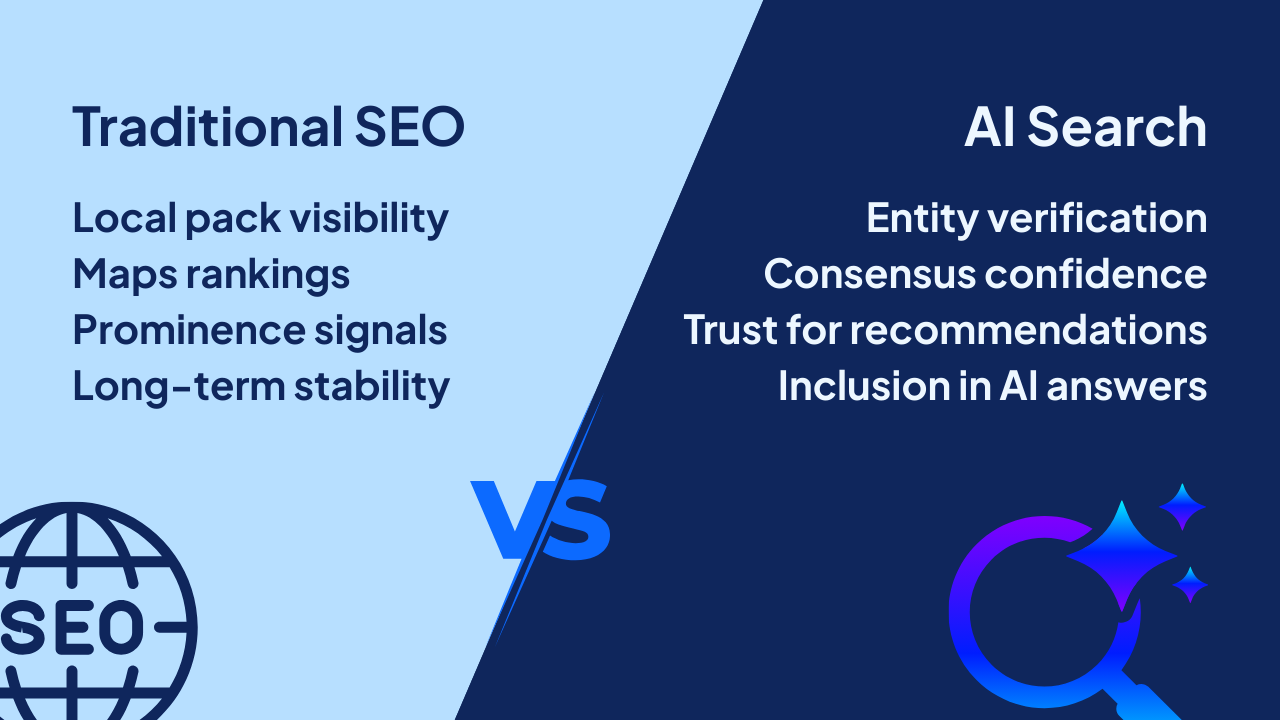
Unlike traditional local SEO—where citations primarily supported map rankings—AI search engines treat citations as confirmation signals. When an AI system answers a local query like “best urgent care near me” or “top Italian restaurants in Chicago”, it evaluates citation consistency across multiple sources to determine which businesses it can safely recommend.
Structured vs. Unstructured Citations in SEO and AI Search
Structured citations are listings placed in organized formats—think business directories—displaying standard fields like NAP, business hours, and categories.
Checklist: Name, Address, Phone (NAP); business website URL; hours of operation; precise business categories—all included in the structured listing to help answer engines and AI parse details comprehensively.
Major Sources for Structured Citations
- Google Business Profile: The top citation source globally for structured NAP data.
- Yelp: Critical for reviews, categories, and visibility in both Google and AI results.
- Industry directories: Specialized listings (e.g., Avvo for legal, Healthgrades for medical).
- Data aggregators: Networks pushing NAP info to dozens of platforms.
Unstructured citations, in contrast, are informal mentions of a business within news articles, blogs, or social media content, where the NAP elements might not be grouped in a standardized way.
Example: “Acme Bakery, 123 Main St, brings fresh scones to the city, as covered in a city news article,” versus a Yelp directory listing.
Both types are essential: structured citations deliver clear data for algorithmic consumption by search engines and AI, while unstructured citations build authority and brand context that advanced answer engines increasingly reference — and this is exactly what a Perplexity Visibility Tracker helps validate by showing whether those citation signals are strong enough to earn inclusion in AI-generated local answers.
For AI and SEO, structured citations help machines parse and validate core business data, fortifying both Google’s “prominence” factor and AI trust signals. Unstructured citations, meanwhile, broaden discoverability, signaling relevance—and when picked up by answer engines, strengthen ROI on content and PR initiatives.
AI vs Traditional Citations (Key Difference)
Traditional local SEO: Citations help Google rank businesses in local search packs.
AI search: Citations help AI systems determine whether a business is mentioned at all in generated responses.
If an AI engine cannot confidently reconcile a business’s details across trusted sources and structured listings, LLM citation tracking helps you monitor whether your brand is being cited or omitted in AI-generated responses.
Did you know?
Why Local Citations in AI Search Matter for Visibility and Trust
Local citations remain central to search engine optimization for multiple reasons. For Google, consistent NAP citations confirm a business’s legitimacy, supporting core ranking signals like prominence and proximity. For answer engines and AI search models, citations serve as real-world verification points—feeding critical data to LLMs like ChatGPT and Gemini, which increasingly surface summarized answers using citation-backed sources.
Whether the context is ranking in Google’s Local Pack or inclusion in AI-generated business summaries, citations play a crucial dual role in trust and visibility.
Key Benefits for Businesses
- Increased discoverability and prominence on search and AI answers
- Improved user trust via consistent, visible NAP data
- Direct SEO outcome: higher local rankings and reinforced brand authority
How Do Local Citations Impact AI Search Rankings and Visibility?
Local citations affect this selection in several ways:
1. Entity Validation
AI systems use citations to confirm that:
- The business exists
- The location is accurate
- The services offered align with the query
Conflicting listings weaken confidence and reduce inclusion likelihood.
2. Location Confidence
For geo-specific queries, AI systems cross-check citations to validate proximity. Businesses with strong, consistent local listings are more likely to appear in AI responses tied to neighborhoods, cities, or regions.
3. Consensus Signals
AI search favors agreement across sources. When the same business appears consistently across Google Business Profile, directories, review platforms, and trusted sites, it signals consensus — a key requirement for AI-generated recommendations.
4. Review and Sentiment Weighting
Reviews embedded within citation platforms heavily influence AI responses. AI systems often summarize sentiment (e.g., “highly rated,” “popular,” “well-reviewed”) directly from citation data rather than from business websites.
Did you know?
Why AI Search Relies on Local Listings and References
AI search engines are designed to reduce uncertainty. When answering local queries, they must confidently recommend real businesses in real locations — without the luxury of follow-up clarification.
Local listings and citations solve this problem.
AI systems rely on them because they provide:
Structured, Machine-Readable Data
Local listings offer standardized fields (location, hours, categories, reviews) that AI systems can ingest and compare efficiently. This makes them more reliable than long-form web pages when generating quick, location-specific answers.
Cross-Source Verification
AI engines cross-check the same business across multiple platforms. If listings align, confidence increases. If they conflict, the business may be excluded from AI responses entirely.
Real-World Validation
Listings and reviews reflect operational reality — whether a business is open, active, reviewed, and relevant right now. AI systems prioritize this “ground truth” over static website claims.
Faster Answer Generation
AI Overviews and conversational assistants need to respond instantly. Pulling from citation-backed sources allows AI to generate answers without deep crawling or interpretation delays.
Did you know?
This explains why businesses with strong citation coverage often appear in AI answers even when their websites rank lower organically.
What Causes AI to Exclude a Local Business
Even strong businesses are excluded from AI-generated local answers when citation signals create ambiguity.
- duplicate listings with mismatched NAP
- conflicting primary categories
- closed / outdated hours across platforms
- name variations that split entity recognition
How AI Systems Use Local Citations in AI Search to Generate Answers
While the core logic is similar, AI platforms surface local citations differently.
Google AI Overviews
Google AI Overviews rely heavily on citation-backed sources — including business profiles, directories, and review platforms — to validate which local entities can be safely referenced inside answers.
For local queries, Overviews often cite:
- Review aggregators
- Business profiles
- Location-based directories
Did you know?
ChatGPT & Perplexity
Conversational AI tools rely more heavily on:
- Review platforms
- Directory-style sources
- Community-driven references
These platforms emphasize:
- Consensus across sources
- Reputation signals
- Clear entity disambiguation
Business websites are cited less frequently unless they are reinforced by strong third-party citations.
What This Means for Marketers
- AI visibility is no longer just about “ranking your site.”
- It’s about being reference-ready across the local data ecosystem.
- If AI cannot reconcile your business details quickly, it will choose a competitor it can.
Industry-Specific Impact of Local Citations in AI Search
Local citation impact varies by industry because AI systems weight trust and risk differently depending on user intent.
Restaurants & Hospitality
AI systems prioritize:
- Reviews
- Menus
- Hours
- Popularity signals
Restaurants with strong review-platform citations are significantly more likely to be named in AI-generated “best near me” answers.
Healthcare Providers
Accuracy and trust dominate.
AI favors:
- Verified listings
- Medical directories
- Consistent NAP data
Did you know?
Retail & Local Chains
AI looks for:
- Location accuracy
- Inventory or service confirmation
- Brand consistency across regions
Strong citations help AI distinguish between similarly named locations.
Service Providers (Plumbers, Lawyers, Agencies)
AI relies heavily on:
- Category accuracy
- Reviews
- Local authority signals
For these businesses, citation completeness often outweighs backlink profiles in AI answers.
How to Improve Local Citations for AI Search
Improving citations for AI search is less about volume and more about clarity, consistency, and confirmation.
Core Actions That Matter Most
- Standardize business details across all platforms
- Eliminate duplicate or outdated listings
- Ensure categories and services are precise
- Maintain active review profiles
- Prioritize authoritative directories for your industry
Did you know?
AI systems reward businesses that are easy to understand — not just easy to find.
Local Citations vs Traditional Local SEO
| Traditional Local SEO | AI Search Marketing |
|---|---|
| Focus on rankings | Focus on references |
| Website-centric | Ecosystem-centric |
| Click-driven | Zero-click visibility |
| Local pack competition | AI answer inclusion |
Local citations now serve a dual role:
- Supporting classic local SEO
- Powering AI-generated local recommendations
Ignoring either limits visibility.
Top Citation Directories: US and Industry-Specific Platforms
Building powerful citation coverage starts with submitting complete and accurate business data to authoritative US and niche directories. These platforms serve as fundamental benchmarks for SEO and are primary data sources for AI answer engines.
Below are key resources to target for optimal coverage:
- Google Business Profile
- Yelp
- Apple Maps
- Bing Places
- Better Business Bureau (BBB)
- Yellow Pages (YP.com)
- Industry-specific directories (Healthgrades, Avvo, Houzz, TripAdvisor, Angi)
- Data aggregators (Data Axle, Neustar Localeze, Foursquare)
- Chamber of Commerce directories (city, state, and regional associations)
Niche and Vertical Directory Opportunities
- Healthcare professionals: Healthgrades, ZocDoc
- Law firms: Avvo, FindLaw
- Real estate: Zillow, Realtor.com
Chamber of Commerce and Industry Associations
- Local Chamber of Commerce online directories: Considered trusted by both search and answer engines.
Mastering NAP Consistency: Avoid Ranking and Trust Issues
Maintaining absolute consistency of your Name, Address, and Phone number (NAP) is one of the most critical factors in both ranking and consumer trust for local citations across SEO and AI-optimized platforms. Even small discrepancies can cause significant issues—from lost AI answers to dropped rankings and failed conversions.
Every citation should match your official NAP exactly, eliminating differences in abbreviations, suite numbers, or phone formatting. Businesses should create a single master record of their official data and use it as the source for every new and existing citation. Consistency is as vital for AI as it is for Google, directly impacting visibility and credibility.
- Keep a “single source of truth” file with official NAP data
- Copy and paste NAP for every citation entry to avoid typos
- Align website NAP, directory NAP, and schema data for uniformity
- Monitor for and correct inconsistencies proactively, especially after rebrands or moves
- Use NAP formatting that matches local conventions if possible
- Audit relevant listings regularly and fix errors before they multiply
Common Citation & NAP Mistakes to Avoid
- Duplicates: Multiple listings for one location with minor NAP variants
- Formatting drifts: “Suite 100” vs. “Ste 100”; spelling of “Street” vs. “St.”
- Outdated contact info: Old phone numbers or addresses left unchanged
FAQs
Yes, but only indirectly. GEO tools help improve citation consistency and entity accuracy, which AI systems use to decide whether a business can be confidently mentioned in “near me” answers.
Yes. In AI-driven search, citations influence whether your business is named, not whether it’s clicked. Visibility now happens inside AI-generated answers, where citations act as trust validators even without traffic.
Yes. AI systems rely on cross-source agreement. Conflicting names, addresses, or categories reduce confidence and often lead to exclusion, not lower ranking.
Listings and third-party references often matter more for AI-generated local answers. Websites support authority, but citations confirm reality — location, operation, and relevance.
It varies by platform, but changes typically influence AI visibility within weeks, not days. AI systems re-evaluate entities continuously, not on fixed crawl cycles.
Yes. AI systems apply higher trust thresholds to industries like healthcare and legal services, while restaurants and retail rely more heavily on reviews and popularity signals.
Key Takeaways: Local Citations in the AI Search Era
In AI-driven search environments, visibility depends on validated local references rather than rankings alone. Local citations now determine whether a business is mentioned at all inside AI-generated answers, not just where it appears in traditional results.
Consistency, accuracy, and cross-platform consensus have become the primary competitive advantages, turning citations into visibility infrastructure that supports both local SEO and AI search—rather than simple SEO hygiene.