
AI Citation Stability in 2027: What 2.03 Million Citation Entries Reveal
 Khadija ZamanAI Search ManagerI'm Khadija Zaman, AI Search Manager at Wellows, where I lead generative and answer engine optimization (GEO/AEO) — building the automated workflows that track brand citations…Read Full Bio
Most new AI citations break in a day. Wellows tracked 2.03 million new citation entries in 2026. The median initial run was one day. All five engines agreed.
First-period next-day retention ran from 10.0% to 28.2%. Pages could return after a run ended. None of 45 layout features passed the adjusted test.
So one missing citation is no reason to rewrite. Check your tracking first. Then check the next few answers.
TL;DR
Your website appeared in an AI answer yesterday. Today, the citation is missing. Should your team rewrite the page?
A single absence gives you too little evidence. Check subsequent answers and confirm your tracking worked first.
Wellows studied recorded citations across five AI search engines. The research covered two eight-week periods in 2026. Newly recorded sources typically had brief initial runs. For each engine, the median initial run was one day. That finding comes from the first eight-week period.
That measures uninterrupted presence in the captured source lists. Pages could return after disappearing. Historical tracking usually stored five source rows per answer. Missing URLs could still appear elsewhere in the answer.
For founders, these findings support caution around daily changes. Repeated checks can inform whether a change deserves investigation. The study does not establish effects on leads or revenue.
Research data: collected from 13 July to 1 November 2026. 2027 guidance: apply these findings when checking citation changes and deciding whether to rewrite a page.
- 1 day
- Median initial period of continuous citation in the first period, for each of the five engines.
- 2.03M
- Newly recorded citation entries in the first period. These are not unique webpages.
- 0 / 45
- Layout tests passing the multiple-testing threshold in 207 usable page pairs.
Jump to a section
What does AI citation stability mean in this study?
Here, AI citation stability means how consistently a source URL appears in recorded answers over time. We measure two distinct things. Both belong in a broader AI brand-presence report:
- Continuity
- How long a URL remains present without interruption for the same project, region, question and engine.
- Frequency
- How often that URL appears across valid observation days, even if there are gaps between appearances.
Continuous citation means that a URL appears in the recorded sources on consecutive calendar days. A valid next day without the URL ends that period. A missing answer leaves the outcome unknown. Multiple answers captured on one day are combined: presence in any stored answer counts as presence that day.
A returning citation starts a new period
Illustrative example for one URL and one tracked question; these are not study observations.
| Day | Monday | Tuesday | Wednesday | Thursday | Friday |
|---|---|---|---|---|---|
| Recorded status | Present | Present | Absent | Present | No answer |
The initial period lasts two days. Thursday begins a new period of continuous citation; Friday cannot confirm either continued presence or loss. With partial source capture, “absent” means absent from the stored list.
This study’s measures are separate from the dashboard’s composite Citation Stickiness score. The published methods describe a score combining Visibility and Stability over 30 completed days. This research does not validate that score as a predictor of future citations or business outcomes.
How long do new AI citations last?
The median initial period of continuous citation was one day for each of the five engines in the first period. That pattern repeated in the second period for the four engines with adequate later tracking; Perplexity’s later coverage was sparse.
Period A: 13 July–6 September 2026. Period B: 7 September–1 November 2026. Each lasted eight weeks, with a preceding 28-day lookback.
What qualified as a newly recorded source?
- The URL had no recorded appearance in the preceding 28 calendar days within the same tracked series.
- The previous day had a valid answer without that URL.
- The URL appeared in a stored source list on the entry day, which also had a valid answer.
“Newly recorded” does not mean first-ever citation. A URL could have appeared before the lookback, and the main analysis allowed missing answers within that lookback. Those days remain unknown, not confirmed absences.
The chart and the exact counts below use the same aggregate results.
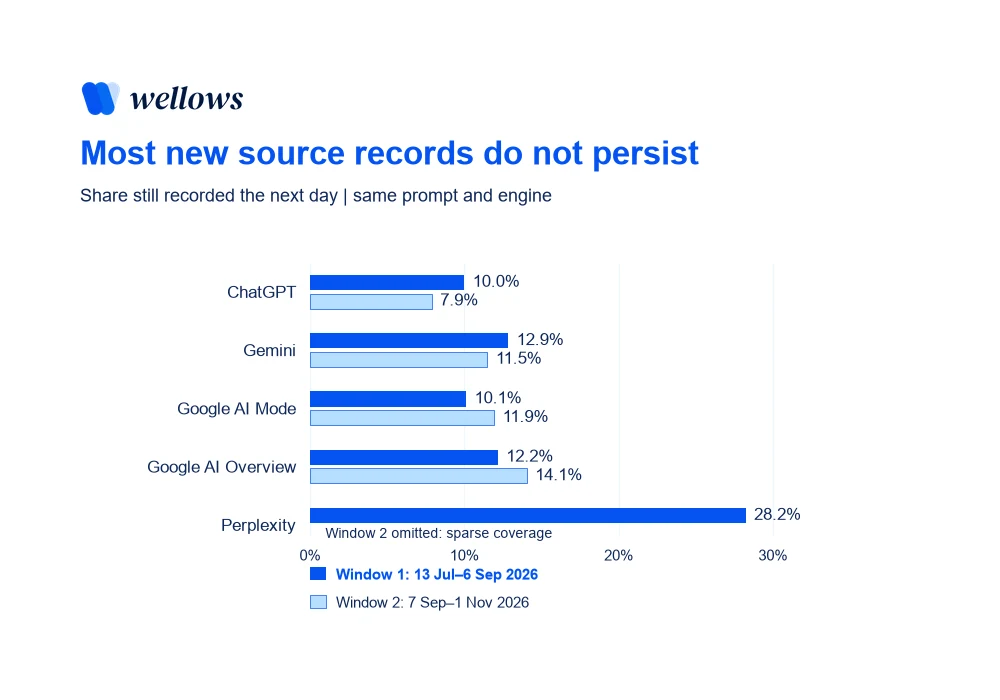
Period A: 13 July–6 September 2026. There were 2,034,964 newly recorded citation entries.
| Engine | All new citation entries | Retained / eligible next day | Next-day retention | Still present 3 days later | Still present 7 days later |
|---|---|---|---|---|---|
| ChatGPT | 566,259 | 51,629 / 516,083 | 10.0% | 1.3% | 0.2% |
| Gemini | 181,453 | 20,268 / 157,696 | 12.9% | 2.4% | 0.5% |
| Google AI Mode | 615,564 | 56,940 / 562,644 | 10.1% | 1.5% | 0.2% |
| Google AI Overviews | 431,825 | 46,396 / 381,313 | 12.2% | 2.4% | 0.6% |
| Perplexity | 239,863 | 61,096 / 216,395 | 28.2% | 10.0% | 3.2% |
Period B: 7 September–1 November 2026. There were 827,342 starts, including the sparse Perplexity series. Changing project and question mix means the smaller total cannot be interpreted as a visibility decline.
| Engine | Retained / eligible next day | Next-day retention |
|---|---|---|
| ChatGPT | 22,377 / 283,493 | 7.9% |
| Gemini | 8,620 / 74,987 | 11.5% |
| Google AI Mode | 15,536 / 130,140 | 11.9% |
| Google AI Overviews | 29,913 / 212,899 | 14.1% |
| Perplexity | Not reported | Sparse coverage |
How to read the denominator: ChatGPT retained 51,629 of 516,083 eligible first-period starts, or 10.0%. Its 566,259 total starts include entries without a valid next-day answer. We exclude those entries from next-day retention rather than counting them as losses.
The three- and seven-day figures estimate uninterrupted survival through those transitions. They do not measure the probability of returning after a loss. A single missing citation also differs from AI citation decay, which describes a sustained decline in citation frequency.
One day describes continuous presence, not total citation lifetime. It describes the initial uninterrupted run in the captured sources. The study does not establish permanent loss after that run ends.
Did incomplete tracking explain the brief citation periods?
We repeated the analysis requiring valid answers on all 28 preceding days. The median remained one day. This stricter check retained 286,948 first-period starts, just 14.1% of the main cohort, and 232,582 second-period starts across four engines.
The pattern therefore held under a complete-lookback check, but most main-cohort entries did not meet that coverage requirement. Missingness can still affect interpretation.
Why new citations and all citations need separate baselines
Across the reported engine-period results, all-source next-day retention ranged from 26.5% to 64.5%. That population includes recurring sources and differs from newly recorded entries.
The descriptive equal-chance benchmark divided average captured source counts by the distinct URL pool for each question and engine. New-source retention was 0.89–1.34 times its matching benchmark; all-source retention was 2.62–3.50 times its matching benchmark.
These ratios do not establish how engines select sources. They provide descriptive context. The URL pool includes sources first recorded later in the period, assumes equal selection probabilities and does not recreate the 28-day entry rule.
Which page traits were associated with repeat visibility?
For this comparison, a frequent source appeared on at least 70% of valid days; a rare source appeared on at most 20%. Each tracked series needed at least 14 valid days. These labels measure frequency, not the length of continuous citation.
We matched project, region, question and engine, yielding 25,697 matched groups in Period A and 6,732 in Period B. Within each group, we calculated the share of frequent and rare pages with each trait, then averaged those shares with equal weight per group.
| Page trait | A: frequent | A: rare | B: frequent | B: rare |
|---|---|---|---|---|
| Platform label: explicit brand mention | 11.1% | 4.9% | 16.0% | 6.8% |
| Selected social or UGC domain | 6.2% | 12.5% | 2.7% | 12.8% |
| Editorial-style URL path | 31.8% | 25.4% | 29.9% | 23.6% |
Brand-mention labels: verify the actual page
The explicit-brand label was about 2.3 times as common among frequent sources in both periods. These are Wellows platform labels; historical page text was not independently checked. The comparison also did not hold the website constant.
Practical use: review publishers that repeatedly appear for your target questions. Check the accuracy of their descriptions of your brand before proposing coverage or corrections. The label association does not establish that adding a brand mention will increase citations.
Editorial paths: the average hides variation
Editorial-style paths included blog, news, guide, resource, learn and insights sections. A URL path is a classification shortcut, not a measure of endorsement or content quality.
Although the average editorial share was higher among frequent sources, it was higher in only 37% of first-period matched groups, lower in 53%, and tied in the rest. The aggregate difference did not describe most individual groups.
Use the pattern to choose a test, not a publishing formula. Inspect the questions, publishers and actual pages in your own market before allocating an editorial coverage budget.
Social sources and authority scores need context
The selected social/UGC group covered Reddit, Quora, YouTube, LinkedIn, Facebook, Instagram, TikTok, Medium and Twitter/X. Its smaller share among frequent sources does not measure channel ROI or show that all social content is less useful.
Platform authority scores showed no consistent direction: frequent versus rare averages were 54.2 versus 52.3 in Period A and 51.6 versus 52.2 in Period B. These were not Ahrefs Domain Rating scores, and the results do not establish an authority target.
The three displayed trait directions held at engine level in both periods, but later Perplexity coverage remains a limitation. Brand-naming questions also had more frequent sources; informational questions generally exceeded purchase questions. Keep question types separate when reporting these patterns.
Did page formatting distinguish frequent sources?
We selected 300 matched page pairs, each with a frequent and rare source for the same question and engine. Both pages were usable in 207 pairs, or 69% of those selected. Social/UGC pages and PDFs were excluded.
We tested 45 features using downloaded HTML, including headings, tables, summaries and structured data. No feature passed the Bonferroni threshold of 0.05 ÷ 45, approximately 0.0011.
| Feature | Frequent sources | Rare sources |
|---|---|---|
| Median word count | 1,612 | 1,570 |
| Median H2 count | 9 | 8 |
| Table of contents: 5+ anchor links | 37.7% | 28.0% |
| FAQ heading | 35.3% | 29.0% |
| FAQPage schema | 17.4% | 20.3% |
| Table | 34.3% | 29.0% |
| Summary or key-takeaways heading | 25.1% | 21.3% |
| Any JSON-LD schema | 81.6% | 81.2% |
| Author markup | 58.9% | 59.9% |
The table-of-contents feature had the smallest unadjusted p-value, about 0.035, but did not pass the adjusted threshold. Publishing that result alone would overstate the evidence.
No significant result is not proof of no effect. This exploratory comparison cannot establish that formatting never matters. Use summaries, headings and tables to help readers; see what schema markup does and does not establish for AI visibility, and test any claim that a specific change improves citation persistence.
Pages were downloaded on 23 November 2026, after tracking ended. They may differ from the versions originally cited. Download failures could also select an unrepresentative subset. Tests did not adjust for shared projects or websites, and this layout comparison was not repeated for Period B.
Two age-related fields could admit dates after the tracking window. They cannot support historical freshness claims. Excluding those two tests leaves 43; none passes the corresponding 0.05 ÷ 43 threshold.
A six-step playbook for citation changes
Use the research to improve measurement and prioritisation. The workflow below is practical guidance, not an intervention proven by this study.
01Fix the question set
Owner: SEO manager. Choose questions tied to buying decisions and map each to a page. Keep engines, regions, languages and collection settings consistent. Separate brand facts, comparisons, recommendations and informational questions.
Output: A question register, page owners and a dated settings log.
02Check capture before calling a loss
Owner: Analytics owner. Save answers and source URLs. Distinguish successful collection, collection failure and partial capture. For AI Overviews, distinguish confirmed non-appearance from failure to collect. Record brand mentions separately from links to owned pages.
Output: A collection log that preserves unknown outcomes.
03Establish a baseline
Owner: Analytics owner. Start with 14 days of daily observations, then extend when coverage or variation limits interpretation. Report appearances alongside valid observations and scheduled checks. Keep continuous citation and later returns separate.
Output: Counts and rates by engine and question group. Fourteen days is a planning starting point, not a guaranteed sample size.
04Investigate a specific problem
Owner: SEO owner. Check access, indexing, redirects and whether the page answers the question. Use citation gap analysis to prioritise the questions and pages to investigate. For Google’s AI features, check indexing, snippet eligibility and Search Console’s Search generative AI control. Inspect third-party descriptions before proposing outreach.
Output: Affected URLs, a verified issue and a proposed fix.
05Test against unchanged pages
Owner: Content and analytics owners. Record the edit and deployment date. Choose comparable unchanged pages before editing; randomise eligible pages when practical. Confirm retrieval of the update where observable. Use an initial 14-day review period and extend when necessary.
Output: Appearance-rate changes versus controls, with coverage and uncertainty. A single returning citation does not prove the edit worked.
06Make a decision and set the next review
Owner: SEO manager. Expand a tactic only when sustained results and uncertainty support it. Account for related questions, engine changes and site-wide changes. Track AI referral visits in GA4 and qualified conversions separately from citation metrics.
Output: Expand, revise or keep measuring, with supporting counts and a review date.
Report measures with their denominators
| Measure | Calculation | Interpretation |
|---|---|---|
| Collection coverage | Successful observations / scheduled checks | Separate collection failures from confirmed AI Overview non-appearance. |
| Page appearance rate | Valid observations listing the URL / valid observations | State whether source capture was partial. |
| Next-day retention | Eligible appearances retained tomorrow / eligible appearances today | Use adjacent calendar days with valid answers on both days; state the entry population. |
| Return rate | Completed citation periods followed by a return within a stated window / completed citation periods with complete follow-up | Report exclusions and collection cadence. |
| Brand mention rate | Valid answers naming the brand / valid answers | Check accuracy and context before calling a mention a recommendation. |
| Qualified referrals | Identified AI referral visits and attributable qualified conversions | Report attribution limits; citations alone do not establish business impact. |
Repeated answers to one question are not independent samples. Before scaling a tactic, account for related projects, questions, domains and dates. Without random assignment, even a comparison with unchanged pages can leave alternative explanations. To connect measurement with business results, use the AI visibility ROI framework.
Your execution checklist
Copy the checklist with your current ticks.
Select checklist text to copy
Select the text below and copy it. The button includes your current ticks when available.
Ticks reset on reload. Copy the checklist or download the editable tracking templates to keep your progress.
Download checklist and tracking templates
How this compares with other citation research
These studies use different starting populations, time windows and units. Their percentages provide context; they are not interchangeable performance targets.
- Ahrefs, October 2026: followed approximately 37,500 starting-day citations across five tools for 20 days. It reported next-day losses of 50%–83% and that about 75% of disappearing citations returned during the study. Those are different denominators from our newly recorded entries.
- Digraph, October 2026: evaluated 535 first-time URL–engine–tracker lifecycles with follow-up. Seventeen percent were cited again within 14 days. Follow-up cadence varied, affecting the opportunity to observe a return.
- Detailed, September 2026: reported 14% day-to-day turnover for core ChatGPT cited domains versus 74% for the tail. Domain turnover counts arrivals and departures; it is not uninterrupted URL retention. The core classification uses full-period frequency. Detailed’s author is affiliated with Ahrefs, so these are related sources.
- Chen and Koudas, October 2026 preprint: analysed 158,099 answers and 468,037 citations. Associations for FAQs, schema and summaries that appeared across websites were not significant within websites. That concerns citation frequency, not this study’s continuous-citation outcome.
- Sielinski, revised August 2026 preprint: used repeated sampling across three generative-search platforms to examine measurement uncertainty. It supports treating visibility as an estimate with uncertainty rather than a fixed result from one check.
Keep eligibility and persistence separate. Google’s documentation requires indexing and snippet eligibility for supporting links in AI Overviews and AI Mode; no special AI schema is required. Its generative AI controls documentation also describes a Search Console control for Search and Discover generative features. Eligibility does not guarantee citation.
Methods and limitations
This is observational research using Wellows records. It shows how often captured sources stayed present. It cannot show that page changes caused citation changes.
- Windows: 13 July–6 September and 7 September–1 November 2026. Each had a 28-day lookback.
- Unit: one URL per project, region, question and engine. Entries are not unique webpages.
- Missing answers: a gap leaves the outcome unknown. It is never counted as a loss.
- Source capture: tracking usually stored five sources per answer. A missing URL could still be in the full answer.
- Page traits: the comparison did not hold the website constant. Labels are Wellows platform labels, not verified page text.
- Layout test: 207 of 300 page pairs were usable. Pages were downloaded on 23 November, after tracking ended.
- Period comparisons: projects and questions changed between periods. Do not read differences as gains or losses.
- Verification: the aggregate arithmetic can be rechecked. The private records have not been independently validated.
Frequently asked questions
Does the one-day result mean a page permanently lost its citation?
No. It means the initial uninterrupted run ended under the study’s recorded-source rules. A URL can return later. Missing answers leave the outcome unknown, and partial capture can miss links in the full answer.
When should I rewrite a page after losing a citation?
Confirm collection worked, inspect subsequent valid answers and investigate a specific access or answer-quality problem. A single absence does not establish that the page needs a rewrite.
Will adding FAQs, tables or schema make citations last longer?
This study did not establish that effect. No feature passed the adjusted threshold in the exploratory layout comparison. Use formatting for reader needs and valid structured data for its supported purposes; test any retention claim separately.
Can I compare the engines directly?
The rates describe the tracked populations. Question mix and answer availability differed, and later Perplexity coverage was sparse. Use a fixed question set and consistent capture rules for your own comparisons.
Does this research validate the Citation Stickiness score?
No. The eight-week retention and frequency measures differ from the dashboard’s 30-day composite score, formerly called Stable Visibility Score. Read the score alongside daily observations, coverage, brand accuracy and qualified referrals.
Can an independent reader reproduce the whole study?
Aggregate arithmetic can be checked, but the private observations, historical labels and page extraction cannot be independently verified from the published article. Full independent replication requires the underlying data and extraction methods.
Summarise this article


I'm Khadija Zaman, AI Search Manager at Wellows, where I lead generative and answer engine optimization (GEO/AEO) — building the automated workflows that track brand citations… More about me