- TechMonitor reports that 76% of U.S. insurers have already adopted generative AI in at least one function.
- IBM found that 44% of consumers use digital assistants or chat-based tools to understand insurance terms.
- J.D. Power reports that 58% of U.S. consumers research financial products online before speaking with an agent.
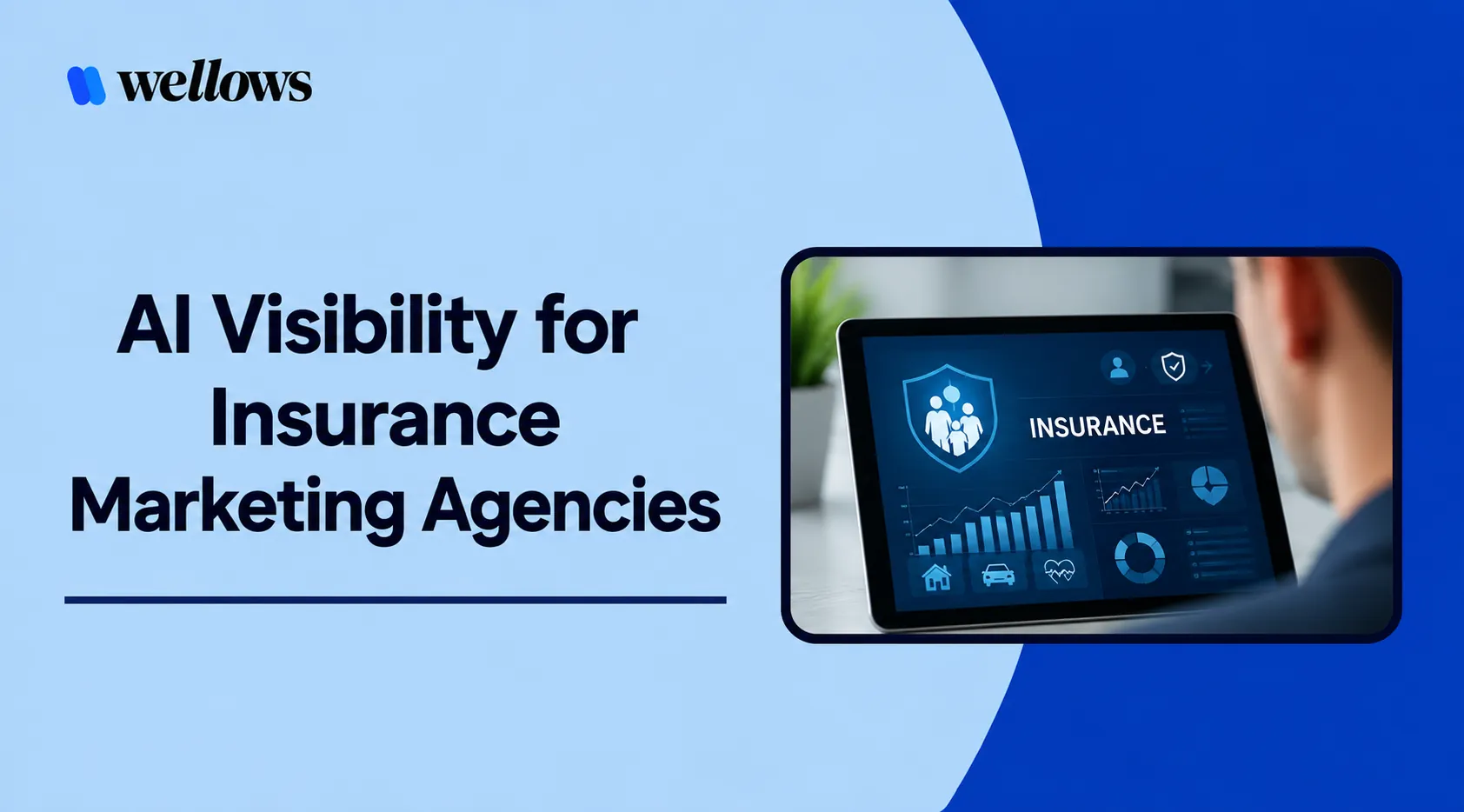
AI systems increasingly influence how customers choose insurers, because models rely on structured, verifiable coverage data when generating recommendations. As a result, strong AI Search Visibility for Insurance Brands now shapes which providers enter early consideration for auto, home, life, and renters insurance.
Instead of browsing comparison sites, many consumers use ChatGPT, Gemini, Perplexity, or Bing AI to interpret deductibles, exclusions, and claims workflows. Brands with consistent policy data, clear terminology, and stable sentiment appear earlier inside these AI-driven answers.
Wellows, an AI search visibility platform, identifies missing citations, weak GEO signals, and unclear coverage structures that reduce placement in generative answers. Strengthening these signals improves visibility across high-intent insurance queries and directly supports quote volume and policy growth.
What Does AI Search Visibility Mean for Insurance Companies?
AI search visibility shows how clearly AI systems understand an insurance brand, its products, and its risk profile. When consumers ask “What does AI search visibility mean for insurance brands?”, systems check whether the insurer appears as a verified entity with accurate, structured facts.
AI Visibility for Insurance Companies depends on strong entity recognition. Models read your organization name, policy categories, coverage tiers, claims satisfaction data, and sentiment to decide if your brand is safe to mention. Clear, consistent insurance terminology improves these signals.
Generative engines assess citation patterns across AI Overviews, LLM answer boxes, and conversational responses. They prioritize insurers with transparent coverage data, stable reviews, and third-party credibility. Conflicting or incomplete information pushes visibility toward competitors.
Compared to traditional SEO, generative visibility depends on how often a brand appears inside conversational answers, not just how it ranks in SERPs. GEO strengthens this visibility by structuring insurance metadata so AI tools can reuse it confidently in queries like “AI Visibility for Insurance Companies.”
Did you know?
How Can You Assess Your Current AI Search Visibility as an Insurance Brand?
When assessing AI Search Visibility for Insurance Brands, the first question is simple: how often do AI assistants actually name your insurer when users ask about auto, home, renters, life, or small-business coverage? This baseline shows whether your brand appears during high-intent policy discovery.
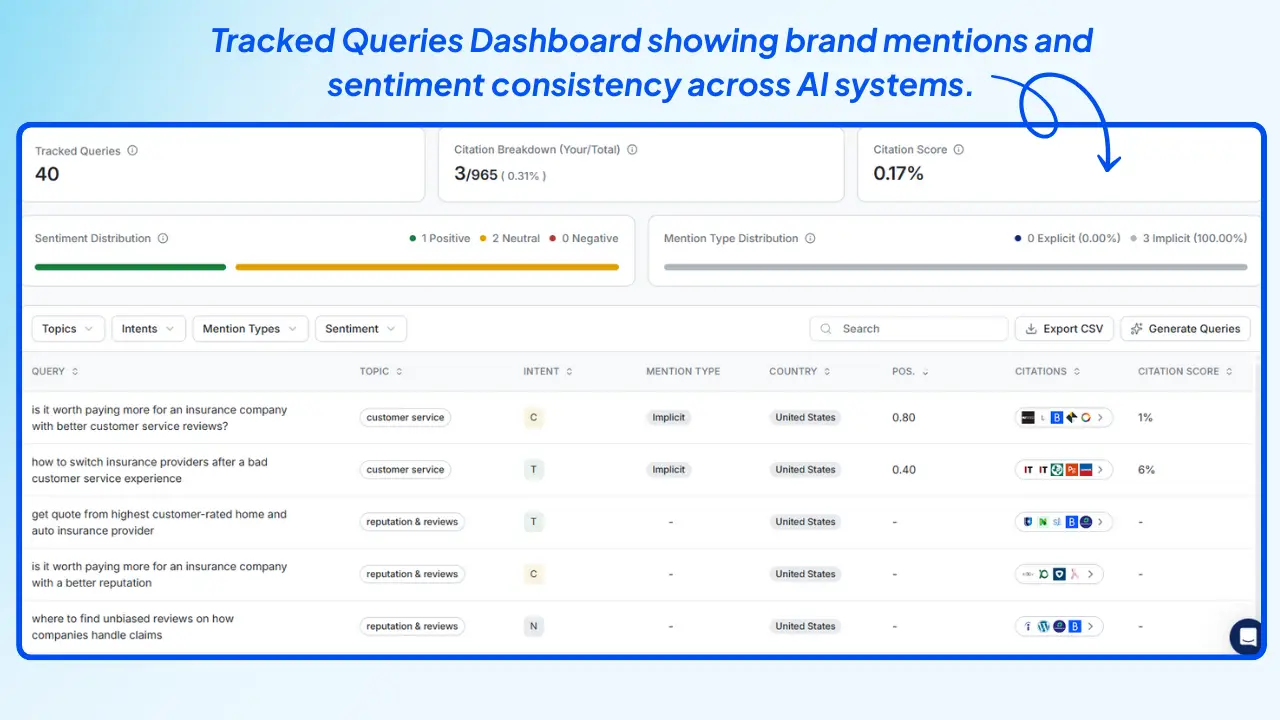
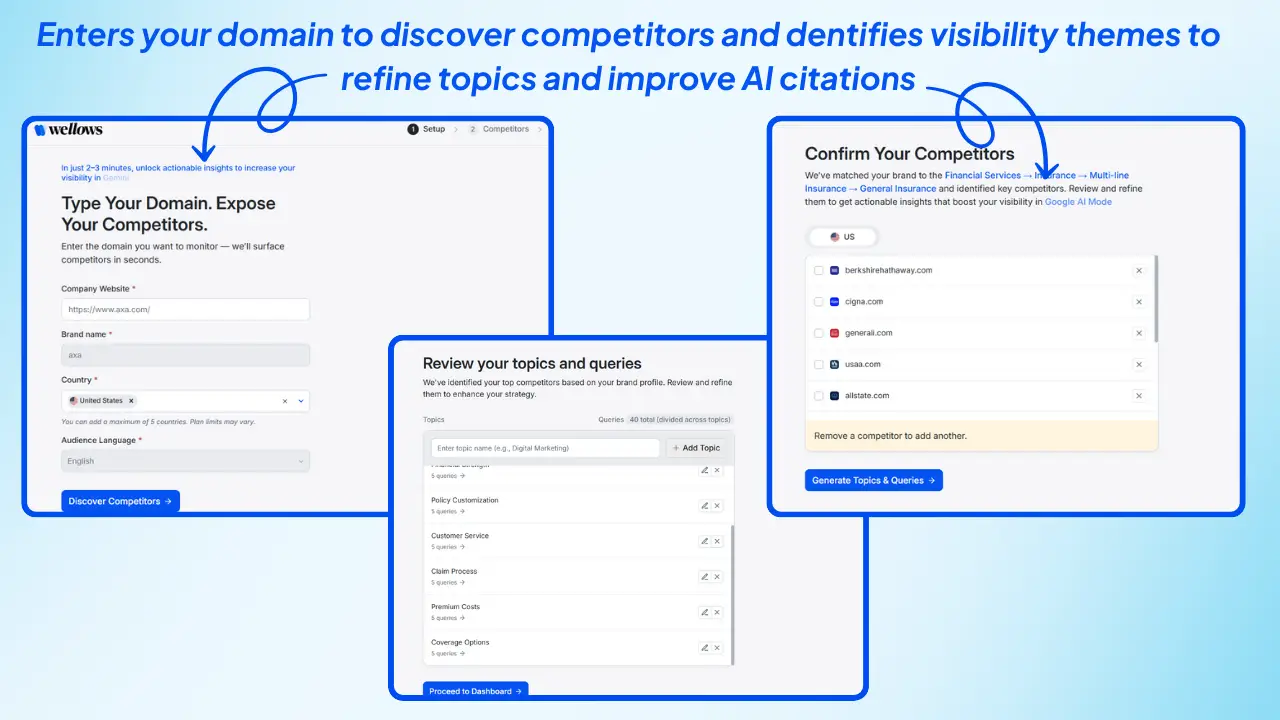 I then add the insurer’s domain into the Wellows AI visibility platform. For a mid-tier carrier such as axa.com, Wellows scanned 40 insurance-intent queries and detected only 3 citations—all implicit—resulting in a 0.17% Citation Score and a competitive Rank #9. In contrast, Progressive (65 citations), Allstate (57), USAA (30), and Nationwide (29) dominate generative visibility.
 Next, I examine how Wellows clusters the insurer across core themes such as pricing & value, claims experience, policy customization, customer service, and reputation & reviews. AXA underperforms in every topic cluster, even in areas where its product strengths align with user intent. This gap reflects missing structured data, inconsistent policy terminology, and weaker external validation.
 The Citation Score Comparison chart clarifies the competitive distance. While Progressive leads with 0.0772 and Allstate follows at 0.0523, axa.com sits near the bottom at 0.0017. This converts assumptions about visibility into quantifiable competitive benchmarks across the insurance landscape.
 From here, I evaluate explicit and implicit wins. Wellows shows that AXA records 0 explicit mentions and 3 implicit mentions, meaning AI uses AXA-aligned value signals—bundling savings, pricing guidance, claims advice—but credits competitors instead. These “credit shifts” reveal the exact places where structured content improvements can convert implicit visibility into fully attributed citations.
 I then review Competitive Insights and Top Cited Queries. High-volume prompts such as “how to switch insurance providers after a bad customer service experience” and “is it worth paying more for better customer service reviews?” heavily favor Progressive, Allstate, and USAA. AXA appears only implicitly, showing its content does not meet AI engines’ thresholds for explicit recommendation.
 Finally, I analyze cross-LLM performance. AXA’s sentiment sits at 33% positive and 67% neutral, with 0% negative mentions—an encouraging base for scaling visibility.
 Yet AXA shows 0% coverage inside Google AI Overview and Google AI Mode, underscoring how inconsistent policy structures suppress multi-engine presence.
Why Do Competing Insurance Brands Rank Higher in AI Answers?
Did you know?
AXA lacks explicit mentions. With 0 explicit citations and a 0.17% Citation Score, AXA falls below regional and national competitors. LLMs avoid naming insurers directly when product definitions, deductibles, exclusions, and state variations appear incomplete or inconsistent.
GEO and compliance signals are weaker. Competitors like Progressive and State Farm maintain stronger state-level clarity and regulatory alignment. Wellows shows AXA receiving 0% visibility in Google AI Overview and Google AI Mode, indicating missing GEO cues and unclear regional pricing logic.
Authority indicators favor competitors. AI engines amplify brands reinforced by AM Best ratings, J.D. Power claims data, and verified review ecosystems. AXA’s sentiment profile—33% positive, 67% neutral—is stable but not strong enough to compete against insurers with deeper review volume and more uniform satisfaction signals.
Competitors dominate key insurance intents. Wellows Competitive Insights show Progressive, Allstate, USAA, and Nationwide leading nearly every high-intent theme, including customer service, policy customization, and claims performance. AXA appears only as an implicit value source, meaning AI reuses AXA-aligned insights but credits rivals due to clearer metadata.
Policy clarity gaps suppress citations. Inconsistencies across exclusions, endorsements, and claims steps make it harder for AI to map AXA’s product reliability. Competing insurers with predictable workflows earn visibility in prompts like “best home insurance for families” or “why do competitors rank higher in AI answers.”
What Is the Current State of AI Search Visibility in the Insurance Sector?
Major insurers dominate AI citations: Progressive (65 citations), Allstate (57), USAA (30), and Nationwide (29) lead generative visibility. Their consistent coverage definitions, strong third-party references, and structured policy data make them “safe defaults” for AI assistants across auto, home, renters, and life insurance queries.
Mid-tier carriers struggle with visibility: AXA’s Wellows scan shows only 3 implicit citations out of 40 tracked queries, producing a 0.17% Citation Score and a Rank #9. Many regional and mid-market insurers show similar patterns due to inconsistent policy structures, unclear deductibles, and limited external validation.
Coverage-type clustering is predictable: AI systems heavily cluster answers around auto, home, life, and renters insurance because these categories contain stable deductible logic, risk segmentation, and underwriting factors. Brands with complete machine-readable limits, premiums, and exclusions win more citations in these segments.
Sentiment impacts visibility: AXA’s sentiment profile—33% positive, 67% neutral, 0% negative—is healthy but not competitive. Insurers with broader review ecosystems and stronger claims-satisfaction signals receive more recommendations in customer-service and pricing-value prompts.
AI visibility gaps across LLMs persist: AXA records 0% presence in Google AI Overview and Google AI Mode, while competitors appear across nearly every engine. Multi-LLM presence now defines category leaders because AI discovery spans ChatGPT, Gemini, Bing AI, and Perplexity.
Niche coverage areas remain wide-open: In pet, travel, cyber liability, and specialty commercial insurance, no clear citation leaders exist. Insurers with structured content, accurate risk definitions, and GEO-aligned metadata can gain early dominance in these under-served generative segments.
GEO Strategies for Insurance Providers: How to Improve AI Mentions Fast
AI Search Visibility for Insurance Brands improves fastest when coverage data, structured facts, and product-led content work together. Effective GEO strategies for insurance providers focus on clarity, compliance, and entity accuracy so AI systems can safely reuse insurance information inside generative answers.
9 Practical GEO Strategies for Insurance Providers
How Can Insurance Brands Improve Product Visibility in AI Search?
AI systems evaluate insurers based on how consistently they present structured policy data. Strong improving insurance product visibility in AI search begins with clear coverage definitions, verifiable facts, and predictable formatting across auto, home, renters, life, pet, and small-business insurance pages.
Models check whether insurers provide complete, structured details for pricing factors, deductibles, limits, exclusions, underwriting rules, and claims processes. Brands with clear, stable documentation appear more frequently in AI-driven policy recommendations.
Did you know?
Did you know?
Did you know?
Did you know?
Did you know?
Did you know?
Did you know?
Did you know?
Did you know?
Insurance brands that maintain consistent policy structures, detailed underwriting explanations, and clear comparison pages earn stronger placement in AI search. These signals help models decide which insurers feel safest to surface in coverage-specific recommendations.
How to Get Your Insurance Brand Mentioned in AI Answers?
AI systems mention insurers when they can verify coverage facts, understand product structure, and trust the brand’s authority signals. Clear, structured, and scenario-ready content is the fastest path to how to get insurance brand mentioned in AI answers across auto, home, renters, life, and specialty insurance queries.
Models rely on machine-readable data, accurate underwriting rules, and predictable taxonomy. When these elements align, AI engines surface the insurer confidently inside high-intent recommendations.
When underwriting transparency, structured FAQs, scenario-based Q&As, and state-level clarity align, AI assistants gain enough confidence to mention the insurer consistently across generative search results.
How AI Improves Search Visibility for Insurance Brands
AI systems evaluate insurers based on how well they surface accurate, consistent coverage data. Strong visibility begins with clear entities, structured policy fields, and predictable terminology across auto, home, renters, life, pet, and small-business insurance pages. This is central to How can AI improve search visibility for insurance brands?
Models check whether insurers provide complete, verifiable product information. Brands with stable coverage models and reliable underwriting data appear more often in generative prompts, supporting how AI enhances visibility for insurance brands across multiple product lines.
Did you know?
Did you know?
Did you know?
Did you know?
Did you know?
Insurance brands that maintain consistent coverage definitions, structured policy data, and strong third-party credibility earn more placements across AI discovery layers. These signals help models decide which insurers feel safest to feature in coverage-specific recommendations.
Best Practices for AI Search Optimization in Insurance
AI systems surface insurers that present clear, structured, and verifiable coverage data. Strong visibility depends on Best practices for AI search optimization in insurance, especially when underwriting logic and pricing factors are easy for models to interpret.
Modern AI tools for improving search visibility in insurance evaluate entity clarity, sentiment stability, and machine-readable product details. Insurers with predictable terminology and consistent metadata gain stronger placement across generative answers.
Insurance brands that maintain structured underwriting data, stable risk categories, and transparent premium and claims information earn stronger AI visibility. These signals help models determine which insurers are safe to recommend.
How Insurance Brands Increased AI Mentions
AI platforms surface insurers through direct citations and indirect recognition patterns. Both influence Case studies of AI enhancing insurance brand visibility across auto, renters, home, life, and small-business insurance queries.
A fictional auto insurer , “DriveSure Auto” , increased explicit citations after unifying underwriting rules, deductibles, eligibility factors, and claims workflows across all state pages.
AI began treating DriveSure as a “safe pick” because its structured data and policy language were consistent across every coverage line.
Wellows exposed missing elements such as outdated discount pages, unclear premium logic, and inconsistent claims instructions that prevented direct mentions earlier.
A fictional B2B small-business insurer , “PrimeShield Commercial” , saw implicit wins across general liability and cyber insurance queries because its coverage explanations were strong, but structured product fields were incomplete.
Wellows revealed “credit shifts,” showing where PrimeShield’s insights powered AI answers but competitors received recognition due to clearer metadata, stronger risk segmentation, and better third-party citations.
Clear value expression matters. Insurers improve mentions by describing premiums, deductibles, exclusions, and endorsements simply, without conflicting definitions across product pages.
Claims transparency boosts visibility. AI prioritizes insurers with structured claims timelines, required documentation lists, and state-specific rules. Brands with vague or outdated claims pages lose confidence signals in generative evaluations.
Risk-model alignment strengthens ranking. Clear mappings of customer segments, young drivers, coastal homes, small retail businesses, pet risk tiers, help AI recommend the right insurer. Models avoid brands with inconsistent risk labeling.
Trusted citations amplify structure. Consistent summaries across AM Best ratings, J.D. Power claims data, Google reviews, and regulatory filings reinforce an insurer’s authority. AI elevates brands with stable sentiment and cross-channel accuracy.
How Should Insurance Brands Handle Bias, Accuracy, and Compliance in AI Search
In insurance, biased or incomplete AI answers are more than incorrect, they can create liability, mislead consumers, and trigger compliance issues. Because coverage rules vary by state, inaccurate or oversimplified AI responses can expose insurers to regulatory scrutiny and reputational risk.
Did you know?
Reduce misquoting and policy inaccuracies: Clarify deductibles, exclusions, endorsements, and claims steps using consistent language across all policy pages. AI systems surface brands with reliable, aligned definitions and avoid insurers with conflicting product descriptions.
Address state-level regulatory requirements: Insurance rules differ significantly across states. Maintain state-specific pages for pricing factors, mandatory coverages, and legal disclosures so AI does not generalize or misrepresent your compliance posture.
Establish a lightweight AI governance framework: Define which AI tools teams may use, where human review is mandatory, and how insurance product data should be validated before publication. Regular audits help prevent outdated rates, coverage changes, or withdrawn offerings from appearing in AI answers.
Handled well, bias mitigation, accuracy controls, and compliance governance work together to protect consumers while strengthening AI Search Visibility for Insurance Brands on a reliable, trustworthy foundation.
Why Insurance Teams Should Use Wellows as Their AI Visibility Platform
Traditional SEO tools were not built for the AI search era. They track rankings and backlinks but cannot see how AI systems cite, compare, or describe insurers inside conversational answers. For AI Search Visibility for Insurance Brands, this leaves a critical blind spot where today’s policy shoppers make decisions.
Wellows closes that gap by giving insurers a clear view of how AI systems interpret and compare their brand. As an AI search visibility platform and broader GenAI visibility stack, it shows how often your brand appears in AI answers, what tone those mentions carry, and how your visibility compares to national and regional competitors, all inside one autonomous marketing platform.
| Feature | Wellows | Traditional SEO Suite | Basic AI Monitoring Tools |
|---|---|---|---|
| AI Citation Tracking (ChatGPT, Gemini, Bing, Perplexity) | Yes Tracks insurer mentions across major AI engines for auto, home, renters, life, pet, and small-business coverage queries. | No Focuses only on rankings, not AI citations. | Partial Some monitoring, rarely insurance-specific. |
| Implicit Citation Detection (Unlinked Mentions) | Yes Finds where your coverage value appears in AI answers without naming your brand. | No Cannot detect uncredited mentions. | No Shows visible mentions only. |
| Citation Score + Sentiment Fusion | Yes Combines citation frequency, share of voice, and AI-generated sentiment into one visibility score. | Partial Generic brand metrics, no LLM scoring. | Limited Basic counts, no sentiment context. |
| Insurance-Focused Benchmarking | Yes Benchmarks your brand against GEICO, Progressive, State Farm, Allstate, and segment peers. | No Competitors based on keywords, not AI answers. | No No category-level benchmarks. |
| Explicit vs Implicit Wins Dashboard | Yes Reveals where competitors receive credit due to stronger structured data or clearer policy explanations. | No Cannot distinguish citation types. | No No actionable visibility diagnostics. |
| LLM Benchmarking | Yes Shows how major AI systems describe your underwriting, pricing, claims steps, and coverage tiers. | No SERP-only perspective. | Limited Minimal prompt-based analysis. |
| Competitor Visibility Analysis | Yes Identifies where insurers like GEICO or Progressive dominate specific coverage intents. | Partial Tracks keyword competitors instead of AI mention competitors. | No No cross-brand comparison depth. |
| Insurance Category Clustering | Yes Groups AI queries by themes, deductibles, exclusions, claims, pricing, to show where visibility gaps exist. | No Lacks AI intent modeling. | Partial Generic clustering without insurance context. |
How to Measure Progress & Plan the Next 90 Days
To turn AI Search Visibility for Insurance Brands into a measurable growth channel, insurers need clear visibility targets and a structured 90-day plan. This ensures every AI improvement translates into policy quotes, bind rates, and retention gains.
Did you know?
- Citation Score: Measures how often AI assistants recommend or reference your insurance brand in coverage-specific queries.
- Citation Rank: Shows your position against competitors such as GEICO, Progressive, State Farm, and Allstate across shared insurance prompts.
- Tracked Queries: Real policyholder questions , “best renters insurance for apartments,” “affordable car insurance for new drivers,” “cyber liability insurance for small businesses.”
- LLM Coverage: Frequency and consistency of your brand’s presence across ChatGPT, Gemini, Bing AI, and Perplexity for auto, home, renters, life, and specialty lines.
- Sentiment by Coverage Type: AI-interpreted tone around claims satisfaction, customer experience, pricing fairness, and renewal transparency.
- Policy Clusters: Visibility across core categories , deductibles, endorsements, exclusions, claims workflows, underwriting rules.
- Third-Party Citations: Mentions across AM Best, J.D. Power, BBB, Google reviews, and regulatory bodies that influence AI trust signals.
- Weeks 0–4: Run a Wellows audit, fix entity mismatches, publish structured FAQs for deductibles and claims, and standardize wording across all coverage pages.
- Weeks 4–8: Build GEO-led clusters for auto, home, renters, life, and commercial lines. Refresh state pages, tighten exclusions, and align underwriting definitions.
- Weeks 8–12: Strengthen third-party visibility through updated AM Best summaries, J.D. Power claims insights, and verified review profiles. Iterate based on Citation Score and sentiment shifts.
AI search visibility is now the foundation of brand discovery across multiple sectors. These industry guides show how organisations improve citations, entity accuracy, structured content, and sentiment signals to strengthen their presence inside generative answers.
- AI Search Visibility for Hospitality Brands: Strengthen visibility across AI-powered travel planning, hotel comparisons, and booking-oriented prompts.
- AI Search Visibility for IT Services Brands: Improve visibility in AI-driven evaluations of IT consulting, cloud services, cybersecurity offerings, and managed service providers.
- AI Search Visibility for Legal Services Brands: Strengthen citations across attorney recommendations, case-type queries, and practice-area evaluations.
- AI Search Visibility for HR & Recruiting Brands: Improve placement in AI-driven employer evaluations, HR tech recommendations, and ATS tool comparisons.
- AI Search Visibility for Gaming Brands: Strengthen game discoverability with structured metadata, genre clarity, and cross-platform consistency.
- AI Search Visibility for Legal Services Brands: Strengthen citations across attorney recommendations, case-type queries, and practice-area evaluations.
Insight: Brands that maintain structured metadata, consistent sentiment, and cross-channel accuracy earn stronger placement inside generative answers, gaining a measurable advantage in AI-powered discovery.
FAQs
Conclusion
Did you know?
Did you know?
Did you know?
Did you know?
Did you know?
Did you know?