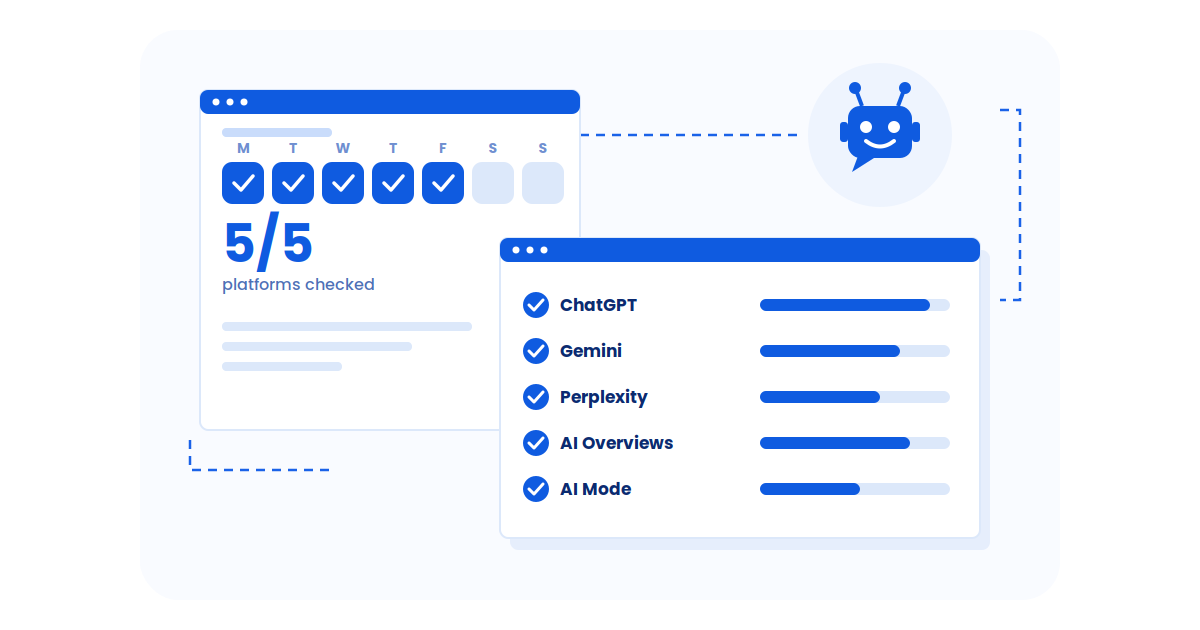
AI-led research is transforming how enterprises evaluate IT service providers. Instead of browsing vendor websites, buyers now rely on ChatGPT, Google Gemini, Copilot, and Perplexity to generate shortlists for cloud consulting, cybersecurity, DevOps, and managed services.
- According to BrightEdge, AI Overviews now appear in 13% of global searches, reducing traditional organic clicks by 79%.
- This shift has changed buyer expectations. The 2025 G2 Buyer Behavior Report found that 56% of B2B buyers use AI to compare technology vendors, and 55% rely on AI-generated shortlists before engaging a provider.
As a result, firms with cleaner technical metadata, structured service descriptions, and consistent authority signals appear more often inside generative answers, directly influencing improving IT services brand AI search rankings.
For IT service providers, generative visibility now shapes credibility, lead generation, and enterprise trust. When AI engines recommend a cloud consultant, MSP, or cybersecurity provider, buyers perceive these mentions as validated, low-risk options, often before they ever visit a website.
What Does AI Search Visibility Mean for IT Services?
AI visibility for IT service brands refers to how often an IT provider, MSP, or cloud consultancy is cited inside AI-generated answers from ChatGPT, Gemini, Copilot, and Perplexity. The concept of AI search visibility now shapes how generative engines determine which technology partners to recommend.
AI systems interpret entities by reading structured service definitions, certifications, security frameworks, integration capabilities, and technical metadata. This shift changes search engine visibility for technology brands because AIs prioritize machine-verifiable accuracy over keyword-based optimization.
For today’s buyers, digital presence for IT service providers depends on whether AI can clearly understand and validate the brand’s expertise.
How Can AI Improve Search Visibility for IT Services?
AI-driven search is changing how enterprises evaluate IT providers. Rather than visiting multiple vendor websites, buyers depend on ChatGPT, Gemini, Copilot, and Perplexity to identify cloud partners, MSPs, cybersecurity specialists, and DevOps consultancies. These systems analyze structured service data, certifications, security frameworks, and documented performance to determine which brands appear in generative answers.
GEO (Generative Engine Optimization) enhances visibility by making IT service entities machine-readable. When service models, compliance details, integration capabilities, and technical attributes follow consistent structure, AI systems can interpret them reliably and match them to buyer intent.
AI improves visibility by prioritizing providers with clear entity architecture, validated expertise, and structured service definitions, leading to stronger placement across high-intent AI recommendation paths.
IT Services Company AI Visibility Strategies
Effective IT services company AI visibility strategies begin with ensuring AI systems can interpret technical offerings with clarity. Generative engines rely on structured, machine-readable service data and core visibility factors to understand where a provider fits across cloud consulting, MSP support, cybersecurity operations, DevOps automation, and infrastructure modernization.
Together, these strategies ensure IT providers appear more consistently in generative answers, improving visibility across ChatGPT, Gemini, Copilot, and Perplexity for high-intent technical queries.
Managed Service Provider GEO Optimization
Effective managed service provider GEO optimization focuses on making MSP data structured, consistent, and machine-verifiable so AI systems can surface providers confidently in queries such as “best managed IT services” or “top MSP for SMBs.”
Did you know?
Did you know?
Did you know?
Did you know?
Did you know?
When MSP offerings, SLAs, pricing, and technical workflows are fully structured, generative engines can evaluate them with confidence, boosting visibility across AI-driven procurement journeys.
How IT Brands Can Track AI Mentions & Benchmark Competitors
The Accenture.com Wellows dataset reveals how IT service providers can evaluate generative visibility through citation score, tracked queries, sentiment performance, and competitor benchmarking.
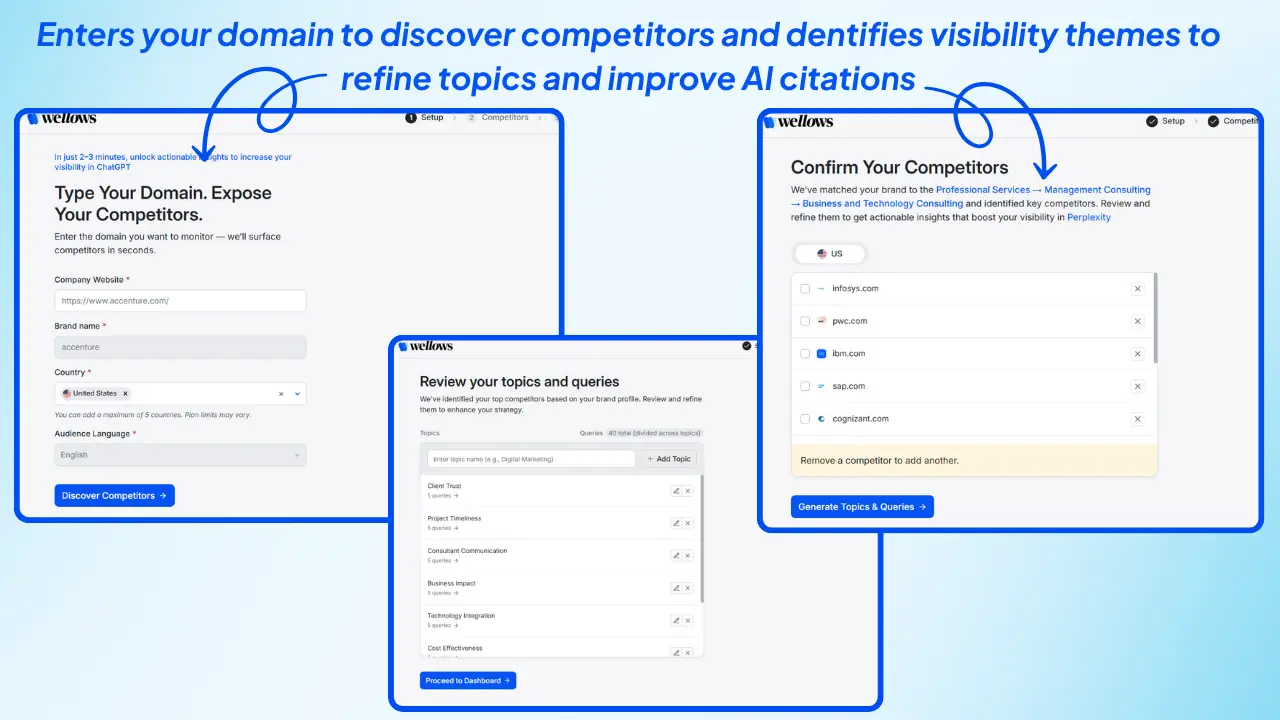
These insights show where rivals gain AI citations, and where Accenture can close high-impact visibility gaps across ChatGPT, Gemini, Copilot, and Perplexity. Effective tracking depends on reliable AI visibility audits and tools like a Perplexity Visibility Tracker that highlight how consistently a brand appears across LLMs.
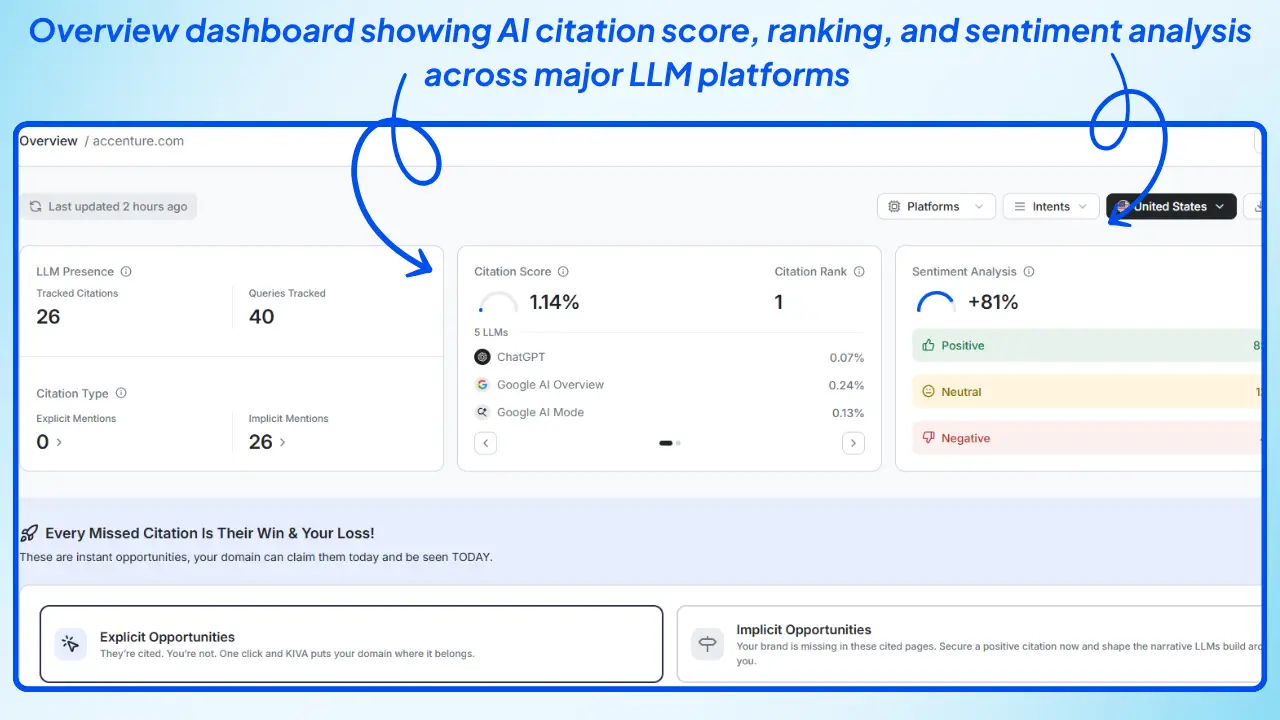
Citation score insights: Accenture holds a 0.93% citation score with 19 implicit mentions and 0 explicit mentions. This indicates that AI systems reference Accenture’s capabilities indirectly but do not consistently credit the brand by name.
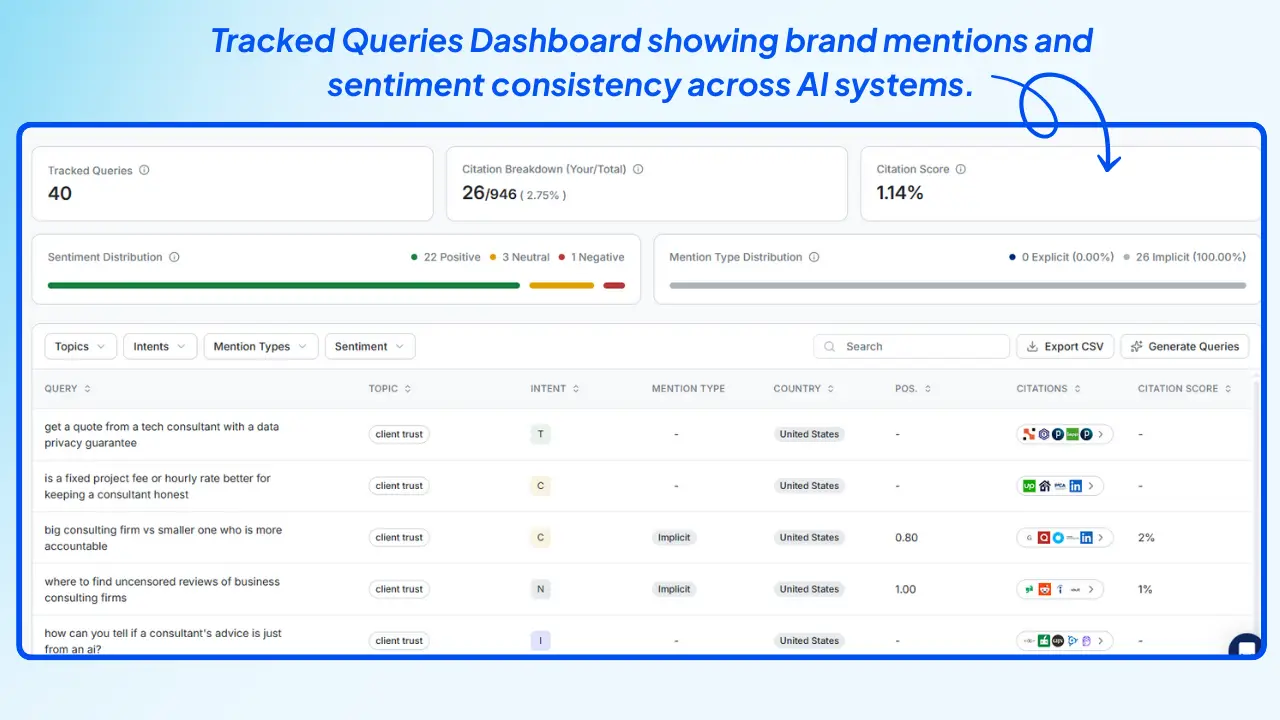
Tracked query patterns: Wellows monitored 40 IT-related queries across cloud consulting, business transformation, AI governance, and enterprise integration. Many were dominated by PwC, SAP, and IBM, showing that competing providers hold stronger entity signals for consulting and technology leadership topics.
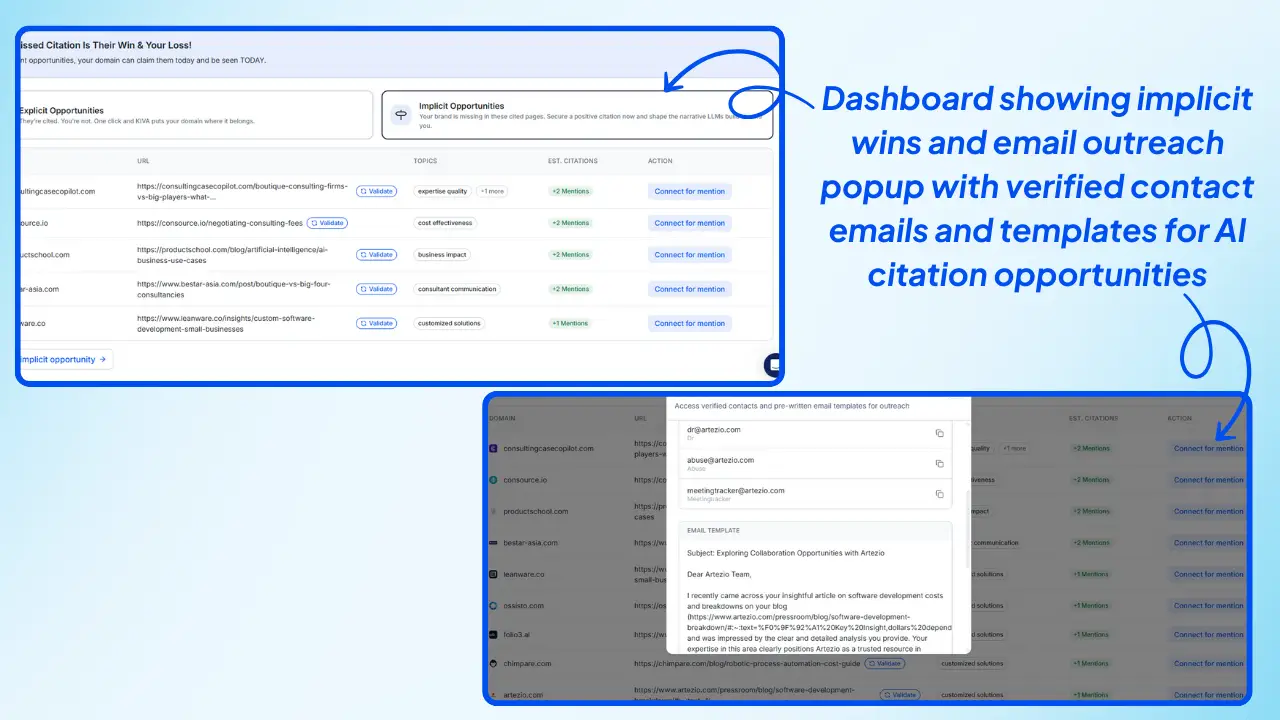
Implicit opportunities: Accenture appears in contextual answers but loses attribution to PwC, SAP, and IBM due to stronger structured metadata and clearer practice-area definitions. These 19 implicit mentions represent immediate opportunities to strengthen service taxonomy, certifications, and cloud architecture signals.
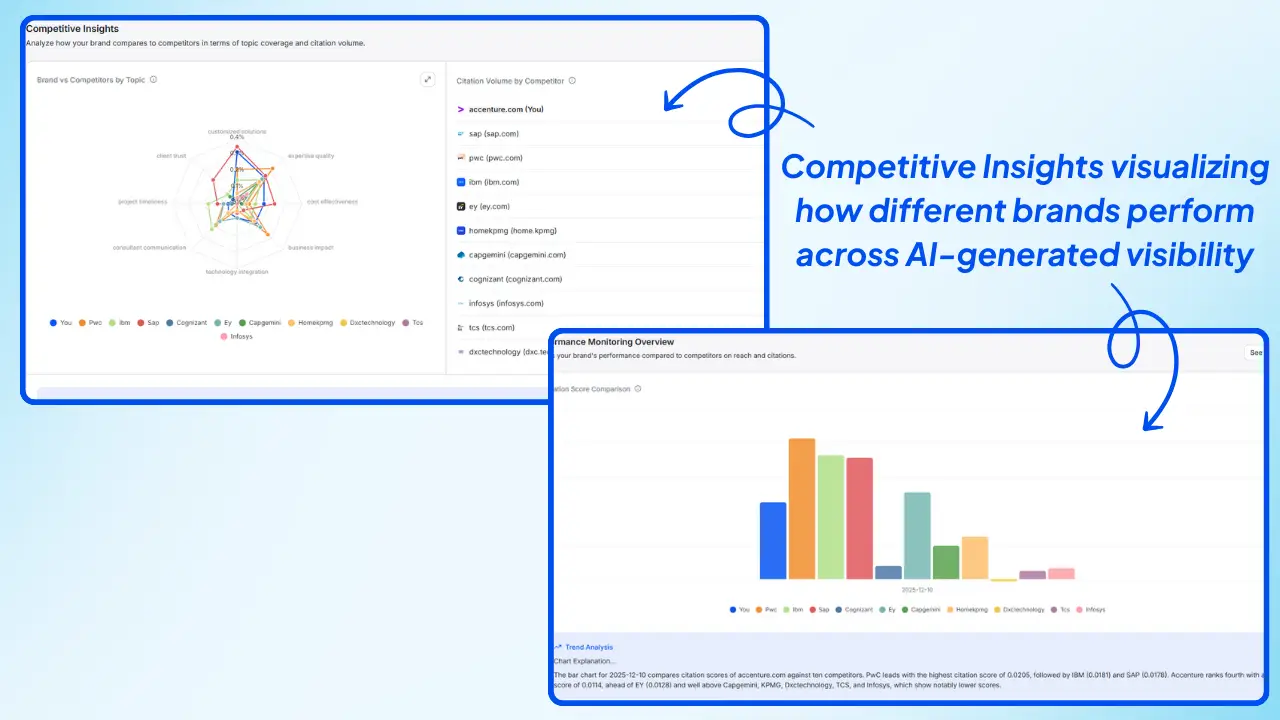
Competitor radar insights: Benchmarking shows PwC, SAP, and IBM outperform Accenture in categories such as business impact and consultant communication. Accenture leads in customized solutions and expertise quality but exhibits lower representation in client trust and technology-integration topics.
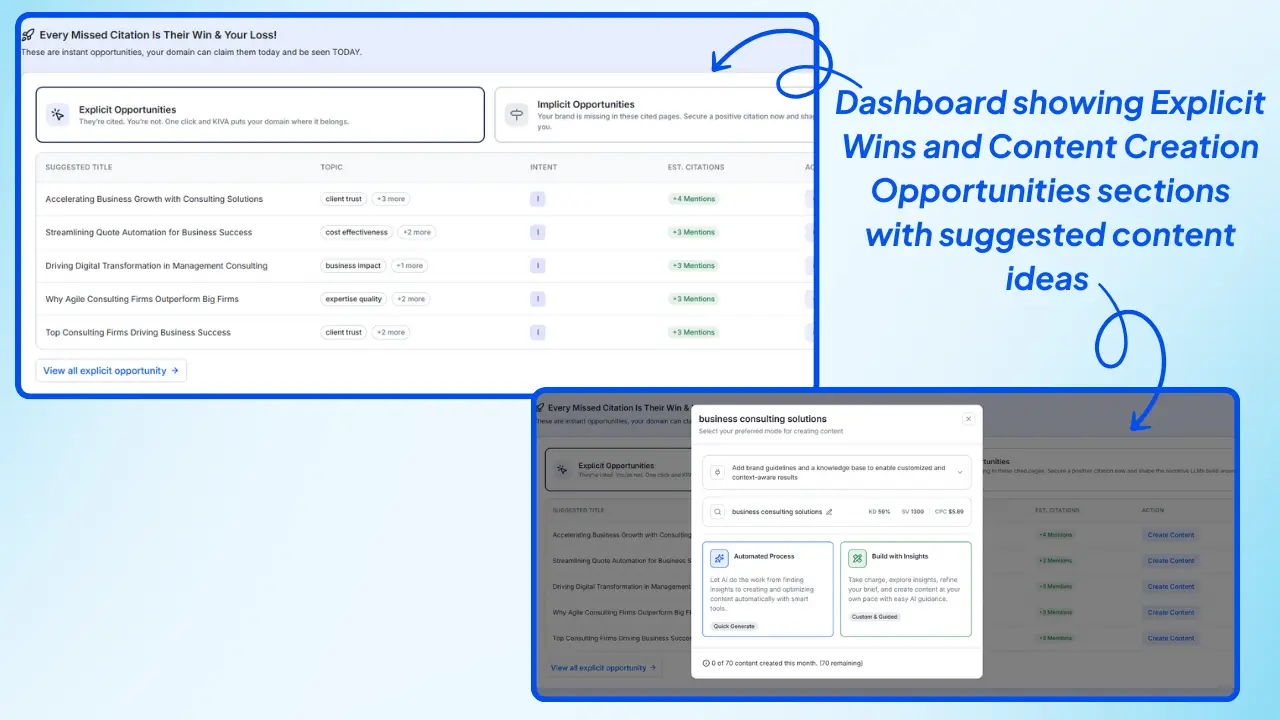
Wellows also identifies explicit opportunities, queries where competitors are cited but Accenture is not. These include topics such as AI governance, data privacy consulting, technology-integration strategy, and enterprise business-impact analysis. Improving schema coverage, surfacing certifications, and clarifying cloud-service metadata helps reclaim these citations.
By refining entity consistency, strengthening external authority, and acting on implicit opportunities, Accenture can significantly improve its AI-driven visibility and outperform competitors across enterprise technology recommendation paths.
Curious how visible your IT brand is inside AI engines?
Cloud Provider Presence in Generative Search
Strong cloud provider presence in generative search depends on how clearly AI systems can interpret a company’s cloud specialization, certifications, integrations, and partner capabilities. When users ask queries such as “best AWS consulting partner,” “Azure migration specialist,” or “GCP for data engineering,” AI engines surface providers whose technical metadata is structured, consistent, and verifiable.
Cloud companies that publish complete partner credentials, AWS Competency badges, Azure Solutions Partner designations, or GCP Specializations, earn more visibility because these elements act as machine-verifiable trust signals. Integration schemas, supported architectures, and deployment frameworks also guide AI systems in matching providers to cloud-specific intent.
Did you know?
Structured cloud metadata, accurate partner badges, and consistent terminology across all service pages significantly increase a provider’s likelihood of appearing in AI-generated cloud consulting recommendations.
Best Practices for AI Search Visibility in IT Brands
Strong best practices for AI search visibility in IT brands focus on structured service metadata, verifiable authority signals, and consistent technical documentation that AI systems can interpret without ambiguity. These practices align with proven AI visibility strategies used across high-performing technology brands.
Did you know?
Did you know?
Did you know?
Did you know?
Did you know?
Did you know?
Brands that maintain precise, verifiable, and consistent IT metadata earn stronger placement across generative engines, improving visibility during high-intent enterprise evaluation journeys.
Key Components of AI Search Visibility for IT Service Providers
Strong visibility depends on how accurately AI systems interpret your entity structure, authority signals, and sentiment patterns. These factors shape the most important AI search visibility metrics for IT service providers, determining which brands appear in enterprise-focused generative recommendations.
These components collectively shape whether an IT provider appears in high-intent generative queries and earns visibility during enterprise technology evaluation cycles.
AI Tools for Enhancing Search Visibility in IT Services
IT providers increasingly rely on platforms that reveal how often they appear inside AI-generated answers and how competitors outperform them. The most complete solution for AI tools for enhancing search visibility in IT services is Wellows, designed specifically to measure, compare, and improve AI-driven visibility for technology brands.
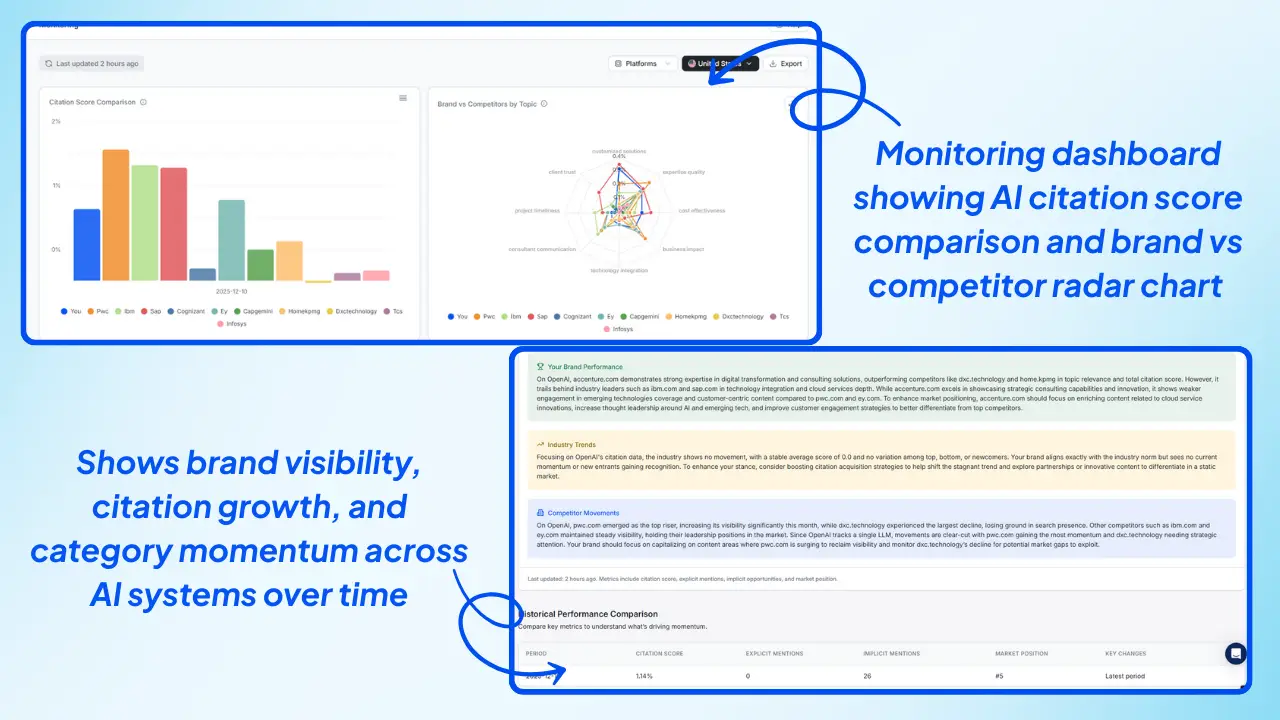
Wellows brings all AI visibility intelligence into one place, citations, competitors, sentiment, and opportunity mapping, making it the definitive platform for IT service providers looking to strengthen generative search performance.
How AI Influences Search Visibility for IT Service Brands
Understanding how AI influences search visibility for IT service brands is essential because generative engines prioritize technical authority, verified expertise, and consistent metadata, far beyond traditional keyword-driven SEO signals. This shift reflects the broader need to combine SEO and GEO so AI systems can interpret IT service entities accurately.
AI evaluates IT expertise through verified credentials. Cloud certifications, security clearances, and partner designations help AI assess whether a provider is trustworthy enough to recommend for enterprise workloads.
Technical authority signals drive higher placement. Brands with strong credibility in AWS, Azure, GCP, DevOps, cybersecurity, or data engineering appear more frequently inside generative answers.
Tool and ecosystem alignment strengthens visibility. Providers with documented expertise in Kubernetes, Terraform, Snowflake, Datadog, Okta, or ServiceNow match more intent-driven AI prompts.
Consistency across platforms builds AI trust. Stable service descriptions, certification listings, and technology stacks across websites, directories, and cloud marketplaces reduce ambiguity for AI engines.
Sentiment influences recommendation likelihood. Positive themes in reviews, testimonials, and case studies help AI models treat the provider as reliable and low-risk, especially in cybersecurity and managed services.
AI ultimately rewards IT brands with verified expertise, consistent metadata, and strong external validation, surfacing them more often in high-intent generative queries.
Case Studies on AI Search Visibility for Tech Companies
The Accenture Wellows dataset provides one of the strongest case studies on AI search visibility for tech companies, revealing how enterprise IT brands gain or lose visibility across generative engines like ChatGPT, Gemini, Copilot, Claude, and Perplexity.
Did you know?
Did you know?
Did you know?
Did you know?
Did you know?
Did you know?
These findings show that even top global tech consultancies lose visibility when metadata, entity clarity, and topic specialization are not aligned with AI patterns, making structured signals essential for sustained generative presence.
Search Optimization for IT Brands in an AI-Driven Landscape
Generative systems have transformed search optimization for IT brands by shifting emphasis from keyword ranking to verifiable technical expertise. This transition moves SEO toward GEO, where structured IT service data becomes critical for visibility in AI-driven evaluations.
As AI reshapes discovery, IT brands must optimize service architecture, terminology, and technical clarity to win visibility across generative systems.
Online Visibility Strategies for Tech Companies
Modern online visibility strategies for tech companies depend on how consistently AI can verify expertise across multiple platforms. Generative engines validate authority through external signals, cross-channel accuracy, and technical credibility.
Did you know?
Did you know?
Did you know?
Did you know?
Did you know?
These strategies enhance trust signals across platforms, improving a tech company’s generative visibility and recommendation frequency.
AI-Based Search Visibility for IT Companies
Understanding AI-based search visibility for IT companies is essential because AI engines analyze technical precision, structured service information, and verified expertise rather than traditional ranking factors.
AI visibility depends on clarity, verification, and engineering depth, allowing IT companies to surface prominently in complex enterprise evaluation queries.
Audience Insights: How IT Buyers Use AI to Evaluate Service Providers
Different IT buyer segments rely on AI to evaluate technical capability, security maturity, and cloud specialization. Their search behavior shapes which providers appear in generative results.
CIOs. Ask strategic queries like “best partner for digital transformation” or “top IT consulting firms for multi-cloud strategy,” prioritizing governance, architecture maturity, and long-term capability.
CTOs. Search for “Kubernetes consulting experts,” “DevOps automation partner,” or “best cloud-native engineering teams,” focusing on engineering depth and tooling expertise.
Procurement teams. Query “top MSP for hybrid cloud,” “best vendor for SOC maturity,” or “cost-effective IT support provider,” emphasizing SLAs, pricing clarity, and compliance verification.
Engineering managers. Look for “best partner for Terraform pipelines,” “data engineering consultants,” or “Azure migration specialists,” highlighting technical workload alignment.
AI elevates providers whose expertise signals clearly match these intent patterns, rewarding structured capability, verifiable credentials, and consistent technical specialization.
Wellows supports agencies managing multiple IT service portfolios and startups building early market traction in competitive technology environments. The same AI visibility principles now apply to MSPs, cloud consultancies, cybersecurity firms, and IT product companies as enterprise buyers increasingly rely on generative systems to evaluate and shortlist technology vendors.
AI search visibility now shapes how brands are discovered across every major sector. These industry insights show how organisations strengthen citations, improve entity accuracy, enhance structured content, and maintain sentiment stability to perform better inside generative engines.
- AI Search Visibility for Mobile Apps Businesses: Improve app discovery through AI recommendations, task-based queries, and generative assistant comparisons.
- AI Search Visibility for Fashion & Apparel Brands: Strengthen citations through consistent sizing data, trend signals, and structured product attributes.
- AI Search Visibility for HR & Recruiting Brands: Improve placement in AI-driven employer evaluations, HR tech comparisons, and recruitment tool queries.
- AI Search Visibility for Gaming Brands: Boost discoverability with structured game metadata, genre clarity, and platform consistency.
- AI Search Visibility for Insurance Brands: Strengthen presence in AI-led policy comparisons, risk assessment queries, and claims guidance results.
- AI Search Visibility for Legal Services Brands: Strengthen citations across attorney recommendations, case-type queries, and practice-area evaluations.
Insight: Brands that maintain structured metadata, consistent sentiment patterns, and accurate multi-channel information achieve stronger placement inside generative answers and gain a measurable advantage across AI discovery ecosystems.
FAQs
AI search visibility for IT services refers to how often an IT provider is cited or recommended inside AI-generated answers across ChatGPT, Gemini, Copilot, and Perplexity. AI systems evaluate structured service data, certifications, partner badges, and engineering credibility to determine which brands appear in high-intent enterprise queries.
AI algorithms improve IT brand visibility by analyzing verifiable technical signals such as cloud certifications, integration depth, case studies, and sentiment quality. Brands with consistent, machine-readable expertise across cloud, cybersecurity, DevOps, or data engineering rank higher in generative recommendations.
AI-enhanced search visibility describes the increased presence IT brands gain when generative engines cite their services, capabilities, or certifications. This visibility depends on structured data, verified technical proof, partner recognitions, and authority signals across public channels.
AI increases visibility by mapping IT service offerings, such as cloud migration, managed services, cybersecurity, or DevOps automation, to user intent patterns. Providers with detailed, validated, and consistent technical metadata appear more frequently in enterprise-focused AI answers.
Brand visibility in the digital landscape influences how AI models assess IT credibility. Consistent presence across LinkedIn, GitHub, cloud partner directories, and analyst reports strengthens authority, helping AIs rank IT providers more confidently in recommendation queries.
IT services search visibility with AI is shaped by structured service definitions, verified certifications, cloud partner status, integration documentation, engineering artifacts, and sentiment patterns. These signals guide AI systems in selecting the most credible providers for enterprise queries.
Final Thoughts
• Citations now replace rankings. AI engines surface IT providers directly inside answers, making in-answer citations more influential than traditional search rankings for discovery, trust, and vendor selection.
• Structured IT service data determines visibility. Cloud capabilities, certifications, integration maps, SLAs, and technical proofs must be machine-readable for AI systems to validate and recommend IT service brands.
• AI visibility requires ongoing optimization. Product-led IT companies must continuously track explicit and implicit AI mentions, monitor competitor citations, and refine entity clarity to stay visible across ChatGPT, Gemini, Copilot, and Perplexity.
• Generative discovery shapes buyer decisions first. Enterprise buyers shortlist providers before visiting websites, meaning AI visibility directly impacts pipeline, credibility, and market leadership.
• Wellows enables measurable IT visibility growth. By monitoring citations, detecting gaps, and benchmarking against competitors, IT brands can systematically improve their presence inside generative engines.