AI-driven discovery is reshaping how users find mobile apps. Instead of browsing app stores or scanning search results, users now rely on ChatGPT, Google Gemini, and Perplexity to recommend apps for specific tasks. These systems surface apps directly inside AI-generated answers, shifting visibility from rankings to recommendations.
- Mobile app discovery behavior has changed. Over 62% of consumers now use AI assistants to research apps or software before installing (Gartner, 2024).
- At the same time, Google AI Overviews appear in 13% of global searches, driving a 79% drop in organic click-through rates on affected queries (BrightEdge, 2025).
As users depend on generative answers to decide which apps to install, AI Search Visibility for Mobile App Businesses determines which products get surfaced first.
This reflects the broader great decoupling, where discovery separates from store rankings and redistributes through AI assistants. Apps with strong Search Engine Visibility gain exposure at the decision moment, while others never enter consideration.
- Mobile app discovery now happens through AI assistants. Users rely on ChatGPT, Gemini, and Perplexity to find apps for specific tasks.
- AI recommends apps it can clearly understand. Visibility depends on well-defined purpose, audience, and use case.
- Attribution matters more than rankings. Apps gain visibility when they are named directly inside AI-generated answers.
- Generative Engine Optimization enables AI recommendations. Structured signals help AI classify and trust an app.
- AI search visibility functions as infrastructure. Apps optimized for AI interpretation gain sustained discovery over time.
What Does AI Search Visibility Mean for Mobile Apps?
AI search visibility for mobile apps describes how often an app is understood and recommended inside AI-generated answers. Visibility is no longer based on page rankings or app store position. It depends on whether AI systems can clearly identify an app’s category, function, and intended audience.
AI evaluates apps as entities, not pages. When users ask for a “budgeting app for freelancers” or a “habit tracker with AI,” assistants surface apps that match the task and context. This aligns with Generative Engine Optimization, where structured signals help AI classify and trust an app.
Unlike traditional SEO, AI visibility is about being included directly in the answer. This mirrors Answer Engine Optimization, where success means being recommended at the decision moment, even before users reach an app store.
How Is AI Used in Mobile App Discovery and Marketing?
AI is changing mobile app discovery by matching user tasks to apps instead of ranking search listings. When users ask for “a budgeting app for freelancers” or “an AI note-taking app,” assistants interpret intent first, then surface apps that best fit the use case. This process relies on user intent modeling, where context and goals matter more than keywords.
Did you know?
Through AI agents in web search, these systems act as decision layers between users and apps. Instead of showing long result lists, AI produces short recommendations based on relevance and trust.
This fundamental shift in ChatGPT vs Traditional Search means that for app marketing teams, visibility now depends on clarity, positioning, and consistency rather than just broad keyword matching.
For app marketing teams, this shift means visibility depends on clarity, positioning, and consistency. Understanding how to rank high on ChatGPT and similar assistants is now a core requirement for digital strategy; apps that clearly communicate their specific use cases are far more likely to be recommended at the exact moment a user is ready to install.
How Can AI Improve Mobile App Visibility Across Search and AI Assistants?
What Are the Key Factors for AI Search Visibility for Mobile Applications?
Entity clarity. AI systems must clearly understand what an app is, what problem it solves, and who it is for. Apps with well-defined categories, functions, and audiences are easier for AI to classify and recommend. These principles align with generative engine visibility factors, which explain how AI interprets entities.
Trust signals. AI favors apps it can trust. Verified information, consistent descriptions, and credible third-party references reduce uncertainty and increase the likelihood of being surfaced. Strong trust indicators help AI systems confidently include an app in recommendations.
Consistency across sources. When app store listings, websites, reviews, and external mentions align, AI systems see reliability. Inconsistencies weaken confidence and reduce visibility, even if the app performs well in stores.
Sentiment stability. AI evaluates overall sentiment, not isolated reviews. Apps with steady, positive feedback are more likely to be recommended than apps with volatile or unclear sentiment patterns. This makes sentiment stability a strategic priority for FinTech Startups, which often operate in trust-sensitive categories like lending, investing, or payments, where AI hesitancy can block visibility.
Recognizable brand signals. Clear naming, consistent positioning, and repeated references help AI identify an app as a distinct brand. Strong brand signals reinforce credibility and improve AI-driven visibility.
What Is the Role of AI in App Store Optimization (ASO)?
Did you know?
Did you know?
Did you know?
Did you know?
What Are App Developer GEO Best Practices for AI Search Visibility?
How to Improve AI Search Visibility for Mobile Apps?
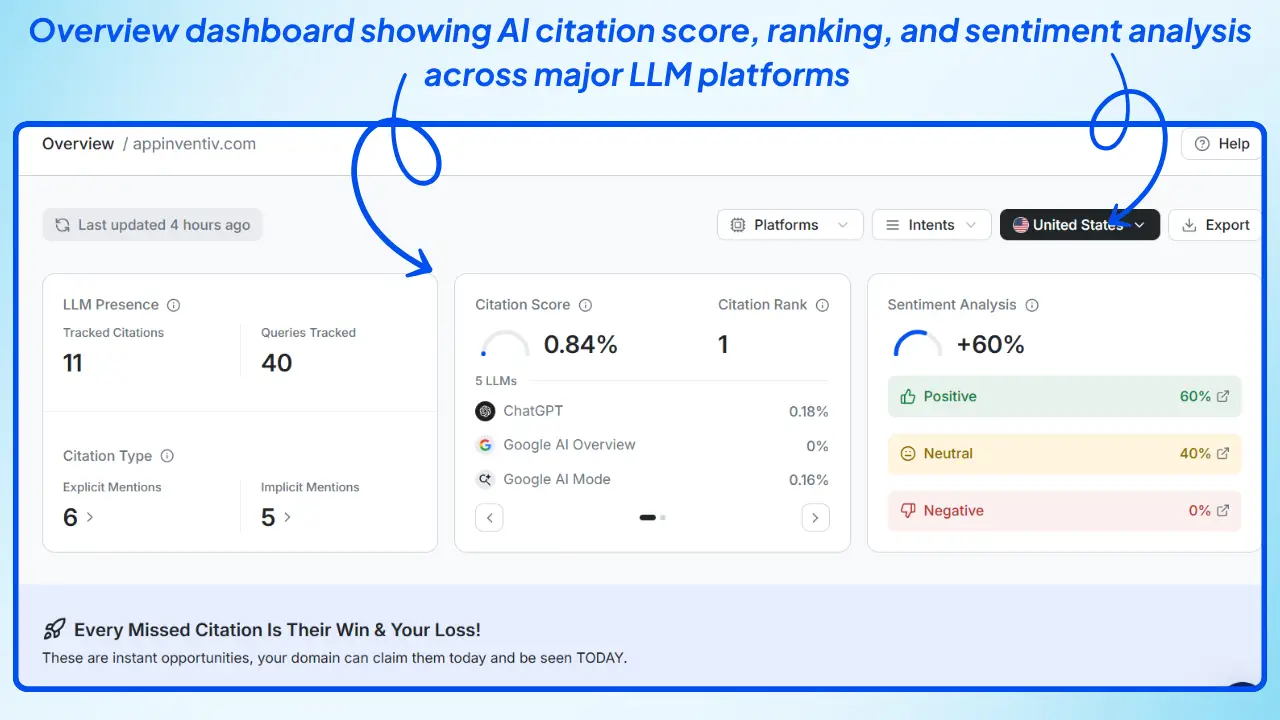
In the Appinventiv dataset, the brand appears across 40 tracked queries with 11 total citations, split between 6 explicit and 5 implicit mentions. These signals reveal where AI already understands relevance and where visibility gaps exist. Detection focuses on identifying cited intents and missed opportunities using query fan-out generator, rather than guessing new keywords.
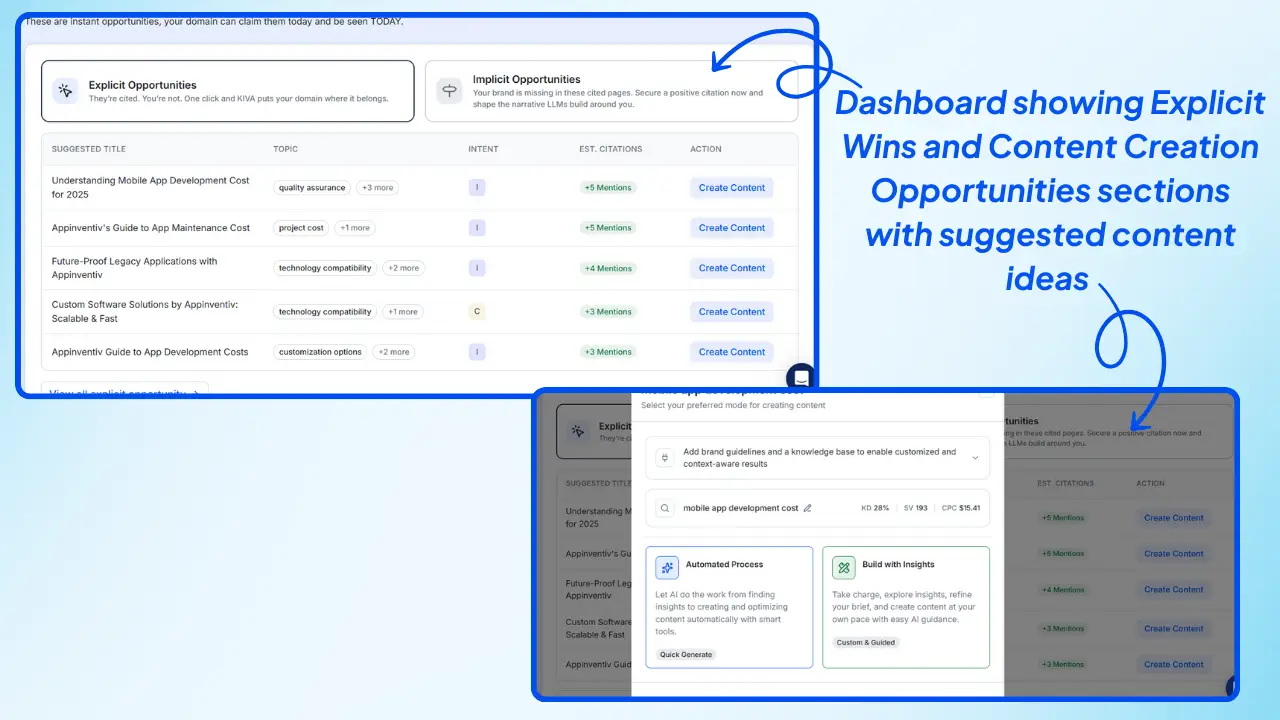
The explicit opportunities table highlights recurring high-intent themes such as mobile app development cost, app maintenance pricing, and technology compatibility, each associated with multiple estimated citations. Using structured SEO briefs for AI search helps align content with how AI interprets cost, quality assurance, security, and post-launch support.
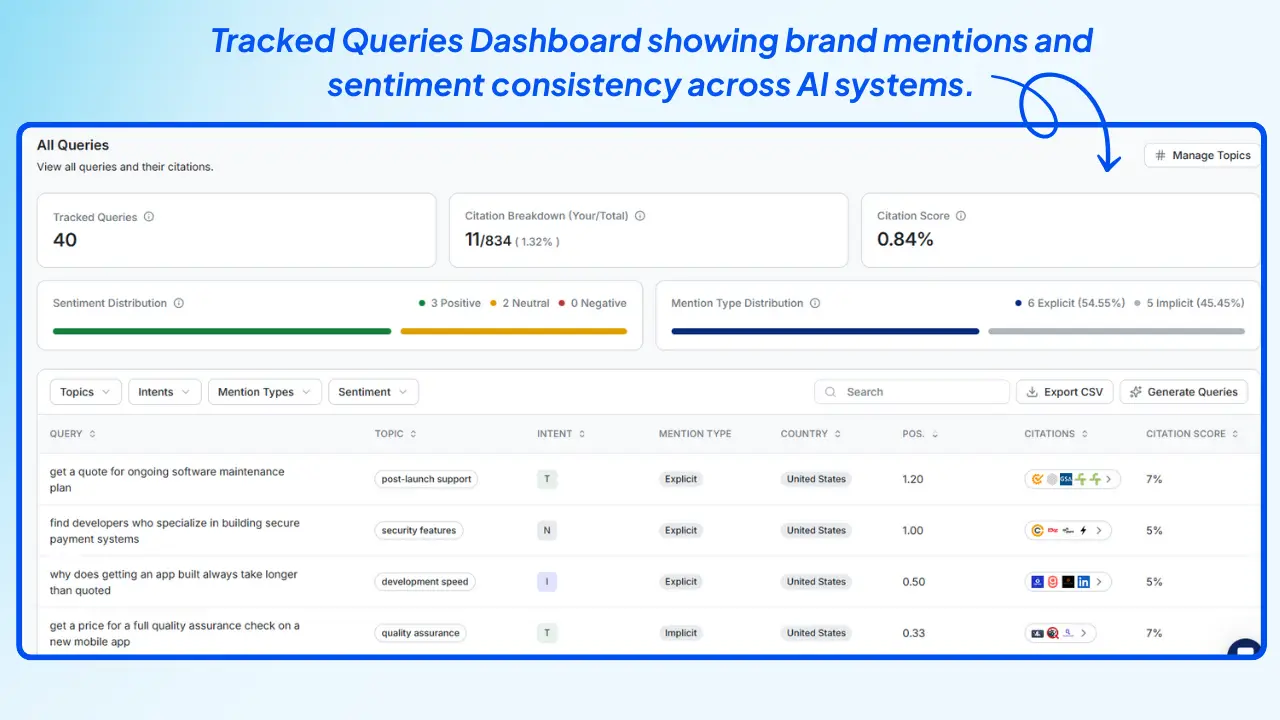
A stable sentiment profile with 60% positive and 0% negative sentiment further strengthens trust. Validation focuses on whether implicit mentions convert into explicit citations and whether visibility expands across LLMs like ChatGPT and Google AI Mode.
This detect → structure → validate workflow turns AI search visibility into a repeatable system. Instead of chasing rankings, mobile app teams improve discovery by aligning with how AI evaluates relevance, trust, and intent across search and AI assistants.
How to Get a Mobile App Recommended by AI Assistants?
AI assistants recommend mobile apps based on whether they can confidently name the app inside an answer. These systems evaluate what AI search engines cite and surface only apps they can clearly attribute to a specific use case.
Did you know?
Did you know?
Did you know?
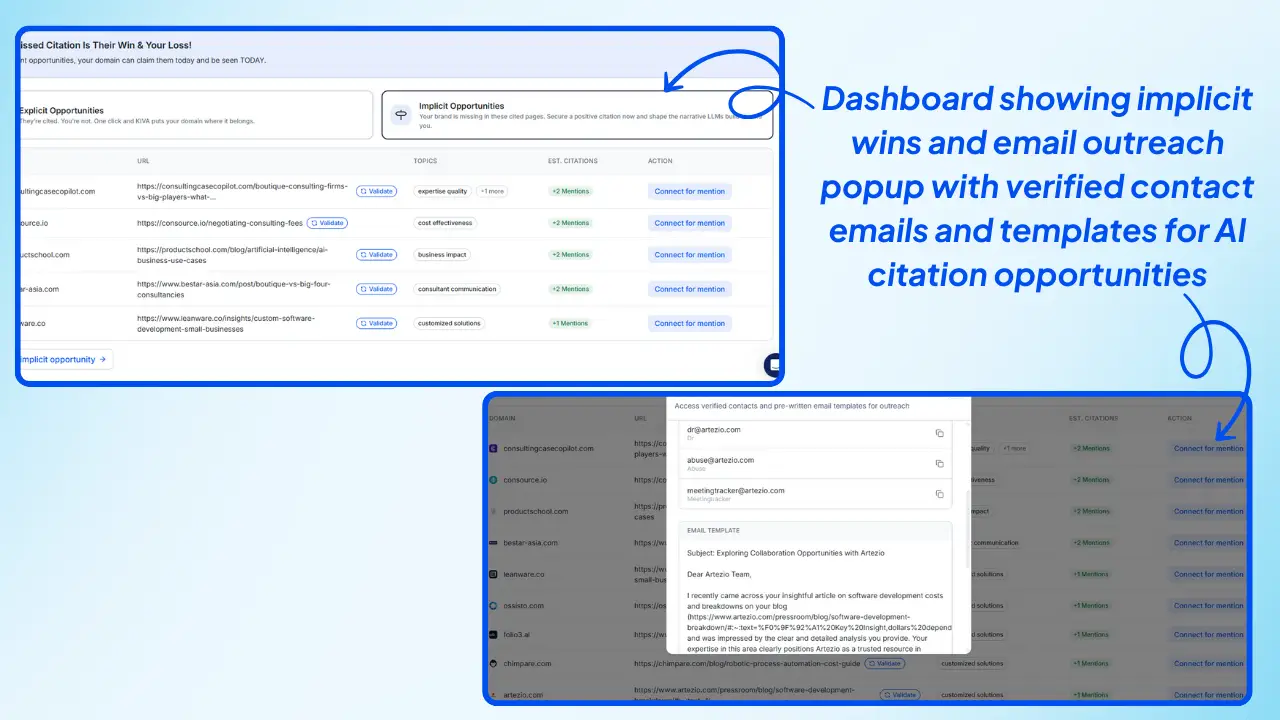
When attribution is clear and consistent, implicit recognition converts into explicit recommendations, increasing how often an app is surfaced by AI assistants at the decision moment.
Want to see how your mobile app development business performs inside AI search? Start Your 7-Day Trial
iOS and Android App Visibility in Generative AI: What’s Different?
| Visibility Dimension | iOS App Interpretation | Android App Interpretation |
|---|---|---|
| Primary AI context source | AI relies more on brand mentions, reviews, and external references to understand iOS apps as trusted entities. | AI places stronger emphasis on web-accessible metadata, structured descriptions, and broader ecosystem signals. |
| Role of ecosystem signals | Closed ecosystem signals lead AI to infer trust from consistency and authority across public sources. | Open ecosystem allows AI to draw signals from multiple surfaces, including web content and Android-related data. |
| Generative AI exposure | iOS apps are more frequently surfaced through brand-led and reputation-driven AI answers. | Android apps are more often surfaced through task-based and feature-specific AI responses. |
| AI assistant behavior | AI systems prioritize confidence and attribution when recommending iOS apps. | AI systems prioritize contextual relevance and problem–solution fit for Android apps. |
| LLM alignment | Visibility is influenced by how well an app aligns with cross-platform AI assistants. | Visibility is influenced by integration with Google-led AI systems, including Google AI Mode. |
| Generative model influence | AI interprets iOS apps through broader generative summaries and brand trust patterns. | AI interpretation is more tightly connected to Google’s ecosystem and Gemini search visibility behavior. |
This difference means iOS visibility in generative AI depends more on brand consistency and trust signals, while Android visibility depends more on how clearly AI can interpret functionality and context across Google-led AI systems.
Why Do Competitors’ Apps Rank Higher in AI Results?
Clearer entity positioning. Competitors often rank higher because AI systems can clearly identify what their app is, who it is for, and when it should be recommended. Apps with ambiguous positioning or overlapping use cases create uncertainty, reducing AI confidence even if the feature set is strong.
Stronger structural alignment with AI interpretation. Many apps still optimize for rankings rather than AI understanding. This reflects common search optimization myths, where teams assume more features or content automatically increase visibility, while AI actually rewards clarity and consistency.
Better attribution signals. AI systems surface apps they can confidently cite. Competitors with consistent naming, stable descriptions, and repeated external references are easier to attribute. Apps with fragmented metadata or shifting narratives are less likely to be named directly.
Alignment with AI answer patterns. The ChatGPT visibility experiment shows that AI assistants favor apps that fit established response patterns. Competitors often win because their positioning matches how AI already frames answers, not because they offer more functionality.
In most cases, competitors rank higher in AI results due to structural clarity and positioning alignment. AI systems reward apps they can easily understand and confidently reference, not those with the longest feature lists.
What Are the Most Important Mobile App Visibility Metrics Using AI?
Did you know?
Higher citation frequency indicates stronger relevance and alignment with user intent, as defined by AI visibility KPIs.
Did you know?
Did you know?
Did you know?
Together, these metrics explain not just whether an app is visible, but how reliably it is recognized and recommended by AI systems.
What AI Tools Help With Mobile App Search Visibility Optimization?
AI tools support mobile app visibility by diagnosing how apps are interpreted and cited, not by automating rankings. These platforms analyze where an app appears in AI-generated answers, which intents trigger mentions, and where attribution breaks down. This diagnostic approach aligns with effective strategies for AI visibility enhancement, where understanding visibility gaps comes before making changes.
Rather than publishing content automatically, AI visibility tools reveal structural issues, helping companies like Tech startups identify what’s holding them back before scaling.
They surface missed citations, implicit mentions, sentiment patterns, and inconsistencies across AI systems. This allows teams to adjust positioning, metadata, and messaging with precision instead of guessing what AI prefers.
Advanced platforms also assess how apps are interpreted across text, reviews, images, and external references. This matters because AI recommendations increasingly depend on multi-modal optimization for citations, where signals from multiple formats reinforce trust.
Used correctly, AI tools act as visibility intelligence layers. They show why an app is or is not being recommended, helping teams improve AI search visibility through informed decisions rather than shortcuts.
How Wellows Improves AI Search Visibility for Mobile App Businesses
| Wellows Capability | What It Measures | Impact on Mobile App AI Visibility |
|---|---|---|
| Citation Score | Tracks how often a mobile app is explicitly or implicitly cited inside AI-generated answers. | Confirms whether AI assistants actually recommend the app, delivering measurable AI visibility benefits beyond rankings. |
| Explicit & Implicit Citation Tracking | Identifies where competitors are named instead of your app, or where your app is referenced without attribution. | Reveals missed recommendation opportunities and attribution gaps that directly affect AI-driven discovery. |
| GenAI Visibility Stack | Combines citation data, sentiment analysis, and competitive benchmarking across multiple LLMs. | Explains why AI systems prefer certain apps, enabling evidence-based visibility improvements. |
| LLM Visibility Monitoring | Measures app presence across ChatGPT, Perplexity simultaneously. | Ensures consistent visibility across all AI-mediated discovery surfaces. |
| Sentiment Analysis | Tracks positive, neutral, and negative sentiment associated with app mentions over time. | Improves AI trust and recommendation probability by stabilizing perception signals. |
| Competitive Visibility Benchmarking | Compares app visibility metrics against competitors across identical AI queries. | Helps mobile app teams understand relative positioning and defend share of AI recommendations. |
| Historical Visibility Tracking | Stores longitudinal data on citations, sentiment, and attribution changes. | Shows how updates, positioning changes, or market shifts affect AI recognition over time. |
| AI-Visible Marketing Insights | Connects visibility data with growth-stage and go-to-market strategies. | Supports scalable AI-visible marketing for startups and product-led mobile app teams. |
Wellows operates as an AI search visibility platform and autonomous marketing platform.
It helps mobile app businesses measure, diagnose, and improve how AI systems recognize and recommend their apps across generative search and AI assistants.
Want to see how your app performs inside AI-driven discovery?
Is AI Necessary for Mobile App Visibility in 2026 and Beyond?
Apps must be prepared for machine consumption. Signals like llms.txt reflect a shift toward explicitly guiding AI systems on what information matters. This mirrors how technical SEO once shaped crawler behavior, but now applies to generative interpretation.
Explore AI Search Visibility Across App-Driven Industries
AI search visibility is now a core driver of how mobile apps are discovered, compared, and recommended across AI assistants and generative search systems. These industry guides show how app-led brands improve citations, entity clarity, structured data, and sentiment signals to strengthen their presence inside AI-generated answers.
- AI Search Visibility for Insurance Brands: Enhance visibility in AI-driven policy comparisons, risk evaluations, and claims guidance.
- AI Search Visibility for IT Services Brands: Improve visibility in AI-driven evaluations of IT consulting, cloud services, cybersecurity offerings, and managed service providers.
- AI Search Visibility for Healthcare & Hospitals: Strengthen visibility for patient apps through trust signals, compliance clarity, and consistent functionality descriptions.
- AI Search Visibility for Legal Services Brands: Strengthen citations across attorney recommendations, case-type queries, and practice-area evaluations.
- AI Search Visibility for Entertainment Brands: Increase app discovery by structuring content types, audience segments, and usage contexts for AI assistants.
Insight: Mobile apps that maintain structured metadata, stable positioning, and consistent sentiment across platforms earn stronger placement inside generative answers, gaining a measurable advantage in AI-powered app discovery.
FAQs
AI search visibility refers to how often a mobile app is understood, cited, or recommended by AI systems such as ChatGPT, Gemini, and Google AI Overviews when users ask task-based or solution-oriented questions.
AI systems can surface apps inside recommendations, comparisons, and answers before users visit app stores. This increases awareness and consideration even if installs do not rise immediately.
Tools that track citations, attribution accuracy, and sentiment are more effective than keyword-focused tools, because AI systems prioritize trust and clarity over rankings.
AI evaluates apps based on intent matching, task resolution, and contextual reliability, while traditional SEO focuses on keywords, traffic, and click-through behavior.
Niche apps gain visibility when their use case, audience, and constraints are clearly defined, allowing AI systems to recommend them confidently for specific problems.
Yes. As AI assistants increasingly mediate discovery, apps that lack machine-readable clarity and consistent interpretation risk being excluded from future recommendation layers.
Conclusion: AI Search Visibility as the Growth Layer for Mobile Apps
AI search visibility now sits alongside traditional discovery as a permanent growth layer for mobile apps. Search engines still drive traffic, but AI systems increasingly shape preference, shortlists, and recommendations before users ever reach an app store.
Sustainable visibility comes from alignment, not replacement. Teams that combine SEO and GEO ensure their apps remain discoverable to both humans and AI systems, supporting consistent interpretation across evolving search environments.
Data reinforces this direction. Recent AI search visibility statistics show steady growth in AI-mediated discovery across industries, indicating a structural shift rather than a temporary trend. For mobile apps, AI visibility is becoming the layer that connects product clarity, trust, and long-term growth.