The rise of AI search engines and zero-click experiences has redefined brand visibility, compelling marketers and businesses to rethink their digital strategies. As 58.5% of searches now end without a click due to AI-generated answers, discovery increasingly happens inside AI interfaces rather than on websites (SEO Round Table). In this environment, mastering answer engine ranking tactics is fundamental to staying visible where decisions are now being made.
At Wellows, we see firsthand that success is no longer just about ranking first in traditional search. What matters now is whether platforms like ChatGPT, Gemini, and Perplexity recognize your content as a reliable source worth citing in generated responses. Brands that fail to adapt risk losing influence even while maintaining strong Google positions.
This guide breaks down how answer engines evaluate, extract, and reference information. It focuses on aligning content with AI interpretation, semantic clarity, and real user intent so professionals and marketers can build sustained, measurable visibility in modern AI-driven search environments.
TL;DR
- Answer engines like ChatGPT, Gemini, and Perplexity do not rank pages the way Google does; they generate answers by selecting and synthesizing trusted sources.
- Visibility in AI search depends on answer engine inclusion and citation patterns, not traditional blue-link positions.
- Being cited by AI requires content that is structured, current, authoritative, and easy to extract.
- Many classic SEO metrics fail in AI search because users often receive complete answers without having to click through.
- Specific content formats, clear answers, lists, FAQs, and structured sections are cited more frequently by answer engines.
- Authority in AI search comes from clarity, consistency, and third-party validation, not keyword density.
- This guide explains how answer engines work, why citation patterns change rapidly, and how brands can adapt.
- The focus is on earning mentions and trust in zero-click environments, not just chasing rankings.
What is Answer Engine Optimization (AEO)?
Answer engine optimization (AEO) refers to the set of practices that prepare content so AI search engines and answer platforms, like ChatGPT, Perplexity, Gemini, and Google AI Overviews, can easily understand, extract, and cite that information in their responses.
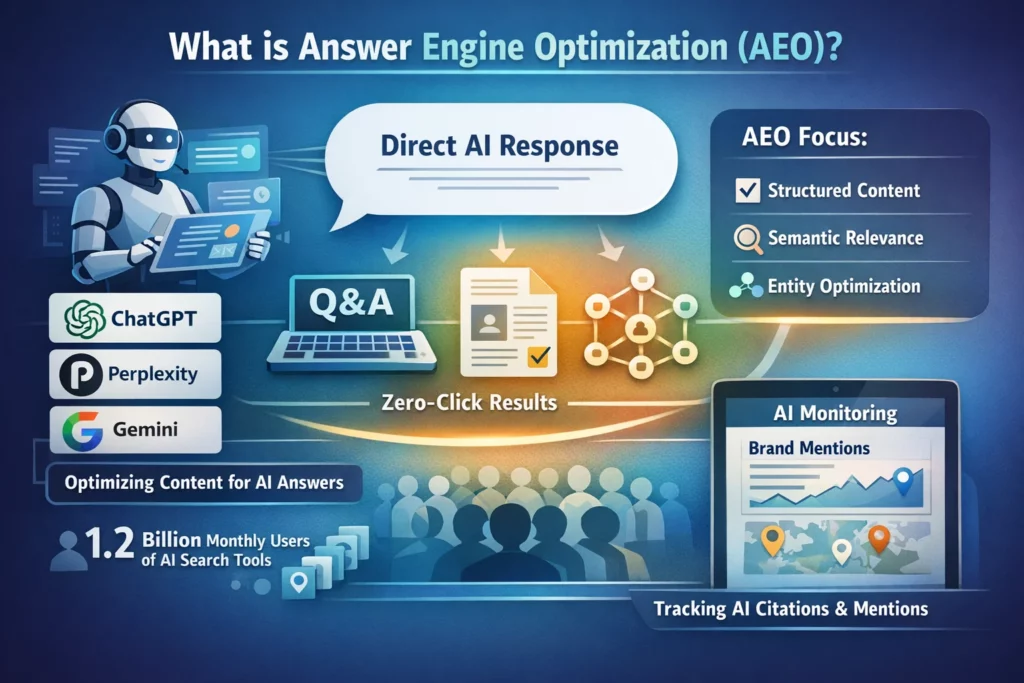
Unlike traditional SEO, which focuses on ranking positions on search engine result pages, AEO focuses on being the answer itself so that AI-driven, zero-click, and conversational search experiences recognize and reference your content directly. In essence, AEO aims for inclusion in AI responses, not just visibility in a ranked list of links. (Ahrefs) (SEO.com)
AI search adoption is rapidly growing. According to recent data, there are over 1.2 billion monthly users of AI search tools such as ChatGPT, Gemini, and Perplexity combined, with zero-click and conversational results appearing on more than half of all queries in some environments. (Webvello). This shift means brands must think beyond traditional rankings and make their content ready for AI systems to cite, reference, and reuse.
AEO emphasizes structured content, semantic relevance, and clarity so that answer engines can easily extract precise facts and responses. Practices like schema markup, question-and-answer formatting, and clearly defined entity relationships help AI platforms parse and trust your content. Tools like Wellows play a key role in monitoring how often and where your brand is cited across AI search environments, helping teams refine strategies that lead to repeated inclusion rather than just traditional clicks.
AEO vs SEO: Core Distinctions
This distinction matters as zero-click behavior accelerates. SparkToro’s research shows that only 374 out of every 1,000 U.S. Google searches result in a click, with the rest ending inside search or AI interfaces. (SparkToro)
SEO relies heavily on keywords and backlinks. AEO prioritizes structured answers, entity clarity, and extractable formatting so AI systems can reuse information confidently. This is why brands can rank well in Google yet remain absent from AI answers.
Key Similarities and Overlaps: SEO & AEO at a Glance
Both SEO and AEO depend on clear user intent alignment and high-quality content that answers questions directly.
Technical readiness matters in both systems: crawlability, clean structure, fast load times, and structured data improve visibility.
Google confirms that performance and accessibility signals continue to influence AI-enhanced search experiences. (Google Search Central)
Content credibility overlaps as well. AI systems favor sources that demonstrate expertise and clarity, echoing Google’s E-E-A-T principles.
Ahrefs analysis shows that AI Overviews most often cite clear, informational content rather than aggressively optimized pages. (Ahrefs)
Takeaway: SEO builds discoverability in ranked results, while AEO determines whether your content is reused, trusted, and cited inside AI-generated answers. Modern visibility strategies require both.
Why Is AEO Critical for Brands Now?
Answer Engine Optimization has become urgent because AI search is now a primary discovery layer, not an edge case.
AI-powered tools are reshaping how people research, compare, and trust information, especially in high-intent moments. According to StatCounter, Google’s traditional search dominance in the U.S. has already slipped below 90 percent as AI-driven experiences grow alongside it. (StatCounter)
AI search adoption directly impacts brand visibility and credibility. The majority of searches now end without a click, meaning brands increasingly win or lose visibility inside AI answers rather than on websites. If your content is not selected, summarized, or cited, it effectively disappears from the user journey.
For marketers and decision-makers, this changes the rules of performance measurement. Visibility now depends on whether AI systems trust your content enough to reuse it. This is where answer engine ranking tactics become essential, shifting focus from traffic capture to authority recognition inside AI responses.
Key AI Search Platforms for Modern AEO
ChatGPT: Enormous adoption for general and business research, blending LLM training data with Bing/Google scraping for answer generation.
Google AI Overviews: Delivers AI-generated summaries at the top of Google Search; critical for both B2C and B2B industries.
Perplexity: Real-time web access and high-quality source citations; increasingly influential for product research and expert-level queries.
Gemini: Integrated into the Google ecosystem, powering both standard and conversational AI search experiences for millions of users.
Copilot (Microsoft): Aggregates web results and context into summarized, zero-click answers; targets both enterprise and consumer audiences.
Claude: Growing in professional and research-focused user segments with deep analytical capabilities.
Apple Intelligence: Will soon integrate AI search across iOS and macOS, merging device and web data for answer engine experiences.
Meta AI: Targets social and discovery-based queries; expected to power a new wave of conversational and community-driven discovery.
Grok: Known for integrating real-time information from social platform X (formerly Twitter) and expanding its reach into news/trends.
Emerging platforms: Watch for incremental rollouts on niche/industry platforms and productivity tools, future-proofing means monitoring these trends and adapting fast as AEO opportunities fragment.
Google’s Advanced AI Search Capabilities
Google AI Overviews now synthesize information directly within Search, often reducing the need for users to click through to individual sites. Ahrefs analysis shows that AI Overviews can significantly reduce organic click-through rates, even for high-ranking pages.
AI Mode, introduced in 2025, deepens this shift by expanding query understanding and contextual aggregation. Instead of ranking ten blue links, Google increasingly presents a single synthesized response. This reinforces why answer engine ranking tactics must focus on being included in summaries, not just ranking below them.
Why This Matters
Even stable Google rankings can coexist with declining visibility if your brand is not included in AI-generated summaries and synthesized answers.
Standalone Answer Engines and Their AEO Role
ChatGPT delivers broad visibility for brands with clear, answer-driven content structures (ChatGPT features).
Perplexity’s hybrid model rewards well-cited content and drives high-intent traffic to authoritative sources (Perplexity features).
Claude surfaces detailed answers, favoring expert-led sites with deep topical coverage (Claude, Gemini, Copilot).
Gemini integrates natively with all Google services, expanding the reach of content optimized for both web and conversational queries.
Copilot offers wide discovery thanks to Microsoft’s ecosystem, strengthening B2B exposure for cited brands.
All platforms value content that is recent, actionable, and easily digestible by machine extraction, bells-and-whistles formatting is less effective than clear, semantically aligned structuring.
Core takeaway: AEO is no longer about preparing for the future. It is about remaining visible right now as AI systems increasingly decide which brands are trusted enough to appear in answers.
How Do Answer Engines Work?
Modern answer engines operate by combining two distinct intelligence layers: large-scale pre-trained knowledge and real-time information retrieval.
Large language models such as ChatGPT and Gemini are trained on massive datasets, including the Common Crawl, Wikipedia, books, and public forums such as Reddit. This training phase allows models to learn language patterns, entity relationships, and general world knowledge, forming the baseline they use to interpret and respond to queries.
To stay current, answer engines layer this foundation with retrieval-augmented generation (RAG), which pulls live web content when a question requires up-to-date or verifiable information. Instead of ranking pages like Google, these systems retrieve small content segments, evaluate relevance in context, and synthesize a single response. This is why understanding how AI Selects Sites to cite becomes critical for brands aiming to appear consistently in AI-generated answers.
For marketers applying answer engine ranking tactics, this dual system changes the optimization mindset. Authority is built over time through consistent, high-quality publishing, while visibility depends on freshness, clarity, and machine-readable structure. Content that is regularly updated, clearly segmented, and easy for models to extract stands the strongest chance of being retrieved, synthesized, and cited as AI search behavior continues to evolve.
Key shift: Answer engines do not “choose pages.” They assemble answers from fragments they trust, understand, and can verify in context.
Most Frequently Cited Sources in AI Results
Wikipedia: Preeminent due to coverage, reliability, and machine parsing readiness.
Reddit: Offers human insights, consensus, and community-driven Q&A; frequently cited for practical advice.
Quora: Houses comprehensive question-based content; favored for clear, self-contained answers.
YouTube: Valued for tutorial and demonstration content, especially in Google AI Overviews.
G2: Leading for B2B/product research citations.
LinkedIn: Increasingly present in professional and thought leadership answers.
Gartner: Sourced for authority in B2B and technology verticals.
Did you know?
Why Answer Engines Cite Certain Content Formats More Frequently?
Answer engines do not evaluate content the way humans or traditional search engines do. They are not reading pages end to end, nor are they judging narrative quality in isolation.
Instead, they assess whether specific segments of content can be extracted, verified, and reused as complete answers inside an AI-generated response.
This is why format matters as much as substance. Content that is broken into clear, self-contained units, such as lists, FAQs, tables, and short explanatory blocks, is easier for AI systems to retrieve and cite. Long narrative paragraphs often fail not because they lack expertise, but because they require additional interpretation and context stitching, which increases the model’s uncertainty.
In practice, answer engines favor content that reduces ambiguity. Clear headings, single-topic paragraphs, and direct summaries allow models to confidently lift a section without misrepresenting meaning. This explains why many authoritative pages are overlooked while simpler, well-structured resources dominate citations.
Structure and Extractability Drive Citation Frequency
Answer engines prioritize extractability over elegance. Each section of content is evaluated independently and must stand on its own.
Each section of content is evaluated independently, meaning it must stand on its own without relying on surrounding context. When a paragraph answers one question completely and unambiguously, it becomes a stronger candidate for citation.
Elements that consistently improve extractability include:
High-extractability content signals
- Explicit question-style headings: Clear, interrogative headings help AI map content directly to user intent.
- Short, declarative answers: Concise answers placed near the top of sections reduce ambiguity.
- Lists and tables: Structured formats isolate facts, making them safer to reuse verbatim.
- Clear semantic relationships: Well-defined entity connections help models maintain meaning when extracting fragments.
This structural clarity aligns closely with how AI systems retrieve information. Content that can be lifted cleanly without ambiguity consistently outperforms equally authoritative but less structured alternatives.
Recency, Verification, and Reuse Shape Long-Term Visibility
Beyond structure, answer engines continuously reassess which sources feel current and reliable. Citations rotate frequently, especially in fast-moving topics, because AI systems favor content that signals freshness and ongoing relevance. Even minor updates can reset a page’s eligibility for citation.
Off-domain signals also reinforce trust. When similar information appears consistently across reputable platforms, forums, and professional networks, AI systems gain confidence in reusing it. This is why citation durability often depends on cross-platform consistency, not just on-page optimization, a dynamic that many teams track through the Search Engine Visibility guide .
Did you know?
Ultimately, the formats that win are those that combine clarity, modularity, and ongoing maintenance. These traits make content easier to retrieve today and safer to cite tomorrow.
Understanding Google’s Query Fan-Out for AI Results
- Query expansion: Google breaks a single query into many semantically related sub-queries.
- Intent clustering: Each sub-query maps to different intents, definitions, and comparisons.
- Content surface expansion: Pages covering multiple related angles increase citation eligibility.
Google’s AI Mode and Overviews rely on query fan-out, which breaks a core query into dozens of semantically related subqueries and topic clusters. Optimizing for a broad set of associated terms and intent variations increases the surface area for citations in AI-driven responses, especially when supported by structured data and topical relevance.
Optimization insight: Pages designed as modular topic hubs, rather than single-answer articles, align best with query fan-out behavior and earn more consistent AI citations.
Comprehensive Strategies for Answer Engine Optimization
Effective answer engine ranking tactics require more than isolated fixes. Brands that earn consistent AI citations approach AEO as a system, combining technical accessibility, structured content, authority signals, and continuous measurement.
The goal is not short-term visibility, but sustained inclusion across answer engines as models and retrieval logic evolve.
A practical starting point is a full-scope audit that evaluates how your content, infrastructure, and brand signals appear to AI systems. Using an AI search visibility audit checklist, teams can identify gaps across crawlability, extractability, entity clarity, and off-site credibility before prioritizing actions.
At this stage, strategy matters more than volume. Optimizing selectively for high-intent queries, core entities, and citation-worthy assets produces better results than spreading effort thin across every page.
Build a Strong AEO Foundation: Content, Entities, and Structure
At the content layer, answer engines favor clarity over creativity. Pages that lead with direct answers, use descriptive headers, and maintain tight topical focus are easier to extract and cite. This is where internal structure and semantic alignment become critical.
High-performing AEO content typically:
Answers one primary question per section
Uses clear subject-predicate-object relationships
Reinforces entities through consistent terminology
Connects related pages through intent-driven internal links
Brands that organize their sites using AI SEO topic clusters tend to perform better in answer engines because clustered content reinforces topical authority and reduces ambiguity during retrieval.
Just as important, internal links should strengthen meaning, not navigation. Linking conceptually related pages helps AI systems understand how ideas connect, improving citation confidence across multiple queries.
Benchmark and Monitor AI Search Visibility
AEO success cannot be inferred from rankings alone. Brands need visibility into how often they are mentioned, cited, or implied across ChatGPT, Gemini, Perplexity, and Google AI Overviews.
Visibility now depends on presence inside answers, not just performance in SERPs.
This is where ongoing monitoring becomes essential. Tracking citation frequency, competitive share of voice, and sentiment trends allows teams to detect volatility early and respond before visibility declines. Platforms like Wellows surface these patterns by monitoring how brands appear across AI answers, not just whether pages rank.
When teams connect monitoring insights with LLM citation strategies, they can move from reactive fixes to proactive optimization, reinforcing the signals that answer engines repeatedly trust.
Strengthen Technical SEO for AI Engines
Answer engines are less forgiving than traditional search when it comes to technical barriers. If content cannot be rendered cleanly or parsed quickly, it may be skipped entirely.
Priority technical actions include:
Technical foundations for AI visibility
- Server-side accessibility: Ensuring server-side rendered content is accessible to AI crawlers
- Logical structure: Maintaining clean, logical heading hierarchies
- Consistent schema: Implementing a consistent schema for articles, FAQs, and entities
- Crawler permissions: Verifying robots.txt and LLM access settings
Many brands overlook how technical debt compounds in AI search. Pages that still perform adequately in Google can quietly disappear from AI answers due to rendering issues or inconsistent markup. Addressing this gap is a core component of durable answer engine ranking tactics.
Incorporate Local and Platform-Specific Signals Where Relevant
For brands with geographic presence, local signals increasingly influence AI answers. Answer engines often surface business information directly from location data, reviews, and local schema, rather than just from website pages.
Improving local AEO means:
Keeping Google Business Profile data accurate and current
Encouraging authentic customer reviews
Aligning NAP data across directories
Adding geo-specific FAQs where appropriate
This local clarity helps answer engines resolve ambiguity, especially for “near me,” service, and comparison queries.
Elevate Brand Authority Through Multichannel Presence
Answer engines rely heavily on external validation. Brands that are frequently cited tend to appear across multiple trusted environments, not just on their own websites.
Effective authority building includes:
Publishing original research or proprietary insights
Participating meaningfully in platforms like LinkedIn, Reddit, and Quora
Earning coverage in industry publications
Maintaining consistent brand narratives across channels
This is also where AI brand sentiment tracking becomes valuable. Monitoring how your brand is framed across forums and AI responses helps ensure authority signals remain positive, accurate, and up to date.
Wellows supports this stage by revealing both credited and uncredited mentions, allowing teams to correct gaps and reinforce trusted narratives before they solidify in AI outputs.
Turn AEO Into a Continuous System
- Audit visibility and citations: Audit visibility and citations
- Optimize structure and clarity: Optimize structure and clarity
- Expand authority through credible mentions: Expand authority through credible mentions
- Monitor performance shifts: Monitor performance shifts
- Iterate based on real AI behavior: Iterate based on real AI behavior
Answer engines evolve quickly. Brands that revisit content, refresh data, and adapt their structure regularly are far more likely to sustain visibility than those that rely on static optimization.
In practice, durable answer engine ranking tactics come from consistency, not hacks. Teams that align content, technology, and authority around how AI systems actually retrieve and cite information gain a lasting advantage.
FAQs
Answer engines are AI-powered systems like ChatGPT, Gemini, Perplexity, and Google AI Overviews that generate direct responses instead of ranked lists of links. Unlike traditional search engines, they synthesize information from multiple sources and may cite content without sending users to a website.
Answer engine ranking tactics focus on making content easy for AI systems to understand, extract, and cite. This includes answer-first structure, clear entity signals, semantic clarity, schema markup, and strong external credibility. The objective is inclusion in AI-generated answers rather than traditional SERP positions.
High Google rankings do not guarantee AI inclusion, as answer engines prioritize clarity, context, and citation quality over page position. Content can rank well in Google yet be excluded from AI responses if it lacks direct answers or an extractable structure.
Answer engines evaluate how clearly a source answers the question, its topical relevance, consistency across trusted platforms, recency, and third-party validation. Sources that are frequently referenced and well-structured are more likely to be cited.
In AI search, success is measured through citation frequency, inclusion across answer engines, share of voice in AI responses, and consistency of brand framing. These signals indicate influence and authority even when user clicks are minimal or absent.
Conclusion
Answer engines have changed how visibility is earned, measured, and sustained. Success is no longer defined by blue links or traffic alone, but by whether your brand becomes a reliable source for AI-generated answers. By applying modern answer engine ranking tactics, brands can align content with how systems like ChatGPT, Gemini, and Perplexity interpret intent, extract meaning, and decide what to cite.
The brands that lead in AI search are those that adapt early and consistently. Investing in clear structure, semantic clarity, authority signals, and ongoing measurement ensures your content remains eligible as answer engines evolve. When executed correctly, answer engine ranking tactics move your brand from being searchable to being referenced, trusted, and repeatedly included where decisions now begin.