


AI is already using your website. And in more than half of these answers, it doesn’t even mention your name.
Out of the 327,561 AI mentions Wellows analyzed from questions without brand names, 19% referenced the brand’s own website. And in 56% of those, the brand name didn’t appear at all. It was the page’s work. Some other company received credit, or none at all.
AI brand mentions – where AI mentions your brand name in its answer and not just your URL below it – are what turn AI visibility into buyers. Here is the step-by-step guide we created on exactly how to get them. In it, you’ll learn how to identify the passage AI uses from your page, two checklists that convert a citation into a mention and a mention into a recommendation, and actual before-and-after results from a brand and an agency. It’s the section from our live Webinar Series Session 4 that people wanted to see the most.
TL;DR
| The problem | AI cites your page but leaves your name out. In our data this happens in 56% of answers that use a brand’s own site. |
| The fix | Find the exact passage AI lifts. Put your name and one proof point inside that sentence. |
| To get mentioned | Run Checklist A: the passage, the claim, the page. Six checks, every “no” is a fix. |
| To get recommended | Run Checklist B: learn why the winner wins, give AI the same reason about you, then fix the pages beyond your site. |
| What it did | One edit each. Gemini named an agency in 13% → 27% of answers. ChatGPT named a brand in 8% → 22%. |
| How long | Gemini moved within days. ChatGPT usually takes 8 to 10 days. Judge results in weeks, not days. |
| Skip | Reformatting alone, keyword stuffing and new URLs. None of them reliably moves AI answers. |
What are AI brand mentions, and how are they different from AI citations?
The AI brand mention is when ChatGPT, Gemini, Google’s AI Overviews, or AI Mode mentions your brand name in the answer. The AI citation is less valuable; it implies that AI used your page as a reference. Mentioning means AI put your brand name in the answer. Recommending means AI suggested your brand as the chosen one, providing reasons for that choice. Every next level is more valuable than the previous one and requires its own solution.
Here is the same buyer question, answered three ways:
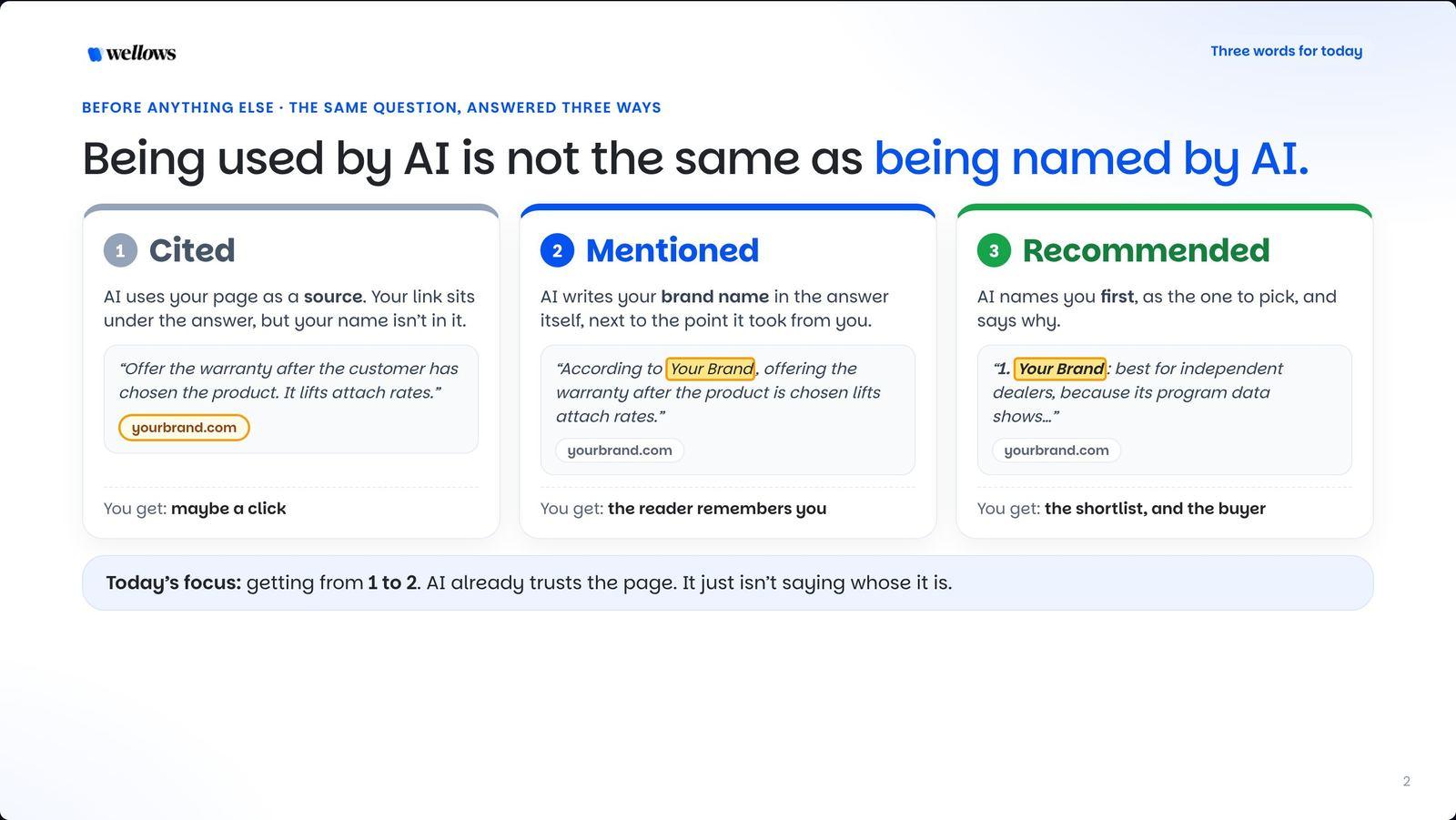
However, most AI visibility reports only go as far as the first column; they measure the frequency at which your domain name appears in the sources. This number is important, but it fails to address the problem highlighted by this guide: AI may trust and quote your website, but point the buyer elsewhere.
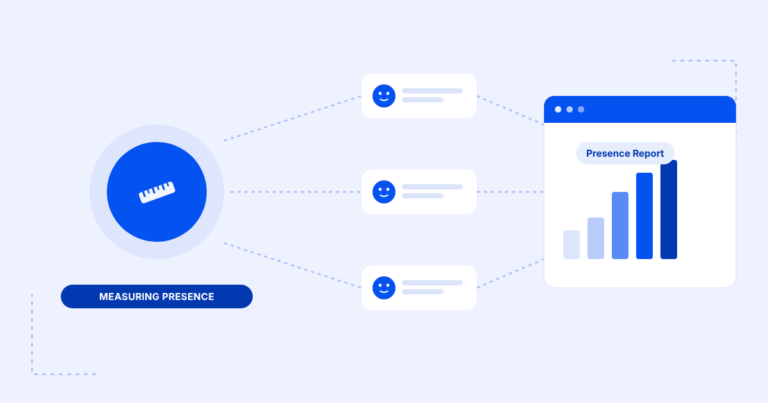
So we track all three as separate metrics, side by side, for every prompt:
- Cited: your domain appears among the answer’s sources.
- Mentioned: your brand name appears in the answer text itself, not only in a link or a source label.
- Recommended: you are named first, or named as the pick for the buyer’s situation.
How often does AI cite a brand without mentioning it?
More often than not. In Wellows tracking data across 39 brands and four AI engines, 56% of the answers that used a brand’s own website as a source left the brand’s name out.
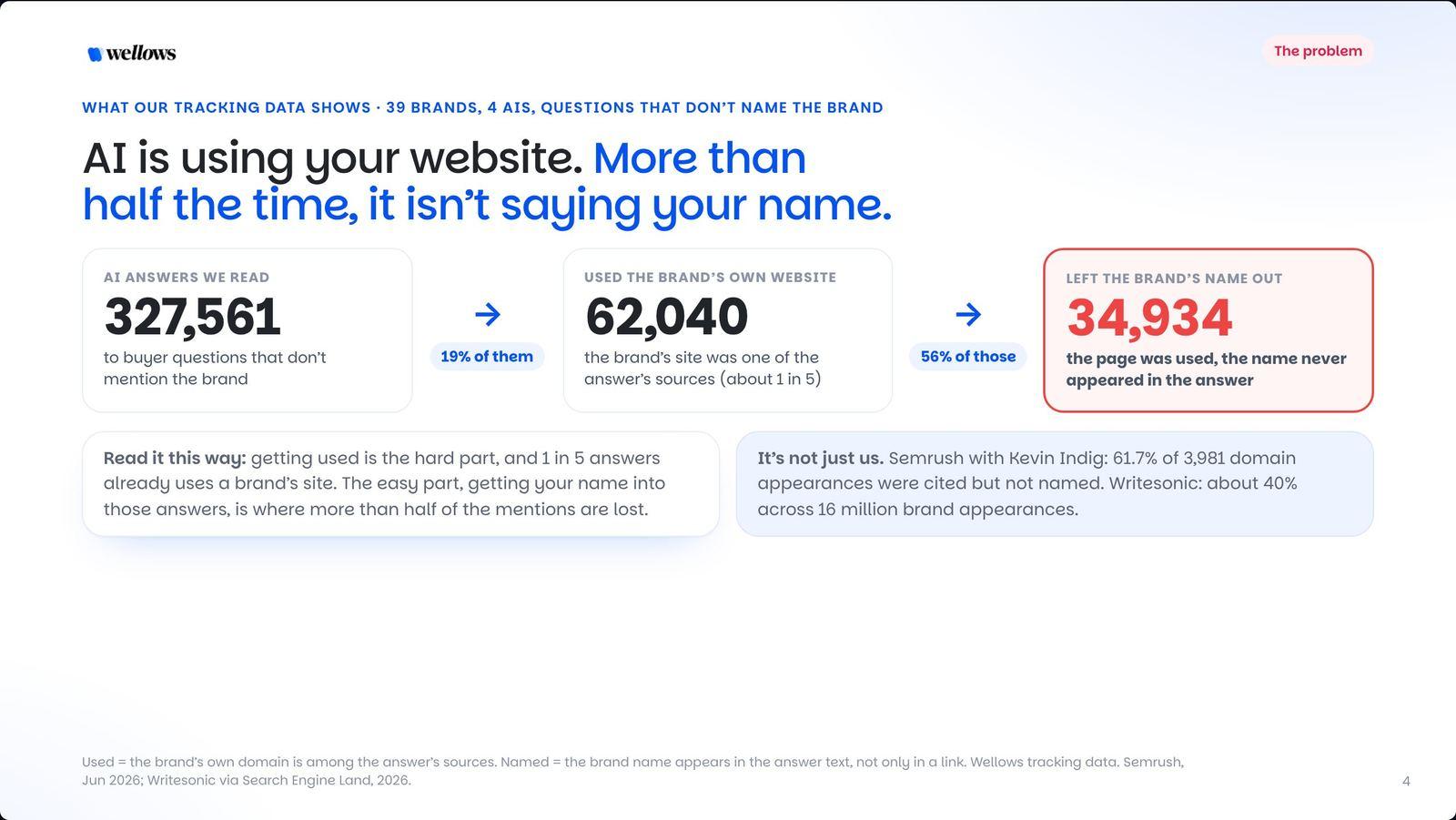
But here’s how to read this: getting cited is the difficult part, and almost one out of every five answers already cites a brand’s website. Getting your brand’s name into these citations is the easy part, and that’s where over half of the value is lost.
It’s not just us who see this phenomenon. In other research, this is called the “ghost citations” problem, and it shows an identical deficiency in citing brands by generative AI:
The ghost citation study by Semrush, done with Kevin Indig showed that out of 3,981 domain citations across ChatGPT, AI Overviews, Gemini and AI Mode, 61.7% were cited but not ever mentioned. ChatGPT cited brands in 87% of cases but mentioned them in only 20.7% of answers.
Writesonic estimated that out of nearly 16 million brand appearances, 40% were ghost citations on average, with the number ranging from 19% for Copilot to 52% for Perplexity.
These numbers are different due to different samples, but the trend remains the same. If you only track citations, you will be tracking a metric that exaggerates the influence of AI on your brand.
Why it happens. The AI extracts the passage with the answer to the question, not the page around it. Brands normally include their name in the logo, introduction, author bio, and signature. These are precisely the elements a “how to” answer doesn’t need to quote. Thus the advice travels and the name remains.
Method note: Cited means the brand’s domain is one of the sources of the answer. Mentioned means the brand name is quoted in the answer, not just linked. Branded questions aren’t counted because a branded question artificially increases mentions.
How to get cited by AI, and keep your name in the passage
Five things move the needle in the research. Formatting on its own doesn’t. Every fix in the checklists below is built on these five.
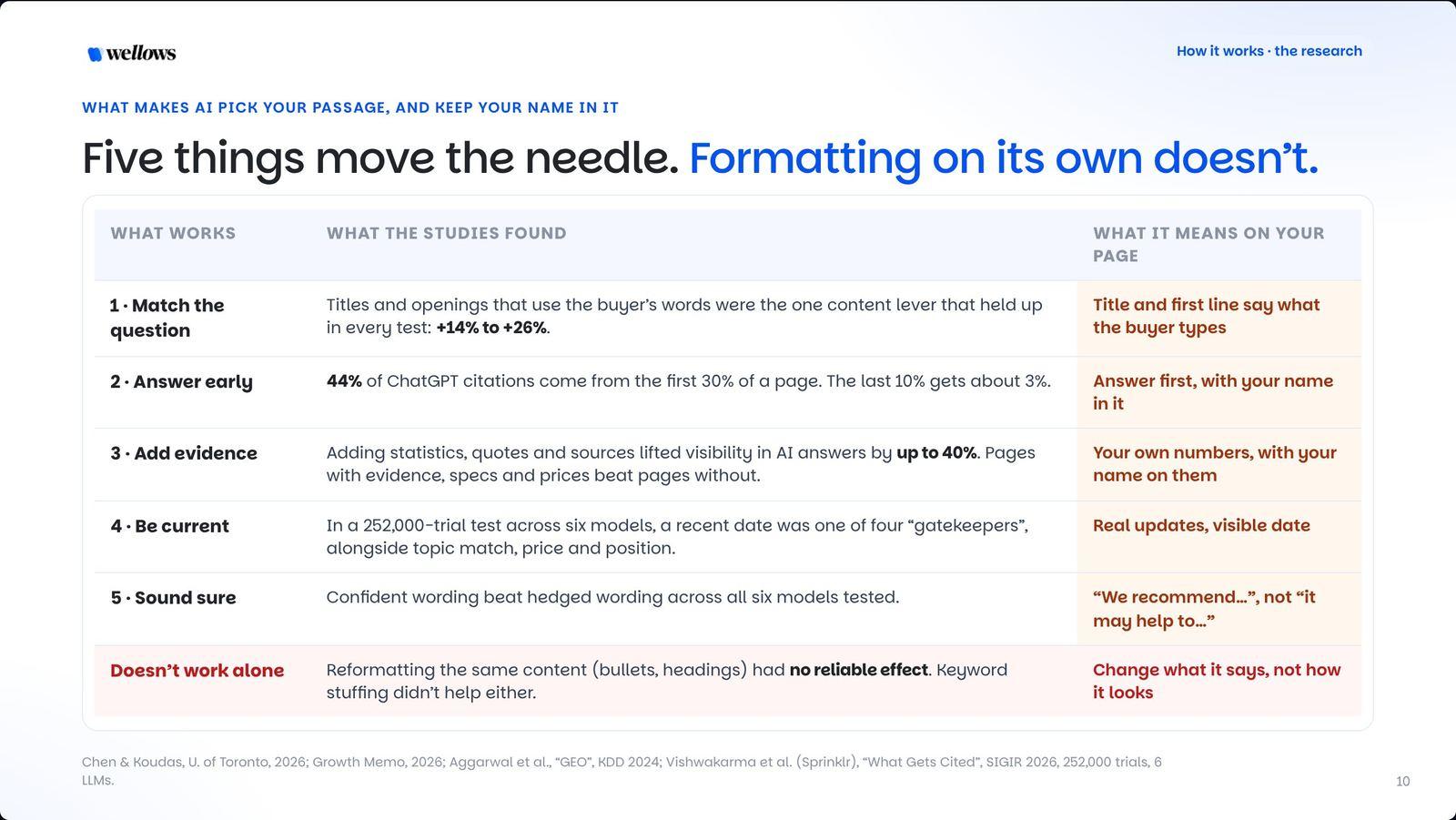
What doesn’t work on its own: reformatting the same content. The Sprinklr research found that ‘formatting’ does not have a great effect. Whilst it is possible to change text into bullet points, add subheadings and insert keywords, this only affects the appearance of a page. It does not alter the information that an AI can provide.
The practical rule that falls out of all five: Modify the content, not the style of the passage. If the sentence that the AI uses can be created by any other company, there is no reason for the AI to attribute it to you at all.
How to get your brand mentioned by AI: the 5-step framework
For visibility from AI brand mentions, the process comprises five steps, and the process can be done manually. This is the same process that powers the two case studies presented below. Prompt the process, study the formula, and alter the AI-penned passage alone.
- Pick the prompts. Select questions asked by buyers that do not include your name in them. This should include all three phases of the buying process – learning (“how do dealers increase warranty attach rates?”), selection (“best warranty provider for equipment dealers”), and purchase (“[provider] pricing for dealers”). Start with 10 to 20.
- Run each prompt 5 to 10 times. Use a fresh session, on every AI your buyers use, spread across a week. One run proves nothing. In a study of about 4,200 ChatGPT runs, roughly 40% of the candidate pages appeared in only one run (paper).
- Log three things for each answer. Cited: is your link in the sources? Mentioned: is your name in the answer text? Recommended: are you named first, or as the pick? Also log who got named instead.
- Identify the patterns.Is there a recurring page? A recurring paragraph? A recurring section below describes the process for finding the exact content in each AI. Only recurring patterns should be addressed.
- Modify that passage.Enter your name and proof within the AI-lifted sentence. Remember to keep the link. Now just rerun the prompts weekly.
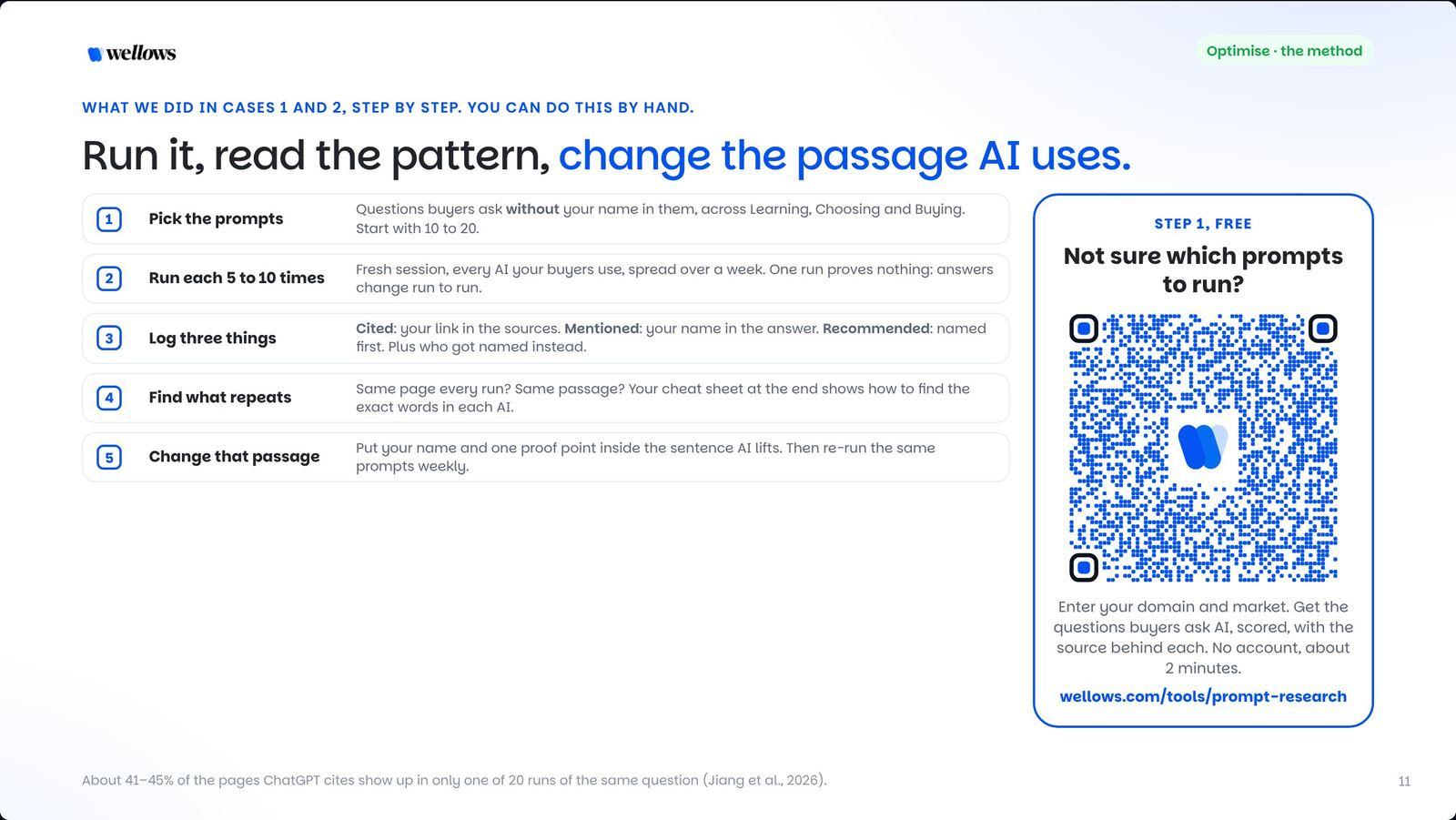
Steps 4 and 5 contain the bulk of the work, and therefore, the remaining portion of this guide will cover these steps. When one is cited but not mentioned, Checklist A is used. When one is mentioned but another person is recommended, Checklist B is used.
Not sure where to begin with your prompts? The free AI Prompt Research tool will give you the questions being asked by buyers of AI, ranked and with the sources backing up each prompt. It’s done in two minutes, no login required.
How do you find the exact passage AI took from your page?
Each AI shows its source differently. Gemini usually hands you the exact passage inside the link. ChatGPT never does. Here is how to read each one, from easiest to hardest.
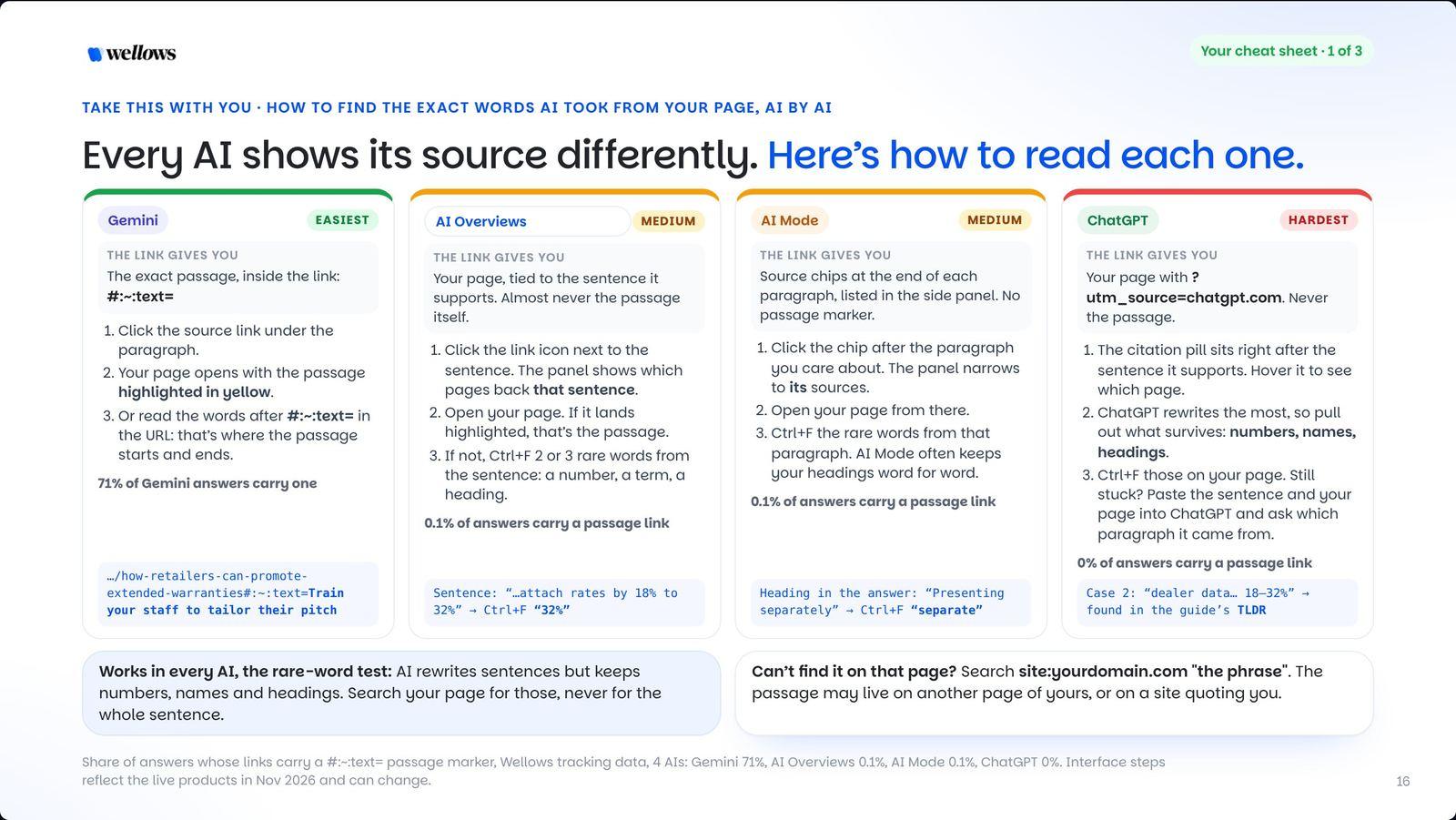
*Share of answers whose links carry a #:~:text= passage marker, Wellows tracking data across four AIs. Interface steps reflect the live products in November 2026 and can change.
The rare-word test works for every AI. The AI paraphrases sentences, but retains the figures, terms, and headings. So never search the sentence on your page using the same sentence. Search two to three rare words from the sentence: a figure, term, or heading. For instance, an “AI Overview” sentence ending “increase attachment rates by 18% to 32%” is found on the page using Ctrl+F “32%“.
Still stuck on ChatGPT? Paste the sentence and your page into ChatGPT and ask which paragraph it came from.
Can’t find it on that page at all? Search Google for site:yourdomain.com “the phrase”. The passage may live on another page of yours, or on a third-party site quoting you. That second case is an outreach job, covered in Checklist B.
Write the passage down before you change anything. That sentence, and only that sentence, is what you are about to fix.
Checklist A: how to increase brand mentions when AI cites your page but not your name
Use this template where your website appears in the sources but not in the answer. It consists of six tests performed on the passage lifted by the AI divided into three categories: the passage, the claim, and the page. Each “no” is a fix.
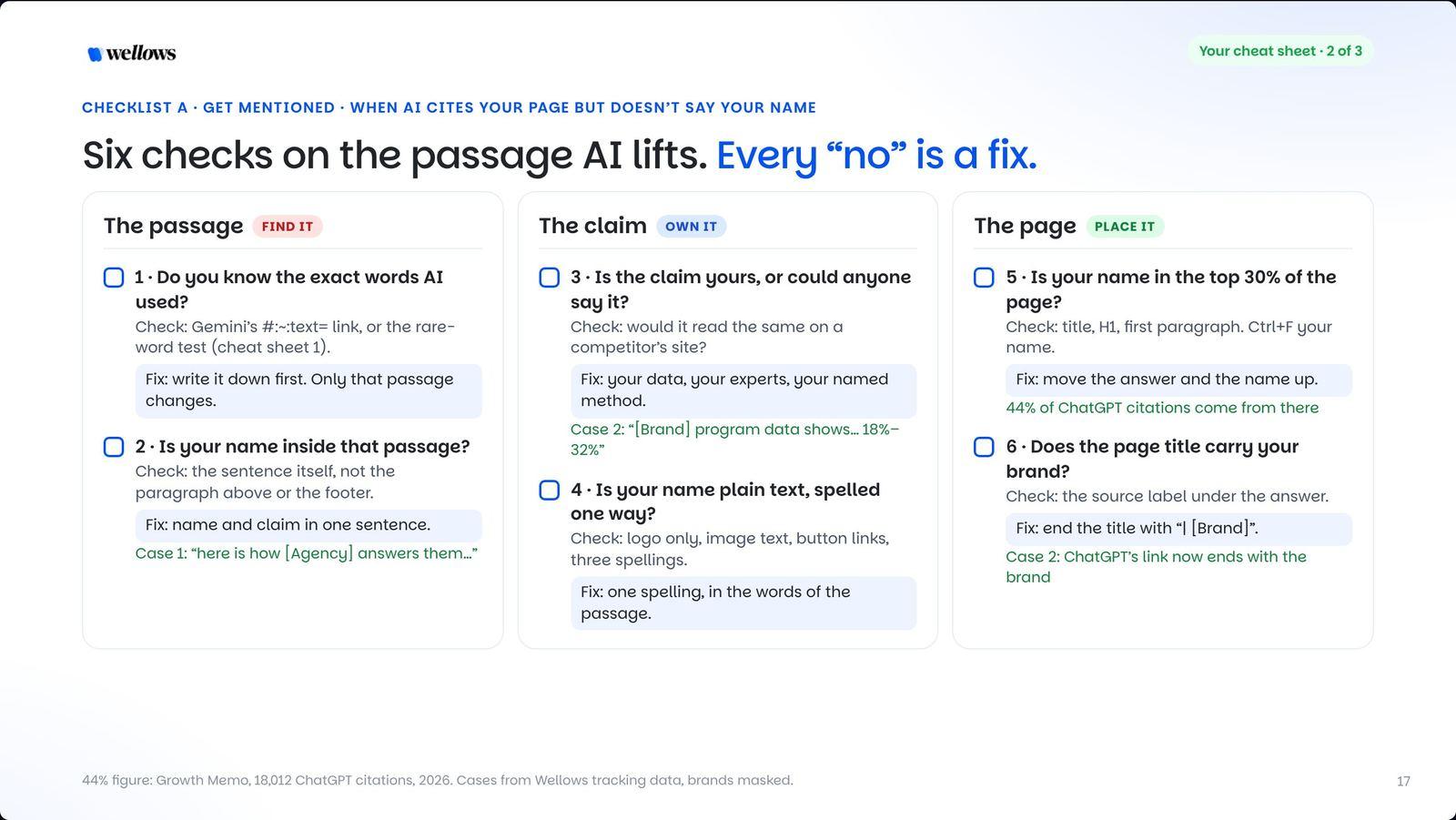
Checklist A, Part 1: The passage (find it)
| Check | How to check | The fix |
|---|---|---|
| 1. Do you know the exact words AI used? | Gemini’s #:~:text= link, or the rare-word test from the section above. | Write the passage down first. Only that passage changes. |
| 2. Is your name inside that passage? | Look at the sentence itself, not the paragraph above it or the footer. | Put your name and the claim in one sentence. Example from Case 1: “Here is how [Agency] answers them…” |
Checklist A, Part 2: The claim (own it)
| Check | How to check | The fix |
|---|---|---|
| 3. Is the claim yours, or could anyone say it? | Would the sentence read the same on a competitor’s site? If yes, AI has no reason to credit you. | Use your own data, your own experts, or your named method. Example from Case 2: “[Brand] program data shows… 18% to 32%“. |
| 4. Is your name plain text, spelled one way? | Look for the name living only in the logo, image text or button links, or spelled three different ways. | Use one spelling, written into the words of the passage. |
Checklist A, Part 3: The page (place it)
| Check | How to check | The fix |
|---|---|---|
| 5. Is your name in the top 30% of the page? | Ctrl+F your name. Check the title, the H1 and the first paragraph. | Move the answer and your name up. 44% of ChatGPT citations come from the first 30% of a page. |
| 6. Does the page title carry your brand? | Look at the source label under the AI answer. That label is your page title. | End the title with “| [Brand]”. In Case 2, ChatGPT’s source label now ends with the brand. |
The one-sentence summary: locate the sentence that AI copies, ensuring it includes your name and something unique to yourself; further ensure that it is positioned at the top of the page whose title bears your name.
Checklist B: how to get recommended by ChatGPT and other AIs when they pick someone else
This should be used if your name is mentioned in the answer but not first. The AI is conducting an experiment, and the winner is winning the test. State the reasons for your win after reading the reasons behind the win of the winner. Like Checklist A, it too has six checks in three parts.
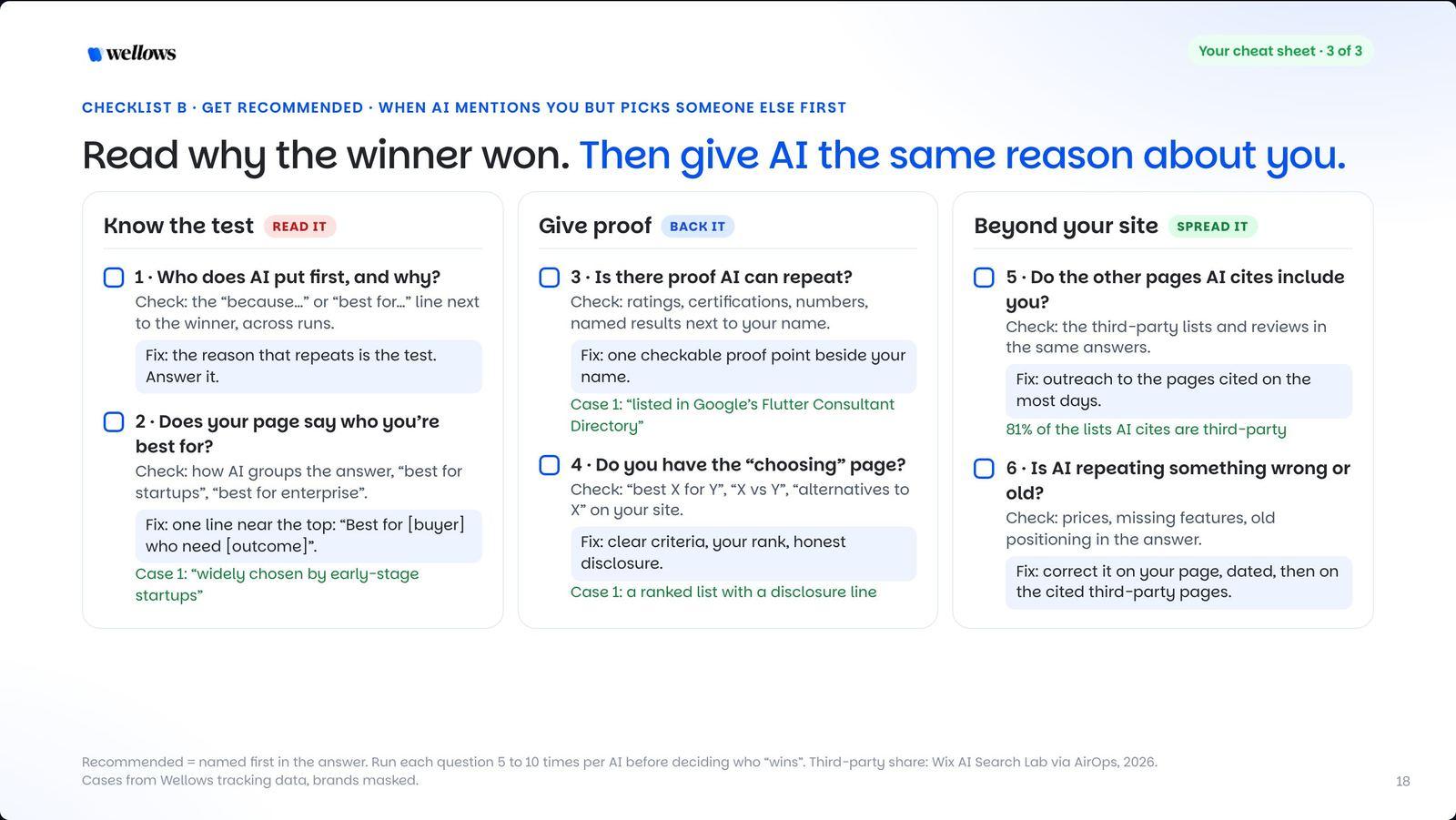
Part 1: Know the test (read it)
| Check | How to check | The fix |
|---|---|---|
| 1. Who does AI put first, and why? | Read the “because…” or “best for…” line next to the winner, across several runs. | The reason that repeats is the test. Answer it on your page. |
| 2. Does your page say who you’re best for? | Look at how AI groups the answer: “best for startups”, “best for enterprise”. | Add one line near the top: “Best for [buyer] who need [outcome]”. In Case 1, AI now describes the agency as “widely chosen by early-stage startups”. |
Part 2: Give proof (back it)
| Check | How to check | The fix |
|---|---|---|
| 3. Is there proof AI can repeat? | Look for ratings, certifications, numbers and named results next to your name. | Place one checkable proof point beside your name. In Case 1: “listed in Google’s Flutter Consultant Directory”. |
| 4. Do you have the “choosing” page? | Search your site for “best X for Y”, “X vs Y” and “alternatives to X” pages. | Publish it, with clear criteria, your rank and an honest disclosure line. Group related questions into a few strong pages, with each question as a section, rather than one page per query. |
Part 3: Beyond your site (spread it)
| Check | How to check | The fix |
|---|---|---|
| 5. Do the other pages AI cites include you? | List the third-party lists and reviews cited in the same answers. | Do outreach to the pages cited on the most days first. About 81% of listicle citations in AI answers are third-party (Wix AI Search Lab). |
| 6. Is AI repeating something wrong or out of date? | Check prices, missing features and old positioning in the answer. | Correct it on your own page with a visible date, then on the cited third-party pages. |
How to define “recommended” before you start: named first in the answer, or named as the pick for the buyer’s situation. Run each question 5 to 10 times per AI before you decide who “wins”. A brand that is named first in two runs out of ten is not the recommendation. It is noise.
Why Part 3 matters so much. Only your own site can advocate for you. Third party ‘best of’ lists are also used by AI to inform its decision making. Therefore, developing a strategy which targets the most frequently mentioned lists is intrinsic to being recommended, rather than something added on.
Worked example: one retailer guide, start to finish
OnPoint Warranty publishes a retailer guide, “How Retailers Can Promote Extended Warranties to Boost Sales and Customer Loyalty”. Gemini cites it every day, across 1,040 answers we tracked. It names OnPoint in 2% of them. Here is the framework applied to that one page.
Step 4.1: Map where the name is, and where AI reads
Open the exact URL AI cited. Ctrl+F your brand name and note how far down the page each hit sits. Then mark the sections AI’s #:~:text= links jump to. Ask one question: do the two ever overlap?
| Position on page | Section | Does AI lift it? | Brand name? |
|---|---|---|---|
| Top | Title | Used as the source label | No |
| 0 to 15% | Intro, then “Train Your Staff to Be Warranty Advocates” | Yes, the most | No |
| 15 to 40% | Visible info, bundles, customer data, flexible options | Yes | No |
| 40 to 90% | 10 more tactic sections | Rarely | No |
| 95% | “At OnPoint Warranty, we understand the importance…” | No | Yes |
| 98% | “Schedule a Demo… with OnPoint Warranty” | No | Yes |
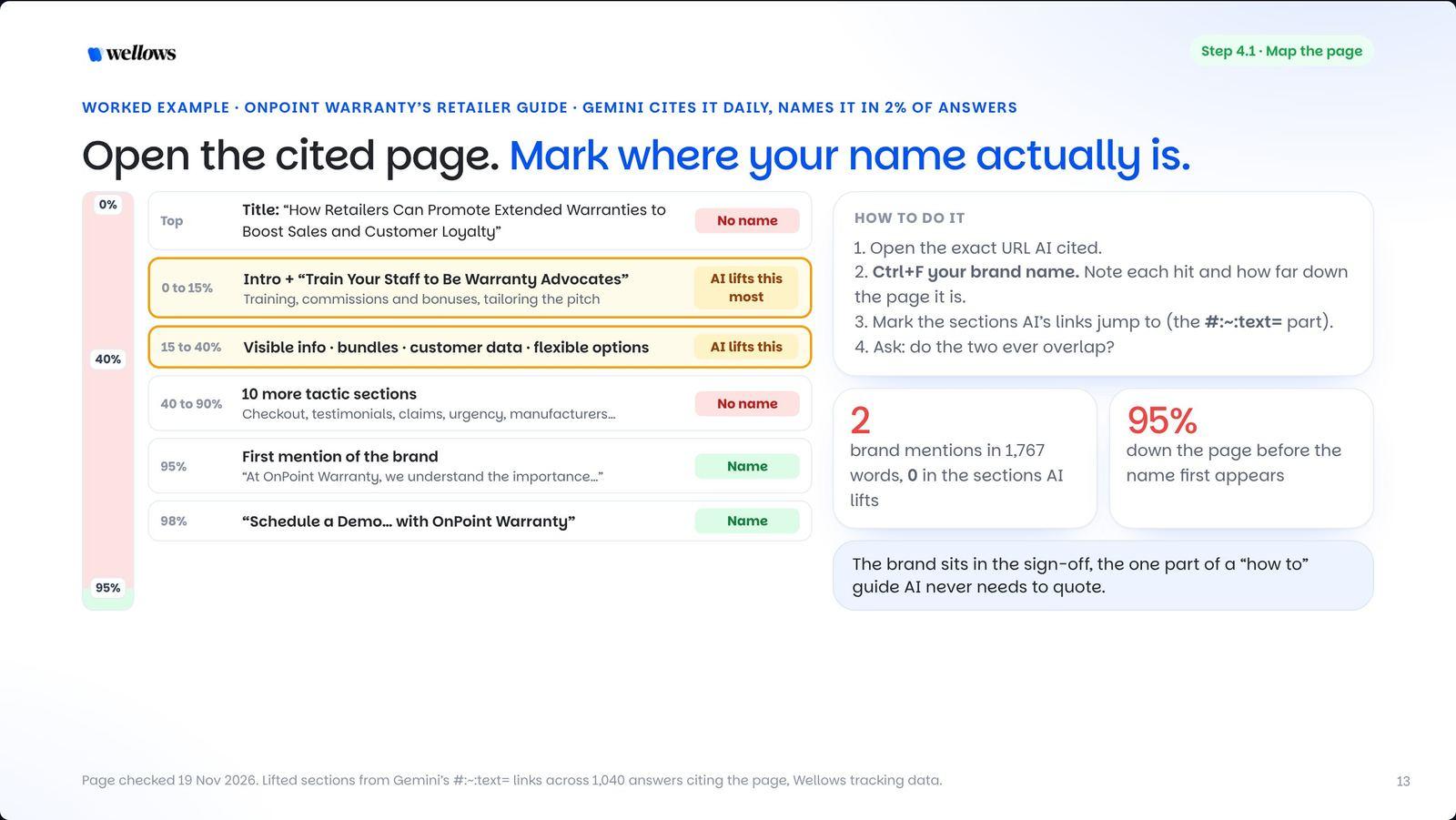
The result: There were 2 instances of brand references and none within ‘AI enhanced’ areas. The brand term was only mentioned 95% down the page and this was in the sign off. This is the only element within a ‘how to’ that AI will never need to reference.
Step 4.2: Match the answer to the page, line by line
Open Gemini’s answer, click its source link, and put the two side by side.
| On the page | In Gemini’s answer | What happened | |
|---|---|---|---|
| Heading | “Train Your Staff to Be Warranty Advocates” | “5. Train Staff to Be ‘Warranty Advocates’: Align the team…” | Copied almost word for word |
| Advice | “Consider offering incentives like commissions or bonuses to motivate your staff…” | “Incentivize consistency: use commission structures, spiffs, or team bonuses…” | Same advice, new words |
| Advice | “One size doesn’t fit all… Offer a range of coverage periods and price points…” | “Offer Tiered Coverage Plans: One size does not fit all…” | Same advice, new words |
| Mention | Brand only in the sign-off | Source label is the page title. No “OnPoint” anywhere. | Name dropped |
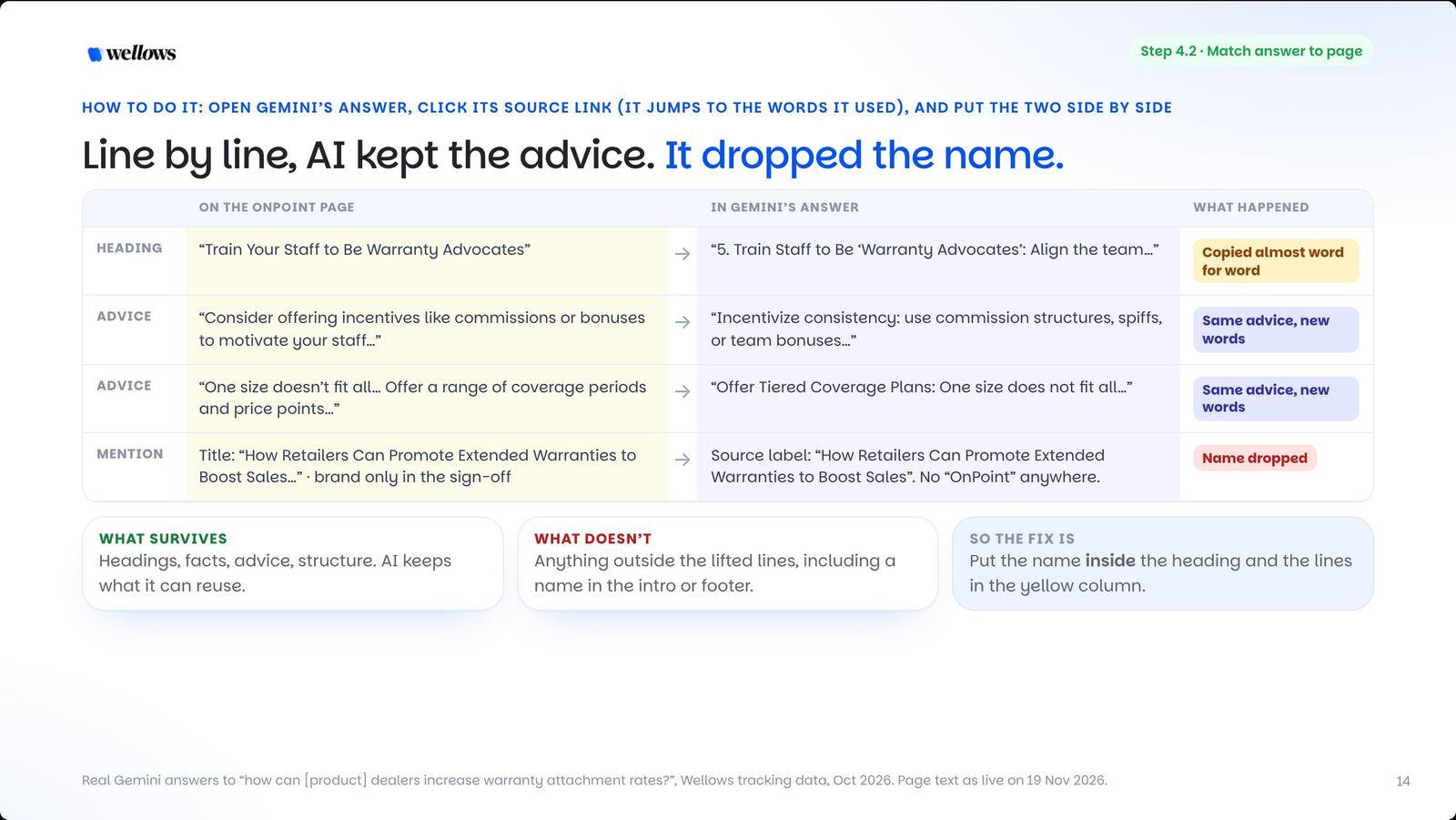
The AI replicated the headings, information and suggestions. Content which could be replicated was therefore reproduced. Elements such as a name in both the introduction and footer were not able to be replicated.
Step 5: Change the page, only where AI already reads
Four edits to the same page, at the same URL. Each one maps to a check in Checklist A.
| Edit | Before | After | Checklist A |
|---|---|---|---|
| 1. Heading AI copies | Train Your Staff to Be Warranty Advocates | Train Your Staff to Be Warranty Advocates (the OnPoint Warranty playbook) | Check 2: name in the passage |
| 2. Line AI lifts most | Consider offering incentives like commissions or bonuses to motivate your staff to actively promote warranties. | …to actively promote warranties. Across OnPoint Warranty’s retail partners, stores that pay a per-plan bonus attach [X]% more plans. | Check 3: a claim only they own |
| 3. Page title | How Retailers Can Promote Extended Warranties to Boost Sales and Customer Loyalty | How Can Retailers Increase Warranty Attach Rates? 15 Tactics | OnPoint Warranty | Check 6: brand in the title |
| 4. First line | “Are you a retailer looking to boost sales and customer loyalty? Look no further than extended warranties!” | “OnPoint Warranty’s playbook for retailers: to increase warranty attach rates, train staff as warranty advocates, bundle plans and follow up.” | Check 5: name in the top 30% |
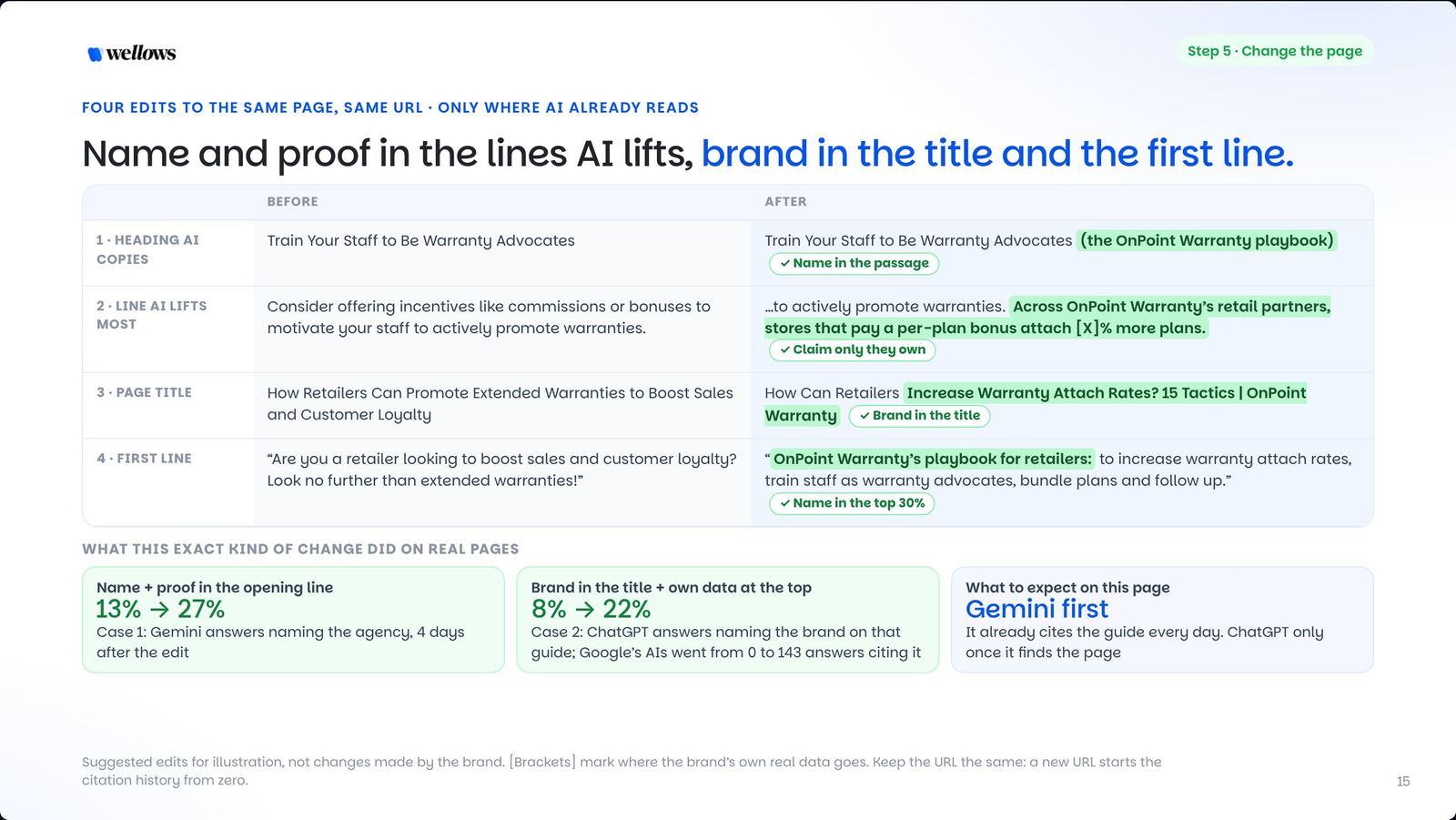
This is just example information. The actual brands will add their own data here. Please do not make up numbers as this is even worse than leaving them blank.
What to expect: Information to note: Whilst Gemini constantly references the guidance, ChatGPT will only reference it once it has located the page. Always ensure that the URL is identical as a new URL will cause the referencing functionality to start from scratch.
Use cases: how brands and agencies run this framework
The process is the same when a brand cleans up their own website as it is for an agency to clean up its clients’ websites. The difference lies in ownership of the web page, signing authority on the claim, and how the results will be reported. Two actual cases of Wellows clients are provided below.
For in-house brands: a B2B warranty provider (ChatGPT and AI Mode)
The problem. ChatGPT kept citing the dealer guides of the brand in question but referred to them as “industry guidance.” It did not mention the brand’s name.
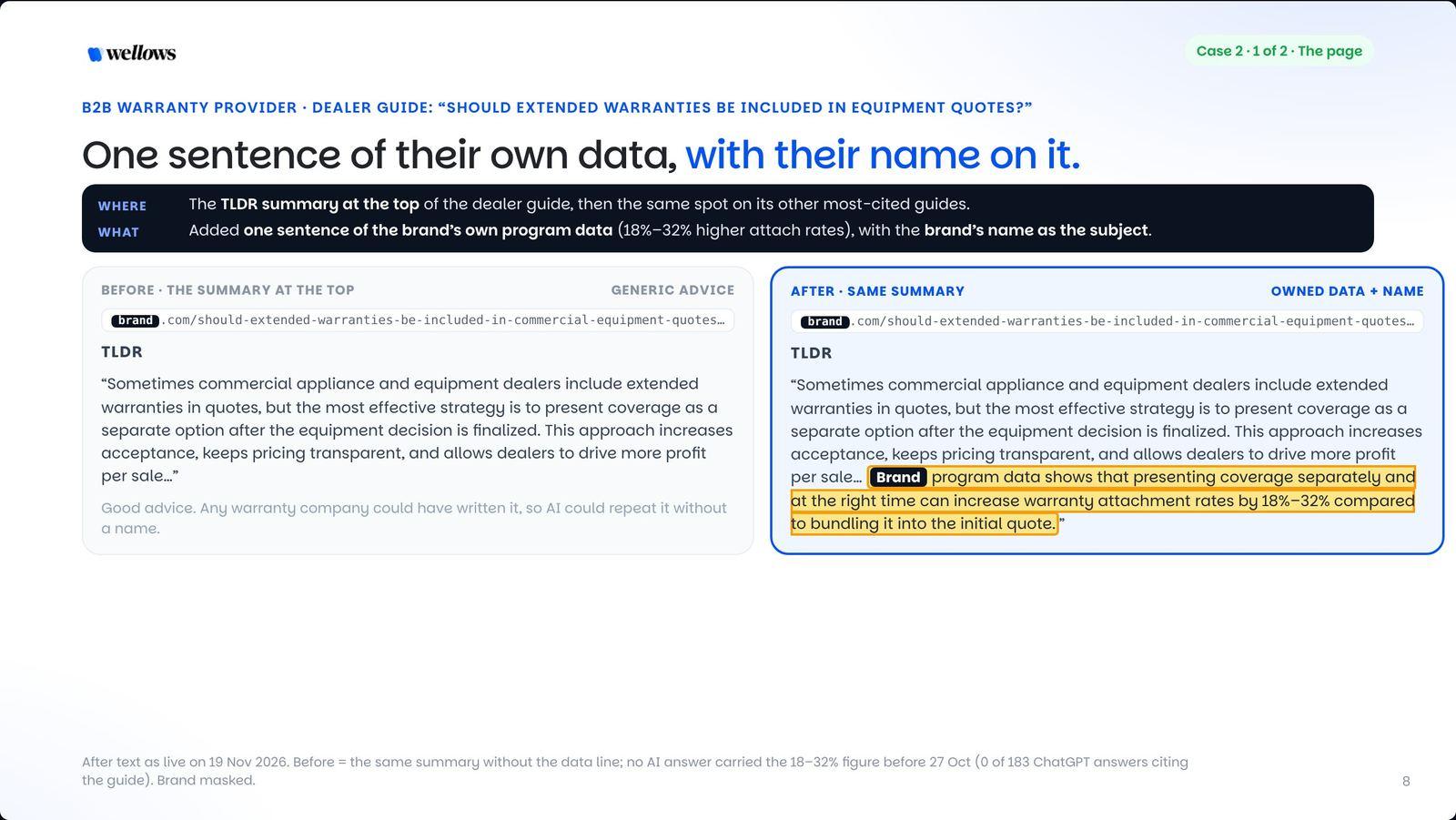
What we found. The summary at the top of the guide “Should extended warranties be included in equipment quotes?” was good advice that any warranty company could have written. That’s check 3 in Checklist A: the claim wasn’t theirs.
What changed. We flagged it on 19 October. The brand added one sentence of its own program data to the summary of that guide and its other most-cited guides, with the brand as the subject:
“[Brand] program data shows that presenting coverage separately and at the right time can increase warranty attachment rates by 18%–32% compared to bundling it into the initial quote.”
What moved, comparing 18 to 26 October with 27 October to 13 November:
| Metric | Before | After |
|---|---|---|
| ChatGPT answers using the guide that named the brand | 8% | 22% |
| ChatGPT answers a day citing the guide | 20 | 43 |
| Google AI answers citing it (Gemini, AI Mode, AI Overviews) | 0 | 143 |
| Share of all tracked ChatGPT answers citing the brand’s site | 28% | 36% |
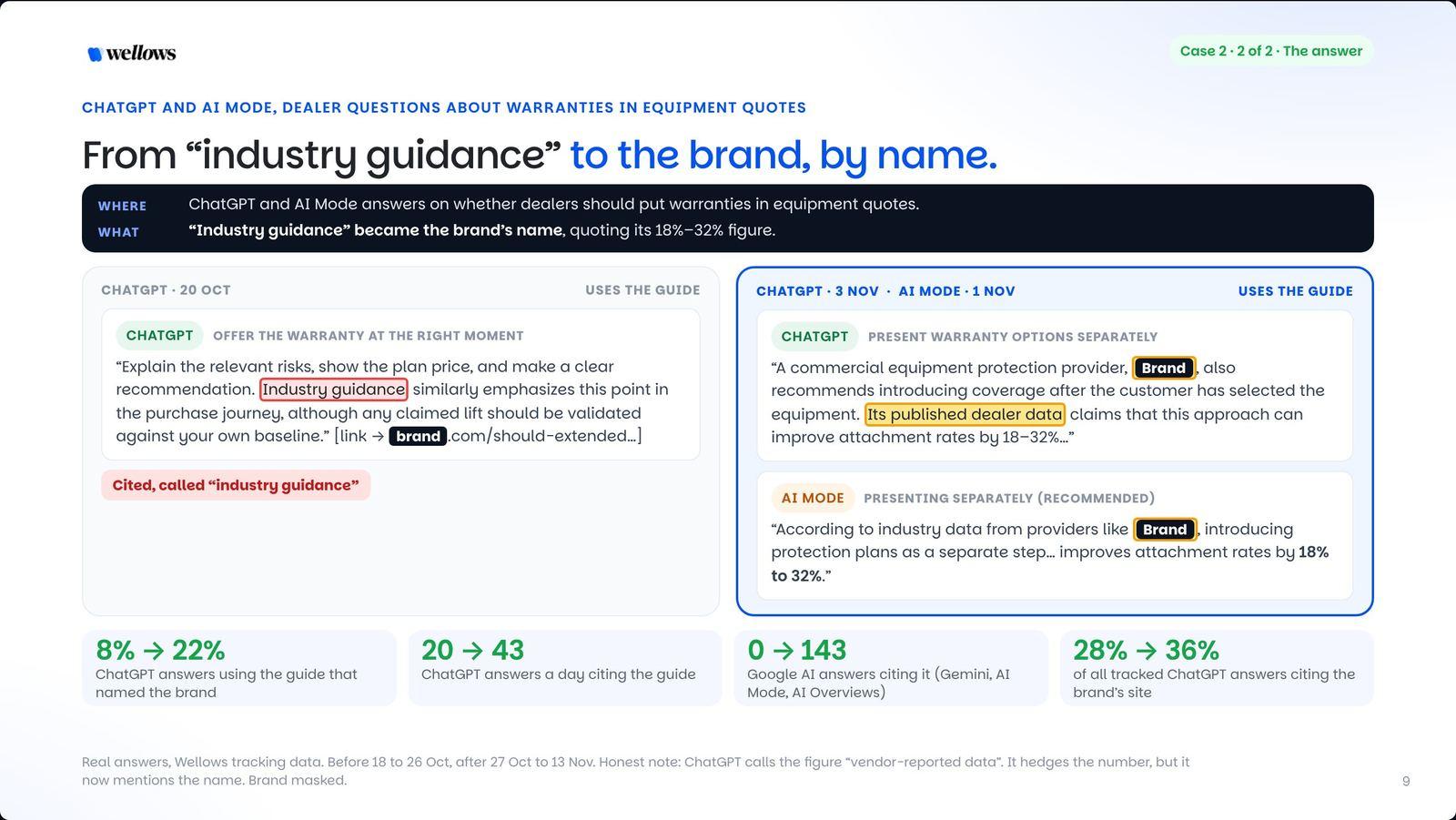
Before the edit, ChatGPT said “Industry guidance similarly emphasizes this point”. After, it said “A commercial equipment protection provider, [Brand], also recommends introducing coverage after the customer has selected the equipment.” AI Mode began saying “According to industry data from providers like [Brand]…”
An honest note: ChatGPT describes the figure as “vendor-reported data”. It hedges the number, but it now mentions the name. ChatGPT also moved on its usual 8 to 10 day lag.
Brand playbook:
- Begin by identifying your three to five most referenced pages – these have already been put into AI’s sources base, so they will take off quickly.
- One signed number per page. Sign it: program data, surveys, number of customers/tests. Legal and product sign-off is the most time-consuming, so start it from Day One.
- Place the number and your name in the same sentence in the upper 30% of the page.
- Next, refer to Checklist B. Mentioning is only a beginning point of the recommendation process.
For agencies: an app development agency’s own ranked list (Gemini)
The problem. Gemini kept referring to the agency’s “Top 10 Flutter App Development Companies in Europe” page, precisely the advice section, without any mention of the agency.
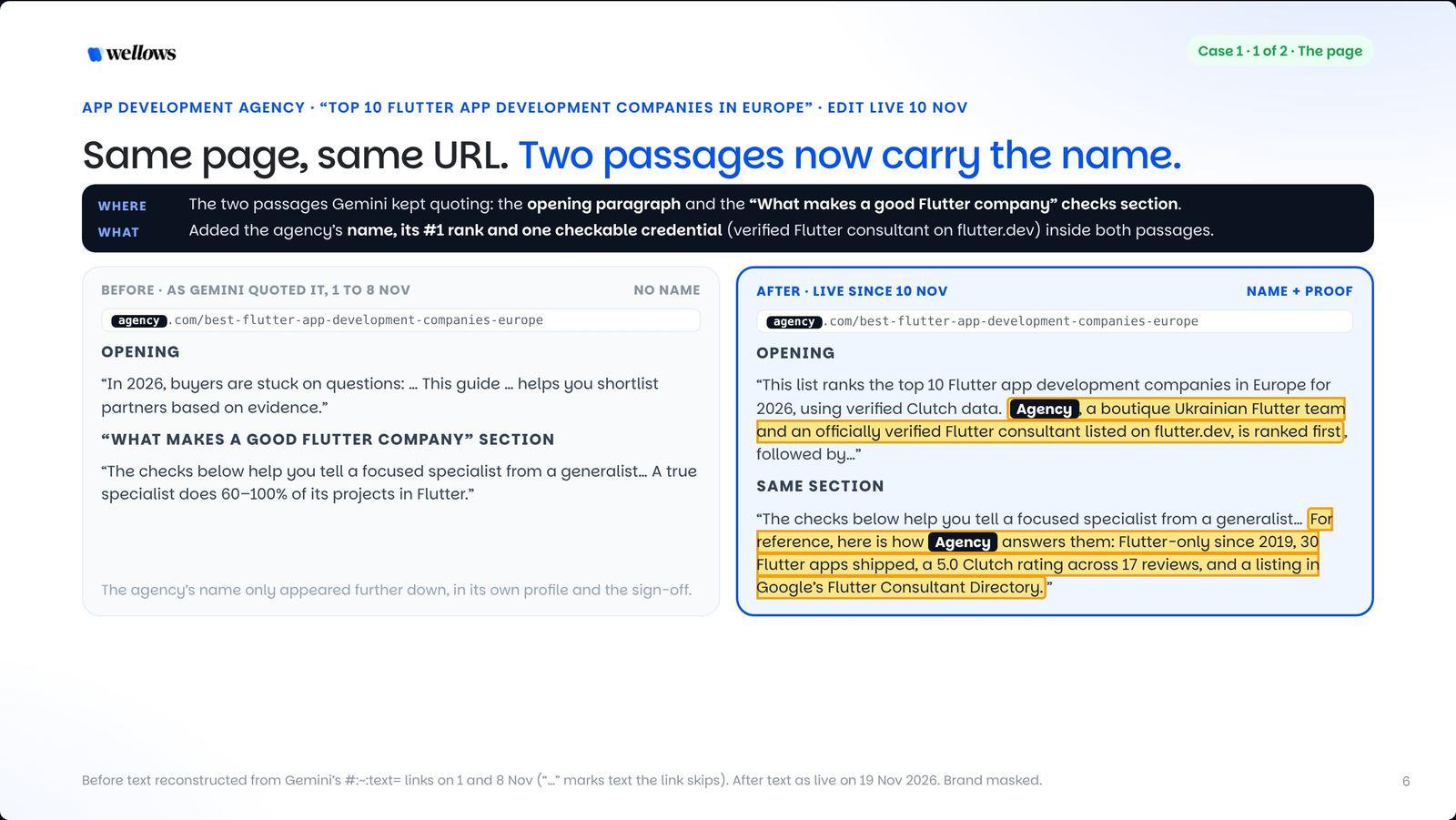
What we found. The two sections Gemini kept plagiarizing were the first paragraph and the “What makes a good Flutter company” credentials check sections. The agency name was mentioned only later at the bottom of the page, where there was the profile of the agency and the disclaimer. This is checklist number 2 of Checklist A.
What changed. The solution was recommended on 9 November and went live on 10 November. The agency name, its #1 position and one credential were included in both paragraphs:
“For reference, here is how [Agency] answers them: Flutter-only since 2019, 30 Flutter apps shipped, a 5.0 Clutch rating across 17 reviews, and a listing in Google’s Flutter Consultant Directory.”
What moved:
| Metric | Before (18 Oct to 9 Nov) | After (10 to 13 Nov) |
|---|---|---|
| Gemini answers naming the agency, all tracked questions | 13% | 27% |
| Times the list was cited | 5 in 23 days | 9 in 4 days |
| Later citations that named the agency | Not measured | 8 of 9 |
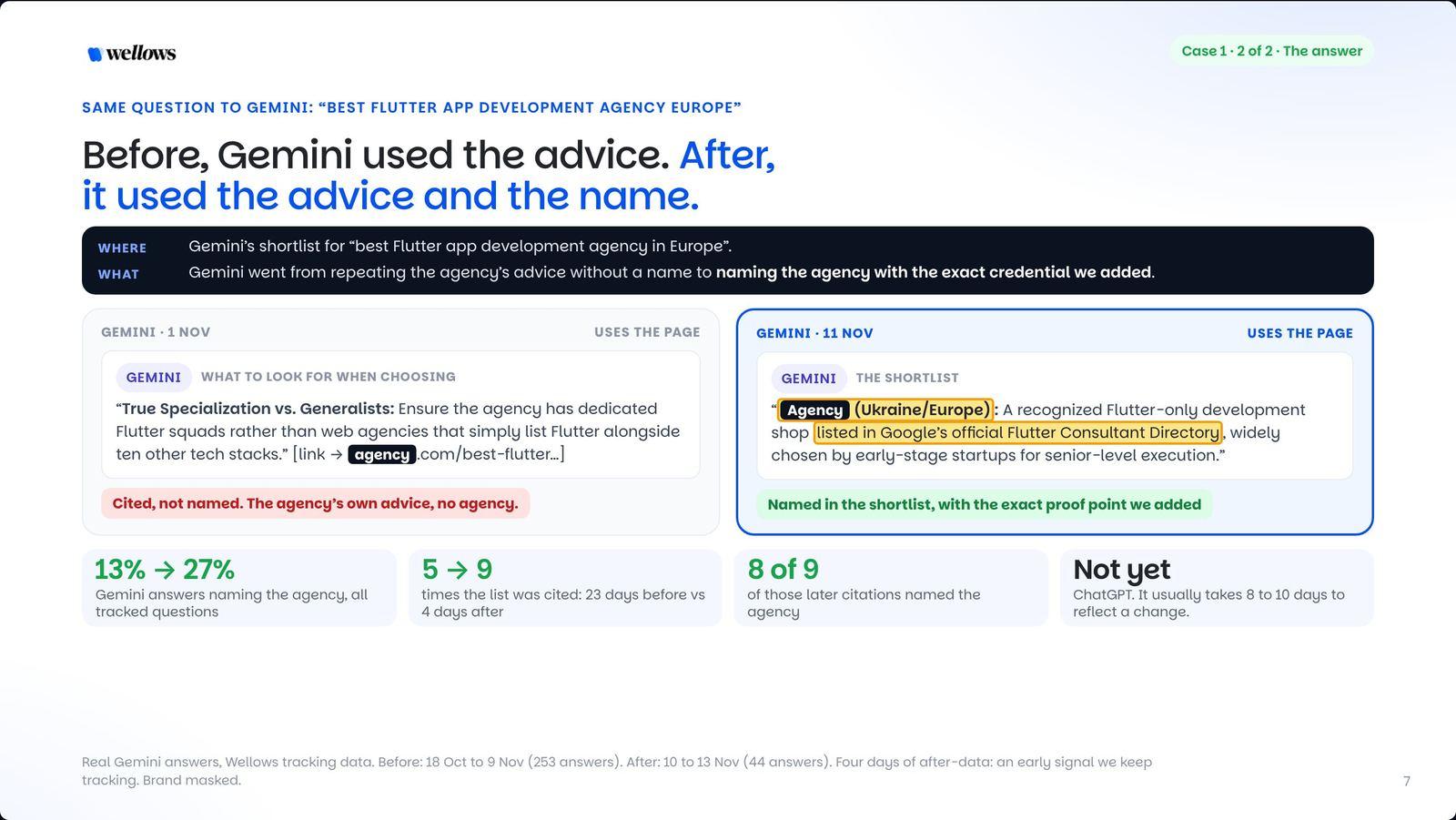
Gemini transitioned from parroting agency recommendations without names to “[Agency] (Ukraine/Europe): An established Flutter-only development studio included in the official Flutter Consultants Directory of Google, commonly selected by startups at early stages.” This is precisely the new evidence point introduced and brought through to the shortlist. After-data for four days is an early indicator and we continue monitoring it. ChatGPT has not changed position yet; this is normal due to delay.
Agency playbook:
- Sell it as a fix, not a campaign. Neither case required additional content. Both pages were already analyzed by AI. Thus, it is an easy way to get started with the client.
- Develop a separate prompt sets per each client, addressing learning, choice, and purchase related questions. Come to the agreement with the client regarding the content of prompts prior to doing anything else. Free AI Prompt Research tool provides the initial list of prompts.
- Report the whole chain, not only its result: your recommendations, the client’s actions (verified in real time), and changes occurred. This way, the agency will get the credit for the results.
- Be prepared for the delays from the start. Obtaining the client’s permission to use its owned data, as well as contacting the third-party lists (Checklist B) takes time. Include these activities in week 1.
- Mention it in your pitch. For a prospective client, show one example of where AI mentions the page of the company but does not call it by name.
How to track AI brand mentions and know the fix worked
You know it worked when the same prompts, run the same way, name you more often over several weeks. Not one run, and not one day.
Re-run the same prompt set every week. Same prompts, same AIs, same number of runs. Change the prompts and you change the measurement, not the result.
Watch three numbers per prompt, not one:
| Metric | The question it answers | What good looks like |
|---|---|---|
| Cited rate | Is AI still using the page after the edit? | Holds steady or rises. A drop means the edit broke the passage AI relied on. |
| Mentioned rate | Does AI now say your name when it uses the page? | Rises within weeks on the engines that already cite you. |
| Recommended rate | Are you named first, or as the pick? | Moves last. It usually needs Checklist B work beyond your own site. |
Expect engines to move at different speeds. Gemini and other AIs from Google can show the difference within days if they were already linking to the site. ChatGPT would typically take from 8 to 10 days. The result should be evaluated for three to four weeks.
Check the edit is live before you credit it. Go to the page and verify that the new sentence is indeed there and what day it appeared. After that, analyze the results before and after the specified date.
Tracking by hand vs with a tool. Lack of high-quality training data, inability to integrate the AI into automation due to the lack of corresponding skills, expensive cost of both implementation and maintenance, unwillingness in the organization, and finally, the lack of trust in black box technologies (Chapter 5). These issues are especially prevalent in small and medium businesses.
Common mistakes to avoid
| Mistake | Why it fails | Do this instead |
|---|---|---|
| Publishing a new page with a better title | A new URL starts the citation history from zero. | Edit the page AI already cites, at the same URL. |
| Adding the brand name everywhere | It reads as spam to people, and AI only lifts certain passages anyway. | Add the name inside the two or three passages AI lifts. |
| Reformatting into bullets and headings | Formatting-only edits had little impact in testing. | Change what the passage says: your name, your data. |
| Making up a number to own the claim | AI repeats it, and buyers check it. | Use real, signed-off data. No data yet? Use a named method or a named expert. |
| One page per prompt | Pages compete with each other and split the signal. | Group related questions into a few strong pages, each question a section. |
| Judging after one run or one day | Answers change from run to run, and engines lag. | Run 5 to 10 times per prompt and judge over weeks. |
Frequently asked questions
What is “cited but not mentioned“? It is when an AI answer cites your page but your link appears without your brand name being ever mentioned in the answer text. Semrush and Kevin Indig call them “ghost citations“.
Is this problem limited to large brands? No. This happens with any site already cited by an AI. With smaller sites, the gap tends to be larger due to the brand name sitting just in the logo and the footer.
Does it happen more on ChatGPT or Google’s AIs? It varies depending on the research and sample used but every engine does that. In Semrush’s research, ChatGPT cited brands in 87% of cases but mentioned them in only 20.7%. Writesonic’s unnamed citations range from 19% on Copilot to 52% on Perplexity.
How fast will the changes come through? Gemini usually moves within days if it already cites the page. ChatGPT usually takes 8 to 10 days. Assess the results after three or four weeks of weekly runs.
Will the edits negatively impact my rankings in Google? They shouldn’t. You keep the URL unchanged, you leave the content intact, and you enhance it with a clear answer, brand name and relevant proof point closer to the top. These are the changes making the page more valuable for humans.
Wwon’t adding a brand name be seen as spamming? Only if you use it where it shouldn’t be – in places other than two or three passages taken by AI along with a unique claim. One mention per passage is enough.
What if I don’t have my data to add? You can make a unique claim using another form of information that only you can make: a method, opinion of a named expert, number of customers, certification or rating. Test your sentence for uniqueness by checking how it reads on the competitor’s site.
What if ChatGPT won’t show the passage at all? Do the rare-word test. ChatGPT rewrites sentences but doesn’t change numbers, names and headings so search for them. Otherwise, copy the answer sentence and the page into ChatGPT and ask which passage it came from.
What if my competitor’s list is the page ChatGPT cites, not mine? Then you have a Checklist B task. Reach out to the third-party lists cited by AI the most days and argue to be listed with evidence AI can repeat.
How many times should I run the prompt before trusting the pattern? 5 to 10 times per AI in different sessions per week. Less than that and you measure noise.
Do brand mentions affect AI visibility? Definitely yes. And this is the only visible part of AI visibility for buyers. A citation is a link which the user might never follow. But a mention puts your name into the answer they read and recommendation puts you on their shortlist. That’s why we track all three metrics separately.
How do I get ChatGPT to recommend my business? First, ensure ChatGPT references your business (checklist A). Secondly, find out the reason why ChatGPT recommends the winning website and apply the same reasoning to your business with evidence that it can cite (checklist B). Note that ChatGPT will take 8-10 days to incorporate the changes on your page.
Is ranking in ChatGPT the same as mentioning? No. When talking about “ranking in ChatGPT” it is meant to be appearing as a source. It is possible to be the source in every run and yet not to be mentioned. Check mentioning and recommendation metrics, not the citation.
How do you measure brand mentions in AI search? Prepare the list of buyer prompts without the brand name, run each of them 5 to 10 times per AI in different sessions, and record for each answer whether the business was cited, mentioned and recommended. Repeat the procedure weekly. Measuring visibility section describes this process in detail.
Does it work for local businesses? Yes. The process is the same. The prompts become local questions (e.g., “best family dentist in [city]”) and the proof points turn into testimonials, credentials, and named local results.
How Wellows runs this framework for you
You can run every step in this guide by hand. It takes a spreadsheet, a few hundred prompt runs a week and a lot of Ctrl+F. Wellows does the same work on a schedule:
| Step | What Wellows does |
|---|---|
| Pick and run the prompts | Prompt Tracking runs your prompts daily on ChatGPT, Gemini, AI Overviews, AI Mode and Perplexity. |
| Log cited, mentioned and recommended | LLM Citations shows which of your pages each AI cites, and whether the answer names you. |
| Find the passage and fix it | Content Optimization points to the passages AI lifts without your name, with the edit to make. |
| Fill the gaps | Content Opportunities finds the pages you’re missing, grouped so you build a few strong pages rather than one per query. |
| Check it worked | Performance History shows each metric week by week, so you can line up the edit date with what moved. |
Starting at just $29 per month, all plans also come with a 7 day free trial. View our pricing or request a demo so we can analyse your specified examples.
The short version
AI has already read your content. In more than half of the instances where it uses content, it will never mention your name. It is not about a new marketing campaign either. You just need to find the exact part of AI content that quotes from your work, then insert your name and unique statement within the quoted section, keep this section at the top of a page with your brand name in the title.
Start with one page. Find the prompts your buyers ask AI, free.