AI powered influencer outreach strategies are rapidly redefining how brands discover creators, personalize engagement, and measure real ROI. As influencer ecosystems become more crowded and competitive, manual outreach no longer scales. AI now drives smarter influencer discovery, predictive audience matching, and data-backed personalization, making outreach faster, more relevant, and measurably more effective.
This shift is accelerating as marketing teams adopt automation and intelligence across the funnel. 63% of marketers plan to use AI in influencer marketing, signaling a clear move toward AI-first workflows (InBeat). At the same time, visibility in AI brand visibility in generative search is increasingly shaping which creators, brands, and narratives gain authority online.
In this guide, we break down what effective AI powered influencer outreach strategies look like in 2026, from discovery and vetting to personalization, automation, and ethical safeguards. You’ll learn how AI tools are transforming outreach workflows, where human judgment still matters most, and how to build scalable influencer programs designed for long-term credibility and performance.
TL;DR
- AI powered influencer outreach strategies replace manual discovery with data-driven creator selection, personalization, and performance forecasting.
- AI helps brands identify the right influencers faster using audience relevance, credibility, and engagement quality, not just follower count.
- Modern influencer outreach relies on automation for scale, while keeping it human with AI-assisted personalization.
- AI tools can predict campaign ROI, flag potential fraud, and optimize partnerships in near real time.
- Influencers and personal brands can boost visibility by structuring profiles for AI systems like ChatGPT to recognize expertise and authority.
- Winning in 2026 means combining human creativity with AI intelligence, while staying ethical, transparent, and trust-first.
How AI Is Reshaping Influencer Marketing and Outreach
AI powered influencer outreach strategies are fundamentally changing how brands plan, execute, and scale influencer marketing.
What was once a relationship-heavy, manual process is now increasingly driven by data, automation, and predictive intelligence. AI influencer marketing enables teams to move beyond follower counts and surface-level engagement, focusing instead on relevance, credibility, and measurable impact across channels. This shift allows brands to run larger, more precise outreach programs while maintaining personalization and performance accountability.
AI analyzes audience overlap, content themes, and engagement quality to identify creators who align with brand values and campaign goals.
Machine learning models surface high-probability partnerships based on historical performance, sentiment, and topical relevance.
AI tools generate context-aware outreach messaging that reflects an influencer’s content style, audience, and past collaborations.
Campaign outcomes can be forecast before launch, helping marketers allocate budgets more efficiently.
AI continuously evaluates engagement signals and adjusts targeting, timing, and creative direction mid-campaign.
Understanding how creators shape brand perception across platforms, supported by techniques like AI brand sentiment tracking, helps reduce reputational risk.
Automation streamlines repetitive tasks such as shortlisting, follow-ups, and reporting, freeing teams to focus on strategy and relationships.
Strategic shift: AI does not replace relationships in influencer marketing, it removes friction so brands can invest more deeply in the partnerships that actually matter.
Core AI Capabilities Powering Modern Influencer Campaigns
Modern influencer marketing is no longer powered by intuition alone. AI powered influencer outreach strategies rely on a stack of intelligent capabilities that transform how creators are discovered, evaluated, and optimized at scale.
AI models analyze large creator datasets to identify influencers based on audience relevance, engagement patterns, and topical alignment rather than surface-level metrics.
Historical performance data is used to forecast reach, engagement, and conversion likelihood before partnerships are finalized.
NLP evaluates influencer content tone, themes, and consistency to ensure brand-safe alignment and authentic messaging.
AI powered influencer outreach strategies rely on automation to streamline shortlisting, outreach sequencing, follow-ups, and reporting at scale.
AI examines audience demographics, interests, and behavior to validate whether an influencer truly reaches the intended market.
Advanced models detect fake followers, engagement inflation, and suspicious activity that can undermine campaign ROI.
Live data feeds allow AI systems to adjust targeting, content timing, or influencer mix as campaigns unfold.
AI consolidates insights from social platforms, content channels, and web signals to provide a unified performance view.
Key insight: The real power of AI in influencer marketing comes from combining these capabilities into a single system, one that continuously learns, adapts, and improves outcomes over time.
Traditional Influencer Outreach vs AI Powered Influencer Outreach Strategies
This comparison highlights how AI powered influencer outreach strategies fundamentally change discovery, execution, and optimization, moving brands from manual guesswork to scalable, insight-led partnerships.
| Traditional Influencer Outreach | AI Powered Influencer Outreach Strategies |
|---|---|
| Manual influencer discovery based on follower counts and surface-level metrics | Data-driven discovery using audience relevance, topical authority, and engagement quality |
| Spreadsheet-based tracking and one-off outreach efforts | Automated workflows that scale outreach, follow-ups, and performance tracking. Tools that help teams automate seo outreach are essential to move beyond manual execution and maintain consistent engagement across influencer cohorts. |
| Generic messaging with limited personalization | AI-assisted personalization based on content themes, audience behavior, and brand fit |
| Reactive optimization after campaigns end | Predictive analytics and real-time adjustments during active campaigns |
| High risk of influencer fraud and mismatched audiences | Built-in fraud detection and audience authenticity analysis |
Traditional influencer outreach relies heavily on manual research, intuition, and static reporting, which limits scale and increases the risk of partnering with creators who look influential on paper but fail to deliver measurable impact. As platforms and audiences fragment, these approaches struggle to keep pace with performance expectations and ROI accountability.
Why this shift matters: AI powered influencer outreach strategies replace guesswork with structured intelligence, enabling brands to act on evidence, not assumptions.
By combining automation, predictive modeling, and cross-platform signals, brands can prioritize influencers who consistently shape perception and drive outcomes. This shift mirrors broader changes in digital visibility, similar to the Google rankings and AI citations gap, where surface-level metrics no longer reflect true influence.
The result is a mindset shift from manual outreach execution to scalable, insight-led relationship building, where influence is measured by impact, not appearances.
End-to-End Workflow for AI Powered Influencer Outreach Strategies
AI powered influencer outreach strategies work best when executed as a connected system, not a collection of one-off tactics. The workflow below outlines how leading teams operationalize AI from planning through long-term scale.
- Define campaign objectives and success metrics: Start by clarifying what success looks like, brand awareness, conversions, content creation, or authority building. AI systems perform best when goals are explicit, measurable, and aligned with downstream attribution models.
- Map audience segments and intent signals: Use AI to analyze audience behavior, platform preferences, and topical interests. This step ensures influencer selection is driven by relevance and audience overlap rather than vanity metrics alone.
- Discover influencers using AI-assisted research: Apply machine learning models to surface influencers based on content themes, engagement quality, historical performance, and niche authority. This replaces manual discovery with scalable precision.
- Vet influencers for authenticity and fit: AI evaluates engagement patterns, follower authenticity, sentiment alignment, and past brand collaborations to reduce fraud risk and mismatched partnerships.
- Segment influencers by role and impact: Group creators into tiers such as awareness drivers, conversion-focused partners, or long-term advocates. This segmentation informs outreach tone, compensation models, and content expectations.
- Generate personalized outreach frameworks: AI tools help draft outreach angles informed by each influencer’s content style, audience interests, and past collaborations, while leaving room for human refinement to preserve authenticity.
- Activate campaigns with workflow automation: Automate scheduling, follow-ups, approvals, and asset tracking to minimize manual effort and ensure consistent execution across influencer cohorts.
- Monitor performance and narrative impact: Track engagement, content resonance, audience sentiment, and brand lift in near real time. AI highlights patterns that indicate which creators are shaping perception most effectively.
- Optimize, scale, and retain top performers: Use predictive insights to double down on high-performing influencers, refine messaging, and transition successful partnerships into long-term relationships.
Why this workflow scales: When executed correctly, AI powered influencer outreach strategies transform influencer marketing from a manual, campaign-by-campaign effort into a repeatable growth system.
The workflow emphasizes intelligence, adaptability, and measurable impact, allowing brands to scale influence without sacrificing relevance, authenticity, or trust.
AI Powered Influencer Discovery and Vetting at Scale
Scaling influencer programs without sacrificing trust requires more than faster discovery. AI powered influencer outreach strategies bring rigor, consistency, and risk reduction to how creators are identified and vetted.
How AI evaluates influencers beyond surface-level metrics
- Topic and niche alignment: AI systems analyze an influencer’s historical content to determine whether their primary themes, language, and expertise consistently align with your brand’s category and campaign goals.
- Audience quality and relevance: Instead of focusing only on follower count, AI evaluates audience demographics, interest clusters, and engagement authenticity to ensure real reach among the right users.
- Engagement pattern analysis: Machine learning models detect unnatural spikes, repetitive comments, or engagement pods, helping filter out inflated or manipulated profiles.
- Sentiment and tone assessment: Natural language processing reviews captions, comments, and community interactions to assess whether an influencer’s tone matches your brand values.
- Brand safety screening: AI flags controversial topics, risky associations, or inconsistent messaging that could create reputational risk post-collaboration.
- Historical collaboration performance: Past brand partnerships are analyzed for engagement lift, audience response, and content longevity to predict future effectiveness.
- Authority and credibility signals: AI identifies whether an influencer is referenced, quoted, or engaged with as a subject-matter voice within their niche ecosystem.
Why this matters: AI influencer discovery replaces manual spreadsheets and subjective judgment with scalable, data-backed vetting, allowing brands to grow programs without increasing risk.
By evaluating authenticity, relevance, and credibility in parallel, brands can confidently shortlist influencers who not only reach audiences, but also influence trust and perception. This systematic approach reduces risk, improves campaign ROI, and enables influencer programs to scale without sacrificing quality or alignment.
How AI Evaluates Influencer Credibility and Authenticity
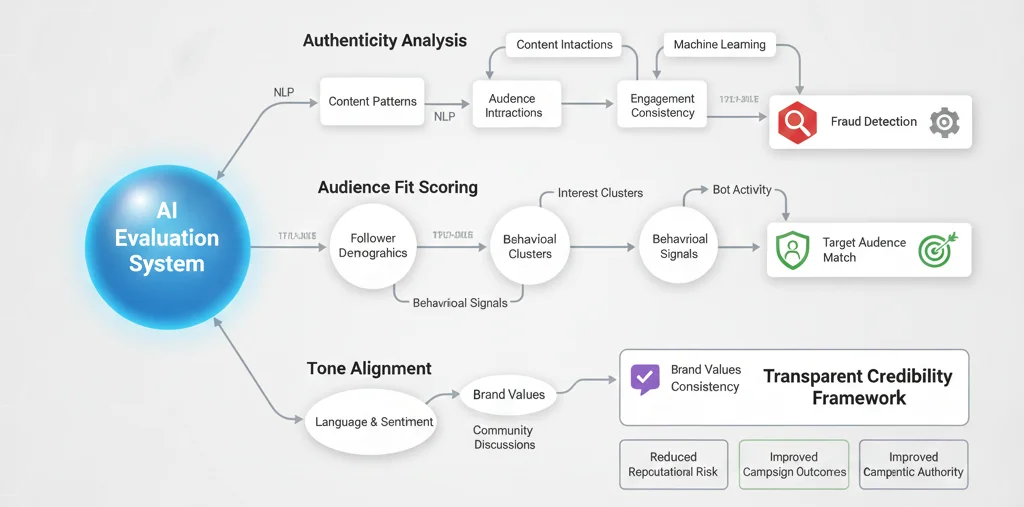
AI evaluates influencer authenticity by moving beyond surface-level metrics like follower count and post frequency. Using machine learning and natural language processing, systems analyze long-term content patterns, audience interactions, and engagement consistency to determine whether influence is earned or artificially inflated. Signals such as repetitive comments, sudden follower spikes, or engagement anomalies help identify fraud, bot activity, and coordinated amplification tactics that undermine credibility.
Audience fit is another critical factor in AI credibility scoring. Algorithms assess whether an influencer’s followers genuinely match the brand’s target demographic by examining interest clusters, behavioral signals, and historical engagement depth. This ensures partnerships reach relevant audiences rather than broad but misaligned ones. AI also evaluates tone alignment by analyzing language, sentiment, and communication style across captions, replies, and community discussions to confirm consistency with brand values.
Together, these layers form a transparent credibility framework. Instead of relying on subjective judgments, brands gain a data-backed understanding of influencer trustworthiness, relevance, and long-term impact. This approach reduces reputational risk, improves campaign outcomes, and ensures influencer collaborations are built on authentic authority rather than vanity metrics.
How Influencers and Personal Brands Can Optimize Profiles for ChatGPT Visibility
As generative AI tools like ChatGPT increasingly shape how people discover experts, influencers and personal brands face a new visibility challenge that goes far beyond followers and rankings.
Visibility is no longer driven only by social reach or search rankings. Instead, AI models reference sources they consider authoritative, consistent, and trustworthy across the web. If your profile, content, or expertise is fragmented or unclear, you may never surface as an expert, no matter how strong your following is.
The solution lies in deliberate AI authority building. ChatGPT and similar systems favor creators who demonstrate topical focus, consistent messaging, and external validation across multiple credible platforms. Profiles that clearly communicate expertise, publish original insights, and are cited or mentioned by trusted sources are far more likely to be recognized as a trusted source in AI search. This means optimizing not just one profile, but your entire digital footprint with AI credibility in mind.
How influencers can increase ChatGPT visibility and AI credibility
- Define a clear expertise niche: Focus your bio, content, and messaging around one or two core topics rather than broad, generic positioning.
- Publish authoritative long-form content: Articles, guides, interviews, or research pieces signal depth and are more likely to be referenced by AI systems.
- Maintain consistent profiles across platforms: Align your bios, titles, and descriptions on LinkedIn, personal sites, podcasts, and publications.
- Earn third-party mentions: Guest posts, interviews, citations, and brand mentions reinforce external validation and authority.
- Use clear, factual language: AI models favor declarative, well-structured statements over vague or promotional copy.
- Demonstrate ongoing relevance: Regular updates, fresh insights, and timely commentary improve recency signals.
- Build contextual credibility: Link your expertise to real-world outcomes, case studies, or documented experience.
AI-first mindset: By treating influencer personal branding as an AI credibility exercise, not just a social growth tactic, you increase the likelihood of being referenced, recommended, and trusted by conversational AI systems shaping discovery in 2026 and beyond.
Content Strategy and Personalization Powered by AI
AI has fundamentally changed how brands approach content strategy and outreach personalization in influencer marketing. Instead of relying on generic briefs or one-size-fits-all messaging, AI content strategy enables brands to analyze audience behavior, creator tone, platform context, and historical performance to tailor content at scale. This shift allows marketers to align brand narratives with the unique voice and audience expectations of each influencer, without sacrificing consistency or efficiency.
At the outreach level, AI-powered personalization moves beyond simple name insertion. Modern systems can evaluate an influencer’s past collaborations, content themes, posting cadence, and engagement patterns to inform highly relevant outreach angles. This means brands can reference specific creator interests, recent posts, or audience needs in a way that feels authentic rather than automated. The result is higher response rates, stronger relationships, and collaborations that feel mutually beneficial rather than transactional.
From a campaign execution perspective, AI also supports adaptive content planning. Performance signals, such as engagement velocity, sentiment shifts, or audience feedback, can be analyzed in near real time to refine messaging, formats, and creative direction mid-campaign. This continuous feedback loop allows brands to test variations, double down on high-performing narratives, and course-correct underperforming content quickly. When used thoughtfully, AI-powered outreach personalization enhances creativity rather than replacing it, enabling influencer campaigns that scale efficiently while still feeling human, relevant, and credible to audiences.
Campaign Automation and Performance Optimization with AI
AI campaign automation has become essential for managing influencer programs at scale, without increasing operational complexity or losing creative control.
Instead of manually tracking emails, deliverables, timelines, and results across multiple creators and platforms, AI-driven systems centralize campaign execution and performance monitoring. This allows teams to focus on strategy and relationship building while repetitive coordination and analysis tasks run in the background.
From an analytics standpoint, AI enables deeper insight into influencer performance beyond surface-level metrics. Influencer analytics powered by machine learning evaluate engagement quality, audience response patterns, sentiment shifts, and content resonance over time. These systems help brands identify which creators consistently drive meaningful outcomes, such as trust, consideration, or conversions, rather than relying solely on vanity metrics like follower count or impressions.
AI also improves optimization during live campaigns. By analyzing real-time signals, brands can refine messaging, creative formats, and influencer activation strategies before campaigns end. This transforms influencer outreach from a static, set-and-forget initiative into a dynamic performance channel that improves with every iteration.
How AI Automates and Optimizes Influencer Campaigns
- Automated performance tracking: Collect engagement, sentiment, and audience interaction data across platforms in one centralized system.
- Predictive optimization: Identify early indicators of high- or low-performing influencer content and adjust strategy before campaigns end.
- Workflow efficiency: Reduce manual reporting, follow-ups, and data consolidation through automated pipelines.
- Cross-campaign benchmarking: Compare influencer results across campaigns to inform smarter future outreach decisions.
- Continuous learning loops: Feed performance insights back into planning to improve influencer selection and content direction over time.
Why this matters: By combining automation with intelligent optimization, AI-powered influencer campaigns become more measurable, adaptable, and cost-effective, turning influencer marketing into a scalable, performance-driven growth channel.
Recommended AI-Powered Influencer Marketing Tools & Platforms (2026)
Choosing the right AI-powered influencer marketing tools is the difference between running outreach on intuition and running it on intelligence. In 2026, leading platforms don’t just help brands find influencers, they help predict performance, validate credibility, automate execution, and measure real impact.
Below is a curated overview of the most effective AI-powered influencer marketing platforms brands use today for discovery, audience intelligence, outreach workflows, content performance, and campaign analytics.
| Platform | Primary Strength | Best For |
|---|---|---|
| Upfluence | AI-driven influencer discovery, audience filtering, and creator CRM | Brands managing large influencer programs with long-term relationship tracking |
| InfluencerMarketing.AI (IMAI) | Predictive analytics, campaign outcome forecasting, and brand safety scoring | Performance-focused teams prioritizing ROI and pre-launch insights |
| HypeAuditor | Audience quality analysis, fraud detection, and pricing intelligence | Brands that need high-confidence creator vetting and authenticity validation |
| Modash | Deep audience analytics and large-scale influencer vetting | Data-driven marketers sourcing creators across global markets |
| Creator.co | End-to-end influencer workflows with AI-assisted discovery | Agencies and mid-sized brands running multiple concurrent campaigns |
| Insense | UGC-focused creator sourcing and content collaboration workflows | Brands scaling influencer-generated content for paid and organic distribution |
| Sprout Social Influencer Marketing | Influencer discovery and analytics integrated with social media management | Teams aligning influencer strategy with broader social performance efforts |
How to choose: No single platform does everything best. High-performing teams often pair one outreach or CRM-focused tool with one deep analytics or verification platform, depending on whether scale, authenticity, content velocity, or ROI measurement is the primary goal.
As influencer marketing becomes increasingly AI-mediated, competitive advantage comes from selecting platforms that align with campaign objectives and integrating them into a repeatable, intelligence-driven outreach system.
Ethical, Privacy, and Trust Considerations in AI Influencer Outreach
As brands adopt AI powered influencer outreach strategies at scale, ethical use becomes a non-negotiable requirement. AI can accelerate discovery, personalization, and performance analysis, but without safeguards, it can also introduce risks around transparency, consent, and brand trust. Responsible AI usage ensures that automation strengthens relationships rather than undermining credibility with creators and audiences.
One of the primary concerns is influencer transparency. Automated outreach that feels generic, deceptive, or overly invasive can damage long-term relationships. Influencers increasingly expect clarity around why they were selected, how their data was analyzed, and whether AI played a role in outreach or evaluation. Brands that clearly communicate intent and maintain human oversight tend to see higher response rates and stronger partnerships.
Data privacy is another critical factor. AI systems often rely on social, behavioral, and performance data to evaluate influencers. Brands must ensure that data collection aligns with platform policies and regional regulations, and that personal data is handled securely and proportionately. Over-collection or misuse of data can expose brands to compliance risks and reputational harm.
Finally, bias and authenticity risks must be addressed. Poorly trained AI models may favor certain demographics, content styles, or engagement patterns, unintentionally excluding diverse voices. To preserve trust, brands should regularly audit AI outputs, balance automation with human judgment, and prioritize ethical guidelines that align with brand values. When applied responsibly, AI enhances influencer outreach without compromising integrity or trust.
Emerging Trends Shaping AI Powered Influencer Outreach Strategies
AI powered influencer outreach strategies are evolving rapidly as platforms, creators, and audiences adapt to automation, generative AI, and shifting trust dynamics. These trends define how brands future-proof influencer programs in 2026 and beyond.
The following developments are reshaping how brands discover creators, build relationships, and measure influence in an AI-first marketing environment:
Key Trends to Watch in 2026
- AI agents managing end-to-end outreach workflows: Autonomous AI agents are beginning to handle discovery, prioritization, timing, and follow-ups, reducing manual effort while preserving human review checkpoints.
- Rise of nano- and micro-influencer intelligence: AI increasingly favors smaller creators with high trust, relevance, and engagement quality over inflated follower counts.
- Hyper-personalized outreach at scale: Outreach messages are now tailored using content history, audience tone, and creator context, improving response rates without sounding automated.
- AI-driven authenticity and fraud detection: Advanced models analyze engagement patterns, comment quality, and audience composition to flag fake followers and synthetic engagement early.
- Influencer authority signals in AI search: Influencers increasingly act as knowledge entities, with AI systems referencing credible creators in answer engines and generative search results.
- Virtual and AI-generated influencers: Brands are experimenting with virtual personas for controlled storytelling, while audiences demand higher transparency around synthetic creators.
- Sentiment-led creator selection: AI sentiment analysis helps brands avoid reputational risks by evaluating creator tone, past controversies, and audience perception before outreach.
- Performance prediction before campaigns launch: Predictive models estimate reach, conversions, and ROI before contracts are signed, improving budget efficiency.
- Ethical AI as a differentiator: Brands emphasizing transparency, consent, and fairness in AI powered influencer outreach strategies gain long-term trust with both creators and audiences.
Looking ahead: The most resilient influencer programs will be those that balance automation with accountability, using AI to scale intelligence, not replace relationships.
Case Study Snapshot: Virtual Influencers and AI-Led Campaigns
One of the most cited examples of a successful virtual influencer is Lil Miquela, a computer-generated persona created by Brud that has collaborated with global brands such as Prada, Calvin Klein, and Samsung. Designed using a mix of AI, CGI, and human creative direction, Lil Miquela demonstrates how virtual influencers can drive engagement without the unpredictability of human creators.
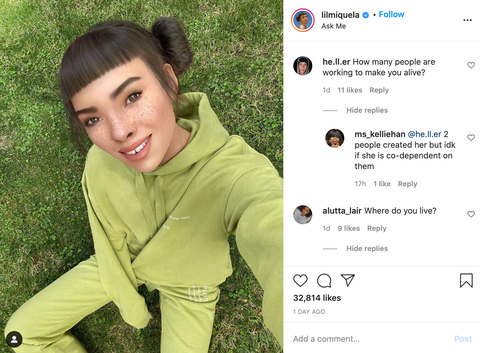
AI-led campaigns around virtual influencers rely on data-driven audience modeling, sentiment testing, and content optimization before launch. Brands can simulate messaging, predict engagement, and maintain complete control over tone, values, and timing. According to reporting by Influencer Marketing Hub, virtual influencers often achieve engagement rates comparable to or higher than mid-tier human influencers while reducing brand risk and coordination costs.
This case highlights how AI campaign examples are expanding beyond automation into creator identity itself, reshaping how brands experiment with influence in controlled, scalable ways. (Influencer Marketing Hub – Virtual Influencers)
FAQs
AI powered influencer outreach strategies use artificial intelligence to identify, evaluate, and prioritize influencers, automate personalization, and optimize campaign performance based on data rather than manual guesswork.
No. AI supports decision-making by surfacing insights and patterns, while humans still define brand voice, partnerships, and final outreach choices.
Yes. AI tools help smaller teams scale outreach, find niche creators, and personalize communication without large budgets or dedicated influencer teams.
AI analyzes audience quality, engagement patterns, and sentiment signals to reduce fraud and ensure influencers align with brand values and audience expectations.
When implemented responsibly, these strategies rely on publicly available data and compliant tools, making transparency and consent critical to ethical execution.
Conclusion
AI powered influencer outreach strategies have fundamentally changed how brands discover creators, personalize engagement, and measure real impact. By combining data-driven discovery, authenticity checks, automation, and performance optimization, teams can move beyond vanity metrics and build influencer programs rooted in trust, relevance, and long-term value. The most effective strategies treat AI as an intelligence layer, enhancing human judgment rather than replacing it, so outreach remains authentic while operating at scale.
As influencer marketing continues to intersect with AI search, brand authority, and digital reputation, AI powered influencer outreach strategies will increasingly determine which voices shape perception and influence buying decisions. Brands that invest early in ethical AI use, smart tooling, and continuous visibility monitoring, supported by platforms like Wellows that surface implicit and explicit brand opportunity signals, will be best positioned to build sustainable influence in an AI-driven marketing ecosystem.