SEO keyword tracking has long been the backbone of search performance measurement, helping teams monitor rankings across the SERP and adjust strategy over time. Today, that foundation is expanding. With AI Overviews, Perplexity, and zero-click answers reshaping discovery, SEO keyword tracking now extends beyond positions into how, where, and whether brands are surfaced or cited by AI systems. Community discussions on Reddit and Quora consistently highlight this shift, with over 65% of SEO professionals still relying on tools like SEMrush, Ahrefs, or Google Search Console for rank monitoring, even as expectations evolve (Reddit, Quora).
The challenge is that traditional timelines and benchmarks no longer tell the full story. Rankings may move slowly, fluctuate by intent, or fail to translate into visibility inside AI-generated answers, which is why understanding how long does it take to rank your website on Google is only part of setting realistic expectations. Modern SEO keyword tracking must account for both classic rank movement and emerging AI search visibility, where citation and inclusion often matter more than clicks.
At Wellows, we approach SEO keyword tracking as an AI-first visibility layer that complements traditional rank monitoring by revealing how brands appear in AI-driven search experiences across systems such as Google AI Overviews and Perplexity.
TL;DR
- SEO keyword tracking has evolved beyond monitoring Google rankings to include AI answers, citations, and zero-click visibility.
- Modern tracking must cover both traditional SERPs and AI platforms like ChatGPT, Google AI Overviews, and Perplexity.
- Ranking position alone no longer reflects true search visibility or brand influence in AI-driven results.
- Tools that track keyword performance, intent shifts, and AI citations provide a clearer picture of real discovery.
- Combining Google Search Console with AI visibility platforms like Wellows creates a more complete visibility framework for 2026.
What is SEO Keyword Tracking and Why Does It Matter in 2026?
SEO keyword tracking is the practice of monitoring how your pages perform for specific search queries over time, typically by observing keyword ranking positions, SERP features, and overall search engine visibility.
Historically, this meant tracking whether a page moved up or down in Google results and correlating those movements with traffic and conversions. For years, this model was enough to explain performance and guide optimization decisions.
In 2026, the role of SEO keyword tracking has expanded significantly. Search is no longer limited to ten blue links. AI overviews, featured snippets, and answer engines now mediate discovery, often resolving queries without a click. As a result, brands can hold stable keyword rankings and still lose visibility if their content is not selected, summarized, or cited by AI systems. This gap explains why websites are ignored by AI search, even when traditional SEO signals appear healthy.
To ground that shift in a clear framework, AI SEO explains how visibility is earned through citation-worthiness and answer extraction, not only rank position.
Key shift: Ranking stability no longer guarantees visibility. Influence now depends on whether content is reused inside AI-generated answers.
Modern SEO keyword tracking, therefore, combines rank monitoring with visibility diagnostics. It looks at where content appears across SERP features, whether it contributes to AI-generated answers, and how consistently it is associated with relevant topics. Keyword ranking alone shows position, but not influence. Search engine visibility now includes presence in summaries, answers, and contextual references that never send a visit.
Platforms like Wellows address this shift by complementing traditional keyword rank tracking with monitoring of AI mentions and citations across emerging search surfaces. A modern SEO keyword tracking tool shows where pages rank, while AI visibility platforms help teams understand whether their content is actually being referenced, summarized, and trusted within AI-driven search environments.
Did you know?
Understanding Keyword Rank Tracking Basics
Keyword rank tracking measures where a webpage appears in search results for a given query at a specific moment in time.
At its core, SEO keyword tracking records ranking positions on a SERP, often segmented by device, location, or language. This data helps teams understand visibility trends, spot gains or losses, and benchmark performance against competitors.
However, keyword ranking basics have clear limits. A position alone does not explain why a page ranks or whether it satisfies user needs. Search engines increasingly evaluate intent, so two pages that rank similarly may perform very differently.
Understanding keyword intent for better SEO results is essential, since intent alignment now matters as much as position, especially across localized and AI-influenced search results.
Did you know?
Core Ranking Metrics You Should Monitor
Essential SEO & AI Visibility Metrics
- Average ranking position: Shows where your pages typically appear on the SERP over time, helping contextualize gains or declines in SEO keyword tracking.
- Keyword distribution: Tracks how many keywords rank in top 3, top 10, or top 100 positions to assess overall search visibility.
- Click-through rate (CTR): Measures how often users click on your result when it appears, revealing whether rankings translate into engagement.
- Impressions: Indicates how often your content is shown, even when no clicks occur, which is critical in zero-click environments.
- Share of voice: Compares your visibility against competitors across tracked keywords to understand relative presence.
- SERP feature presence: Identifies whether your content appears in featured snippets, People Also Ask, or other enhanced results.
- AI Overview inclusion: Tracks whether your brand or content is surfaced in AI-generated summaries, a growing visibility layer tied to brand performance metrics in AI search.
- Ranking volatility: Monitors fluctuations over time, helping distinguish normal movement from structural visibility issues.
Tracking insight: No single metric explains visibility in 2026. True SEO keyword tracking comes from observing how rankings, impressions, SERP features, and AI inclusion interact over time.
New in 2026: Track Rankings and AI Mentions Together
For years, SEO keyword tracking focused almost entirely on where pages ranked on Google or Bing. That model assumed visibility equaled clicks. In 2026, that assumption no longer holds. AI overviews, answer engines, and conversational search tools now surface answers directly, often without sending users to a website, creating a growing gap between rankings and real-world exposure.
This shift explains the widening disconnect explored in the Google rankings and LLM citations gap, where brands ranking well in SERPs still fail to appear in AI-generated responses. Answer engines like ChatGPT and Perplexity select sources based on clarity, authority, and citation-worthiness, not just keyword position, making citation monitoring a new pillar of AI search visibility.
Modern SEO keyword tracking now combines traditional rank data with AI mention and citation signals.
How to Choose the Best SEO Keyword Tracker: Key Capabilities & Features
Choosing the right SEO keyword-tracking tool in 2026 requires looking beyond basic position reports.
While keyword position still matters, modern teams need more profound insight into how visibility translates across traditional SERPs and AI-driven search environments. The best tools help you understand not only where you rank, but also whether those rankings actually contribute to search visibility, traffic, and brand authority.
A strong SEO keyword-tracking platform should offer accurate, location-aware rank tracking across Google and Bing, with the ability to segment by device, geography, and search intent. It should also surface trends over time, helping you correlate keyword movements with algorithm updates, content changes, and competitive shifts. Without historical context and reliable refresh rates, rank data quickly loses strategic value.
What separates leading tools today is AI readiness. As outlined in the Search Engine Visibility, modern rank tracking features increasingly include monitoring AI citations, answer engine mentions, and visibility within AI Overviews. Capabilities such as citation score tracking, entity-level insights, and keyword-to-answer mapping are becoming essential for teams that want to stay visible as search evolves beyond blue links.
Must-have capabilities in a modern SEO keyword tracker
- Accurate rank tracking: Accurate keyword position tracking across locations, devices, and search engines
- AI visibility indicators: AI visibility indicators such as citations, mentions, or inclusion in AI-generated answers
- Actionable reporting: Actionable reporting that ties rank changes to content, intent, and competitive context
- Scalable tracking infrastructure: Scalable tracking for growing keyword sets without data sampling or delays
Selection insight: The best SEO keyword trackers no longer just report rankings. They explain why visibility changes and whether your content is actually influencing what users see in both search engines and AI answers.
Checklist: Must-Have Rank Tracker Features for 2026
Essential capabilities for modern SEO keyword tracking
- Tracking accuracy & freshness: Reliable SEO keyword tracking accuracy with frequent refresh rates and consistent position reporting across Google and Bing.
- Search intent awareness: Intent-aware tracking that distinguishes between informational, commercial, and navigational queries, rather than treating all rankings equally.
- AI visibility signals: AI visibility signals that show whether tracked keywords contribute to AI Overviews, answer engines, or citation-based results.
- Historical performance context: Historical trend analysis to compare ranking movement over weeks and months rather than isolated daily snapshots.
- Real-world segmentation: Location and device segmentation to reflect real-world search behavior across mobile, desktop, and regional SERPs.
- Signal-focused reporting: Clear reporting and alerts that surface meaningful changes without overwhelming teams with noise.
- Audit-ready visibility data: Audit readiness so ranking data can be evaluated alongside crawlability, content structure, and AI accessibility, as outlined in the AI search visibility audit checklist.
2026 reality check: Rank trackers that stop at position data miss how discovery actually works today. The strongest tools connect rankings, intent, and AI visibility into one coherent system.
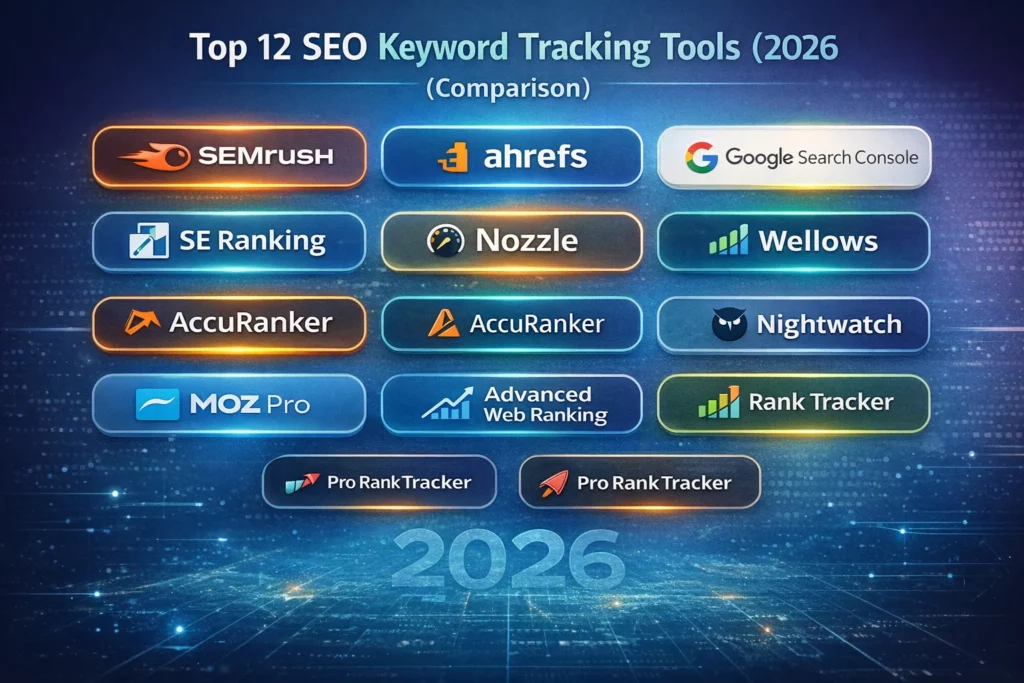
Top 12 SEO Keyword Tracking Tools (2026 Comparison)
The SEO keyword tracking landscape in 2026 spans two distinct categories: classic rank-tracking platforms and AI-era visibility systems. The tools below illustrate how tracking has expanded beyond positions into intent, SERP features, and AI inclusion.
SEMrush
SEMrush remains one of the most widely used platforms for SEO keyword tracking, offering robust rank tracking, keyword discovery, and competitive analysis across Google and Bing. It’s especially strong for teams managing large keyword sets and historical trend analysis.
Ahrefs
Ahrefs excels at providing backlink-driven insights alongside keyword ranking data. Its keyword explorer and SERP history make it valuable for competitive research, though AI visibility tracking remains limited.
Google Search Console (GSC)
Google Search Console (GSC) is the baseline for keyword performance, providing first-party data directly from Google. While essential, it lacks proactive monitoring, competitor context, and AI citation insights.
Wellows
Wellows complements traditional SEO keyword tracking tools by adding an AI-first visibility layer focused on citations, brand mentions, and AI search exposure across ChatGPT, Gemini, and Perplexity. Rather than functioning as a standalone rank tracker, it helps teams understand whether their content and brand are being surfaced, referenced, and trusted within AI-generated search results.
SE Ranking
SE Ranking offers flexible pricing and solid rank tracking for agencies and SMBs, with daily updates and client-ready reporting.
Nozzle
Nozzle focuses on granular SERP data and visual reporting, making it popular for enterprise teams that need pixel-level SERP analysis.
AccuRanker
AccuRanker specializes in fast, real-time ranking updates and is well-suited for teams that require high-frequency monitoring.
Nightwatch
Nightwatch emphasizes local and geo-specific keyword tracking, helping brands monitor rankings across regions and devices.
Moz Pro
Moz Pro combines rank tracking with broader SEO insights, including site audits and keyword difficulty metrics.
Advanced Web Ranking
Advanced Web Ranking is known for forecasting and long-term trend modeling, useful for enterprise reporting and projections.
Rank Tracker
Rank Tracker supports unlimited keyword tracking on desktop, appealing to power users and agencies managing high volumes.
Pro Rank Tracker
Pro Rank Tracker offers straightforward rank monitoring with white-label reporting, best suited for basic tracking needs.
Strategic takeaway: Together, these tools highlight the growing divide between classic ranking tools and AI-era visibility platforms, a shift best understood through the lens of Generative AI vs Google, where rankings alone no longer guarantee discovery.
Which SEO Tracker is Best for You?
Choosing the right SEO keyword tracker by team type
- Solo founders and small teams: Start with Google Search Console for baseline SEO keyword tracking, then layer in a lightweight tracker like SE Ranking as keyword volume grows.
- Content marketers and SEO specialists: SEMrush or Ahrefs work best for monitoring keyword movement, competitor shifts, and SERP volatility across multiple projects.
- Agencies managing multiple clients: Tools like Nozzle or Advanced Web Ranking provide scalable reporting, segmentation, and historical visibility insights.
- Local and multi-location businesses: Nightwatch or AccuRanker are ideal top SEO rank trackers for geo-specific and device-level keyword tracking.
- Brands investing in AI visibility: Wellows is best suited for teams that already use SEO keyword tracking tools and need deeper insight into AI citations, brand mentions, and answer engine visibility across platforms like ChatGPT, Gemini, and Perplexity.
Decision tip: The “best” SEO tracker depends on how discovery happens for your audience, traditional SERPs, local results, or AI-generated answers. Match the tool to where visibility actually matters.
Using Google Search Console and AI Tools Together
Google Search Console remains the foundation of SEO keyword tracking because it provides first-party data directly from Google, including impressions, average position, clicks, and query-level performance. It helps teams understand how pages appear across SERPs, which keywords trigger visibility, and where rankings are improving or declining. However, as search behavior shifts toward AI Overviews and answer engines, GSC alone cannot show whether your content is being cited, summarized, or referenced inside AI-generated results.
This is where pairing GSC with AI SEO tools becomes essential. Platforms that specialize in AI visibility complement traditional keyword data by revealing how brands surface in generative experiences.
For example, Google AI visibility tracking helps teams understand when their content is referenced inside AI Overviews and conversational responses.
Wellows acts as an AI visibility layer alongside Google Search Console, enriching first-party keyword performance data with insights into AI mentions, citations, and brand context. Together, this approach expands SEO keyword tracking beyond rankings alone, helping teams understand where their content performs in search and where AI systems actively reference and frame their brand.
Maximize SEO Keyword Tracking Results with Automation and GenAI Stacks
As search environments become more dynamic, effective SEO keyword tracking requires more than periodic rank checks.
Automation and GenAI stacks enable teams to scale tracking, reduce manual effort, and respond faster to changes in visibility across both traditional SERPs and AI-driven surfaces. Automated workflows help capture ranking shifts, detect emerging keywords, and surface early signals when content begins to lose relevance or gain momentum in AI-generated results.
A GenAI-powered stack connects ranking data, content performance, and AI visibility into a single feedback loop. Over time, this approach compounds results by reinforcing authority, consistency, and discoverability. When paired with strategies outlined in boost brand authority with AI in search, automation transforms SEO keyword tracking into a long-term growth system rather than a reactive reporting task.
Wellows fits into this stack as a continuous AI visibility monitoring layer, helping teams contextualize keyword performance data from search platforms alongside AI citations, brand mentions, and evolving search narratives.
How automation strengthens SEO keyword tracking
- Automated rank monitoring: Automate daily and weekly keyword rank updates to spot trends without manual checks.
- AI visibility alerts: Trigger alerts when priority keywords enter AI Overviews or drop from visibility.
- To automate this process, use the best AI visibility tools in 2026 for daily monitoring, alerts, and citation tracking across AI surfaces.
FAQs
An SEO keyword tracking tool monitors how your target keywords perform across search engines over time, showing changes in ranking positions, visibility, and performance trends. In modern search, it also helps assess how content aligns with user intent and emerging AI-driven discovery surfaces.
Keywords should be monitored on a regular cadence, weekly for most sites and daily for competitive or fast-changing niches. Frequent tracking helps teams respond quickly to ranking volatility, algorithm changes, and shifts caused by AI-generated search results.
Yes. Google Search Console provides free first-party data on keyword impressions, clicks, and average positions. However, it does not show competitor rankings or AI citation visibility, which often requires specialized tools.
Beyond traditional rankings, modern keyword tracking should include visibility across AI answers, intent alignment, SERP feature presence, and consistency of brand mentions. Tools that combine ranking data with AI visibility insights offer a more complete view of performance.
AI citations introduce a new success metric where content can influence visibility without generating a click. This means keyword performance must be evaluated not only by traffic, but also by whether content is surfaced, referenced, or summarized by AI systems.
Conclusion
SEO is no longer just about watching positions rise or fall on a rankings chart. As search behavior shifts toward AI-powered answers, zero-click experiences, and conversational discovery, brands need a broader, more adaptive way to measure visibility. The teams that succeed are those that connect ranking data with intent, content quality, and how often their expertise is surfaced or cited by modern search systems.
By combining traditional metrics with AI-driven insights, SEO keyword tracking evolves from a reporting task into a strategic advantage. When rankings, AI mentions, and automation work together, marketers gain clearer signals, faster feedback loops, and more durable authority across search surfaces. In 2026 and beyond, investing in smarter SEO keyword tracking isn’t optional, it’s how brands stay discoverable, trusted, and competitive as search continues to transform.