AI Search Visibility for Banking & Financial Services Brands has become a defining factor in how modern consumers discover and trust financial providers. Are you confident your bank or fintech brand is showing up in AI search results?
AI assistants like ChatGPT, Google’s SGE, and voice tools are now influencing how people choose financial products — often replacing traditional search. According to the ABA Banking Journal (2025), 51% of consumers now rely on AI for financial advice, a sharp increase from last year.
If your brand isn’t part of those AI-generated answers, you’re missing visibility — and potential customers. Traditional SEO tools can’t measure this new frontier of Search Engine visibility, but that’s where Wellows steps in.
With Wellows, you can monitor your brand’s mentions across ChatGPT, Gemini, Claude, and Perplexity — all from one intelligent dashboard. Track your Citation Score, compare visibility with competitors, and uncover hidden implicit mentions where your brand appears uncredited.
Instantly see how visible your brand really is in AI-generated results — and how to strengthen that visibility strategically.
Did You Know?
60% of U.S. adults now use AI-powered search to find financial information (Gregory FCA, 2025). Gartner projects that traditional search volume will drop by 25% by 2026 as users increasingly turn to AI chatbots (Search Engine Land, 2025). In finance, over half of consumers already use AI for advice. Staying visible in AI results isn’t optional anymore — it’s essential for your brand’s success.
Want to stay ahead? Discover how bank marketers, fintech SEO professionals, and financial brands can use AI visibility platforms like this to lead the way in the GenAI search era.
TL;DR
- AI is replacing traditional search for financial advice and product discovery
- AI Search Visibility = how often your brand appears/cited in ChatGPT, Gemini, Claude, Perplexity
- If you’re not in AI answers, you lose visibility even with good SEO
- Wellows tracks mentions + citations across major AI engines in one dashboard
- Biggest drivers: authority content, schema/structured data, E-E-A-T, freshness
- Finds Explicit wins (competitors cited, you missing) + Implicit wins (unlinked mentions)
- Helps turn insights into actions: content gaps, updates, PR/citation opportunities
- AI visibility needs ongoing monitoring, not a one-time optimization
What Is AI Search Visibility for Banking & Financial Services Brands?
AI Search Visibility for Banking & Financial Services Brands refers to how prominently a banking or financial brand appears within responses from AI-powered tools like ChatGPT, Claude, Google’s Gemini, and Perplexity.
As consumers increasingly rely on these platforms for financial research, comparisons, and advice, visibility in LLM-generated answers is becoming just as crucial as traditional SEO rankings — marking the rise of Generative Engine Optimization (GEO) for the financial industry (Avenuez, 2025).
This evolution aligns closely with insights from SEO and GEO integration research, showing how both approaches now work together to shape AI-driven brand discovery and strengthen overall AI Search Visibility for Banking & Financial Services Brands.
In practice, GEO means optimizing your content so AI models can easily find, interpret, and cite it when answering user queries.
For a bank or fintech company, high AI search visibility might mean your credit card offer is cited as a top recommendation in ChatGPT, or your investment product gets mentioned by Google’s AI when someone asks about “best retirement plans.” It’s the new battleground where being the trusted answer is the goal.
The Current State of AI Search Visibility in Biotech
- Market leaders dominate: Top biotech firms that embrace AI and structured content are much more visible in AI-driven search than smaller players. (Pharma-Mktg, 2025)
- Emerging brands struggle: Many smaller biotech companies have low visibility in AI responses, even when they publish scientific results, due to weaker citation networks and brand recognition. (AirOps Report, 2025)
- Video & community signals rising: Biotech brands that leverage expert videos, patient-community discussions, and forums are gaining more citations in AI surfaces, as AI systems increasingly draw on multimedia and peer insights. (Seer Interactive, 2024)
- Structured content builds advantage: Formal scientific pages, schema-tagged data, and clearly authored research outputs are more likely to be cited by AI platforms than simple marketing overviews. (CMI Media Group, 2025)
What Factors Influence a Financial Brand’s Visibility in AI Search Results?
AI search visibility is no longer driven by keywords alone — it’s shaped by how clearly and credibly a financial brand communicates trust, structure, and authority. Drawing on Wellows insights and cross-industry analysis, here are the key factors that determine AI visibility:
- Content Quality and Authority: AI models prioritize well-written, data-backed, and informative content. Financial brands that publish original insights, case studies, or trend analyses are recognized as authoritative sources.
- Structured Data and Schema: Implementing proper schema markup allows AI to easily understand content types — from interest rates and product details to FAQs. It’s the backbone of machine-readable visibility.
- Brand Mentions and Reputation: AI engines trust what trusted humans do. Frequent mentions in reputable publications like Forbes, Business Insider, or CNBC strengthen brand credibility and influence citation frequency.
- E-E-A-T (Experience, Expertise, Authoritativeness, Trustworthiness): Demonstrating expertise through author credentials, transparent sourcing, and consistent tone enhances visibility and trust in AI-generated summaries.
- Freshness and Relevance: Regular updates keep your brand top-of-mind. AI favors recent, accurate information that reflects the latest market conditions and financial regulations.
- User Experience and Accessibility: Fast-loading, mobile-optimized, and secure websites signal reliability — a factor AI uses to assess a source’s digital trustworthiness.
- Local and Voice Optimization: With the rise of voice queries and localized AI answers, structured business listings and conversational phrasing are critical for regional financial visibility.
In summary, Wellows research shows that financial brands combining clarity, credibility, and structured data achieve stronger and more consistent placements in AI-generated responses.
This aligns with findings from our AI visibility enhancement guide, which highlights how auditing LLM visibility and optimizing SERP presence can amplify these results.
Which Banking Brands Have the Highest AI Search Visibility?
Recent studies show that major banks are leading AI-generated search results. According to Knownful, JPMorgan Chase tops the list with a 67.14% AI visibility score, followed by Bank of America (62.14%), Wells Fargo (55%), and Capital One (52.86%).
In digital banking, AvenueZ notes that Chime, Revolut, and SoFi capture over 50% of AI visibility, while the top ten digital banks collectively hold 83.4%, signaling concentrated recognition among top fintech players.
The AIVO 100™ report also ranks JPMorgan Chase ninth among the most visible global brands. From a Wellows research perspective, this dominance highlights how AI visibility depends on citation consistency, structured data, and brand sentiment — not just keyword rankings. Brands with strong data quality and authority, like Chase and Revolut, are consistently favored in AI-generated answers.
How Can Banking & Financial Services Brands Use Wellows for AI-Driven Search Visibility?
Before building your AI visibility strategy, define your brand’s focus. A large bank might highlight “global commercial banking solutions,” while a FinTech Startup may focus on “low-fee mobile checking accounts for millennials.”
This approach aligns with the principles of Generative Engine Optimization (GEO) — optimizing content for how AI systems discover and present brand information. It’s also a foundational step toward improving AI search visibility for banking & financial services brands, ensuring your content is recognized in the right AI-driven contexts.
I actually ran this experiment myself while testing visibility for leading financial brands using Wellows — and the results were eye-opening.
Even a top player like JPMorgan Chase had areas where it dominated AI answers and others where it barely appeared — not because of weak brand authority, but due to how its content was structured and referenced by AI systems.
That’s when it clicked for me — visibility isn’t about appearing everywhere; it’s about showing up in the right AI answers where your audience is searching.
Each step below includes real examples using JPMorgan Chase to help you visualize the process. Here’s how to use it:
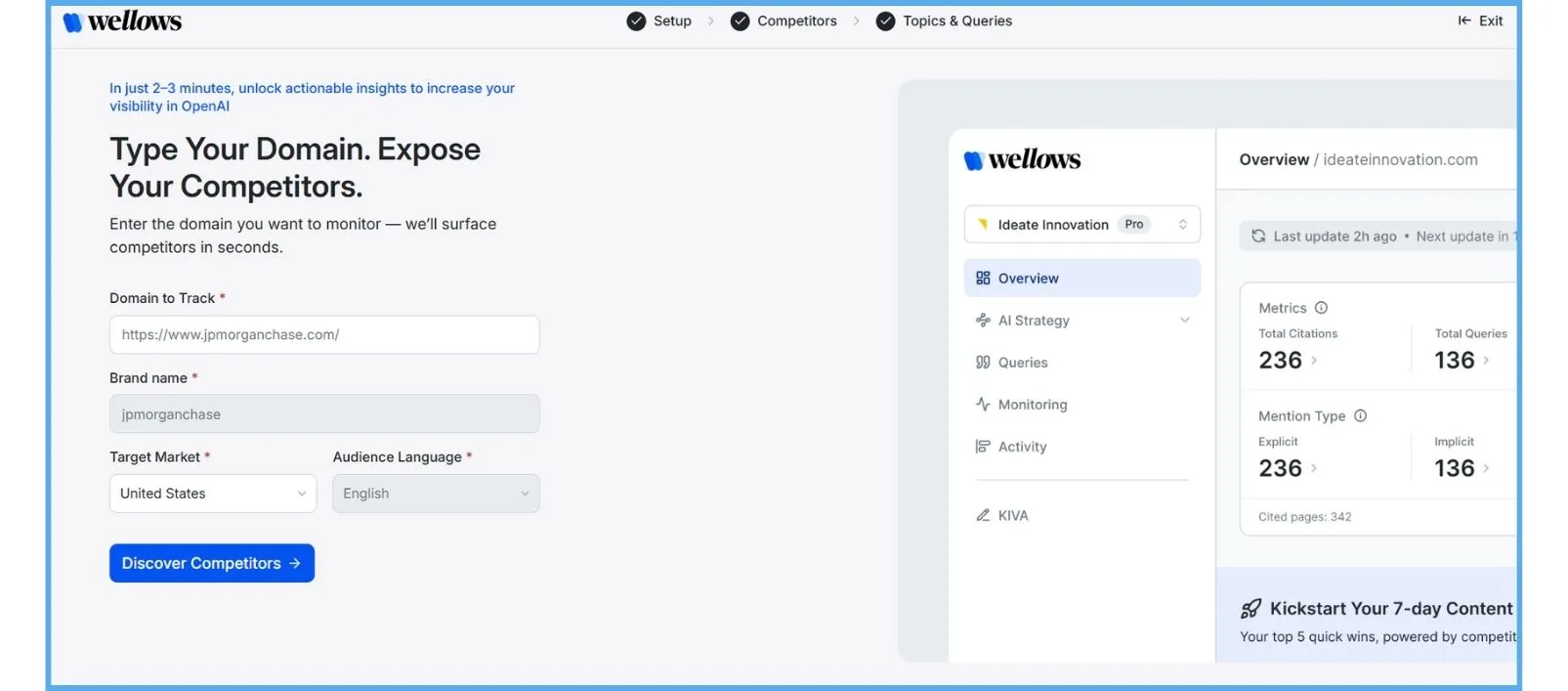
1. Enter Your Brand Domain
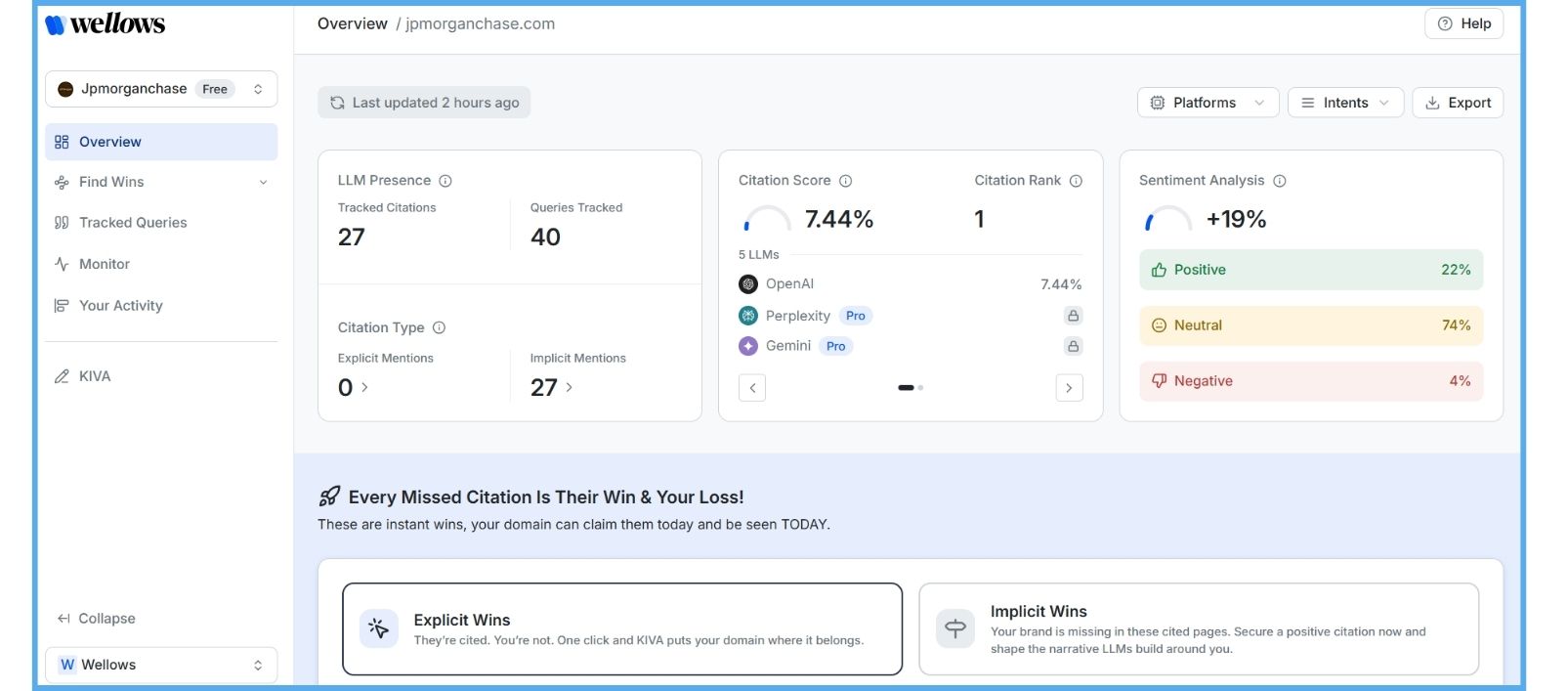
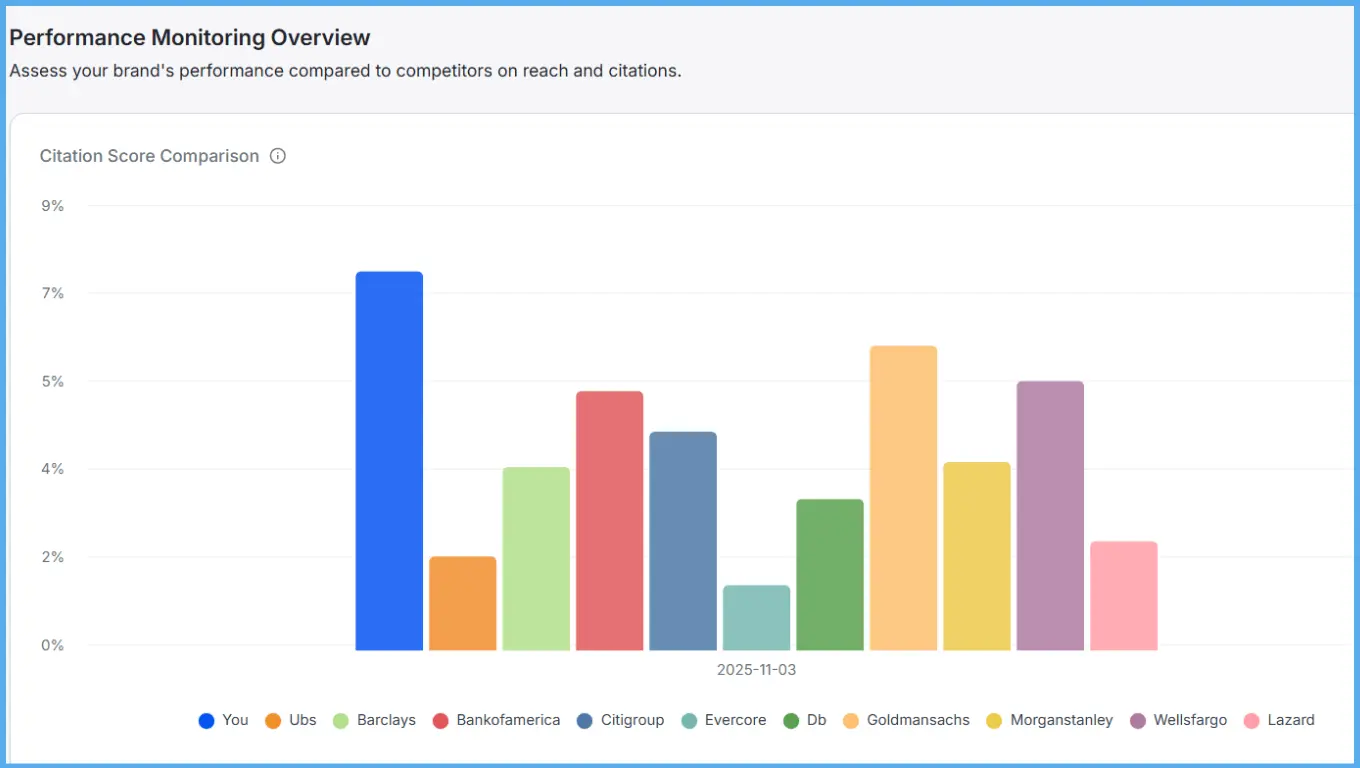
When I started, I added jpmorganchase.com as a test domain. The platform instantly scanned AI-generated answers across ChatGPT, Google’s Gemini, Claude, and Perplexity to identify where the brand was cited, mentioned, or missing. It even pulled metrics like a Citation Score (JPMorgan’s was around 7.44%) and tracked 27 citations in the initial query set.
It was fascinating to see how even small data inconsistencies — such as outdated product names — affected whether or not the AI cited the brand.
2. Brand Matching & Competitor Identification
Once I entered the domain, the AI visibility system automatically categorized JPMorgan Chase under Financial Services → Banking → Commercial & Investment Banking. It then mapped out a competitor set including Goldman Sachs, Bank of America, Wells Fargo, Citigroup, and Morgan Stanley.
This automatic segmentation was a turning point — it showed how AI visibility is industry-aware and how precise classification drives better benchmarking. Comparing JPMorgan to Goldman makes sense; comparing it to a random fintech doesn’t. That precision is what makes these insights actionable.
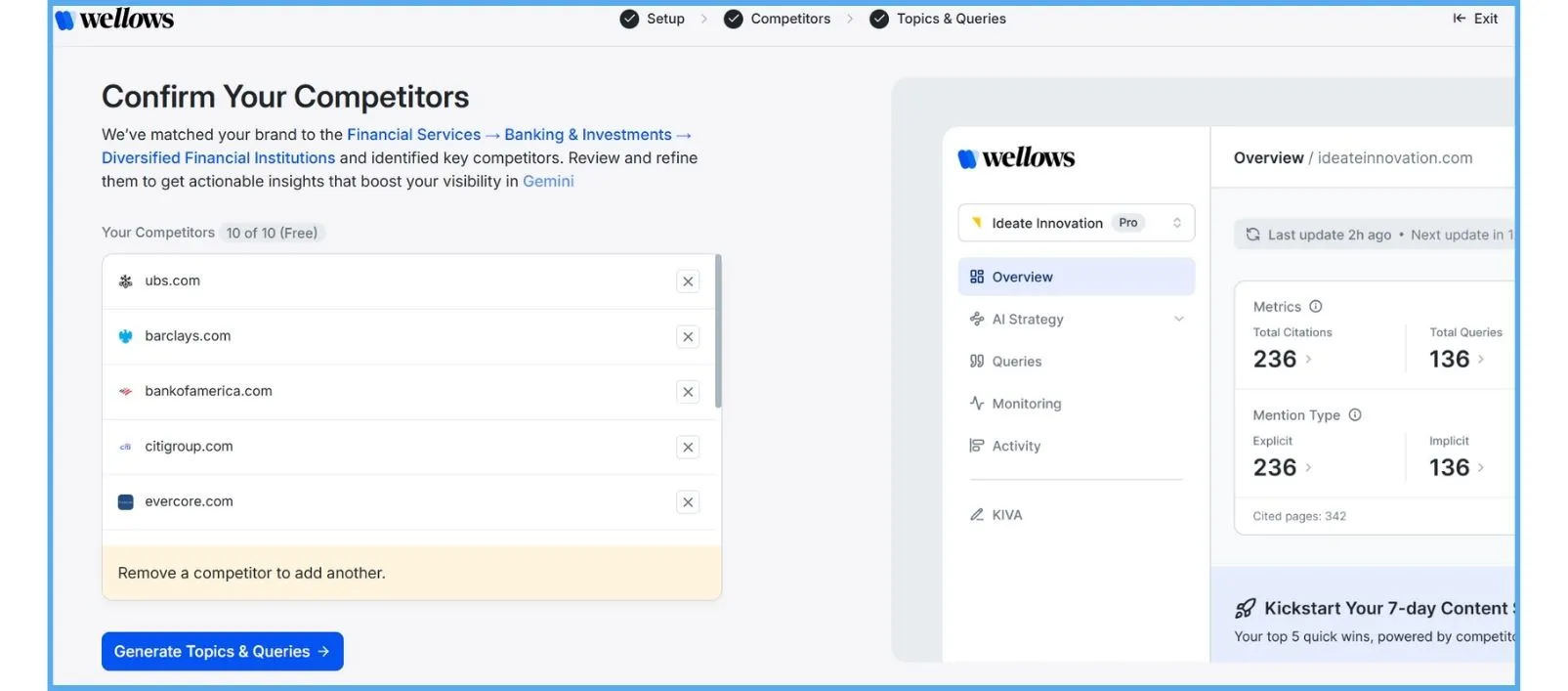
3. Review and Refine Competitors
Next, I reviewed visibility topics tracked for JPMorgan — areas like credit solutions, client relationships, technology integration, pricing transparency, and transaction speed. I added “ESG investments,” knowing sustainability is trending in finance.
This instantly refined the insights, showing different competitors leading each topic. It proved how flexible tracking must be to align with evolving AI interest signals like ESG or crypto banking.
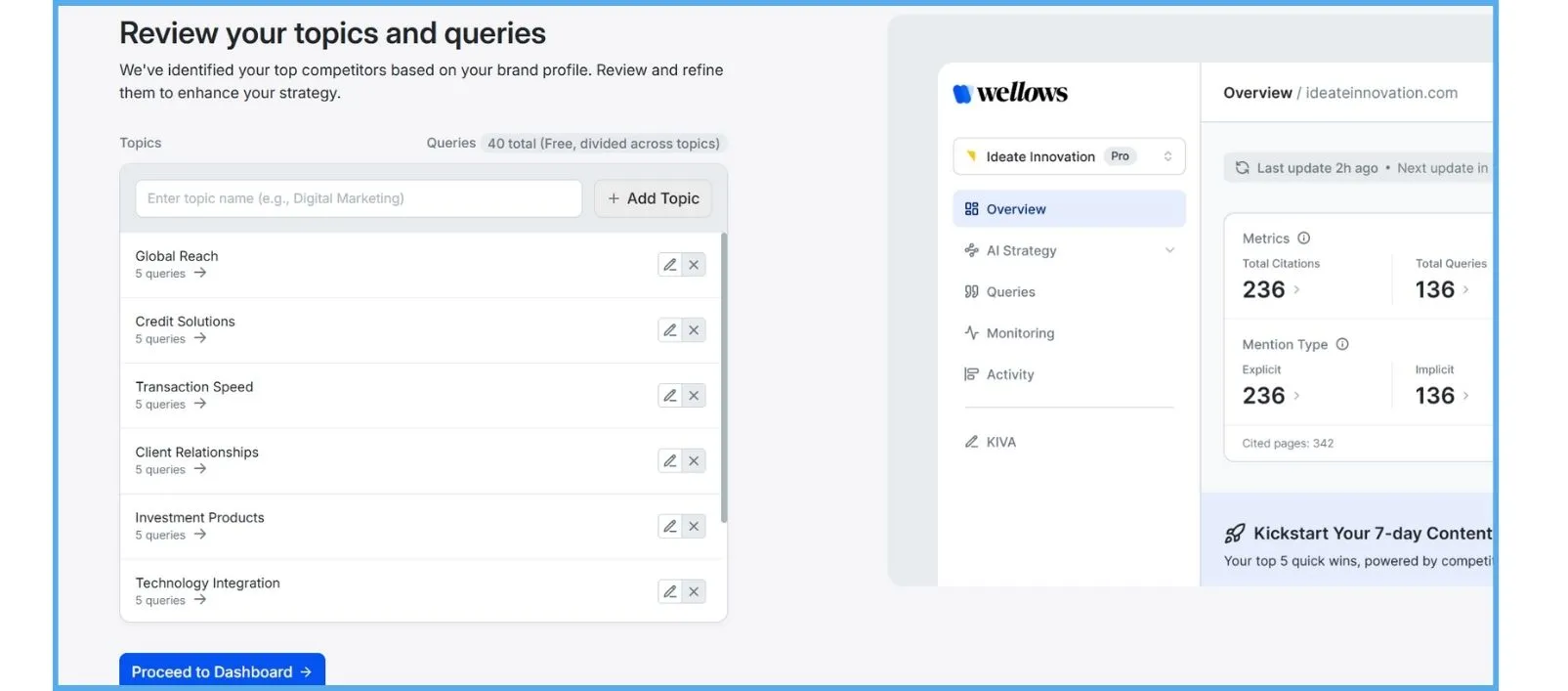
4. Explore the Dashboard
Exploring the dashboard brought everything together. I could instantly see LLM Presence, Citation Score, and Sentiment Analysis across Multi LLMs like, ChatGPT, Gemini, Claude, and Perplexity.
For JPMorgan, the data showed a strong presence on ChatGPT and Gemini with mostly neutral sentiment (typical for financial topics) and a +19% net positive tilt. Its Citation Score was the highest among peers — confirming that reputation and citation frequency often move together.
5. Check Explicit and Implicit Mentions
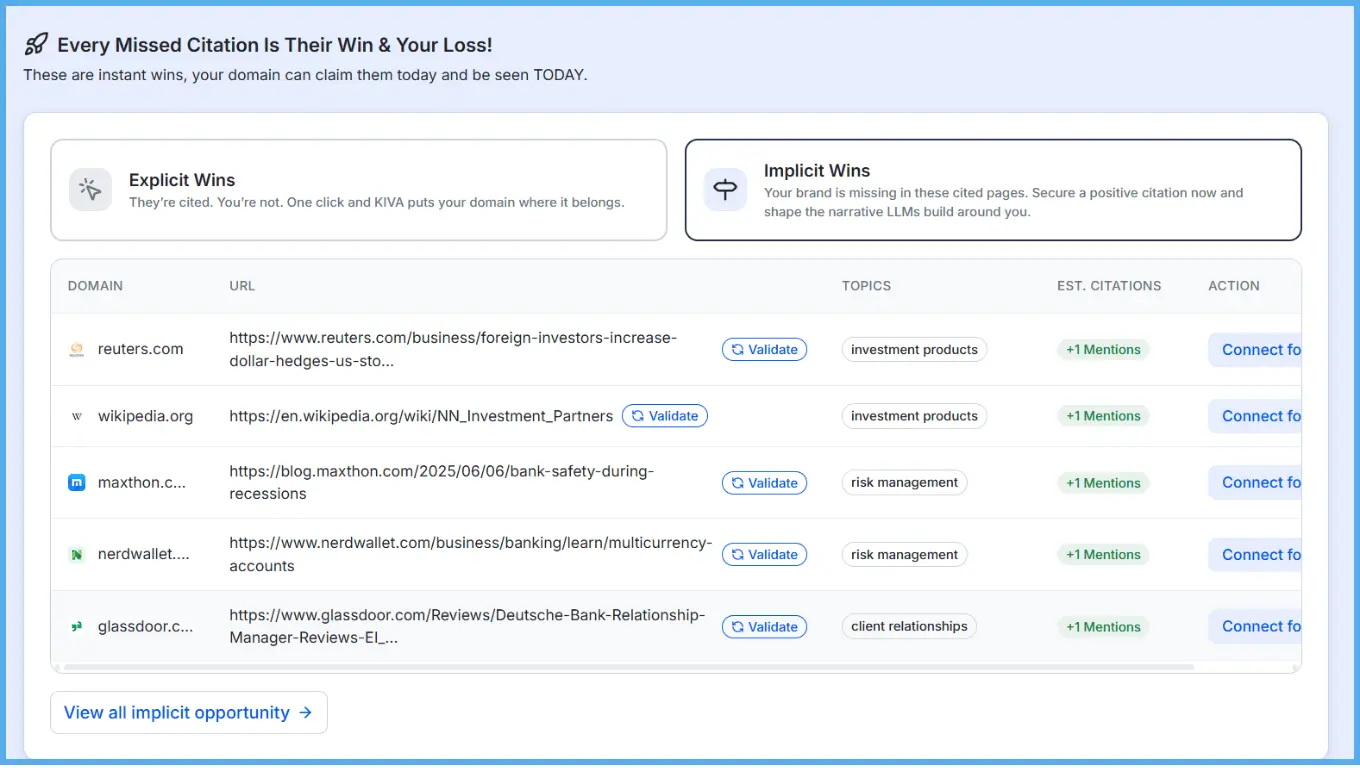
This was my favorite discovery. The system separates Explicit Wins — where competitors are cited but your brand isn’t — from Implicit Wins, where your brand is mentioned without a link. Seeing those “uncredited mentions” opened up new visibility opportunities.
I found examples where Goldman Sachs was cited in AI answers while JPMorgan wasn’t — a clear opportunity to create new content and claim that space. I also spotted implicit mentions where AI referenced JPMorgan’s funds without linking them, offering a direct outreach or PR opportunity.
- Explicit Wins: Pages or AI answers where competitors are cited but your brand isn’t. Click “Create Content” to claim those mentions instantly.
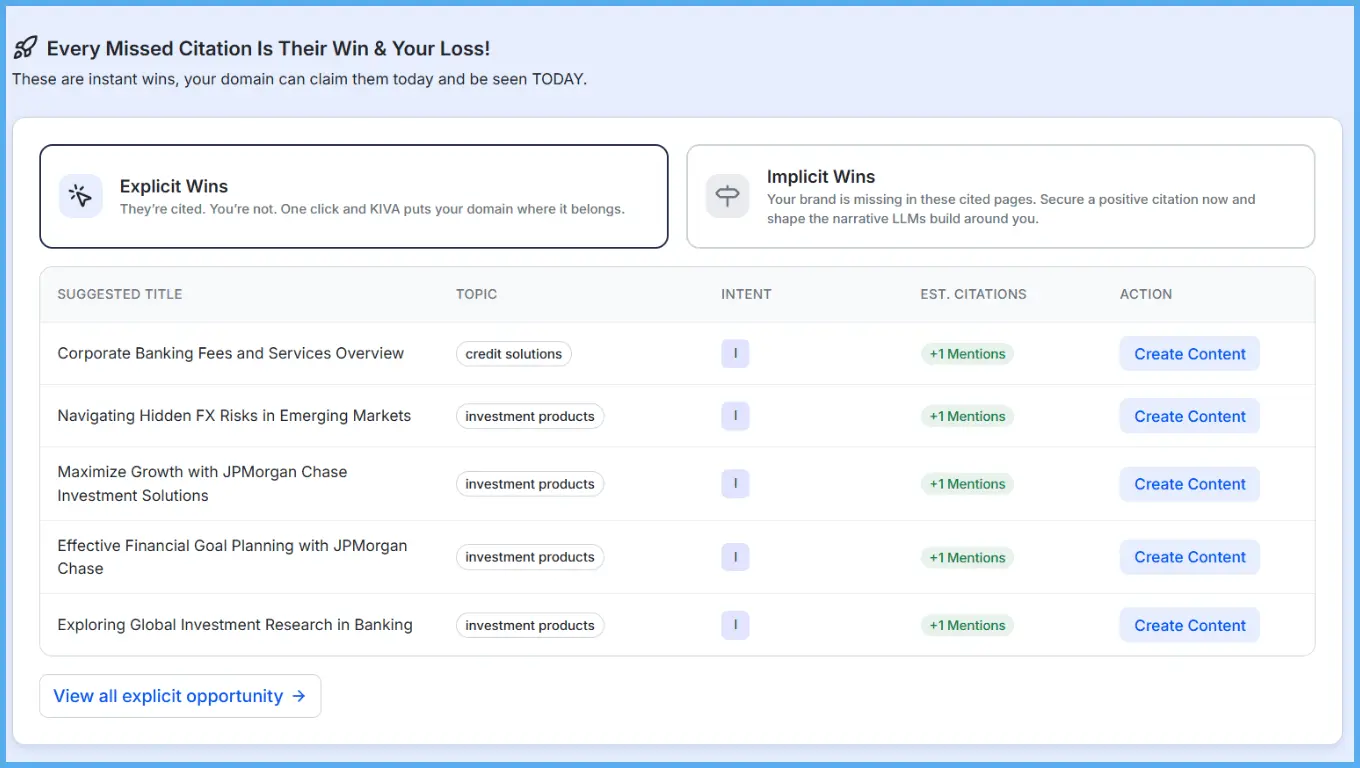
- Implicit Wins: Mentions of your brand without a link — allowing you to turn uncredited references into official citations.
6. Analyze Competitive Insights
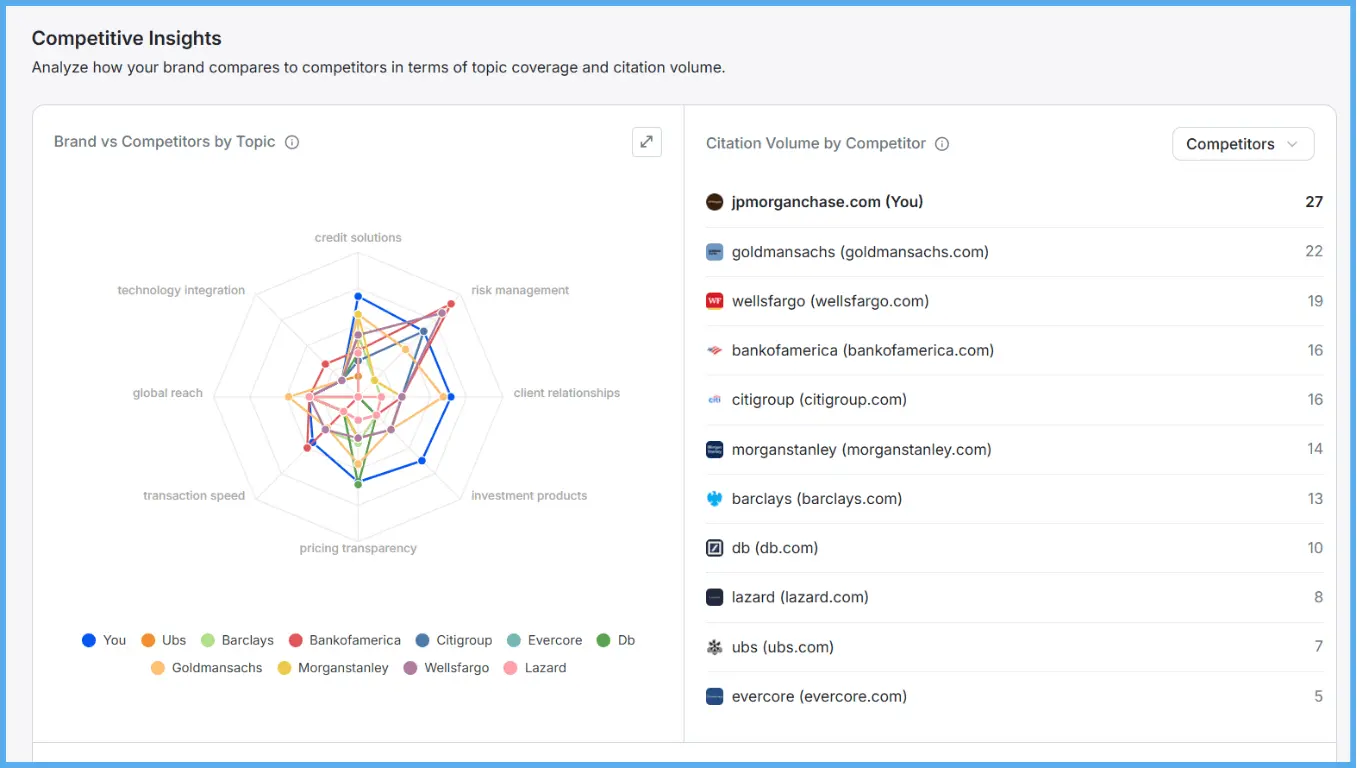
When I opened Competitive Insights, the radar chart revealed how JPMorgan performed against Goldman Sachs and Bank of America across tracked topics. It resembled how AI SEO agents analyze SERP visibility— except this time, it visualized AI-driven performance.
The chart showed JPMorgan leading in “credit solutions” and “client relationships,” but lagging in “technology integration” and “global reach.” It was a clear reflection of how AI perceives brand strengths and weaknesses.
7. Review Top Cited Queries
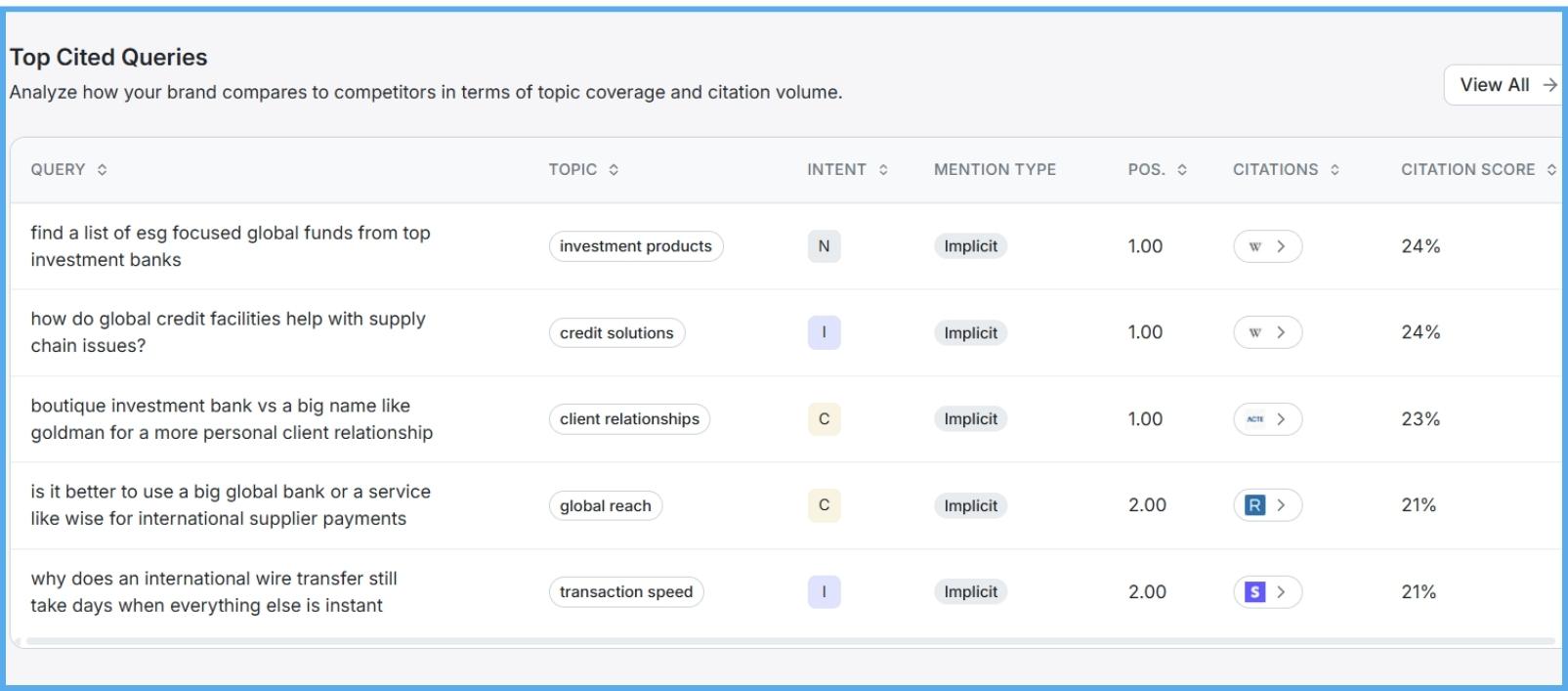
The platform highlighted top AI queries triggering JPMorgan mentions — such as “Why do international wire transfers still take days?” and “Which bank offers better global investment options?”
Seeing these questions revealed exactly how users interact with AI and how those answers shape brand perception. Each cited query becomes a content opportunity — a chance to craft resources that AI can cite confidently.
8. Monitor Performance Over Time
Finally, I tracked how visibility evolved month over month. JPMorgan maintained a ~7–8% Citation Score, with Goldman Sachs, Wells Fargo, and Bank of America close behind. I noticed how product launches or media events influenced citation patterns — a reminder that AI visibility is always in motion.
Continuous tracking showed that staying visible isn’t a one-time task — it’s an ongoing effort tied to PR, content quality, and industry activity.
Pro Tip: From my own scans, I’ve learned that running regular visibility checks through Wellows monitoring— especially before product launches or PR pushes — helps catch new citation opportunities faster and reveals when AI models shift focus.
Ready for the best part? With one click, Wellows generates a complete visibility report — highlighting your brand’s AI mentions, missed citations, and opportunities to improve. All in minutes, not weeks.
Curious to see what AI is saying about your brand? Start Your 7 Day Trial to explore your banking visibility dashboard and start strengthening your presence today.
10 Tips to Transform Your Strategy for Banking & Financial Services Brands
Want to make your financial brand stand out in AI-driven search? These 10 tips blend classic SEO best practices with new-generation strategies like semantic analysis and user intent optimization — helping your content stay visible in AI-generated answers.
10 Tips to Transform Your Banking & Financial Services Strategy
1. Define Your Specialty
Zero in on a clear niche or specialty. For example, focus on small business lending or student loan refinancing rather than trying to be everything for everyone. The sharper your focus, the easier AI platforms recognize your brand as an expert source in that area.
2. Highlight Your USPs
Show what sets you apart — whether it’s no-fee accounts, best-in-class mobile app, or decades of stability. Publish data-backed articles or case studies that prove your strengths (e.g., how your customers save more, or a success story of a business you helped). Concrete proof builds authority with both users and AI.
3. Study Competitor Content
Check which pages from rivals appear in AI results. If NerdWallet or Bankrate consistently dominates “best savings account” queries, analyze why. Then outdo them – update your content, add better data, or answer related questions they missed. If AI sees your page offers more value, it’s more likely to cite you next.
4. Stay Trend-Aligned
Post timely content on emerging financial trends: new tax laws, crypto regulations, inflation tips, etc. For instance, if AI models get questions about “latest Fed rate impact,” have a fresh blog ready. Being current signals to AI that your content is up-to-date and trustworthy, which boosts your visibility.
5. Target High-Value Queries
Prioritize AI queries that are likely to lead to conversions. Think “best 0% APR credit card” or “top 2025 mortgage rates” – queries someone asks when they’re ready to act. Ensure you have dedicated, optimized pages for these, so when the AI is looking for an answer, your offering stands a good chance of being cited.
6. Build Supporting Content
Expand beyond just product pages. Create a web of supporting content: explainers on budgeting, FAQs on loan processes, comparison charts of different account types. This not only educates your audience but also increases the keywords and questions your brand can credibly answer – making it more likely AI will find something from you to include.
7. Align with the Customer Journey
Cover all stages of financial decision-making. Informational: basic guides (e.g., “What is an IRA?”). Comparative: versus or best-of pieces (“Credit Union vs Bank” or “Best retirement accounts for young adults”). Transactional: clear CTAs and how-tos (“How to open an account”). When AI can pull from your content at each stage, you become the go-to resource from exploration to conversion.
8. Update Product-Specific Pages
Audit how each of your key products or services is represented online. If your new credit card isn’t showing up in AI answers but an old one is, refresh that content. Merge or redirect outdated pages and make sure the latest info (with proper schema markup) is front and center. This ensures AI isn’t quoting last year’s data.
9. Optimize Branded Searches
Make sure AI pulls your official info for queries like “XYZ Bank interest rates” or “XYZ Bank login.” Keep your site’s FAQ, About, and Contact info well-structured and up to date. Also, verify your business listings. If someone asks an assistant for your nearest branch or customer support, you want the AI to have the correct details.
10. Use Quick Wins with Wellows
Use a platform like Wellows to quickly spot where you’re missing from the conversation. It can highlight, for example, that a competitor is cited for “best brokerage account” while you aren’t – so you know to beef up that content. These quick insights let you close gaps fast and capitalize on “easy win” opportunities that traditional tools might miss.
What Are the Challenges Financial Brands Face in Maintaining AI Search Visibility?
Even with a strong strategy, optimizing for AI-driven search comes with challenges. As seen in recent AI visibility research, financial brands face unique hurdles due to evolving AI algorithms and competitive dynamics.
Here’s how it helps financial brands overcome them:
Rise of zero-click searches: AI-generated summaries answer queries directly, reducing website visits.
Solution: Use AI visibility tracking to measure brand presence in AI summaries.
Wellows: Yes — tracks brand mentions and citations across ChatGPT, Gemini, and other AI tools so you can see where you appear (or don’t).
Dominance of aggregators and forums: Sites like Reddit and Investopedia often outrank banks with fast-updating, user-driven content.
Solution: Identify where aggregators dominate and fill gaps with authoritative content.
Wellows: Yes — reveals which external domains AI favors and highlights content opportunities to reclaim authority.
Lack of structured data: Missing schema can prevent AI from understanding and citing your content properly.
Solution: Add structured data so AI can interpret financial content accurately.
Wellows: Yes — detects missing schema signals and helps align your site’s data for stronger AI recognition.
Content stagnation: Outdated blogs and product pages reduce citation potential in AI answers.
Solution: Refresh content regularly to match trending topics and user questions.
Wellows: Yes — flags underperforming content and shows which topics are gaining or losing traction.
Inadequate local optimization: Weak location-based content reduces AI-driven local visibility.
Solution: Implement local schema and optimize for region-specific searches.
Wellows: Yes — tracks local citations and supports better geographic visibility in AI answers.
Transparency and bias concerns: AI systems may unintentionally favor certain institutions.
Solution: Monitor representation and ensure fair visibility across AI engines.
Wellows: Yes — provides visibility audits so your brand isn’t left out of key AI-generated narratives.
Why Should You Choose Wellows for Your Financial Brand?
With AI visibility tools evolving rapidly, it’s vital to choose one that truly strengthens your AI search visibility for banking & financial services brands.
Recent studies on ChatGPT’s influence on Google visibility show that brand discovery is shifting toward AI-first ecosystems. Below is a clear, side-by-side comparison between Wellows, Profound, and BrightEdge — three major players in the AI and SEO visibility space.
| Feature | Wellows (AI Visibility Specialist) | Profound (AI Analytics Platform) | BrightEdge (Enterprise SEO Suite) |
|---|---|---|---|
| Multi-Platform Tracking Tracks AI engines beyond Google — ChatGPT, Claude, Gemini, and Perplexity. |
Unified AI visibility dashboard showing brand mentions across platforms. | Focuses on search visibility insights with partial AI integration (ChatGPT only). | Tracks Google SGE and search results; AI coverage is secondary. |
| Explicit vs. Implicit Mentions Differentiates between direct citations and unlinked brand mentions. |
Separates explicit (cited) vs. implicit (mentioned) results for deeper insight. | Tracks mentions but doesn’t classify them by type or source credibility. | Shows mentions via SEO metrics but lacks AI mention classification. |
| Citation Context Understands which questions trigger your brand’s inclusion in AI answers. |
Provides query-level data showing competitors cited alongside your brand. | Offers limited visibility into AI query intent; focuses on engagement metrics. | Lists ranking keywords but doesn’t connect them to AI citations. |
| Sentiment & Topics Measures tone and themes of brand mentions across AI sources. |
Analyzes sentiment and categorizes mentions into financial topics (e.g., loans, banking, credit). | Focuses on quantitative visibility scores; no sentiment evaluation. | Offers topical analysis for SEO, not AI conversation tone. |
| Outreach Tools Helps secure backlinks and citations where your brand was mentioned. |
Includes one-click outreach for unlinked mentions and PR-ready contact info. | Manual outreach; relies on external CRM integrations for engagement. | Lacks outreach automation for citations or PR link-building. |
| Competitor Tracking Measure how your visibility compares with peers. |
Customizable competitor tracking based on AI search queries and financial keywords. | Monitors competitors’ web mentions but lacks AI citation comparison. | Tracks keyword share of voice — not AI-based brand visibility. |
| Integration Compatibility with existing tools and workflows. |
Integrates seamlessly with SEO dashboards; exports AI data for analysis. | Integrates with analytics tools; limited AI-specific export options. | Excellent enterprise integration; AI visibility data is minimal. |
| Pricing Cost structure and accessibility. |
Flexible, transparent pricing with AI visibility focus. | Premium enterprise plans targeting data-rich organizations. | Subscription-based pricing for SEO suites with limited AI insights. |
In summary, Wellows leads as a purpose-built AI visibility platform for financial brands — combining citation tracking, sentiment analytics, and competitor benchmarking in one place.
It helps your team go beyond traditional SEO, giving full visibility into how AI engines interpret, cite, and prioritize your content. For a deeper breakdown, see how to audit brand visibility on LLMs and uncover missed citation opportunities.
How Do Fintech Companies Compare to Traditional Banks in AI Search Visibility?
Fintechs are not just catching up — they’re redefining what AI visibility looks like in finance. According to Knownful, digital-first players such as SoFi capture close to 91% visibility in online banking queries, while traditional banks like Chase and Bank of America remain around 27% in the same category. The gap highlights how fintech agility and user-focused innovation give them a clear edge in AI-driven discovery.
This growing dominance is largely due to fintechs’ adaptive technology, clean data ecosystems, and content tailored to real user intent — traits that align perfectly with how AI systems rank and retrieve information.
In contrast, legacy banks still face challenges from older content structures and slower digital refresh cycles, which can make it harder for AI platforms to read, interpret, or cite their data effectively. Insights from Economy Watch show that many traditional institutions are now partnering with fintechs to improve their AI visibility and relevance.
From a Wellows research perspective, fintech leaders like Revolut and Chime stand out because of their strong digital signals, clear product data, and higher citation consistency across AI systems. These findings emphasize a simple truth: in AI visibility, adaptability and structure outperform scale and legacy.
How Can Financial Institutions Improve Their AI Search Visibility?
To succeed in AI-driven discovery, banks and fintechs must evolve beyond traditional SEO and adopt enterprise AI visibility strategy principles through Generative Engine Optimization (GEO) — a modern framework focused on how AI platforms interpret, rank, and cite content.
This approach lies at the heart of improving AI Search Visibility for Banking & Financial Services Brands, ensuring they remain discoverable and trusted in AI-generated results.
By optimizing for both human readers and machine understanding, financial institutions can secure stronger visibility across platforms like ChatGPT, Gemini, Claude, and Perplexity.
- Publish Expert, Authoritative Content: Create data-driven content that directly answers real financial questions. Research from Knownful shows that Chase’s strong AI visibility (67.14%) is built on consistent, accurate, and value-rich financial education content.
- Optimize for AI Interpretation: Use structured data, schema tags, and natural language to help AI systems interpret your site. AI models prioritize content that’s both machine-readable and human-friendly, increasing your chances of being cited.
- Track and Compare Visibility: Platforms like Wellows help you see where your brand appears in AI results, which competitors are cited more often, and where visibility gaps exist — turning complex data into clear action plans.
- Invest in AI Research and Integration: Top institutions like JPMorgan Chase and Capital One have embedded AI into both marketing and operations, boosting efficiency and AI recognition simultaneously. As noted by Banking Dive, these efforts reinforce digital leadership and long-term visibility.
- Collaborate with Trusted Financial Sources: Being cited in reputable outlets like CNBC, NerdWallet, or MarketWatch strengthens your authority — and increases the likelihood that AI tools will reference your insights.
- Maintain Transparency and Compliance: In a regulated sector like finance, trust is everything. Clear disclosures, secure data handling, and adherence to compliance standards not only build user trust but also improve how AI systems rank your content’s reliability.
From a Wellows research lens, financial brands leading the AI visibility curve share three defining traits: they design structured, AI-comprehensible content; measure visibility continuously; and treat AI discovery as a strategic channel rather than a byproduct of SEO.
That shift — from search to visibility intelligence — is what sets them apart in the age of generative discovery. To understand how this shift uncovers new ranking signals, explore how AI SEO agents use SERP visibility to spot opportunities.
Why Search Intent Matters in the Financial Services Market
Understanding search intent is essential for any strategy aiming to improve AI search visibility. In financial services, intent defines how potential customers interact with both traditional search and AI-driven answers.
Matching your content to these intents increases click-through rates, builds trust, and drives more qualified leads from AI referrals.
Informational Intent
Users looking for general financial knowledge or advice — e.g., “How do mortgage rates work?” or “Why is my credit score important?”.
How to engage: Create simple, jargon-free explainers and guides. Clear, helpful content boosts your credibility and helps AI cite you in educational answers.
Navigational Intent
Users searching for a specific brand or service — e.g., “Chase Sapphire login” or “nearest Wells Fargo ATM.”
How to engage: Keep listings accurate and structured (hours, addresses, links). Strong schema helps AI assistants send users directly to your digital touchpoints.
Transactional Intent
Users ready to act — e.g., “Open a business account online” or “Best 0% APR credit card.”
How to engage: Optimize CTAs like “Apply Now” or “Get a Quote.” Use Product or Offer schema so AI recognizes your pages as transaction-ready.
Comparative Intent
Users comparing options — e.g., “Chase vs. Citi mortgage rates” or “Best life insurance 2025.”
How to engage: Publish updated comparisons and top lists with structured data. Objectivity builds trust and increases your chances of being cited in AI answers.
Aligning content with user intent sends clear relevance signals to AI — strengthening trust, credibility, and your position among top financial brands in AI-driven search results.
Market Insights for Banking & Financial Services Brands
The way consumers manage money and choose financial products has shifted dramatically toward digital channels — and AI now guides many of those decisions. To compete, banks and financial services brands must build strong AI search visibility across research, discovery, and purchase stages.
- Digital banking dominates: By 2025, over 90% of banking interactions worldwide will happen through digital channels, as customers increasingly prefer apps, websites, and AI-powered platforms over in-person visits (G2 Learning Hub, 2025).
- Massive user base: In the U.S., digital banking users will reach 216.8 million by 2025,and globally about 3.6 billion people will bank online by 2024 (ElectroIQ, 2025).
With most consumers now researching financial products online, AI visibility is critical for growth. - Millennials & Gen Z lead the shift: Around 74% of Millennials and 68% of Gen Z prefer digital banking over branch visits (G2 Learning Hub, 2025).
These digital-first generations trust AI assistants, reviews, and fintech apps — making AI-driven visibility key to capturing them. - Video & social media drive financial decisions: About 66% of investors under 40 use platforms like YouTube and TikTok for financial insights, and 48% say finfluencer content influences their decisions (CFA Institute, 2024). A strong, credible social presence boosts trust and AI visibility.
- Branches still matter — but less: About 82% of U.S. consumers value having a nearby branch, yet 24% plan fewer visits going forward (G2 Learning Hub, 2025, ). While human touch remains relevant, discovery and decision-making are now led by AI search.
Digital finance is transforming how consumers discover and choose financial services. AI visibility studies show that structured, consistent data — like up-to-date rates and clear FAQs — significantly improve a brand’s chance of being cited in AI-generated answers.
By the late 2020s, most new accounts, loans, and policies will be influenced by AI-driven discovery. Brands that adapt early and use tools like Wellows to monitor and enhance AI visibility will lead the next era of growth in digital finance.
Audience Insights for Banking & Financial Services Brands
Financial services audiences range from first-time account holders to high-net-worth investors. Understanding their needs and intents helps tailor content, SEO, and AI visibility strategies that engage and convert effectively.
| Audience | Profile | What Matters Most | How to Engage |
|---|---|---|---|
| First-Time Customers | Gen Z, students, or anyone new to banking or credit. | Simplicity, low fees, and easy guidance. | Create beginner-friendly “Banking 101” guides, quick explainer videos, and interactive tools. Use plain language — AI often cites clear, helpful educational content. |
| Affluent & High-Net-Worth | Established professionals or wealthy clients seeking private banking or wealth management. | Personalized service, trust, exclusivity, and performance. | Publish expert insights, whitepapers, and market commentary that showcase credibility and results. Highlight privacy and bespoke offerings. |
| Small Business Owners | Entrepreneurs and SMEs looking for loans, merchant services, or financial tools. | Fast access to credit, time-saving tools, and local or digital support. | Build a business banking hub with guides on loans, cash flow, and funding options. Use structured FAQs — AI cites concise how-to content. |
| Tech-Savvy Fintech Users | Digital-first users of neo-banks, payment apps, and crypto platforms. | Seamless UX, innovation, transparency, and speed. | Highlight app features and security. Share short video demos — AI often summarizes clear, visual tutorials in response to “best fintech app” queries. |
| Active Investors & Traders | Individuals investing through trading apps, robo-advisors, or retirement platforms. | Low fees, platform reliability, and credible market data. | Post comparisons, trend analyses, and product explainers (e.g., “Robo-advisor vs. traditional advisor”). Add FAQ schema for AI-driven investment queries. |
| Retirees & Conservative Savers | Older users focused on security and predictable income. | Safety, clarity, customer care, and human support. | Offer guides on fraud prevention, annuities, and FDIC coverage. Optimize voice search with clear data on senior-friendly hours and support. |
| Budget-Conscious & Underbanked | Consumers seeking affordable and accessible banking options. | Low or no fees, financial education, and quick fund access. | Publish credit-building and budgeting guides. Offer bilingual content and highlight fee-free accounts to capture “best bank for bad credit” AI searches. |
Each audience interacts differently with financial services. By tailoring your content and SEO strategies to each profile, you improve your relevance for specific AI-driven queries and increase the likelihood that AI assistants will cite your brand. AI visibility tools can help identify which segments you’re reaching — and where to grow next.
What Are the Latest Trends in AI Search Visibility for Banking & Financial Services Brands?
AI Search Visibility for Banking & Financial Services Brands is evolving rapidly, shaped by the growth of fintech and advancements in generative AI. Here are the most notable trends shaping how financial brands appear in AI-driven results:
Leading brands dominate AI mentions: Research shows that just 10 digital banking brands account for over 83% of AI search visibility (AvenueZ, 2025). Leaders like Chime, Ally, SoFi, Chase, and Bank of America appear most often in AI recommendations — creating a clear opportunity for smaller institutions to grow visibility through better GEO and citations.
Fintech upstarts face visibility challenges: Many newer fintechs hold only ~17% of total AI visibility (AvenueZ, 2025). Limited brand coverage, fewer backlinks, and weak earned-media signals often keep them out of AI answers — so consistent publishing + PR are key to being cited.
Earned media drives AI citations: Nearly 90% of AI citations come from reputable sources like news outlets, finance blogs, and industry reports (BusinessWire, 2025). Mentions in trusted publications (e.g., Forbes, CNBC) and credible government/education sources increase the likelihood AI systems reference your brand.
Structured content leads AI inclusion: Brands that invest in schema markup, structured FAQs, and clear product data are cited more often in AI results. Comparison tables, labeled rates/features, and machine-readable pages make it easier for AI to parse and confidently include your brand in answers like “best checking accounts” or “mortgage pre-approval.”
These trends make one thing clear — AI search visibility is dynamic, not fixed. The brands winning today may shift as algorithms and user behaviors evolve. Staying adaptive, data-driven, and consistent with structured, trusted content is essential for sustaining AI visibility.
Curious how AI search strategies work across different industries? Explore our specialized visibility guides:
- AI Algorithm Updates: SEO Impact & Recovery Tips: Understand AI SEO updates, ranking impacts, and recovery strategies
- AI Search Visibility for Automotive Brands: Be discovered in AI-powered car comparisons and purchase advice.
- AI Search Visibility for Aviation & Airlines Brands: Show up in AI trip planning and flight search results.
- AI Search Visibility for Beauty & Personal Care Brands: Appear in AI beauty routines and product matchers.
- AI Search Visibility for Entertainment Brands: Improve how streaming platforms, studios, and media catalogs appear across major AI assistants.
- AI Search Visibility for Healthcare & Hospitals: Strengthen clinical authority signals and increase placement in AI-driven medical queries.
- AI Search Visibility Audit Checklist: A practical framework to measure, fix, and grow your brand’s citations across major AI search platforms.
- Boost AI Search Visibility with Knowledge Graphs: Use structured entity mapping to gain AI citations.
Each guide explores real-world applications, examples, and steps to help your business succeed in the age of AI-driven discovery.
FAQs
Conclusion
AI Search Visibility for Banking & Financial Services Brands is reshaping how consumers find and trust financial providers. The landscape shifts fast: even leaders can fade if content isn’t structured, current, and cited by authoritative sources. One day your product is the default answer; the next, an AI prefers a competitor with cleaner data and clearer signals.
That’s where Wellows helps. It closes the gap between traditional SEO and generative search by tracking citations, analyzing real AI queries, and revealing missed opportunities—so your team acts on data, not guesswork. Customers already ask ChatGPT, SGE, Claude, and Gemini for recommendations. The question is whether your brand is part of the answer. With the right tools and GEO strategy, you won’t just keep up—you’ll lead.
![85 Hottest AI Startups to Watch in 2026 [By Valuation, Funding, & Growth]](https://wellows.com/wp-content/uploads/2026/01/hottest-ai-startups.webp)